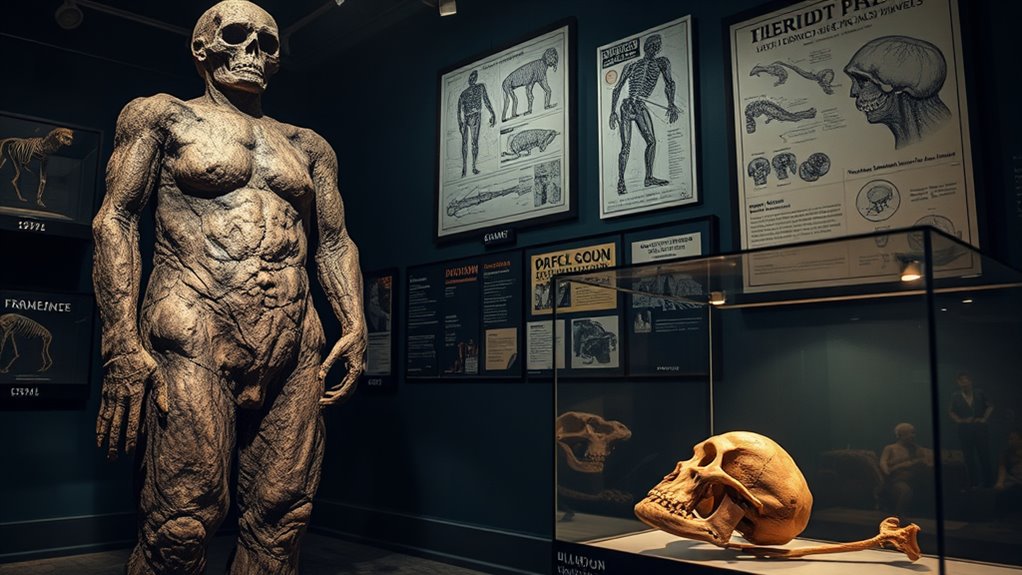

You might think that stories like the Cardiff Giant and Piltdown Man are genuine, but they’re classic hoaxes designed to exploit curiosity and gain fame. The Cardiff Giant was a carved fake thought to be a fossil, while Piltdown Man was a fabricated “missing link” for over 40 years. These deceptions show how appearances can fool us and emphasize the importance of skepticism. Keep exploring to uncover even more surprising truths behind these notorious monster hoaxes.

Prime made for students and young adults
- Fast, free delivery for dorm and study essentials
- Prime Video and Amazon Music included
- Member-only deals
Key Takeaways
- The Cardiff Giant was a carved fake fossil, deceiving the public for years before scientific testing exposed its fraud.
- The Piltdown Man was a forged “missing link” combining human and ape bones, influencing science for over four decades.
- Both hoaxes exploit curiosity and sensationalism to manipulate public perception and gain fame or notoriety.
- Scientific skepticism and rigorous testing are crucial to uncover and debunk such deceptions.
- Recognizing appearance tricks and staying informed helps prevent falling for similar hoaxes today.
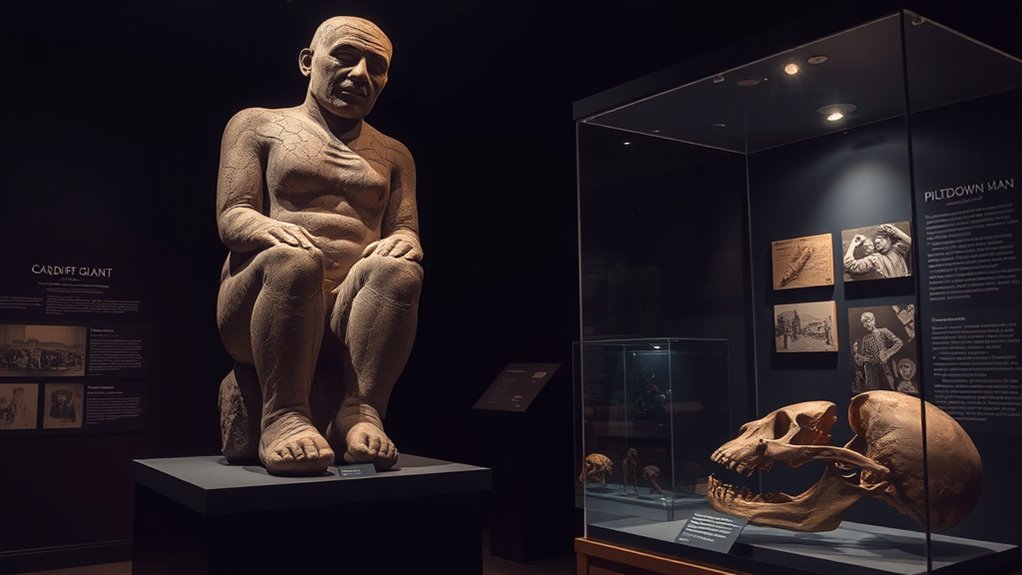
Have you ever wondered how many false stories and scams are hiding just beneath the surface of what you see online? It’s surprising how easily people can be fooled by hoaxes, especially when they tap into our curiosity about the unknown. Take cryptozoology myths, for example. These tales of mysterious creatures like Bigfoot or the Loch Ness Monster have persisted for decades, despite lacking concrete scientific evidence. Many of these stories are fueled by exaggerations, misidentifications, or outright fabrications. It’s easy to get caught up in the excitement, but you need to remain skeptical. The truth is, numerous “proofs” of these monsters have been exposed as scientific frauds, revealing the lengths some will go to deceive for fame, money, or notoriety.
Many hoaxes exploit curiosity about the unknown, revealing how easily people fall for false stories online.
The Cardiff Giant is one classic example. Discovered in 1869 in New York, this enormous purported fossil of a petrified human was later revealed as a carved hoax created by a man named George Hull. For years, people believed it was a genuine ancient specimen, feeding the public’s fascination with prehistoric mysteries. But scientific testing proved it was a carefully crafted fake, designed to trick people into believing in a giant that never existed. The Cardiff Giant demonstrates how easily scientific frauds can manipulate public perception when combined with a desire for sensational stories. It’s a reminder that appearances can be deceiving, and that skepticism remains your best tool in separating fact from fiction.
Another infamous hoax is the Piltdown Man, which fooled scientists for decades. Discovered in England in 1912, it was hailed as a missing link between apes and humans, supporting the idea of human evolution. For over 40 years, experts accepted it as genuine, until scientific analysis revealed it was a forgery. The skull was a combination of human and ape bones, deliberately altered to mimic ancient hominids. The Piltdown Man hoax shows how scientific frauds can influence research and public understanding for years before being uncovered. It also highlights the importance of rigorous testing and skepticism in scientific discovery. Additionally, these cases underscore the importance of scientific integrity and peer review in maintaining accurate knowledge.
These hoaxes serve as cautionary tales. They remind you to question extraordinary claims, especially when they come with sensational stories or visual evidence that seems too good to be true. Whether it’s cryptozoology myths or scientific frauds like the Cardiff Giant or Piltdown Man, the truth often lies beneath layers of deception. Staying informed and critical helps you cut through the noise, ensuring you don’t fall for the next big scam or false story. In a world full of misinformation, a healthy dose of skepticism is your best defense against being fooled.
As an affiliate, we earn on qualifying purchases.
Frequently Asked Questions
What Are the Earliest Recorded Monster Hoaxes in History?
You might be surprised to learn that some of the earliest recorded monster hoaxes involved faked fossils and mythical creatures. Ancient cultures created stories and artifacts to deceive, like fake fossils resembling mythical beasts or legendary monsters. These hoaxes aimed to impress or trick people, often fueling legends. Over time, these false discoveries persisted, shaping stories and myths, and highlighting humanity’s long-standing fascination with mythical creatures and the desire to uncover hidden truths.
How Do Hoaxes Impact Scientific Research Credibility?
Hoaxes harm scientific research credibility by causing credibility challenges and undermining trust. When false findings slip into studies, they threaten research integrity, making it harder to distinguish fact from fiction. You might find yourself questioning genuine discoveries, feeling frustrated or duped. Such deception damages reputations and delays progress, emphasizing the importance of vigilance and verification in science to maintain integrity and guarantee that discoveries are based on genuine evidence.
Were Any Hoaxes Ever Proven to Be Real Discoveries?
Some hoaxes, like cryptozoology myths or folklore exaggerations, have been proven to be real discoveries. For example, the coelacanth, once thought extinct, was rediscovered in 1938, confirming it as a genuine species. While most hoaxes remain false, these discoveries show that what seems like a myth or exaggeration can sometimes turn out to be true, prompting you to keep an open mind in scientific exploration.
What Techniques Are Used to Authenticate Ancient Fossils?
Ever wonder how scientists tell if ancient fossils are genuine? You rely on forensic analysis to examine the fossil’s morphology and consistency with known species. Radiometric dating is key, as it determines the age of surrounding rocks or the fossil itself. These techniques help distinguish authentic fossils from replicas or hoaxes, ensuring you’re uncovering real history rather than fake artifacts. Isn’t it fascinating how science reveals the past?
How Have Modern Technology Debunked Historical Hoaxes?
Modern technology has effectively debunked historical hoaxes through forensic analysis and digital verification. You can see this in how scientists examine materials, DNA, and imaging data to identify fakes, such as the Cardiff Giant or Piltdown Man. Digital tools allow you to compare artifacts with authentic samples, revealing inconsistencies. This scientific approach helps you uncover the truth behind seemingly mysterious discoveries, exposing hoaxes with precision and confidence.
As an affiliate, we earn on qualifying purchases.
Conclusion
As you step back from these legendary deceptions, you realize they’re like cracks in a grand mirror—distorting reality but never shattering it completely. Each hoax, from the Cardiff Giant to Piltdown Man, reminds you that human curiosity is both a treasure and a trap. By uncovering these fabrications, you restore a clearer view of truth, understanding that sometimes, the greatest mysteries are solved not by what’s real, but by what we learn to see beyond the surface.
As an affiliate, we earn on qualifying purchases.
As an affiliate, we earn on qualifying purchases.
Fall Picks
fall essentials
As an affiliate, we earn on qualifying purchases.