
TL;DR

Prime made for students and young adults
- Fast, free delivery for dorm and study essentials
- Prime Video and Amazon Music included
- Member-only deals
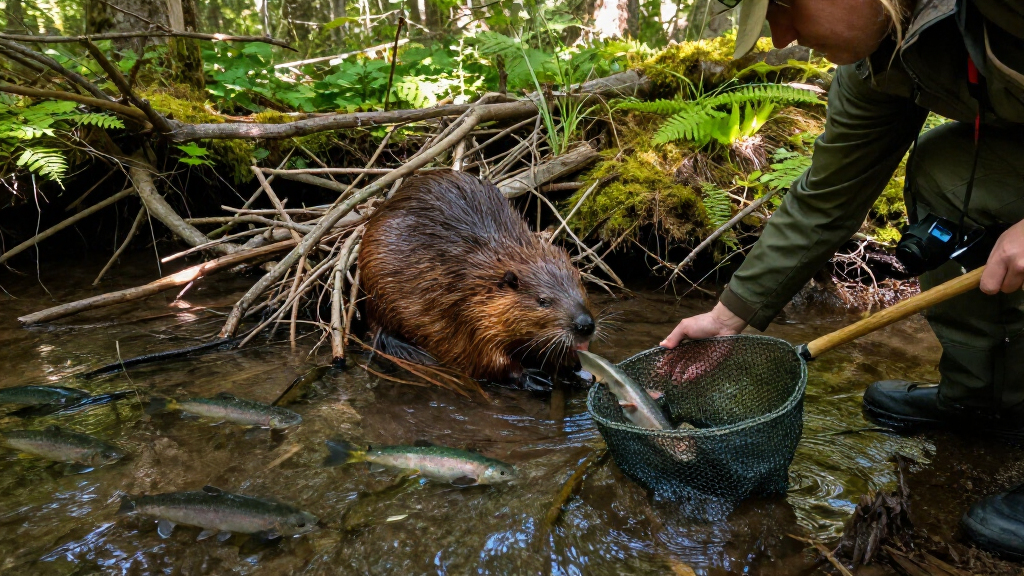
Artificial beaver dams significantly increased juvenile coho salmon survival rates from 8% to 60%. This development suggests promising conservation strategies, but further research is needed to confirm long-term impacts.
Recent data indicates that the installation of artificial beaver dams has dramatically improved juvenile coho salmon survival rates, increasing them from 8% to 60%. This promising development is based on preliminary observations from a conservation pilot project, highlighting a potential new approach to salmon habitat restoration. The findings are significant for fisheries management and environmental conservation efforts, especially in regions where salmon populations are declining.
Conservationists and researchers installed artificial beaver dams in a targeted watershed to mimic natural beaver activity, which historically plays a crucial role in creating suitable habitats for juvenile salmon. Initial monitoring revealed that juvenile coho salmon survival rates, measured over the past several months, increased from a baseline of 8% prior to dam installation to approximately 60% after the intervention. These figures are based on ongoing field surveys and tagged fish tracking, with data still being collected to confirm long-term trends.
Experts involved in the project attribute the improved survival to enhanced habitat complexity, increased water retention, and better protection from predators provided by the artificial dams. The project was initiated by a collaborative effort among local environmental agencies, fisheries scientists, and community groups, aiming to test innovative habitat restoration techniques amid ongoing salmon declines.
While the initial results are encouraging, researchers caution that these findings are preliminary. The project’s duration is relatively short, and additional data is required to determine whether the increased survival rates persist over multiple breeding seasons and broader geographic areas. Nonetheless, the early success has generated significant interest among conservation advocates and policymakers, who see potential in expanding such interventions.
Potential Impact on Salmon Conservation Strategies
The observed increase in juvenile coho salmon survival rates from 8% to 60% could represent a major breakthrough in habitat restoration efforts. If sustained, this approach might offer a scalable, cost-effective method to bolster declining salmon populations in affected watersheds. The success underscores the importance of restoring natural processes, such as beaver activity, which historically shaped healthy aquatic ecosystems. This development could influence future policies, encouraging the integration of artificial beaver dams into broader conservation programs, especially in regions facing habitat degradation and fish population declines.
As an affiliate, we earn on qualifying purchases.
Background on Beaver Dams and Salmon Habitats
Natural beaver dams have long been recognized as ecological engineers, creating wetlands that support diverse aquatic life, including juvenile salmon. Over the past century, beaver populations declined due to trapping and habitat loss, leading to reduced habitat complexity for salmon and other species. Recent conservation efforts have focused on restoring beaver populations or mimicking their effects through artificial dams. Prior studies have suggested that beaver activity benefits salmon by improving water quality, increasing habitat diversity, and providing refuge from predators. However, direct, quantifiable impacts on juvenile survival rates have been limited, making this recent development notable.
The current pilot project builds on these insights, aiming to evaluate whether artificial dams can replicate the ecological benefits of natural beaver activity. The focus is on juvenile coho salmon, a species sensitive to habitat quality and a key indicator of watershed health. The project’s preliminary data aligns with a growing body of evidence that habitat complexity directly correlates with survival prospects for young salmon.
As an affiliate, we earn on qualifying purchases.
Uncertainties About Long-Term Effectiveness
While initial data shows a significant boost in juvenile salmon survival, it is not yet clear whether these gains will be sustained over multiple breeding cycles or in different watershed conditions. The project’s timeframe is limited, and ongoing monitoring is required to determine if the artificial dams continue to provide habitat benefits without unintended ecological consequences. Additionally, the scalability of this approach across larger or more degraded systems remains untested, and further research is needed to understand potential limitations or risks.
As an affiliate, we earn on qualifying purchases.
Next Steps for Monitoring and Expansion
Researchers plan to continue monitoring juvenile coho salmon survival over the next year to assess the durability of the observed benefits. Additional sites may be selected to test the effectiveness of artificial beaver dams in diverse environmental conditions. Funding proposals are underway to expand the project and include long-term ecological assessments, predator-prey dynamics, and water quality measurements. Policymakers and conservation groups are also expected to review early results for potential integration into broader habitat restoration programs.
As an affiliate, we earn on qualifying purchases.
Key Questions
How do artificial beaver dams differ from natural beaver dams?
Artificial beaver dams are man-made structures designed to mimic natural beaver activity, typically constructed from natural materials like wood and soil to replicate the ecological functions of natural dams.
Are there any risks associated with installing artificial beaver dams?
Potential risks include altering water flow patterns in unintended ways or affecting existing ecosystems. Ongoing monitoring is essential to identify and mitigate such issues.
Can this method be scaled to larger watersheds?
It is currently uncertain whether artificial dams can be effectively scaled across larger or more complex systems. Further research and pilot testing are needed.
What is the significance for salmon populations overall?
If sustained, this approach could help reverse declines in juvenile survival, supporting healthier adult populations and overall ecosystem resilience.
Source: hn
Halloween Picks
halloween
As an affiliate, we earn on qualifying purchases.