
Bigfoot is a legendary, hairy giant believed to roam North America’s remote forests and mountains. Known as Sasquatch, it’s described as a tall, upright, ape-like creature covered in dark shaggy hair. Tales of footprints, sightings, and strange sounds keep the legend alive, fueling curiosity and even scientific investigation. While evidence remains inconclusive, enthusiasts continue their search for concrete proof. If you want to explore more about this fascinating creature’s history, sightings, and ongoing mystery, there’s plenty more to discover.
Key Takeaways
- Bigfoot, also known as Sasquatch, is a legendary hairy giant reported in North American remote forests and mountains.
- Footprints over a foot long with dermal ridges support the existence of a large bipedal creature.
- Sightings describe a tall, hairy, upright-walking creature with vocalizations like growls or howls.
- Scientific efforts include DNA testing and trail cameras, but conclusive evidence remains elusive.
- The legend continues to inspire research, folklore, and public fascination with the mystery of undiscovered creatures.
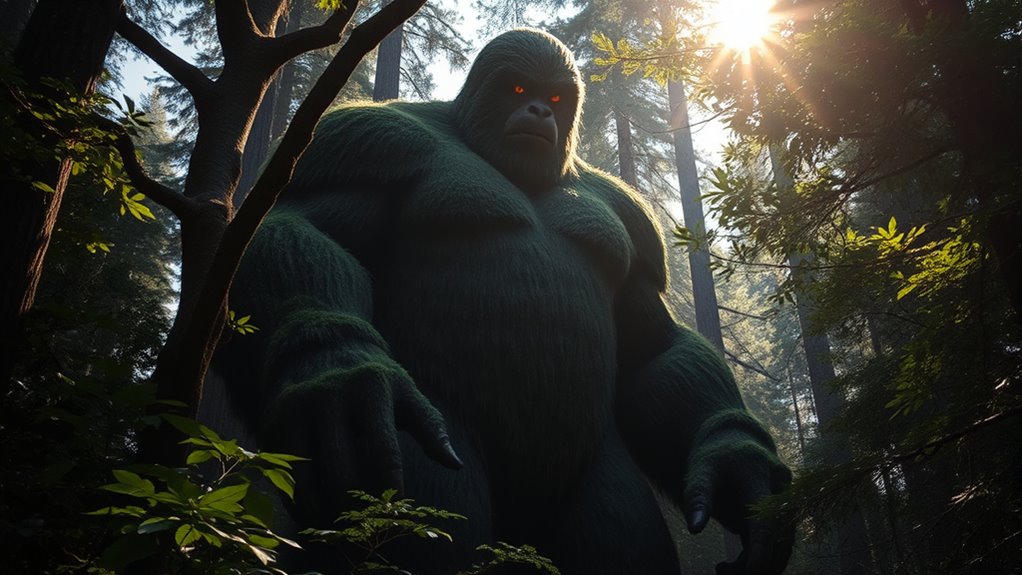
Have you ever wondered if Bigfoot truly exists? The legend of North America’s hairy giant has fascinated people for generations, sparking countless reports of Sasquatch sightings across remote forests and mountain ranges. While many dismiss these stories as hoaxes or misidentifications, others believe there’s enough evidence to keep the mystery alive. One of the most compelling pieces of evidence is the collection of Bigfoot footprints found in various regions. These footprints often measure over a foot long, with distinctive dermal ridges and toe impressions, suggesting something large and bipedal once walked there. Despite skepticism, these footprints have been scrutinized and sometimes analyzed, fueling ongoing debates about their authenticity. Some experts argue they’re elaborate hoaxes, crafted with carved wooden feet or castings, yet others point out the consistency and geographic distribution of these prints as evidence that something real might be out there.
Sasquatch sightings tend to cluster in specific areas, like the Pacific Northwest, where dense forests and rugged terrain provide perfect cover. Witnesses often describe seeing a tall, hairy creature moving swiftly between trees or hearing strange vocalizations that resemble low growls or howls. Many reports include descriptions of a creature covered in dark, shaggy hair and walking upright, resembling a giant ape but with human-like qualities. These sightings, though anecdotal, create a pattern that keeps the legend alive and fuels the quest for proof. People who claim to have encountered Bigfoot often recount feelings of awe, fear, or curiosity, and their stories add to the lore that surrounds this elusive creature. Recent advances in DNA analysis and other scientific techniques continue to challenge traditional skepticism and open new avenues for investigation.
Despite the lack of definitive scientific proof, the ongoing fascination persists. Researchers and enthusiasts continue to explore remote wilderness areas, hoping to find concrete evidence—be it fresh footprints, hair samples, or clear photographs. Technology like trail cameras and DNA analysis has been employed in recent years, but results remain inconclusive. Still, the allure of discovering Bigfoot keeps the search alive, and every new Sasquatch sighting or footprint discovery stirs excitement and debate. Whether you believe or not, the mystery of Bigfoot captures your imagination, inviting you to think about a world where ancient, undiscovered creatures might still roam hidden valleys and shadowy forests, just waiting to be uncovered.
Frequently Asked Questions
Has Any Physical Evidence Conclusively Proven Bigfoot’s Existence?
You might think there’s conclusive proof of Bigfoot, but current physical evidence isn’t definitive. Footprint analysis often shows anomalies, but they can be faked or misinterpreted. Hair sample testing has yielded questionable results, with no conclusive DNA to confirm Bigfoot’s existence. While intriguing, these pieces of evidence haven’t convinced the scientific community, so Bigfoot remains a legendary creature rather than a proven one.
What Are the Most Credible Bigfoot Sightings Recorded?
You should focus on the most credible Bigfoot sightings, which often come from eyewitnesses with high credibility and consistent reports. Footprint analysis from these sightings shows large, unusual tracks that are hard to fake. While no definitive proof exists, these reports are considered more reliable when supported by clear evidence and trustworthy witnesses, making them some of the most compelling accounts in Bigfoot research.
How Do Different Cultures Interpret Bigfoot Legends?
You might find it surprising, but different cultures interpret Bigfoot legends through cultural symbolism and mythological parallels. For example, Native American tribes see Bigfoot as a spiritual guardian, while some Asian cultures compare similar creatures to protective spirits. These legends often reflect deeper beliefs, illustrating how across the world, similar mysterious beings symbolize nature’s power or serve as moral lessons, making Bigfoot a fascinating mirror of human myth-making.
Are There Any Ongoing Scientific Efforts to Find Bigfoot?
Yes, scientists and researchers are actively pursuing cryptid conservation and folklore analysis to find Bigfoot. They often analyze footprint evidence, vocal recordings, and camera traps while respecting local legends. Your involvement can support ongoing efforts by sharing sightings or supporting organizations dedicated to studying these mysteries. While definitive proof remains elusive, these efforts keep the search alive and help protect potential habitat for this legendary cryptid.
What Are the Common Misconceptions About Bigfoot?
You might think Bigfoot is a proven creature, but many misconceptions exist. People often believe hoax theories, thinking all evidence is fabricated, but some sightings remain unexplained. Others confuse folklore origins with real animals, assuming Bigfoot is just myth. In reality, many stories stem from local legends, yet some enthusiasts genuinely believe a mysterious creature might exist. Keep an open mind, but stay critical of sensational claims.
Conclusion
As you step back from the tales and footprints, remember Bigfoot is as elusive as a dream and as real as the forest beneath your feet. The legend lingers like fog, both inviting and mysterious. Whether you believe or doubt, the mystery remains—an ancient giant hiding in plain sight, blending nature’s whispers with human curiosity. In the end, Bigfoot is a reminder that some stories are too wild to ever fully disappear.