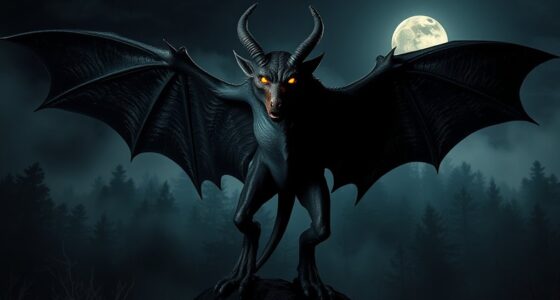
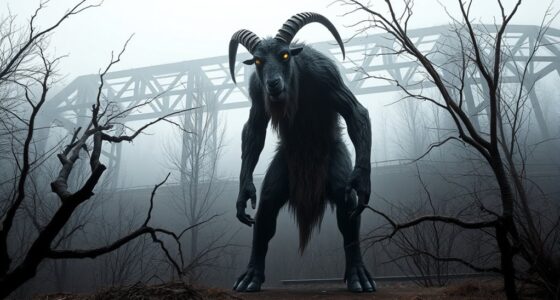
The chupacabra first appeared in Puerto Rico in the mid-1990s, known for preying on livestock like goats. Its legend quickly spread across the Americas, from Mexico to Central America and southern parts of the U.S., inspiring countless sightings and stories. Descriptions vary from a small, spiky animal to a more alien-like creature with glowing eyes. If you want to discover how this myth evolved and what it symbolizes today, there’s more to uncover.
Key Takeaways
- The chupacabra originated in Puerto Rico during the 1990s, linked to livestock deaths and local folklore.
- Reports of sightings spread from Puerto Rico to Mexico, Central America, and southern U.S., expanding the legend.
- Descriptions vary, depicting it as a small, spiny creature or an alien-like being with glowing eyes.
- The legend reflects cultural fears, often explaining livestock deaths or misidentifications of animals.
- Today, chupacabra remains a symbol of cryptid lore, inspiring pop culture and ongoing mystery across the Americas.

Have you ever wondered about the mysterious creature known as the chupacabra? This legendary cryptid has captured the imaginations of many across the Americas, sparking countless stories and sightings. The origins of the chupacabra are deeply rooted in folklore, with its tales first emerging in Puerto Rico in the mid-1990s. Locals began reporting cryptid sightings of a strange, blood-sucking creature that preyed on livestock, especially goats. These early accounts helped shape the folklore origins of the creature, blending traditional superstitions with local fears. Over time, stories of the chupacabra spread beyond Puerto Rico, fueling reports from Mexico, Central America, and even parts of the southern United States. Each new cryptid sighting added layers to the legend, making the creature seem more elusive and mysterious.
As you explore these sightings, you’ll notice how the creature’s description varies. Some describe it as a small, wild dog with spines running down its back, while others claim it resembles a more alien-like being with glowing eyes and sharp teeth. These discrepancies are typical in cryptid lore, where eyewitness accounts often differ based on fear, imagination, and the lack of concrete evidence. Despite the inconsistent descriptions, one thing remains clear: the chupacabra continues to fascinate and terrify those who encounter its legend. The creature’s folklore origins are inextricably linked to local culture and fears, often serving as a cautionary tale for livestock owners. The stories serve to explain unusual animal deaths, fueling community anxieties and reinforcing the creature’s mythos. Interestingly, some Vetted cryptid reports have been linked to misidentifications of known animals or hoaxes, but the legend persists regardless.
Today, the chupacabra’s image has become a symbol of cryptid phenomena, inspiring everything from documentaries to pop culture. Yet, skeptics argue that most cryptid sightings are misidentifications of known animals or deliberate hoaxes. Still, the legend persists because it taps into universal fears of the unknown and the unseen. Whether you believe in the creature or see it as a myth, the chupacabra’s story highlights how folklore origins evolve through cultural storytelling, shaping local identities and fears. Its cryptid sightings continue to spark intrigue, prompting new reports and investigations. Ultimately, the legend of the chupacabra is a testament to how stories can grow and adapt, turning a regional myth into a symbol of mystery across the Americas.
Frequently Asked Questions
Are There Any Scientifically Confirmed Chupacabra Sightings?
You won’t find any scientifically confirmed chupacabra sightings, as cryptid skepticism remains high among experts. Most reported sightings are later identified as dogs or other animals suffering from mange, fitting folklore analysis that suggests the creature is a modern myth. While stories persist, the lack of concrete evidence keeps the chupacabra in the domain of folklore and urban legend, rather than verified biological reality.
What Cultural Significance Does the Chupacabra Hold in Local Communities?
You see, the chupacabra holds deep mythical symbolism in local communities, representing fears and mysteries that spark imagination. It’s more than just a creature; it’s part of community identity, often serving as a symbol of local folklore and storytelling traditions. These beliefs foster a sense of shared culture, connecting residents through tales that preserve history and reinforce collective identity, keeping the legend alive across generations.
How Have Chupacabra Stories Influenced Local Folklore?
You see, chupacabra stories have woven themselves into local folklore like mythical creatures shaping cultural identity. They act as cautionary tales, much like a guardian wolf howling at the moon, reinforcing community values and fears. These stories evolve with each retelling, transforming into symbols that reflect societal anxieties and beliefs, enriching folklore traditions and creating a shared narrative that unites and defines local cultures across regions.
Are There Any Known Biological Explanations for Chupacabra Reports?
Biological explanations for chupacabra reports include theories that it’s a misunderstood animal, like a coyote or dog with mange, making it appear more mythical. Some cryptid research suggests it could be a hybrid or an altered animal, fueling mythical creature theories. While no definitive biological cause exists, many believe the sightings are exaggerated or misidentifications, blending folklore with real animal behavior.
What Efforts Have Been Made to Prove the Chupacabra’s Existence Scientifically?
You might be surprised to learn that cryptozoological research and forensic investigations have been conducted to prove the chupacabra’s existence. Researchers have analyzed hair, blood, and tissue samples, often with inconclusive results. Despite these efforts, no definitive scientific evidence exists. Coincidentally, many sightings remain unverified, making it difficult to confirm the creature’s existence through rigorous scientific methods.
Conclusion
So, now that you know the chupacabra’s journey from Puerto Rico across the Americas, isn’t it fascinating how stories like these capture our imagination? Whether real or myth, they remind us of the mysteries that still surround us. As you ponder these legends, ask yourself: could there be some truth hidden in the tales we tell? Sometimes, the most intriguing stories are the ones that keep us questioning what’s truly out there.