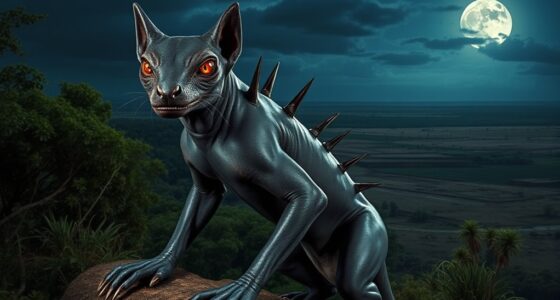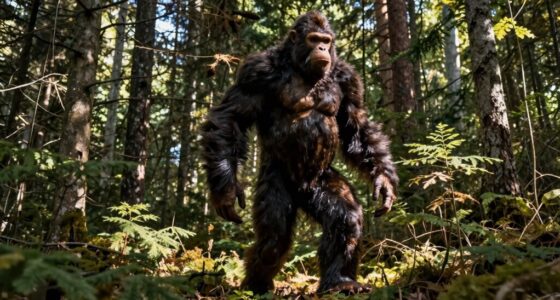
A beginner’s map of classic American cryptids highlights key locations like the Pacific Northwest for Bigfoot, Texas and Puerto Rico for Chupacabra, Lake Michigan for the Lake Monster, Ohio’s Mothman site, and Oklahoma’s Ozark Howler. It shows how regional environments influence the legends and their stories, connecting geography, folklore, and history. As you explore, you’ll discover how these tales shape local identities and carry cultural significance—stick around to see how each legend contributes to America’s mysterious tapestry.
Key Takeaways
- The map would feature regions like the Pacific Northwest, Great Lakes, Southwest, Appalachian Mountains, and Oklahoma, highlighting local cryptids.
- Icons or symbols representing Bigfoot, Mothman, Chupacabra, Lake Michigan Monster, and Ozark Howler would mark their primary sighting areas.
- Different colors or shading could indicate the type of cryptid (e.g., terrestrial, aquatic, aerial) associated with each region.
- Historical legends and cultural influences would be briefly noted next to each cryptid location to show folklore origins.
- The map would serve as a visual guide connecting regional geography with specific cryptid stories and local folklore.
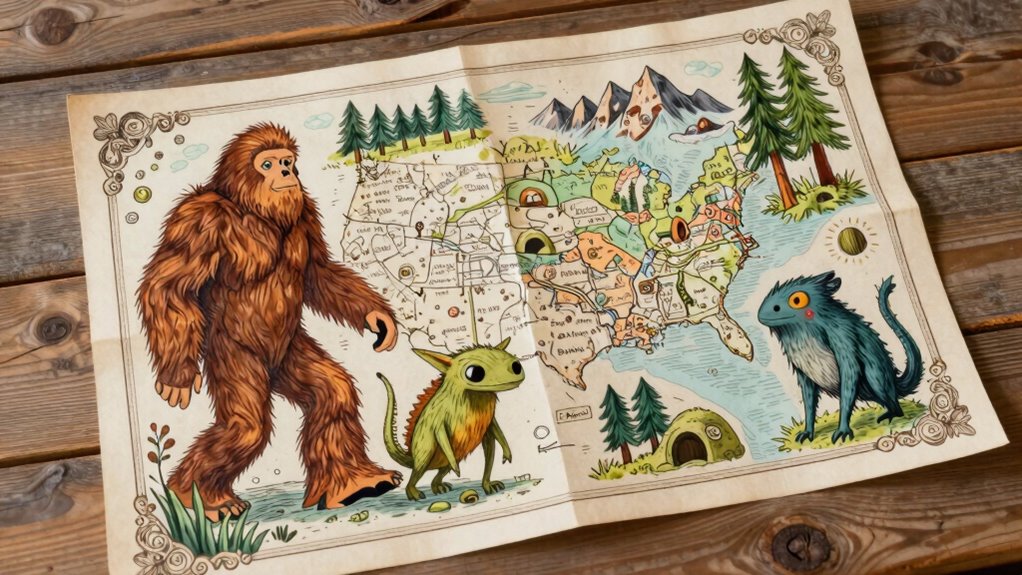
Have you ever wondered where to start when exploring the mysterious world of cryptids? A beginner’s map of classic American cryptids is a fascinating way to begin your journey. It helps you visualize where these creatures have been reported and connects the dots between sightings and local stories. When you look at such a map, you’ll notice that many cryptids are rooted in historical sightings, often recorded decades or even centuries ago, giving each creature a sense of legend and mystery. Some stories date back to early explorers or indigenous tribes, adding layers of cultural significance. These sightings often spark local folklore that persists through generations, shaping the identity of entire regions around tales of strange creatures lurking in lakes, forests, or mountains.
The map would likely highlight well-known spots like the Pacific Northwest, where sightings of Bigfoot, also called Sasquatch, are abundant. You’d see areas like the Cascade Mountains, where numerous reports of large, hairy hominids have made Bigfoot a regional icon. Moving south, the legendary Chupacabra‘s stories are scattered across the Southwest, particularly in Texas and Puerto Rico, where cattle mutilations and mysterious attacks fuel local legends. In the Great Lakes region, tales of the Lake Michigan Monster or similar aquatic cryptids draw from early maritime tales and modern sightings, connecting the area’s history with ongoing curiosities. Exploring cryptid sightings over time reveals how stories adapt and grow within communities, reinforcing local traditions.
Your map would also feature the Appalachian Mountains, home to stories of the Mothman, a winged creature linked to strange omens and tragedy. These stories often emerge from specific events or sightings, blending regional folklore with local history. The connection between sightings and regional lore can be powerful—many of these stories are passed down through generations, shaping local identity and becoming part of community storytelling. Some cryptids, like the Oklahoma’s Ozark Howler, are steeped in local legend, often linked to strange sounds or sightings that have persisted over time. Additionally, understanding the cultural origins of these cryptids can deepen your appreciation for how folklore evolves in different regions. Exploring regional geography influences the types of cryptids reported and how stories develop, making each area uniquely connected to its legends. This geographic variation often reflects the environmental factors that shape local stories and sightings.
By examining the historical context of these reports, you can see how cultural influences shape the way stories are told and remembered, enriching the overall folklore landscape. As you study your map, you’ll see how each cryptid’s story is intertwined with the history and culture of its region. These sightings and folklore tales create a tapestry of mystery that invites further exploration. A beginner’s map acts as a starting point, guiding you through the rich landscape of American cryptids—each pinpoint representing more than just a sighting; it’s a piece of regional history and folklore waiting to be uncovered. This visual guide helps you understand how stories develop, persist, and become part of local identity, making your exploration both educational and exciting.

Folklore and Supernatural Phenomena Of The United States Poster Map Chart Bigfoot Spooky Urban Legends Myths Ghosts Monsters Cryptids Cool Wall Art Print Poster 36×24
- Size: 36×24 inches, fits standard frames
- Material: Lightweight, satin finish paper
- Content: 65 cryptids, myths, legends, and folklore
As an affiliate, we earn on qualifying purchases.
As an affiliate, we earn on qualifying purchases.
Frequently Asked Questions
Are There Any Known Sightings of These Cryptids Today?
You’ll find that sightings of these cryptids are rare today, often rooted in folklore origins and mythical creature classifications. Many reports are anecdotal, with enthusiasts and locals sharing stories, but concrete evidence remains elusive. While some claim to see creatures like the Jersey Devil or Bigfoot, scientific validation is lacking. These sightings continue to fuel curiosity, but they’re mostly part of ongoing folklore, rather than proven encounters with actual mythical creatures.
Which Cryptid Is Considered the Most Famous in America?
Like a shining star in America’s folklore sky, Bigfoot is the most famous cryptid. Its legendary origins are rooted in mythic encounters across forests and mountains, capturing imaginations for generations. People often report mysterious footprints and eerie sounds, fueling the legend. Its mystique makes Bigfoot a symbol of the unknown, inspiring stories, movies, and debates about whether this elusive creature truly exists or if it’s just a mythic mirage.
How Do Cryptids Typically Differ From Real Animals?
Cryptids typically differ from real animals because of their mythical origins and zoological inaccuracies. You’ll notice that cryptids often have exaggerated features, such as oversized bodies or supernatural traits, which don’t match scientific facts. These creatures are born from folklore and legends, making them more imaginative than real animals. Their stories often serve cultural or entertainment purposes, rather than scientific evidence, setting them apart from actual zoological species.
Are There Any Scientific Efforts to Prove These Cryptids Exist?
You can’t judge a book by its cover, but some scientific efforts try to do just that with cryptids. Researchers investigate folklore origins and classify these mythical creatures to find clues about their existence. While mainstream science remains skeptical, some projects analyze alleged evidence, like footprints or hair samples. These efforts aim to separate fact from fiction, but definitive proof remains elusive, keeping cryptids firmly in the domain of legend and mystery.
What Cultural Influences Shaped These Cryptids’ Stories?
You see that folklore origins and cultural symbolism deeply influence these cryptids’ stories. Indigenous legends, regional beliefs, and societal fears shape their tales, reflecting cultural values and fears. For instance, the Sasquatch symbolizes wilderness and the unknown, while the Jersey Devil embodies regional folklore and superstition. These stories evolve over generations, blending cultural symbolism with local history, creating rich, intriguing narratives that capture the imaginations of communities across America.

The United States of Cryptids: A Tour of American Myths and Monsters
As an affiliate, we earn on qualifying purchases.
As an affiliate, we earn on qualifying purchases.
Conclusion
So, sprouting your cryptid collection is simple and sensational. Start small, explore enthusiastically, and embrace the eerie excitement of every encounter. A beginner’s map helps you hone your hunting skills, highlighting hidden haunts and mysterious locales. With curiosity and caution, you’ll confidently chase creatures like Bigfoot, the Mothman, or the Jersey Devil. Remember, the more you discover, the more daring and delightful your cryptid quest becomes. Keep exploring, and let the legendary legends lead your journey!

Monsters of America Cryptid Map United States Folklore T-Shirt
- Map of American folklore creatures: Features regional cryptids and legendary sightings
- Includes famous cryptids: Bigfoot, Mothman, Jersey Devil, Jackalope
- Comfortable classic fit: Lightweight with double-needle sleeve and hem
As an affiliate, we earn on qualifying purchases.
As an affiliate, we earn on qualifying purchases.

Choose Your Own Adventure Cryptid Chronicles: Mothman (Choose Your Own Adventure New Classics)
As an affiliate, we earn on qualifying purchases.
As an affiliate, we earn on qualifying purchases.