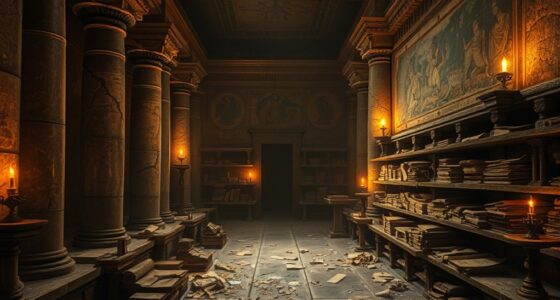

The Library of Alexandria likely held ancient texts that included early classifications and descriptions of mythical creatures, reflecting scholars’ efforts to document legendary beings across different cultures. These texts probably covered dragons, griffins, sea monsters, and other legendary beings, blending myth and observation. If you want to discover how these ancient classifications influenced modern myths and knowledge, keep exploring how these texts shaped our understanding of legendary creatures over time.
Key Takeaways
- The Library of Alexandria contained numerous ancient texts describing mythical creatures and their classifications.
- It likely included early taxonomy of legendary beings, such as dragons and hybrid monsters, based on existing manuscripts.
- No direct evidence confirms it specifically housed comprehensive monster taxonomies, but related texts may have been preserved.
- The library’s loss led to the disappearance of many detailed classifications of mythical creatures.
- Modern knowledge of ancient monster classifications is derived from surviving texts, not direct records from the Library itself.
The Historical Significance of the Library of Alexandria
Why does the Library of Alexandria matter so much in history? It was a hub of knowledge that helped shape how we comprehend cryptozoology myths and folklore classification. The library’s vast collection influenced scholars who studied legendary creatures and their origins. Its importance lies in preserving ancient stories, which later fueled debates on whether these myths had a basis in reality or were purely cultural folklore. By collecting diverse texts, the library enabled early thinkers to analyze and categorize mythical beings, helping to shape the way we interpret legendary creatures today. Its loss is seen as a tragic blow to humanity’s understanding of myth and history. The library’s role in documenting and organizing folklore makes it a cornerstone in the study of legendary creatures and their cultural significance.
Ancient Texts and Records on Mythical Creatures
Ancient texts and records contain a wealth of descriptions and stories about mythical creatures that have fascinated humanity for centuries. These texts often serve as early legendary creature catalogues, offering detailed accounts of beings like dragons, griffins, and sea monsters. They also contribute to cryptid classifications, helping categorize unknown or mysterious entities. You might find references to creatures that blend animal features or exhibit supernatural powers, fueling modern cryptozoology. Many ancient civilizations, from the Greeks to the Chinese, documented their encounters with legendary creatures, preserving these stories in scrolls and inscriptions. These records reveal how ancient societies understood and mythologized the natural world, laying the groundwork for contemporary investigations into cryptids and legendary beast classifications.
- Descriptions of dragons and sea monsters
- Records of hybrid or supernatural beings
- Early cryptid classifications in mythologies
- Influence on modern legendary creature catalogues
The Role of Mythology in Ancient Scientific Inquiry
Mythology played a crucial role in shaping early scientific inquiry by providing a framework for observing and understanding the natural world. It influenced how ancient scholars categorized creatures through mythological taxonomy, blending stories with empirical observations. These myth-based classifications helped explain unfamiliar animals and phenomena, laying groundwork for cryptozoology origins. By linking stories of monsters and legendary beasts to real-world creatures, mythologies encouraged systematic inquiry into the unknown. This approach cultivated curiosity and offered explanations that bridged myth and experience. As a result, mythological taxonomy became an early tool for organizing natural history, fostering a scientific mindset rooted in storytelling, observation, and classification. This interplay between myth and science demonstrates how ancient cultures used mythology as a lens to explore and interpret the mysteries around them.
Evidence of Monster Classifications in Ancient Cultures

Historical records and artifacts from diverse cultures reveal that classifications of monsters and legendary creatures were more than mere stories—they reflect systematic efforts to understand and categorize the unknown. You’ll find evidence of this in ancient dragon depictions, which often symbolize chaos or protection, and in demon classifications that reveal early attempts to distinguish malevolent spirits. Here are four key points:
- Ancient Chinese texts describe various dragon types, indicating an organized taxonomy.
- Mesopotamian artifacts include demon classifications, reflecting spiritual hierarchies.
- Greek mythology features categorized monsters like Hydra and Chimera, hinting at systematic myth-making.
- Egyptian wall carvings depict creatures with specific roles, suggesting early creature classification systems.
These examples show that ancient cultures actively categorized legendary beings, influencing later ideas about monsters.
Possible Contents of the Library’s Collections
The Library of Alexandria likely housed an extensive collection of texts, artifacts, and illustrations related to legendary creatures and monsters from around the world. Among its holdings, you’d find cryptozoological records documenting sightings and legends of elusive creatures. These records might include detailed descriptions, drawings, and local folklore, serving as early forms of mythic creature catalogues. Such materials could reveal the ancient understanding of monsters, blending myth, observation, and cultural beliefs. The collection may have also contained scrolls or manuscripts about mythical beasts like dragons, griffins, and sea monsters, preserved alongside scientific and philosophical writings. Overall, these contents would reflect a thorough attempt to document and classify the mysterious entities that fascinated ancient civilizations.
The Influence of Greek and Egyptian Mythology on Monster Taxonomies
Ancient civilizations like Greece and Egypt deeply influenced how monsters and mythical creatures were classified and understood. Their mythology inspired taxonomy systems that shaped early ancient creature classifications. You can see this impact in the way monsters were categorized based on traits, origins, and symbolism. Here are four ways their mythology influenced taxonomy:
- Mythological origins guiding classification criteria
- Symbolic traits shaping creature categories
- Legendary stories informing taxonomic hierarchies
- Cross-cultural exchanges expanding creature typologies
Why Would the Ancients Document Monsters and Beasts?
People documented monsters and beasts to understand the world around them, often blending observation with myth. These records served as a way to interpret natural phenomena, social morals, and spiritual beliefs, giving symbolic meaning to mythical creatures and ancient beast symbolism. By recording these creatures, you can see how ancient societies used them as allegories for virtues, vices, or cosmic forces. These texts helped explain the unexplainable and reinforced cultural values. Documenting monsters also preserved collective fears and hopes, transforming them into stories and symbols that shaped worldview. This practice reflects a desire to categorize chaos, turning the unknown into meaningful symbols. Understanding this motivation shows how ancient peoples sought order and meaning through myth and symbolism.
| Mythical Creature Symbolism | Ancient Beast Symbolism |
|---|---|
| Cosmic forces | Moral lessons |
| Virtues | Social order |
| Vices | Natural phenomena |
| Spiritual beliefs | Cultural identity |
| Cosmic chaos | Human fears |
Modern Interpretations of Ancient Monster Manuscripts
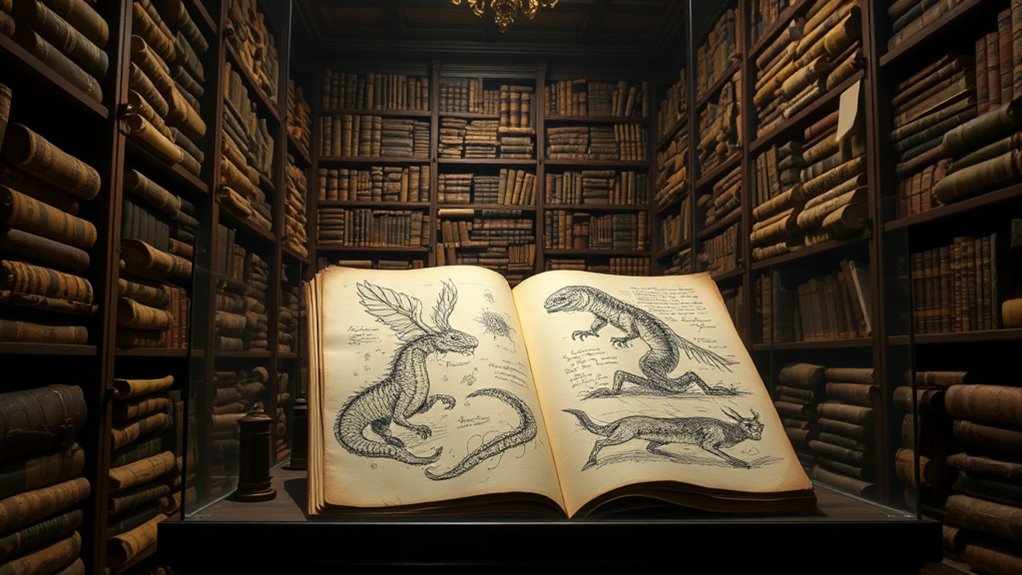
Have modern scholars truly unraveled the meanings behind ancient monster manuscripts? Not entirely, but they’ve made strides in cryptid cataloging and understanding creature symbolism. Today, researchers analyze these texts to interpret how ancient cultures depicted monsters.
- They examine illustrations alongside descriptions to decode symbolism.
- They compare manuscripts across regions to identify shared themes.
- They explore historical contexts to understand why certain creatures appeared.
- They consider mythological influences shaping ancient creature representations.
While some interpret these manuscripts as literal records, others see them as allegories or symbolic messages. Modern approaches blend archaeology, cryptozoology, and cultural studies, aiming to *disclose* the mysteries behind these ancient texts—yet, many secrets still remain.
The Legacy of Mythical Creature Studies in Contemporary Knowledge
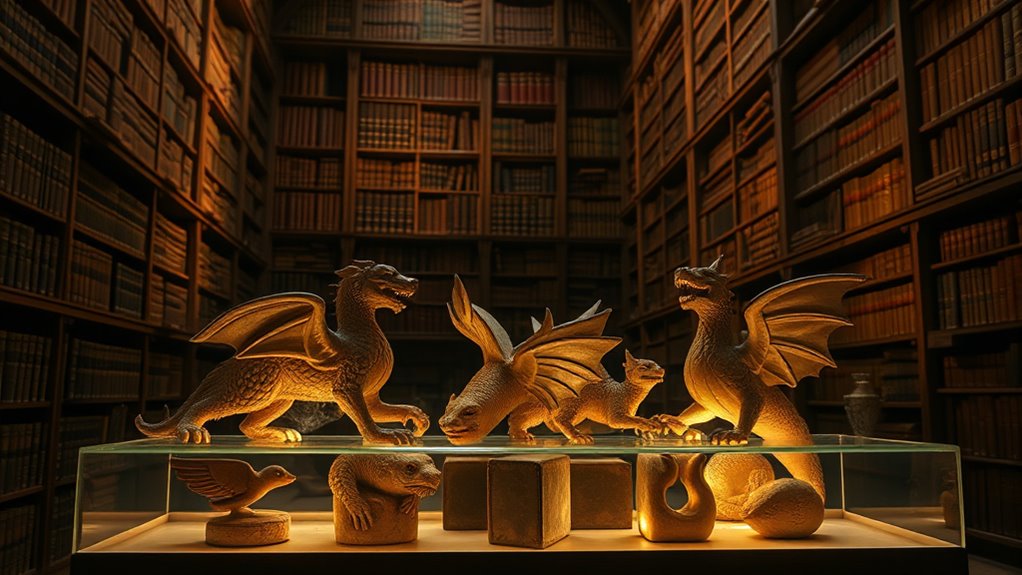
Today, the study of mythical creatures continues to shape our understanding of cultural history and folklore, influencing fields from entertainment to scientific inquiry. Your interest in cryptid folklore fuels ongoing research into mysterious beings and their origins. This has led to the development of mythical taxonomy, where creatures are classified based on traits, stories, and cultural significance. These classifications help you analyze patterns across different cultures and eras, revealing shared beliefs and fears. Modern scholars often draw from ancient texts and folklore to explore how mythic creatures reflect societal values. The legacy of these studies enriches both academic fields and popular culture, inspiring new tales, scientific hypotheses, and even conservation efforts. Ultimately, your engagement with mythical taxonomy keeps alive the wonder and curiosity surrounding these legendary beings.
Frequently Asked Questions
Were Any Actual Monster Classifications Found in the Library’S Remaining Artifacts?
You wonder if any mythical classifications or ancient monster lists were found in the library’s remaining artifacts. While the Library of Alexandria’s ruins contain many scrolls and texts, concrete evidence of detailed monster classifications remains elusive. Some scholars speculate that ancient texts included descriptions of mythical creatures, but no definitive ancient monster lists have been uncovered. Hence, the existence of specific classifications within those artifacts is still a matter of historical mystery.
Did the Library’S Collections Influence Later Scientific Taxonomy Systems?
You might wonder if the library’s collections influenced later scientific taxonomy systems. While ancient creature depictions and mythical creature symbolism often inspired early classifications, there’s no direct evidence they shaped modern taxonomy. Instead, these ancient texts and images helped preserve knowledge of mythical creatures, blending myth with early scientific thought. So, while influential culturally, their impact on formal scientific classification remains limited, serving more as inspiration than direct influence.
How Did Ancient Cultures Verify the Existence of Mythical Creatures?
You explore how ancient cultures verified mythical creature symbolism through ancient verification methods. They often relied on witness testimonies, artistic depictions, and folklore traditions to support these beliefs. While lacking scientific tools, these methods reflected cultural values and storytelling practices, giving mythical creatures a sense of reality. By studying these ancient verification methods, you gain insight into how societies perceived and integrated mythical creatures into their worldview.
Are There Any Direct Links Between the Library’S Texts and Modern Cryptozoology?
You’re wondering if the library’s texts connect directly to modern cryptozoology. While there’s no clear evidence, some believe ancient texts hold clues about mythical creature origins, fueling modern cryptid theories. You might find that these old writings inspire ongoing investigations into ancient cryptid lore, bridging myth and science. Though no definitive links exist, the fascination with legendary beasts continues, driven by historical curiosity and the quest to uncover truth behind ancient cryptid theories.
What Role Did the Library’S Monsters Play in Ancient Religious Practices?
You see, monsters in ancient times often symbolized divine forces, playing a role in mythical rituals that honored gods and explained natural phenomena. These creatures embodied divine symbolism, bridging the human and divine worlds. Their presence in religious practices reinforced spiritual beliefs and conveyed moral lessons. By understanding these monsters’ roles, you gain insight into how ancient societies used mythical beings to connect with higher powers and integrate divine symbolism into their rituals.
Conclusion
While there’s no direct proof the Library of Alexandria housed detailed monster taxonomies, its vast collections hint at a curiosity for mythical creatures. Like a treasure chest of ancient wonder, it likely contained texts on beasts and myths from countless cultures. These stories, woven into history’s fabric, remind you that knowledge and imagination are inseparable threads shaping our understanding of the mysterious world beyond.