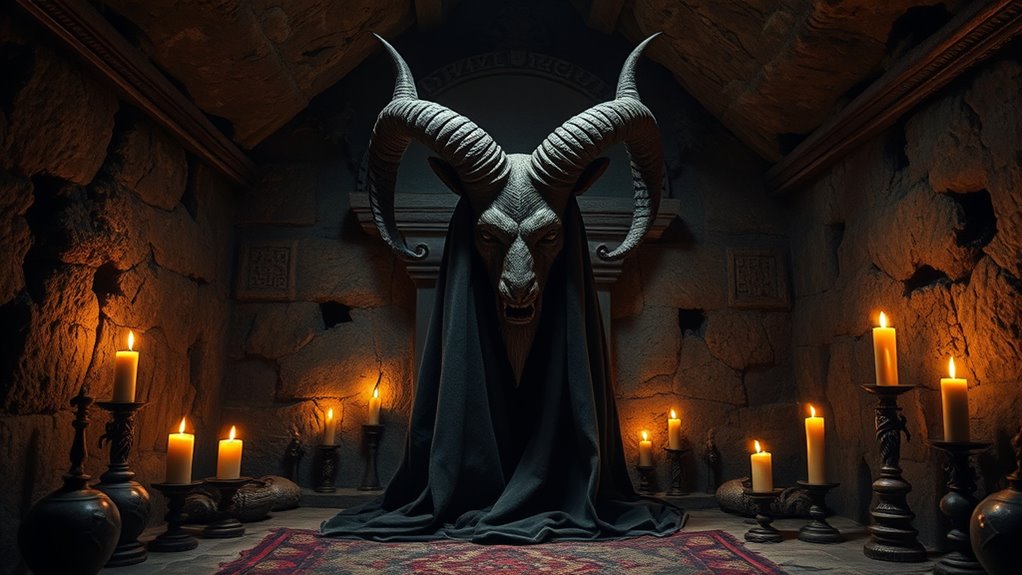

The link between the Templars and goat-headed idols like Baphomet is mostly based on medieval legends and conspiracy theories rather than solid evidence. Historians show that accusations of heresy and devil worship were often exaggerated or false, and there’s little proof that Templars worshipped a goat-headed idol. The modern image of Baphomet as a symbol of occultism developed later. If you keep exploring, you’ll uncover how myths and real history intertwine over the centuries.

Prime made for students and young adults
- Fast, free delivery for dorm and study essentials
- Prime Video and Amazon Music included
- Member-only deals
Key Takeaways
- There is no conclusive historical evidence that Templars worshipped a goat-headed idol called Baphomet.
- Legends linking Templars to goat-headed idols and heresy are based on medieval myths and accusations.
- The modern image of Baphomet as a goat-headed figure was popularized in the 19th-century occult revival.
- Artistic depictions of Baphomet symbolize duality and balance, not actual Templar worship practices.
- The association between Templars and Baphomet largely stems from legends, superstition, and later myth-making rather than historical fact.

The connection between the Templars and Baphomet has long fueled speculation and intrigue, often blending history with myth. This link has been the subject of countless theories, many of which stem from medieval legends and have persisted into modern misconceptions. You might have heard that the Templars worshipped a goat-headed idol called Baphomet, a notion popularized by sensationalized stories and conspiracy theories. But when you look closely at historical records, the reality is much murkier. The Templars were a medieval Christian military order founded in the early 12th century, and much of the lore surrounding them has been shaped by both genuine events and later embellishments. Medieval legends often depicted the Templars as secretive and heretical, fueling accusations of devil worship and occult practices. These stories, whether true or exaggerated, contributed to the image of Baphomet as a sinister symbol associated with the order. However, modern misconceptions have distorted these origins further, turning what little historical evidence exists into sensational stories. For example, some believe that the Templars secretly possessed a goat-headed idol during their trials in the 14th century, which was supposedly a representation of Baphomet. Yet, there’s little concrete proof of this claim. The Templars’ downfall was primarily due to political and financial motives, not heretical rituals involving goat-headed idols. Over time, the legend of Baphomet became intertwined with other occult symbols, especially after the 19th-century occult revival. Artists and writers began depicting Baphomet as a goat-headed figure with mystical significance, further cementing misconceptions about its origins. Today, many associate Baphomet with satanic rituals and black magic, but this is largely a modern construct that distorts the historical context. The symbol itself, as it appears in modern imagery, was popularized by 19th-century occultists like Eliphas Levi, who used it to represent duality and balance rather than any real worship of a goat-headed deity. As you explore the history of the Templars and Baphomet, it’s essential to differentiate between medieval legends—often colored by fear and superstition—and the modern misconceptions that have built upon those stories. The truth is that much of what is popularly believed about the connection between the Templars and Baphomet is more myth than fact. The intrigue persists because stories of secret rituals and hidden idols tap into popular fears and fascination with the occult, but the actual history is far less sensational. Instead, it’s a story of how legends evolve, blending fact and fiction into a compelling narrative that continues to captivate your imagination. Additionally, understanding the historical context helps clarify how myths can develop around secret societies and symbols.
As an affiliate, we earn on qualifying purchases.
Frequently Asked Questions
What Historical Evidence Links Templars to Baphomet Worship?
You won’t find solid historical evidence linking Templars to Baphomet worship, as medieval folklore and religious syncretism often fueled speculation. Accusations arose during the 14th century, but these are based more on confessions extracted under pressure and biased accounts than concrete proof. The idea of Baphomet as a goat-headed idol is likely a product of myth-making, blending cultural influences rather than documented Templar practices.
How Did Baphomet Become Associated With Occult Symbols?
You might think medieval iconography and religious symbolism are straightforward, but they often intertwine with mystery and speculation. Baphomet became associated with occult symbols through 19th-century esoteric traditions, blending pagan imagery with Christian symbols. This juxtaposition transformed it into a powerful icon representing duality and hidden knowledge. Over time, occultists embraced Baphomet, linking it to secret societies and mystical practices, cementing its place in the symbolism of the mysterious and the arcane.
Are There Any Surviving Artifacts Depicting Baphomet?
You’ll find that surviving artifacts depicting Baphomet are extremely rare, but some medieval relics and secret manuscripts hint at its symbolism. These relics, often hidden or damaged over time, suggest an association with esoteric knowledge. Rare illustrations and inscriptions in obscure texts continue to fuel speculation. While no definitive, widely accepted artifact exists, these remnants keep the mystery alive, inspiring ongoing research and intrigue around Baphomet’s historical origins.
Did the Templars’ Beliefs Influence Modern Occult Practices?
You might imagine shadowy figures exchanging secret symbols beneath moonlight, blending medieval superstition with modern mysticism. The Templars’ beliefs, shrouded in mystery, have undeniably influenced modern occult practices. Secret societies have carried forward these esoteric ideas, weaving them into contemporary rituals and symbolism. Their legacy persists, transforming ancient fears into mystical tools, proving that the echoes of medieval superstition still shape the hidden corners of today’s occult world.
What Role Did Baphomet Play in Medieval Templar Rituals?
You might find that Baphomet played a symbolic role in medieval Templar rituals, representing mystical concepts rooted in medieval symbolism. During secret ceremonies, the Templars possibly used Baphomet imagery to embody duality, balance, or divine knowledge. While direct evidence is scarce, some theories suggest that Baphomet served as a powerful ritual symbol, influencing their practices and later occult traditions, emphasizing the importance of hidden meanings within their ritual practices.
As an affiliate, we earn on qualifying purchases.
Conclusion
As you step back from the shadows of history, you can almost see the mysterious goat-headed idol hidden within the darkness, whispering secrets of the Templars’ forbidden rites. The image lingers like a flickering flame in your mind, haunting yet mesmerizing. You realize that beneath the surface, symbols and legends intertwine, inviting you to explore the secrets they’ve guarded for centuries. The mystery remains, just beyond the veil, waiting for you to uncover it.
As an affiliate, we earn on qualifying purchases.
As an affiliate, we earn on qualifying purchases.
Halloween Picks
halloween
As an affiliate, we earn on qualifying purchases.