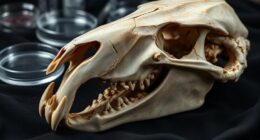
Using modern bite-mark science, researchers now re-examine the Beast of Gévaudan’s legend by analyzing old bite marks with advanced techniques like DNA testing, digital imaging, and forensic profiling. These methods help identify animals involved, distinguish authentic wounds from folklore, and clarify the creature’s true nature. While challenges remain due to degraded evidence, ongoing technological progress promises fascinating insights into this historical mystery—discover more as you explore recent scientific breakthroughs.
Key Takeaways
- Modern bite-mark analysis applies forensic odontology and DNA techniques to re-examine historical evidence of the Beast.
- Advances in imaging and micro-spectroscopy help identify species and distinguish genuine bite marks from folklore.
- Degraded DNA samples from the 18th century pose challenges but can still provide insights into possible suspects or animals.
- Reassessment of bite marks can clarify whether the creature was a wolf, hybrid, or mythological entity.
- Emerging forensic technologies enhance understanding of the Beast of Gévaudan’s true nature, blending science with historical folklore.
Historical Accounts and Early Descriptions of the Beast

Historical accounts of the Beast of Gévaudan date back to the late 18th century, when villagers first reported encounters with a mysterious and ferocious creature terrorizing the region. These early descriptions often blend reality with folklore narratives, portraying the beast as a mythical creature beyond normal comprehension. Local tales depict it as a supernatural being, fueling fears rooted in ancient mythologies of mythical creatures lurking in the shadows. Eyewitness reports describe a beast with extraordinary strength, swift movements, and a terrifying appearance, often exaggerated by storytelling. These stories spread quickly, reinforcing the creature’s legendary status. As folklore narratives evolved, so did the creature’s image, transforming from a real animal into an almost mythical figure that haunted the collective imagination of Gévaudan’s inhabitants.
Traditional Theories and Speculations About Its Identity
Many theories have been proposed to explain the true identity of the Beast of Gévaudan, with enthusiasts and researchers alike offering a range of speculations. Some believe it was a mythical creature from folklore origins, such as a giant wolf or a demonic entity, fueled by local legends. Others suggest it might have been a hybrid or a pack of wolves acting abnormally due to disease or human interference. Folklore origins often link the beast to stories of supernatural monsters or cursed beings that terrorized the region. These traditional theories reflect the fears and beliefs of the time, blending myth and reality. Despite modern science, many continue to be captivated by these folklore-inspired ideas, which help preserve the mystique surrounding the legendary creature.
The Role of Bite Marks in Forensic Science

Bite marks play a essential role in forensic science by providing tangible evidence that can link a suspect to a crime scene or victim. Through bite mark analysis, experts compare the unique pattern of teeth impressions to suspect dental profiles. Modern techniques also incorporate DNA analysis from saliva traces left in the bite area, increasing accuracy. These methods help establish identification and strengthen case evidence. When examining bite marks, forensic odontologists look at factors like size, shape, and alignment. Advances in digital imaging enable detailed comparisons, making it easier to distinguish authentic bite marks from false or coincidental impressions. Overall, bite marks serve as fundamental clues, combining traditional analysis with DNA evidence to build stronger cases.
- Unique dental patterns aid identification
- DNA analysis enhances accuracy
- Digital imaging improves comparisons
Recent Advances in Analyzing Old Bite-Related Evidence

Advances in forensic technology now allow investigators to extract valuable information from bite-related evidence that is decades old. Techniques like high-resolution imaging, DNA analysis, and micro-spectroscopy enable scientists to analyze ancient samples with unprecedented accuracy. This progress helps distinguish real animal bites from mythical creatures often featured in folklore analysis, clarifying historical accounts. By examining bite marks and residue, researchers can better identify the species involved, even when evidence is fragmented or degraded. These methods reduce reliance on assumptions rooted in folklore or legend, sharpening scientific understanding. As a result, you can now approach old cases, like those surrounding the Beast of Gévaudan, with fresh insights, helping to separate fact from myth and providing a clearer picture of the true events behind legendary stories.
Case Studies: Re-Examining Old Bite Mark Evidence From Gévaudan

Re-examining the old bite mark evidence from Gévaudan offers a unique opportunity to clarify historical accounts and separate fact from myth. By applying modern techniques like DNA analysis and behavioral profiling, you can evaluate the authenticity of past claims. These case studies reveal whether bite marks truly match known predators or if evidence was misinterpreted.
Re-examining Gévaudan’s bite marks clarifies myths using DNA and behavioral analysis.
- DNA analysis helps identify species and individual animals, ruling out or confirming suspected predators.
- Behavioral profiling offers insights into animal behavior that could explain attack patterns.
- Reassessment of historical bite marks can challenge long-held legends or support factual accounts.
Through these methods, you gain a clearer understanding of what really happened, shifting the narrative from legend to scientific fact.
Scientific Discoveries and Their Impact on the Legend

Recent scientific discoveries have considerably reshaped our understanding of the Gévaudan legend, shifting it from myth to evidence-based history. These findings reveal how myth evolution reflects changing perceptions and societal fears, rather than a single monstrous creature. Modern analysis, such as bite-mark science and animal studies, challenges the idea of a supernatural beast, suggesting instead that a large predator or multiple animals caused the attacks. This scientific perspective influences cultural influence, helping us see the legend as a product of its time—shaped by fear, storytelling, and social dynamics. By grounding the story in scientific evidence, you can better appreciate how folklore evolves and how historical narratives are shaped by both mythic elements and real-world events.
Limitations and Challenges of Applying Modern Science to Historical Cases

Applying modern science to the Gévaudan case faces significant hurdles due to gaps and biases in the available evidence. You’ll find that technological limitations still restrict definitive analysis of historical data. These challenges make it difficult to draw concrete conclusions about what truly happened.
Evidence Gaps and Biases
Despite advances in forensic science and historical analysis, significant gaps and biases remain when applying modern methods to cases like the Beast of Gévaudan. Cultural biases can skew interpretations, making certain explanations seem more plausible than others. Eyewitness reliability is often questionable, especially when memories fade or become influenced by local legends. These issues can lead to misidentification or overlooked evidence, hindering a clear understanding of what truly happened. Additionally, incomplete records and inconsistent documentation further limit scientific analysis. Such gaps challenge efforts to reach definitive conclusions about the case’s true nature. Recognizing these biases helps you understand that our current knowledge is shaped by both the limitations of evidence and the cultural context of the time.
- Cultural biases influence interpretations of events
- Eyewitness accounts may be unreliable or exaggerated
- Incomplete or biased records limit scientific analysis
Technological Limitations Persist
Modern science faces significant challenges when it comes to solving historical cases like the Beast of Gévaudan because the technology available today often cannot be fully applied to old evidence. DNA degradation over time hampers genetic analysis, making it difficult to identify or confirm animal or human remains. Preserved samples are rare, and even when found, they may contain fragmented DNA that resists sequencing. This limits the ability to compare evidence directly to modern species or suspects. Below is a quick overview of these limitations:
| Challenge | Impact |
|---|---|
| DNA degradation | Reduces sample quality, complicates analysis |
| Limited preserved evidence | Fewer samples available for testing |
| Contamination risks | Can skew DNA results |
| Technological sensitivity | May not detect degraded or tiny DNA fragments |
These hurdles mean we often need to rely on indirect evidence rather than definitive scientific proof.
The Future of Forensic Investigations in Solving Historical Mysteries

Advancements in forensic science are transforming how we approach solving historical mysteries, making it possible to uncover details that once seemed lost to time. You can now leverage DNA analysis to identify individuals or animals involved in past events, even centuries later. Virtual reconstructions allow you to visualize scenes, injuries, or creatures with remarkable accuracy, providing new insights. These tools enable researchers to piece together fragmented evidence and validate hypotheses more confidently. Future forensic investigations may also utilize enhanced forensic databases, improving match accuracy and speeding up discoveries. The combination of molecular techniques and digital modeling opens doors to solving long-standing mysteries. As technology continues evolving, you’ll find yourself capable of unraveling stories hidden within history, bringing clarity and closure to cases once considered unsolvable.
- DNA analysis for historical identification
- Virtual reconstructions of scenes and injuries
- Enhanced forensic databases and modeling
Frequently Asked Questions
How Reliable Are Bite Mark Analyses in Identifying Specific Animals or Humans?
You might wonder about bite mark reliability and forensic accuracy in identifying specific animals or humans. In reality, bite mark analysis has faced significant scrutiny, as it often lacks consistency and scientific validity. Many experts now question its reliability, noting that bite marks can be mistaken or misinterpreted. So, while it can sometimes provide clues, you shouldn’t rely solely on bite mark analysis for definitive identification due to its questionable forensic accuracy.
Can Modern DNA Techniques Be Applied to Old Forensic Evidence From Gévaudan?
You can definitely apply modern DNA techniques to old forensic evidence from Gévaudan. Ancient DNA analysis allows you to extract genetic material from degraded samples, giving you clues about the animal involved. Wildlife forensics tools help identify species and even individual creatures. By combining these methods, you can re-examine historical evidence, potentially uncovering new insights into the beast’s true identity and shedding light on this historic mystery.
What Are the Ethical Considerations in Re-Examining Historical Forensic Evidence?
When re-examining historical forensic evidence, you need to take into account ethical issues like historical bias and cultural sensitivity. You might uncover new truths, but it’s important to respect the context and avoid distorting history or offending communities involved. Being mindful ensures your research remains respectful and objective, honoring the past while embracing modern science. Balancing scientific curiosity with ethical responsibility helps you uncover facts without causing harm or misinterpretation.
How Do Climate and Environmental Changes Affect Bite Mark Preservation Over Centuries?
You might wonder how climate impact and environmental degradation influence bite mark preservation over centuries. Changes in temperature, humidity, and soil conditions can accelerate the deterioration of biological materials, making bite marks less distinct or even erasing them entirely. Environmental degradation can lead to the loss of vital forensic evidence, complicating historical analysis. Understanding these factors helps you assess the reliability of preserved bite marks and the challenges in reconstructing past events.
Could New Scientific Methods Definitively Confirm or Dismiss the Legend of the Beast?
They say truth is often stranger than fiction, but new scientific methods could finally cut through cryptozoology debates and folklore skepticism. You might think science can definitively confirm or dismiss the beast’s legend, but history shows legends often resist complete proof. While advanced bite-mark analysis offers clues, it can’t guarantee absolute certainty. Still, it pushes you closer to understanding, transforming myth into knowledge, one discovery at a time.
Conclusion
Remember, history often reveals secrets only when we look beneath the surface. By applying modern bite-mark science to the Gévaudan mystery, you can uncover truths long hidden. While science can’t solve every puzzle, it moves us closer to understanding the past’s shadows. As the saying goes, “The past is never dead; it’s not even past.” Keep questioning, and you might just uncover the story behind the legend.