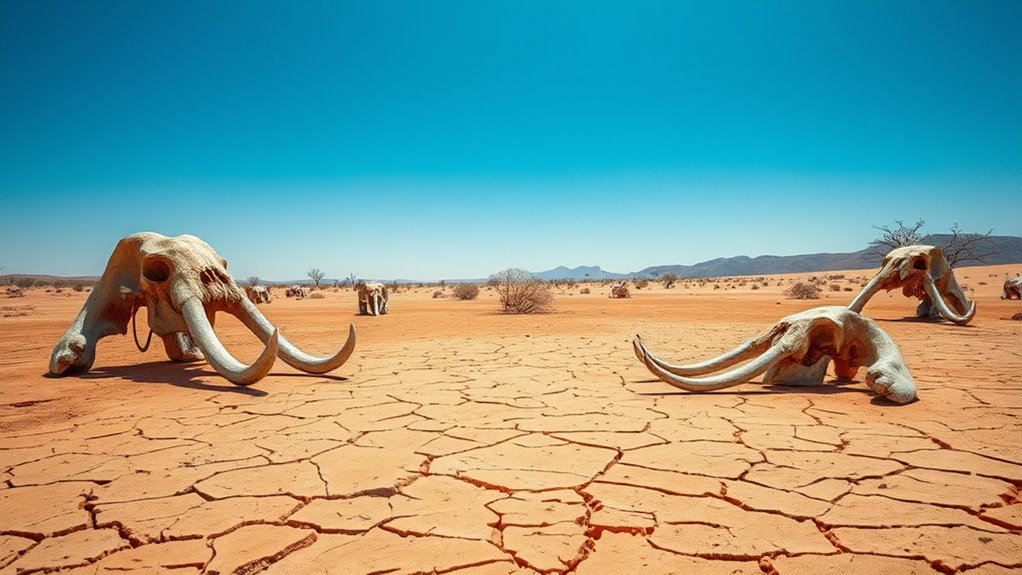
The myth that elephants seek out a special “graveyard” to die is not true. Scientists have shown that elephants don’t pick a final resting place through spiritual means. Instead, carcass locations are influenced by environmental factors like water sources and predator activity. Elephants are social animals that often return to familiar areas, but they don’t deliberately go to a specific site to die. To learn more about the real behaviors behind elephant deaths, keep exploring further.
Key Takeaways
- Elephants do not intentionally seek out specific “graveyards” to die; the myth is culturally based.
- Carcass locations are typically due to environmental factors like water sources and predator activity.
- Observed carcass congregations result from natural behaviors, not mystical guidance or preordained sites.
- Scientific studies, including AI analyses, show elephants lack knowledge of death sites; their behavior is instinctual.
- The myth persists because humans interpret carcass patterns as spiritual or symbolic, not biological facts.

Many believe that elephants instinctively seek out a specific “graveyard” to die, but this myth has little basis in scientific evidence. The origins of this myth are often traced back to observations of elephant carcasses and behaviors that seem to suggest a mysterious knowledge of their end. However, the story isn’t rooted in scientific fact but rather in myth origins that blend cultural symbolism and human interpretation. Historically, many cultures have ascribed spiritual significance to elephants, viewing them as symbols of wisdom, strength, and even spiritual guides. These cultural symbolisms influenced stories about elephants choosing their final resting places, reinforcing the idea that they possess a sort of mystical understanding of death.
The myth likely gained traction because of our tendency to seek meaning in natural phenomena, especially around death and the unknown. When elephants are found dead, their carcasses are often concentrated in certain areas, but this is usually because of environmental factors or water sources rather than a conscious choice. Over time, stories grew that elephants must be “guided” by some innate knowledge to these spots, reinforcing the myth that they have a special connection to their death sites. This intertwining of myth origins and cultural symbolism makes the idea compelling—humans instinctively project their beliefs and spiritual ideas onto animals, especially those as majestic and intelligent as elephants.
In reality, elephants do not seek out a specific “graveyard.” Instead, they are social animals that often return to familiar waterholes or mineral-rich areas, where carcasses may happen to be found. When a herd encounters a dead member, they sometimes show behaviors that seem like mourning or curiosity, but these actions are more about social bonds and natural responses than any mystical awareness. The concentration of carcasses in certain locations is usually explained by environmental factors, such as water availability or predator activity, rather than a conscious decision to die in a particular place. Additionally, recent studies using AI technology have helped scientists analyze elephant movement patterns to better understand their behaviors, further dispelling the myth of a mystical death site.
Understanding the myth origins behind the elephant graveyard myth helps you see how cultural symbolism influences storytelling. It’s a reminder that many animal stories are shaped by human perceptions, not biological facts. While the idea of a sacred or mystical death site is enthralling, science shows us that elephants die where their bodies happen to be, influenced by natural circumstances rather than a spiritual plan. Recognizing this distinction allows you to appreciate elephants for their real behaviors and social structures, rather than myths rooted in cultural symbolism.

LANTOOCAM Solar Trail Camera, 5K WiFi Game Camera, 5200mAh Forever Power, 64GB SD Card, IP66 Waterproof,120° Wide Angle Night Vision for Outdoor Detection, Monitoring Trail Cameras, H.264 MP4 Video
[Ultra-Long Runtime]: Experience ultimate convenience with this solar-powered trail camera's marathon runtime! Equipped with 5200mAh rechargeable battery +…
As an affiliate, we earn on qualifying purchases.
As an affiliate, we earn on qualifying purchases.
Frequently Asked Questions
Are There Real Elephant Graveyards or Giant Death Sites?
There aren’t any real elephant graveyards or giant death sites, as these are rooted in folklore origins and mythical creatures’ stories. You won’t find actual locations where elephants or giants supposedly gather after death. Instead, these tales often symbolize mystery or serve as allegories in legends. While fascinating, they remain part of myth and legend, not factual places, capturing your imagination more than any physical reality.
How Do Elephants Find Their Way to These Supposed Graveyards?
You might think elephants have a secret GPS, but they actually rely on elephant navigation and herd communication. Like the saying “birds of a feather flock together,” elephants follow familiar routes and listen to their herd’s cues. When an elder shows the way, others follow, often leading to known watering holes or old sites. It’s a natural, social process—not a mysterious death trail—guided by instinct and communication.
Do Other Animals Have Similar Mythologies About Death Sites?
Yes, many animals have myths about mythical burial sites that reflect cultural symbolism. You might find stories about whales, wolves, or dragons connected to sacred grounds or death places. These legends often symbolize passage, respect, or the importance of nature’s cycle. You’re encouraged to explore how different cultures imbue these sites with spiritual meaning, highlighting the universal human tendency to link animals with myths of life, death, and the afterlife.
What Cultural Beliefs Surround the Idea of Elephant Graveyards?
You might find that many cultures see elephant graveyards as sites of spiritual significance, believing they hold the spirits of ancestors or sacred energies. These places often become part of funeral rituals, where people honor the dead and seek blessings. The idea is that these sites connect the living with the spiritual domain, emphasizing respect and reverence for nature’s cycle of life and death.
Have Any Archaeological Discoveries Confirmed Elephant Graveyard Existence?
You won’t find concrete archaeological proof of elephant graveyards, as their existence remains rooted in mythical origins and cultural symbolism. While some claim to have uncovered ancient bones, none definitively confirm these sacred sites. Such stories evoke a sense of wonder and mystery, inspiring legends that bridge reality and myth. Still, the allure persists, inviting you to explore the mysteries that lie beyond tangible evidence, where cultural beliefs softly whisper of eternal resting places.

VOOPEAK WiFi Trail Camera, 4K Solar Game Camera Starlight Night Vision Dual Lens, 0.1s Trigger, 2” Display, IP66 Waterproof, Motion Activated Outdoor Camera for Wildlife Monitoring & Security
ULTRA 4K+60MP & DUAL LENS SYSTEM – Capture breathtaking 4K video and crystal-clear 60MP photos with an advanced…
As an affiliate, we earn on qualifying purchases.
As an affiliate, we earn on qualifying purchases.
Conclusion
So, next time you hear about the elephant graveyard, remember it’s more myth than reality. Curiously, studies suggest that elephants can live up to 70 years, meaning they could potentially reach the age where they’d naturally die in their prime. Imagine a herd of aging giants, each one carrying decades of stories, quietly passing away in the wild. It’s a reminder that nature’s mysteries are often more fascinating than legends.

Animal Models of Reproductive Behavior (Neuromethods)
As an affiliate, we earn on qualifying purchases.
As an affiliate, we earn on qualifying purchases.

The Nature of Photographs: A Primer
New
As an affiliate, we earn on qualifying purchases.
As an affiliate, we earn on qualifying purchases.