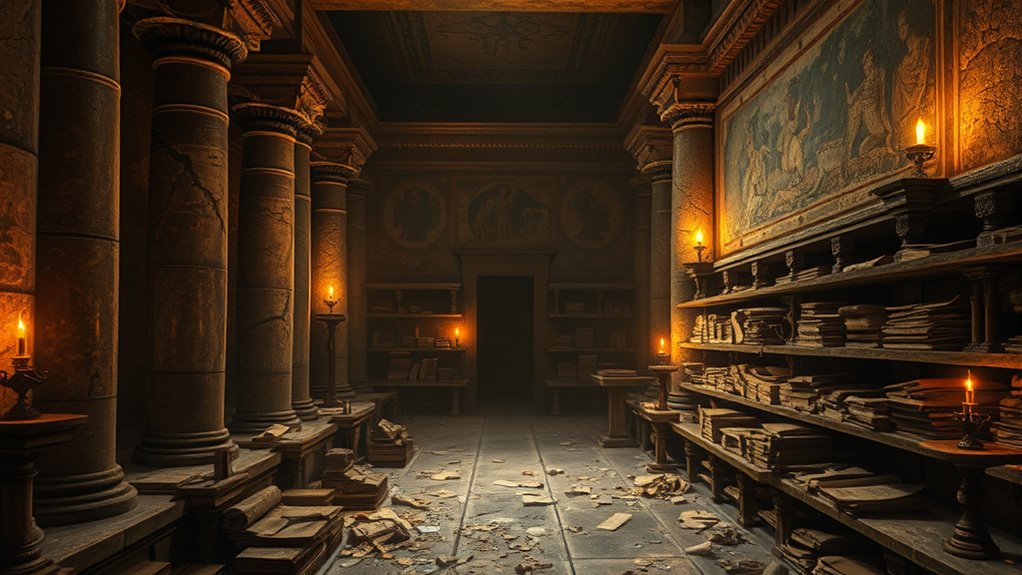

The Lost Library of Alexandria held a vast collection of ancient knowledge from civilization’s greatest minds across Greece, Egypt, Persia, India, and China. If it had survived, you’d have access to early scientific treatises, philosophical dialogues, poetic works, and texts that bridged the gap between ancient and medieval times. Its destruction created an immense gap in human understanding and cultural heritage. Stay with us to uncover more about what was lost and why it matters today.
Key Takeaways
- The library housed manuscripts on philosophy, science, literature, and mathematics from ancient Greece, Egypt, Persia, India, and China.
- It contained early scientific treatises, philosophical dialogues, and poetic works that influenced human thought.
- Much of its collection was lost due to fires, neglect, and political upheaval over several centuries.
- The destruction created a significant gap in historical and cultural knowledge, halting the continuity of intellectual progress.
- Its loss symbolizes the fragility of cultural heritage and highlights the importance of safeguarding knowledge.
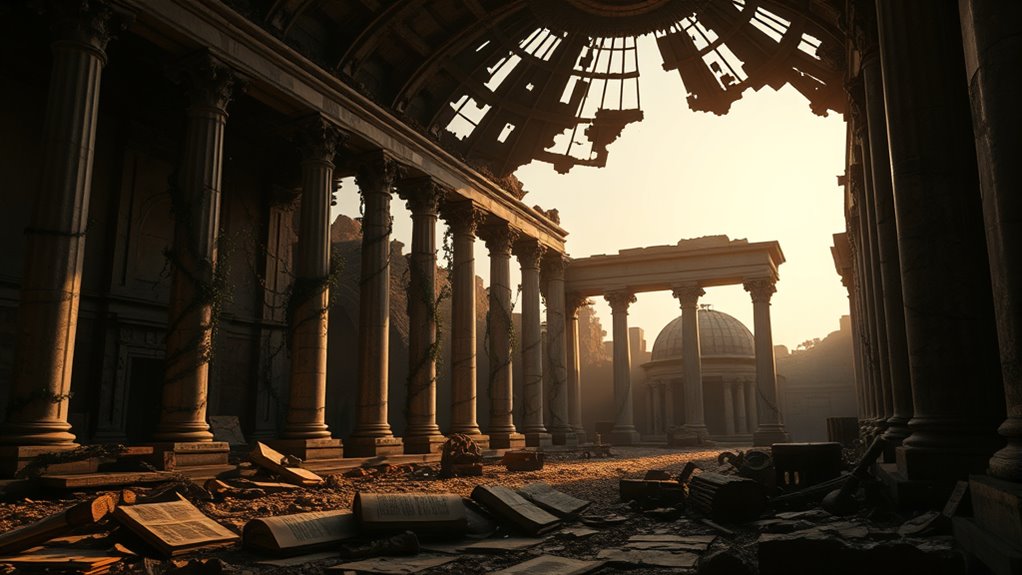
The Lost Library of Alexandria remains one of the greatest mysteries of ancient history, representing a hub of knowledge that vanished centuries ago. It was a place where countless ancient manuscripts, scrolls, and texts were stored, encompassing a wide range of subjects from philosophy and science to literature and mathematics. When the library was destroyed, you lost more than just books; you lost a crucial connection to the intellectual pursuits of ancient civilizations. Historians and scholars have long debated what exactly was contained within its walls, but much remains uncertain due to limited surviving records. The library’s reputation as a repository of knowledge fuels these scholarly debates, with some suggesting it held works from Greece, Egypt, Persia, India, and even parts of China. If true, its destruction meant the disappearance of invaluable insights from these diverse cultures.
You might wonder what kind of knowledge was lost forever in this tragedy. Ancient manuscripts housed there could have included early scientific treatises, philosophical dialogues, and poetic works that shaped the course of human thought. Some of these texts are believed to have been copied from even older sources, making their loss a blow to the continuity of knowledge. The absence of concrete evidence makes it difficult for you to determine the full scope of what was lost, but the impact of this loss is felt across history. The destruction likely resulted from a series of events rather than a single incident, including fires, neglect, and political upheaval, which contributed to the library’s decline.
Additionally, the library’s collection of manuscripts would have served as an important bridge connecting ancient and medieval knowledge, highlighting its role in the continuity of human intellectual progress.
The scholarly debates surrounding the library’s destruction continue to fascinate you. Some argue that the library was never a single, continuous institution but rather a series of collections that grew and shrank over centuries. Others believe its destruction was gradual, happening over multiple incidents, which makes pinpointing a specific date or cause challenging. Despite these debates, what remains undeniable is that the loss of the library’s ancient manuscripts created a significant gap in human knowledge. You are left to imagine what insights and discoveries might have been gained had those texts survived. The library’s legacy endures as a symbol of the fragility of cultural heritage and a reminder of the importance of safeguarding knowledge for future generations.
Frequently Asked Questions
Were Any Texts From the Library Ever Recovered?
No, you won’t find ancient manuscripts from the Library of Alexandria that were recovered intact. Despite efforts, most texts were lost forever, making literary preservation a challenge. Some later copies and references from other sources give glimpses into the library’s collection, but the original manuscripts remain undiscovered. You can appreciate how the loss shaped the course of knowledge, emphasizing the importance of conserving texts today.
How Many Scrolls Were Believed to Be Lost?
Imagine stumbling upon a dusty chest filled with ancient manuscripts—this is how many believe around 400,000 scrolls were lost from the library. You can picture the chaos of scroll preservation fading with time, as countless texts vanished without a trace. These scrolls held priceless knowledge, and losing such a vast collection means we missed centuries of discoveries, history, and wisdom, forever out of reach for future generations.
What Was the Library’s Most Valuable or Unique Collection?
You discover that the library’s most valuable collection was its vast array of ancient manuscripts, which held key knowledge from Greece, Egypt, Persia, and India. These texts represented a rich cultural heritage, preserving philosophies, scientific ideas, and literary works that shaped civilizations. Their loss meant the disappearance of priceless insights, making the library a symbol of knowledge and culture that’s forever missed.
Who Was Responsible for Burning the Library?
You might not realize, but an ancient fire in 48 BCE is often blamed for destroying the library, a tragedy of cultural destruction. Julius Caesar’s troops set fire to Alexandria during his siege, and the flames spread, consuming countless scrolls. Though some argue other incidents played a role, this event marked the library’s fiery end, symbolizing a profound loss of knowledge and cultural heritage.
Could the Library’s Collection Have Influenced Modern Science?
Yes, the library’s collection could have profoundly influenced modern science. If preserved, ancient knowledge housed there might have accelerated scientific discoveries and scholarly impact across fields like mathematics, astronomy, and medicine. Your understanding of history shows that such a vast repository of wisdom could have shaped ideas and innovations we rely on today. Without its loss, the development of scientific thought might have progressed more rapidly and thoroughly.
Conclusion
So, imagine if the lost Library of Alexandria still existed today—you’d be browsing ancient scrolls alongside your favorite modern e-books. Its disappearance meant losing countless secrets of the universe, like a tragic spoiler in history’s best novel. While we can’t turn back time, we can learn from this ancient library’s mystery and endeavor to preserve knowledge now. Because, in the end, every lost book is like missing a critical episode in humanity’s ongoing series.