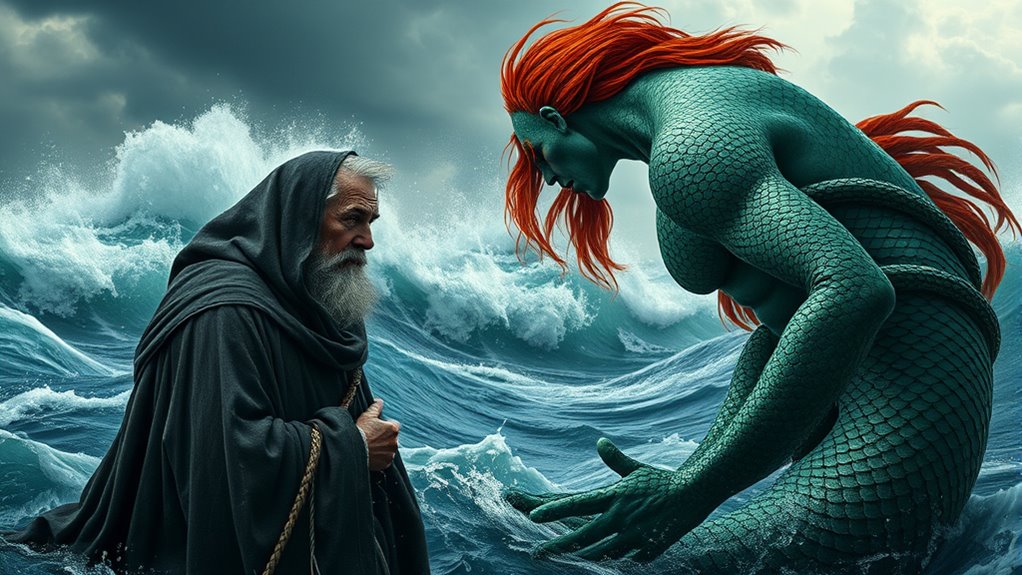

In medieval stories, people often confused the mysterious Sea Monk and the Merman, blending their identities and symbolic meanings. The Sea Monk appeared as a cloaked figure, sometimes with a fish-like face, representing divine judgment or spiritual authority. The Merman, on the other hand, symbolized the ocean’s allure and dual nature—both nurturing and dangerous. This confusion reflects how society viewed the sea as a domain of divine mystery and natural power. To uncover more, explore how these legends evolved over time.
Key Takeaways
- Medieval legends often blurred the distinctions between the Sea Monk, depicted as a cloaked, religious figure, and the Merman, a sea creature with dual nature.
- The Sea Monk was associated with divine punishment or spiritual authority, while the Merman symbolized natural forces and duality of the ocean.
- Sightings and stories contributed to confusion, with both beings sometimes portrayed as guardians or warnings for sailors.
- Artistic depictions and folklore merged their traits, making it difficult to distinguish between the two mythic creatures.
- This confusion reflected broader medieval themes of divine mystery, fear of the unknown, and the ocean’s spiritual significance.
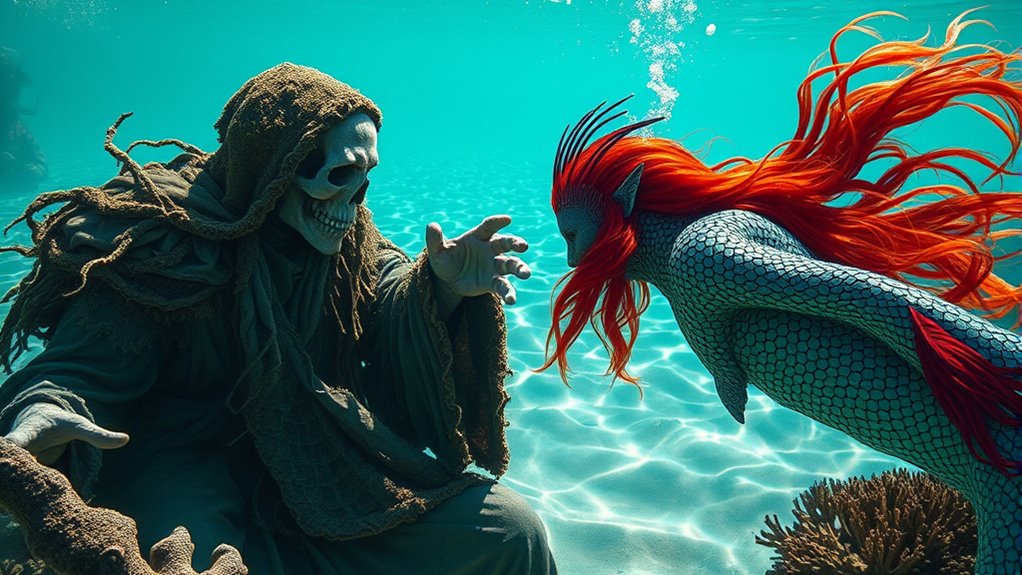
The mysterious depths of the ocean have long sparked stories of strange, mythical beings, among them the Sea Monk and the Merman. These legendary creatures have captured imaginations for centuries, often blending fact, folklore, and superstition. Their origins are steeped in mythical origins that reflect early humanity’s attempt to understand the unknown waters. Many stories suggest that the Sea Monk, a cloaked figure with an eerie presence, symbolizes spiritual authority or divine punishment. In contrast, the Merman, a half-human, half-fish creature, embodies the allure of the sea’s beauty and danger. These beings aren’t just stories; they carry deep cultural symbolism, representing both the spiritual and the natural worlds.
In medieval times, the Sea Monk often appeared in legends as a mysterious figure cloaked in monastic robes, sometimes with a fish-like face or scales. People believed these sightings were divine signs or messages from the ocean’s depths. The mythical origins of the Sea Monk are often linked to religious symbolism, portraying him as a spiritual guardian or a creature punished for sins. His mythic role reinforced the idea that the sea was a place of divine judgment, a domain where humans faced the consequences of their actions. Over time, stories about the Sea Monk reflected societal fears and religious beliefs, making him a symbol of punishment, penance, or divine mystery.
On the other hand, the Merman’s mythical origins are rooted in ancient maritime cultures, where stories of half-human, half-fish beings appeared across different societies. These tales often served as cautionary symbols or representations of natural forces. In some traditions, the Merman was seen as a protector of sailors, guiding ships away from danger or warning of storms. In others, he symbolized temptation, seducing sailors to their doom with his enchanting song. Culturally, the Merman became a symbol of the sea’s dual nature—its capacity for both nurturing and destruction. His mythic presence reinforced the idea that the ocean was a realm of mystery, where humans must respect its power and unpredictability. Additionally, the drivetrain components, like the gears involved in shifting, reflect the complexity and intricacy of navigating such mythic waters.
During the medieval period, confusion arose about these creatures, often blurring the lines between the Sea Monk and the Merman. Sailors and storytellers sometimes mistook one for the other, projecting their fears and hopes onto these beings. The distinction between mythical origins and cultural symbolism became less clear, fueling stories that portrayed the ocean as a realm of divine and monstrous beings. These legends reflected society’s complex relationship with the sea—both as a source of wealth and a spiritual frontier. As a result, the Sea Monk and the Merman became enduring symbols of the sea’s mysterious, multifaceted nature, embodying humanity’s fascination with the unknown.
Frequently Asked Questions
Are Sea Monks Based on Real Historical Sightings or Legends?
Sea monks are based on mythological legends rather than real historical sightings. You see, their mythical origins stem from medieval stories and cultural symbolism, which often blend imagination with superstition. These tales reflect how ancient sailors and cultures viewed the sea’s mysteries, creating legendary beings like sea monks. So, while they’re fascinating, they’re more a product of storytelling and symbolism than actual encounters.
How Do Sea Monks Differ Culturally Across Different Regions?
You’ll notice that cultural variations and regional beliefs shape how sea monks are viewed around the world. In some places, they’re seen as divine protectors, while elsewhere, they’re feared omens. These differences highlight how local folklore, religious influences, and historical encounters influence their portrayal. By understanding these regional beliefs, you see how perceptions of sea monks adapt, reflecting the diverse ways cultures interpret mysterious oceanic phenomena across the globe.
What Are the Symbolic Meanings Behind the Sea Monk Depiction?
You see, the depiction of sea monks often symbolizes marine symbolism and spiritual allegories, representing the mysterious and divine aspects of the ocean. Their strange, monk-like appearance suggests a connection to spiritual contemplation and the unknown depths. These images serve as allegories for humanity’s quest for enlightenment amidst the vast, uncharted waters, reminding you of the divine presence lurking beneath the surface and the spiritual journey into the depths of your soul.
Did Any Ancient Texts Mention Encounters With Sea Monks?
You won’t find direct mentions of encounters with sea monks in ancient texts, but monastic legends often hint at maritime mysticism and strange sea stories that could be interpreted in this way. These stories, woven into the fabric of medieval allegories, evoke the idea of mysterious sea dwellers. While not explicit, they symbolize spiritual journeys and the unknown, blending spiritual symbolism with the enchanting allure of the ocean’s secrets.
How Has Modern Media Influenced Perceptions of Sea Monks and Mermen?
Modern media shapes how you see sea monks and mermen through vivid stories and visual effects, blending mythical symbolism with entertainment. You might think of them as heroic or eerie figures, thanks to movies, TV shows, and books that reinterpret ancient legends. These modern reinterpretations make you imagine them as more complex, mysterious beings, fueling fascination and mythic allure, even if reality remains rooted in historical confusion and myth.
Conclusion
As you explore the legend, remember that over 200 medieval sightings described sea monks or mermen, often blending fact and myth. These tales reveal how confusion and imagination shaped our view of the ocean’s mysteries. So next time you hear about a sea monk or merman, consider how centuries of storytelling have blurred reality. Who knows—maybe some of those stories still hide truths beneath the waves, waiting for you to uncover them.