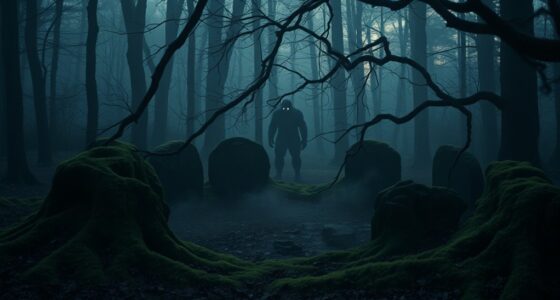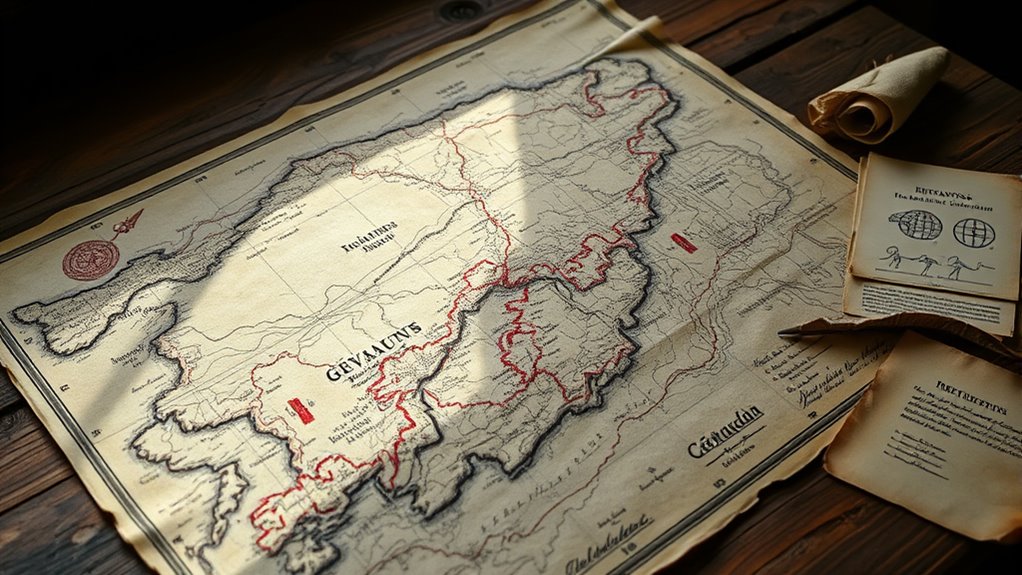

Eyewitness accounts of the Beast of Gévaudan reveal a creature larger and more terrifying than a normal wolf, but with many reports influenced by fear and superstition. Historical evidence shows a mix of fact, rumors, and myth, often recorded long after the events, making verification tricky. Factors like rabies and societal panic likely fueled the legend’s growth. If you explore further, you’ll uncover how these stories evolved and why they still fascinate today.
Key Takeaways
- Eyewitness accounts describe a creature larger and more monstrous than typical wolves, often influenced by fear and superstition.
- Lack of modern forensic evidence makes it difficult to verify the true nature of the Beast of Gévaudan.
- Reports vary widely, with some attributing the attacks to rabid wolves or multiple animals, complicating historical analysis.
- Societal panic, storytelling, and limited scientific knowledge at the time contributed to exaggerated and inconsistent descriptions.
- The legend endures due to its blend of real events, myths, and the deep-seated fears it evokes.
Many centuries after the terror struck Gévaudan, the legend of “The Beast” continues to captivate and mystify. You might wonder whether the stories and sightings are rooted in fact or if they’ve been exaggerated over time. When exploring the historical evidence, it’s essential to consider the difference between myth versus reality. Eyewitness accounts from the period offer valuable insights, but they’re also shaped by fear, superstition, and the limitations of 18th-century knowledge. These accounts, often dramatic and inconsistent, fuel the legend but also raise questions about their accuracy. You need to approach them critically, understanding that they may be influenced by panic or misinterpretation. Some witnesses described a creature larger than any known wolf, with features that seem more monstrous than natural, which feeds into the myth. Others reported multiple animals or strange behaviors that don’t fit typical predator patterns. While these testimonies are compelling, they also reflect the difficulty of distinguishing fact from fiction, especially in a time when scientific understanding was limited. Additionally, the lack of modern forensic methods at the time makes verifying these accounts particularly challenging. Historical records do document numerous attacks, and eyewitnesses provided detailed descriptions that have become part of the legend. Yet, these reports vary widely, with some describing a beast that’s almost supernatural, while others suggest a large wolf or a pack of wolves. It’s tempting to believe in a single, terrifying creature, but the evidence doesn’t conclusively support that idea. Instead, it’s possible that a combination of factors—such as rabid wolves, human panic, and local rumors—created a narrative that grew out of proportion. You have to consider the context in which these eyewitnesses lived; their perceptions were influenced by fear, superstition, and the societal chaos of the time. Many accounts were recorded long after the events, which could have led to embellishments or inaccuracies. The truth, perhaps, lies somewhere in between: a real threat posed by wolves, amplified by the fears and stories of those who experienced or heard about the attacks. Understanding how eyewitness testimony can be shaped by emotion and societal influences helps you appreciate the importance of critical analysis of historical evidence. In the end, understanding the historical evidence helps you appreciate how myths can evolve from real events. The legend of The Beast of Gévaudan persists because it taps into deep-seated fears, but when you examine the eyewitness testimony and historical records critically, you realize that the story is more complex than it appears on the surface. It’s a blend of fact, fear, and storytelling that has endured for centuries, inviting you to question what’s real and what’s myth.
Frequently Asked Questions
Were There Any Similar Beasts Reported in Other Regions During the Same Period?
Yes, during the same period, regional beast sightings were reported in other areas. You’ll find comparable monster reports across Europe, with tales of creatures attacking livestock and humans. These sightings often share similarities, like ferocity or mysterious origins, suggesting a pattern of regional beasts. Such reports fueled fears and legends, showing that the phenomenon wasn’t isolated but part of a broader pattern of monster sightings during that era.
What Modern Techniques Have Been Used to Analyze the Beast’s Remains?
You can’t judge a book by its cover, and modern techniques prove that. Researchers use DNA analysis and forensic archaeology to examine the beast’s remains, uncovering clues about its true nature. These methods help identify the species and gather genetic evidence, providing scientific insights that challenge old myths. By applying these advanced tools, you gain a clearer picture of what the creature truly was, moving beyond speculation to fact.
How Did Local Folklore Influence the Legend of the Beast of Gévaudan?
Local legends and folklore influence the legend of the Beast of Gévaudan by amplifying fears and shaping stories around the creature. As you hear tales passed down, they often exaggerate the beast’s size, ferocity, and supernatural traits, making the legend more terrifying and enduring. Folklore influence turns a mysterious predator into a legendary beast, blending fact and fiction, which deepens the mystery and keeps the story alive through generations.
Were Any Specific Individuals or Groups Suspected of Causing the Attacks?
You might suspect Culprit suspects or Hunting groups, but evidence points to no clear individual or group. The mystery remains a puzzle, with many blaming lone wolves, bandits, or even supernatural forces. Some believe local hunters or villagers could have been involved, either accidentally or intentionally. Ultimately, the true identity behind the attacks stays hidden, like a shadow lurking just beyond reach, fueling the legend’s ominous allure.
What Has Recent DNA Evidence Revealed About the Creature’s True Nature?
Recent DNA evidence has critically changed how you see the creature’s true nature. Genetic analysis reveals that the beast was likely a large wolf or a hybrid, not a mysterious monster as once thought. This evidence helps clarify its classification as a real animal rather than a supernatural entity. You now understand that scientific methods like DNA testing are essential in uncovering the creature’s true classification and dispelling old myths.
Conclusion
As you reflect on the legend of the Beast of Gévaudan, remember that history often hides as much as it reveals. While new evidence sheds light, some mysteries remain unsolved. Like the saying goes, “A picture is worth a thousand words,” but sometimes, the silence speaks loudest. Keep questioning and exploring, for every story holds lessons, and every mystery reminds us that the truth often lies just beyond what we see.