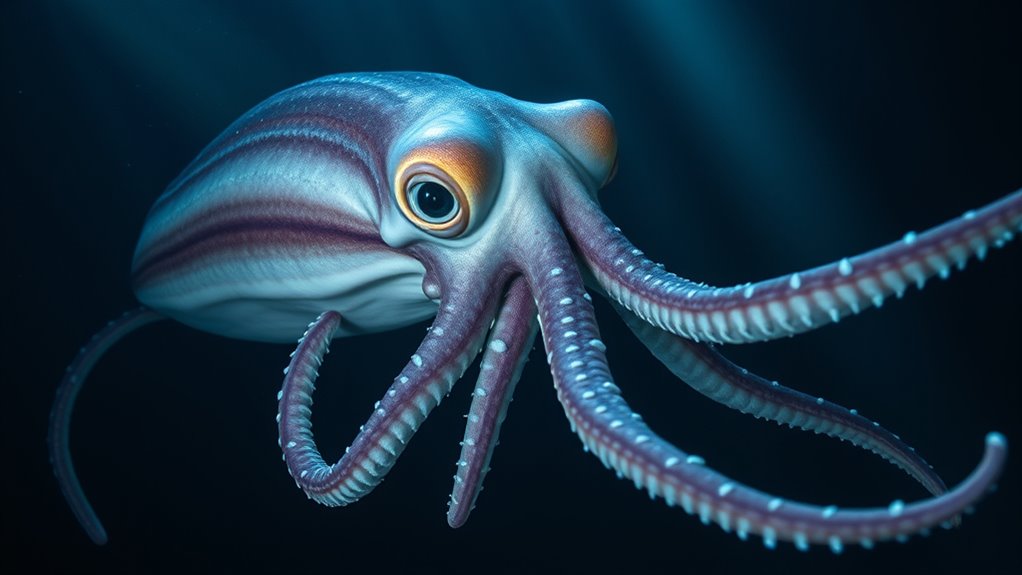

The giant squid’s science reveals remarkable adaptations that help it survive in the crushing depths of the ocean. Its streamlined body and powerful tentacles make swift, precise strikes on prey, while its large eyes detect faint light and bioluminescence. These features turn myth into fact, showcasing an incredible evolutionary marvel. If you keep exploring, you’ll discover more about how these deep-sea predators have evolved to dominate their dark world.
Key Takeaways
- The giant squid’s physical features reveal advanced adaptations for survival in the deep sea’s extreme conditions.
- Its large eyes and sensory systems enable detection of faint bioluminescent signals in complete darkness.
- Muscular tentacles with suckers and hooks allow efficient capture and manipulation of elusive prey like fish.
- These adaptations demonstrate a real, formidable creature, dispelling myths and bridging myth to scientific understanding.
- The Mesonychoteuthis, or colossal squid, represents an evolutionary extension of these deep-sea adaptations.
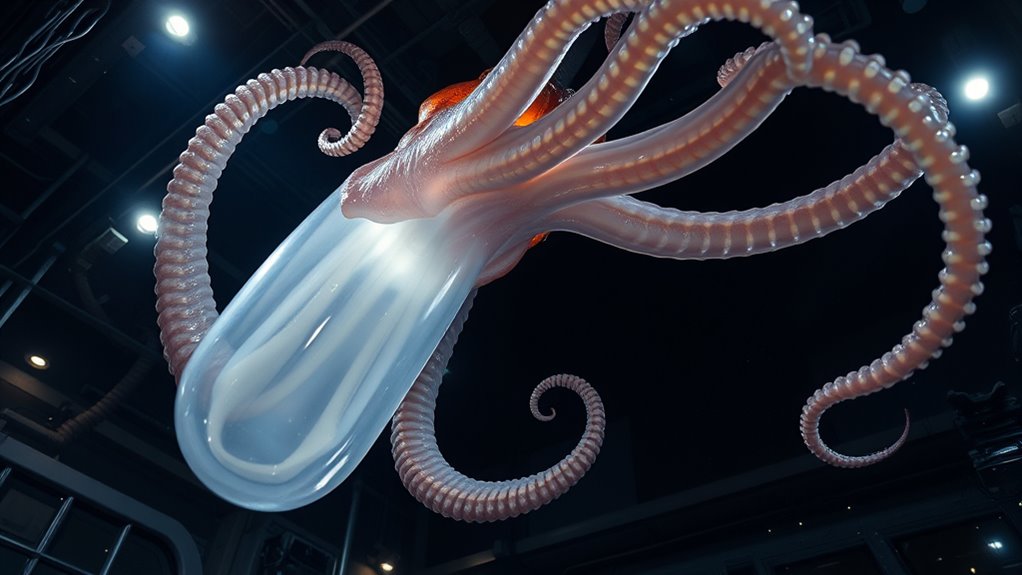
The giant squid has long fascinated scientists and explorers alike, yet much about this elusive creature remains a mystery. As you explore its world, you’ll discover that its survival depends heavily on specialized deep sea adaptations that allow it to thrive in the crushing, dark depths of the ocean. These adaptations include a streamlined body designed for swift movement and large, complex eyes that can detect faint light, helping it navigate and hunt in near-total darkness. Its enormous tentacles are lined with powerful suckers and hooks, enabling it to grasp and manipulate prey with remarkable strength. These features are essential for predator-prey interactions, as they give the giant squid an advantage when capturing agile, elusive prey like fish and smaller cephalopods. Additionally, its body is built for energy-efficient movement, allowing it to cover large areas while conserving oxygen—an essential trait in an environment where oxygen levels can vary. Its muscular tentacles are used to quickly seize prey, often in a swift, decisive motion, reducing the chance of prey escaping. This rapid response is indispensable in predator-prey interactions, especially in an environment where prey can be highly evasive. The squid’s ability to detect prey, chase it down, and secure it with powerful tentacles exemplifies how its adaptations are perfectly suited for survival in the abyssal zone. Its large eyes are among the most impressive in the animal kingdom, capable of detecting bioluminescent signals**, which helps it locate prey or avoid predators in the darkness. Understanding these features highlights the intricate balance between predator and prey** in the deep sea. The giant squid’s adaptations are a reflection of the relentless pressures of its environment, driving it to develop extraordinary capabilities. When you piece together these traits, it becomes clear that the giant squid is not just a creature of myth but a marvel of evolutionary engineering, perfectly adapted to its dark, high-stakes world.
Top picks for "science giant squid"
Open Amazon search results for this keyword.
As an affiliate, we earn on qualifying purchases.
Frequently Asked Questions
How Long Can Giant Squids Live in the Wild?
You can expect giant squids to live around 3 to 5 years in the wild. Their longevity estimates depend on factors like predation, food availability, and environmental conditions. These creatures grow rapidly during their short lifespan, reaching impressive sizes quickly. While exact lifespan figures are challenging to determine, understanding these lifespan factors helps researchers learn more about their role in deep-sea ecosystems and their true life expectancy.
Do Giant Squids Have Any Predators Besides Sperm Whales?
Sure, giant squids aren’t just sperm whales’ snacks. In the deep sea, you’ll find other predators like deep-sea sharks and large fish, all part of complex predator-prey dynamics. Ironically, these squids are rarely the top of the food chain, battling it out with creatures that thrive in darkness and pressure. So, while sperm whales get the spotlight, the deep sea’s predator web is even more tangled and fascinating.
How Do Scientists Track and Study Deep-Sea Giant Squids?
You can learn about deep-sea giant squids by using deep sea sonar to detect their presence and movements, even in the dark depths. Scientists also deploy remote operated vehicles (ROVs) equipped with cameras to observe and study these elusive creatures directly. These tools help gather valuable data, revealing behaviors and habitats, and allowing researchers to track their patterns without disturbing their natural environment.
Are Giant Squids Related to Other Deep-Sea Cephalopods?
You’ll find that giant squids are related to other deep-sea cephalopods through their shared evolutionary history, which highlights unique deep-sea adaptations. They evolved from common ancestors, developing features suited for life in extreme environments. As part of cephalopod evolution, they share traits like tentacles and advanced eyes, helping them hunt and survive. These deep-sea adaptations set them apart from shallow-water cephalopods, showcasing their remarkable evolutionary journey.
What Recent Discoveries Have Been Made About Giant Squid Behavior?
Recent discoveries reveal that giant squids are nocturnal hunters, actively hunting at night in the deep sea. You’d observe them using subtle deep-sea communication, like bioluminescence, to coordinate and locate prey. Their elusive behavior, including sudden movements and deep-sea communication, shows they’re highly adapted to their environment. These insights help you understand their hunting strategies and social interactions, highlighting the complex behaviors of these fascinating deep-sea creatures.
Conclusion
Now that you’ve uncovered the secrets of the giant squid, it’s like peering into a world so mysterious it could swallow entire oceans. These colossal creatures, once myth, now seem like oceanic gods lurking in the depths, wielding tentacles that could wrap around skyscrapers. Their story is a reminder that the ocean’s depths hold wonders so vast and wild, they make the imagination seem tiny. You’ve just glimpsed the awe-inspiring, mind-boggling giants of the deep.