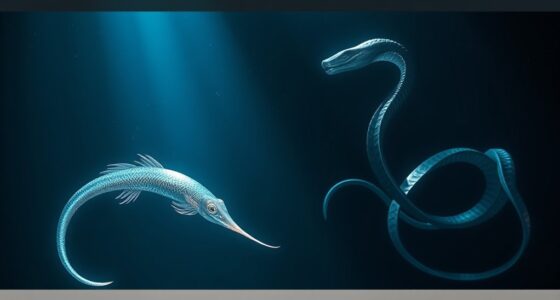
Fossil evidence confirms Titanoboa was a real, enormous prehistoric snake, measuring over 40 feet long and weighing more than a ton. Paleontologists uncovered its fossils in Colombia’s Cerrejón coal mine, revealing clues about its size, movement, and habitat. These fossils show that giant reptiles thrived in ancient tropical rainforests, shaping our understanding of prehistoric ecosystems. If you keep exploring, you’ll discover even more fascinating facts about this ancient monster snake.

Get school and study supplies delivered free — and shop member deals
- Fast, free delivery on millions of items
- Access to Prime Big Deal Days deals on October 6–7
- Prime Video, Amazon Music and more included
Key Takeaways
- Fossil discoveries at Colombia’s Cerrejón site revealed Titanoboa’s enormous size, estimated over 40 feet long and weighing more than a ton.
- Bones and vertebrae fossils helped reconstruct Titanoboa’s movement, feeding habits, and ecological role in prehistoric tropical rainforests.
- Fossil evidence indicates Titanoboa thrived in warm, humid Paleocene climates, supporting giant snake growth and survival.
- The fossils confirmed that giant prehistoric snakes like Titanoboa were real, not mythical, expanding understanding of prehistoric ecosystems.
- Advances in fossil analysis and research continue to uncover detailed information about Titanoboa and prehistoric reptile evolution.

Have you ever wondered how scientists uncover the secrets of ancient giants? It’s a fascinating process that involves detailed fossil discovery and careful analysis of prehistoric reptiles. When you think about these massive creatures from millions of years ago, it’s incredible to realize how much we can learn just from a few bones or fragments. The discovery of fossils provides a window into a world long gone, revealing the size, shape, and even the behavior of creatures like the Titanoboa, the world’s largest snake ever known.
Fossil discovery is a meticulous process that requires patience and expertise. Paleontologists often spend years searching through layers of sediment in prehistoric sites, carefully excavating and cleaning fossilized remains. The fossils of Titanoboa were found in Colombia’s Cerrejón coal mine, a significant find that changed what we knew about prehistoric reptiles. When these fossils were first uncovered, scientists were able to piece together enough evidence to estimate the snake’s enormous size—stretching over 40 feet long and weighing more than a ton. This discovery proved that prehistoric reptiles could reach sizes previously thought impossible, challenging long-held assumptions about the limits of snake growth.
As you consider these fossil finds, it’s clear how vital they are for understanding the prehistoric world. Paleontologists analyze the bones and vertebrae, using them to reconstruct how Titanoboa moved, fed, and interacted with its environment. The fossil discovery of Titanoboa also reveals how warm the climate was during its time, since the snake’s massive size would have required a warm, humid habitat. This insight helps scientists better understand the climate conditions of the Paleocene epoch, just after the dinosaurs went extinct. It’s astonishing to realize that these fossilized remains tell a story of a tropical rainforest teeming with life, where giant reptiles like Titanoboa thrived. Additionally, recent advancements in Natural Language Processing (NLP) have improved data analysis in paleontology, allowing scientists to extract more detailed information from fossil records.
Every new fossil discovery adds a piece to the puzzle of Earth’s ancient history. By studying these prehistoric reptiles, you gain a clearer picture of how life on our planet has evolved over millions of years. The discovery of Titanoboa’s fossils demonstrates that nature’s giants weren’t just the stuff of legends—they were real creatures that once ruled their ecosystems. Thanks to the dedicated work of scientists and the fossil discoveries they make, we continue to expand our understanding of these prehistoric reptiles, revealing the awe-inspiring scale of life that once inhabited our planet.
prehistoric snake fossil replica
As an affiliate, we earn on qualifying purchases.
As an affiliate, we earn on qualifying purchases.
Frequently Asked Questions
How Long Ago Did Titanoboa Live?
You learn that Titanoboa lived about 60 million years ago, during a prehistoric climate that was warmer and wetter than today. Fossil discovery sites in Colombia reveal the ancient environment where this enormous snake thrived. Its fossils help you understand how prehistoric climate influenced giant reptiles, showing that Titanoboa was one of the largest snakes ever. This discovery offers a glimpse into Earth’s distant past and its diverse prehistoric ecosystems.
What Was Titanoboa’s Primary Diet?
You might wonder about its prey preferences and hunting strategies. Titanoboa primarily hunted large aquatic and semi-aquatic animals, like fish, crocodyliforms, and large reptiles. Its massive size allowed it to ambush prey with constriction, wrapping around and squeezing until it suffocated. Its powerful body and stealthy approach made it a formidable predator, dominating its environment by targeting any creature within reach that met its size requirements.
How Does Titanoboa Compare to Modern Snakes?
You’d be amazed by how Titanoboa compares to modern snakes; it was vastly larger, with a snake size comparison showing it reached over 40 feet long. Unlike many modern snakes, it didn’t have venom potential, relying on its immense size and constriction to hunt. Today’s largest snakes, like reticulated pythons, are impressive but still far smaller, highlighting just how colossal Titanoboa truly was in the prehistoric world.
Were Titanoboa Fossils Found in Multiple Locations?
You’ll be fascinated to know that Titanoboa fossils have been found at multiple fossil discovery sites, revealing its broad geographic distribution. These fossils, mainly uncovered in Colombia, demonstrate that the snake thrived in diverse environments across northern South America. The discovery of fossils in different locations confirms that Titanoboa wasn’t limited to a single area, highlighting its massive range during the Paleocene epoch.
Could Titanoboa Still Exist Today Unnoticed?
It’s unlikely you’d still find Titanoboa today unnoticed, given its massive size and prehistoric predator traits. These undiscovered species would probably be spotted quickly if they existed in large populations, especially in remote rainforest habitats. While some believe undiscovered species might still hide in deep jungles, the chances of a creature this large and ancient remaining undetected are slim, considering ongoing exploration and modern technology.
As an affiliate, we earn on qualifying purchases.
Conclusion
You can’t help but be amazed that Titanoboa reached lengths of up to 42 feet, making it the largest snake ever discovered. Fossil evidence proves this massive predator once ruled the prehistoric swampy landscapes. Its incredible size isn’t just a record; it’s a reminder of how extraordinary life can become. So next time you see a snake, remember, there was once a monster snake long enough to wrap around a bus!
dinosaur and prehistoric reptile figurines
As an affiliate, we earn on qualifying purchases.
As an affiliate, we earn on qualifying purchases.
Halloween Picks
halloween
As an affiliate, we earn on qualifying purchases.