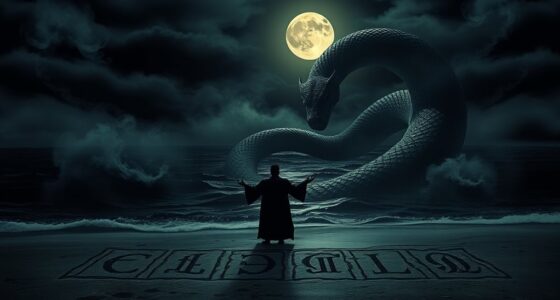
In apocryphal texts, you see how angels rebel and morph into monsters, symbolizing chaos and divine punishment. High-ranking angels, like Watchers, take on hybrid, beast-like forms to challenge divine order. Creatures like the Leviathan embody cosmic conflict with monstrous features representing primal chaos. Figures such as Azazel and the Nephilim reveal how disobedience produces demonic offspring and hybrid beings. If you explore further, you’ll uncover more about the complex symbolism behind these angelic and monstrous encounters.
Key Takeaways
- Apocryphal texts describe angels transforming into monstrous hybrids, symbolizing chaos, corruption, and the perversion of divine purity.
- Hybrid angelic-beast forms challenge celestial hierarchy, blending divine and demonic features to represent moral ambiguity and rebellion.
- The Leviathan exemplifies a cosmic monster embodying divine punishment and chaos, reflecting divine conflict and disorder.
- Demonic offspring like the Nephilim and Azazel symbolize divine disobedience and the consequences of celestial rebellion.
- Visions of angelic creatures such as seraphim, cherubim, and ophanim emphasize structured divine order amid angel-monster encounters.
The Fall of the Watchers and Their Transformation Into Monsters

The Fall of the Watchers marks a pivotal moment in apocryphal texts, where heavenly beings defy divine authority and are cast down to earth. These Watchers occupy a high position within the angelic hierarchy, embodying celestial symbolism of divine knowledge and authority. As they rebel, their transformation into monsters symbolizes a stark departure from their original purity and status. Their fall underscores themes of disobedience and corruption, illustrating how their celestial roles are corrupted by pride and defiance. You see, this event emphasizes how celestial beings, once symbols of divine order, can be turned into figures of chaos when they abandon their heavenly duties. Their descent marks a dramatic shift, transforming pure angels into monstrous entities that challenge the divine hierarchy.
The Book of Enoch’s Descriptions of Angelic-Beast Hybrids

In the Book of Enoch, descriptions of angelic-beast hybrids vividly illustrate the transformation of divine beings into monstrous forms. These hybrids challenge traditional angelic symbolism, blending celestial grace with grotesque features that defy the strict celestial hierarchy. Enoch details how some angels, once high in rank, take on forms with multiple faces, wings, and animalistic traits, symbolizing chaos and corruption within the divine order. These descriptions serve as a stark reminder of the boundaries between the heavenly and the monstrous, highlighting the perversion of angelic purity. By portraying these hybrids, the text underscores the idea that even celestial beings can become corrupted, blurring the line between divine and demonic, and emphasizing the precariousness of their celestial hierarchy.
The Leviathan: a Celestial Serpent With Monstrous Features

You see the Leviathan’s cosmic origins tied to celestial chaos and divine power, emphasizing its otherworldly nature. Its monstrous physical traits, like impenetrable scales and terrifying size, highlight its role as a formidable creature. These features also symbolize deeper meanings, revealing its significance in cosmic battles and spiritual symbolism.
Leviathan’s Cosmic Origins
Many apocryphal texts depict Leviathan as more than just a monstrous sea creature; they present it as a celestial serpent woven into the very fabric of the cosmos. Its origins are intertwined with the divine, embodying celestial symbolism that echoes the angelic hierarchy. Some texts suggest Leviathan was born from primordial chaos, representing the chaotic forces before creation. Its cosmic role aligns with the angels’ order, symbolizing the fine line between divine power and monstrous chaos. This celestial aspect elevates Leviathan beyond mere myth, making it a cosmic force that reflects the universe’s dual nature. Understanding its origins reveals how apocryphal narratives use celestial symbolism to portray Leviathan as a primordial, divine, and cosmic entity.
| Origin Aspect | Description | Symbolic Meaning |
|---|---|---|
| Primordial Chaos | Born from chaos before creation | Represents cosmic disorder |
| Divine Embodiment | Tied to angelic hierarchy | Embodies divine power |
| Cosmic Role | Woven into the fabric of the cosmos | Signifies universal balance |
Monstrous Physical Traits
The Leviathan’s physical form is a terrifying blend of celestial beauty and monstrous features that evoke awe and fear. Its monstrous traits reflect its position in the angelic hierarchy and celestial symbolism. You notice:
- Gigantic scales that shimmer with iridescent light, symbolizing divine power yet hinting at chaos.
- Multiple eyes scattered across its body, representing omniscience and the watchful gaze of higher angels.
- Vast, twisting horns that resemble celestial pathways, emphasizing its celestial origin and monstrous nature.
- Massive, serpentine body with jagged fins and claws, embodying both cosmic elegance and destructive force.
These traits blur the line between divine radiance and primal terror, reinforcing its role as a celestial monster.
Symbolic Significance
The Leviathan’s monstrous features serve as potent symbols reflecting its complex role within celestial hierarchy and mythic symbolism. Its serpentine form and intimidating presence symbolize chaos and divine punishment, acting as a reminder of the limits of angelic authority. In apocryphal texts, the Leviathan often represents the chaos that challenges divine order, embodying a force that even celestial beings struggle to control. Its place within the angelic hierarchy underscores its status as both a creature of divine wrath and a symbol of cosmic disorder. The monstrous aspects highlight the divine judgment that awaits those who defy or threaten heavenly order. Ultimately, the Leviathan’s symbolism reminds us of the perpetual struggle between chaos and divine sovereignty within mythic and celestial domains.
The Role of Azazel and the Demonic Offspring in Apocryphal Texts
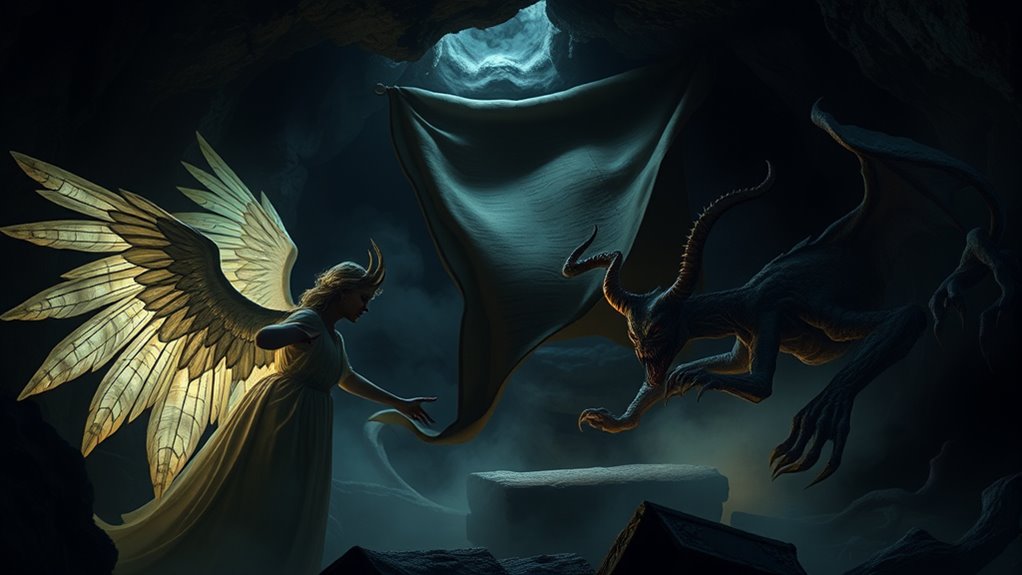
You see Azazel as more than a fallen angel; he’s linked to mystical powers and forbidden knowledge. His story connects to legends of demonic offspring, revealing a darker side of ancient beliefs. Exploring these myths helps you understand how apocryphal texts portray the origins of evil and monstrous entities.
Azazel’s Mystical Role
Azazel emerges in apocryphal texts as a central figure whose mystical role extends beyond a mere fallen angel. You see, he symbolizes the disruption of divine hierarchy and the loss of angelic purity. His significance isn’t just about rebellion but also about the deeper spiritual implications. Consider these aspects:
- He embodies the breach in divine hierarchy, challenging celestial order.
- Azazel’s role highlights the fragile boundary between angelic purity and corruption.
- His influence introduces demonic offspring, revealing the consequences of divine disobedience.
- As a mystical figure, he serves as a conduit between heaven and the chaos of the underworld.
Through these roles, Azazel’s persona underscores complex themes of authority, purity, and spiritual fallibility within apocryphal narratives.
Demonic Offspring Legends
In apocryphal texts, Azazel’s rebellion is closely linked to the emergence of demonic offspring, emphasizing the profound consequences of divine disobedience. These legends depict Azazel as a fallen figure who corrupts the angelic hierarchy by teaching humans forbidden knowledge, leading to the birth of demonic entities. The offspring symbolize a rupture in celestial symbolism, reflecting chaos beyond divine order. This narrative underscores how disobedience among celestial beings results in tangible consequences—mutations of divine purity into demonic forms. You see, these legends serve as warnings about the risks of crossing celestial boundaries. Azazel’s demonic children embody the fallout of celestial rebellion, blurring the lines between angels and monsters and illustrating the destructive power of divine disobedience in apocryphal lore.
The Nephilim: Giants Born From Angelic and Human Interactions
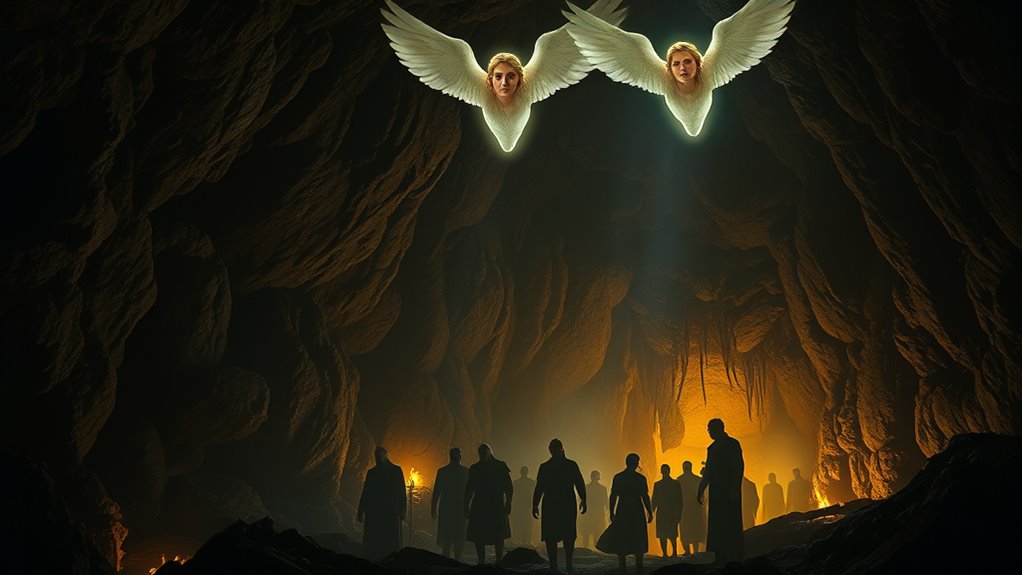
The Nephilim are among the most intriguing figures in apocryphal texts, often depicted as giants resulting from the union of fallen angels and human women. These beings symbolize the chaos of angelic warfare and divine justice. Their existence prompts questions about celestial punishment and the consequences of heavenly rebellion.
Consider these points:
- Their origins link to angels who descended to corrupt humanity.
- They embody the chaos unleashed by celestial warfare.
- Their size and strength symbolize divine punishment for disobedience.
- Their presence foreshadows the flood as divine retribution.
These stories highlight the tension between heavenly beings and humans, illustrating how celestial punishment manifests through monstrous offspring like the Nephilim, bridging the divine and the monstrous.
The Talmudic Accounts of Angel‑Demon Mergers
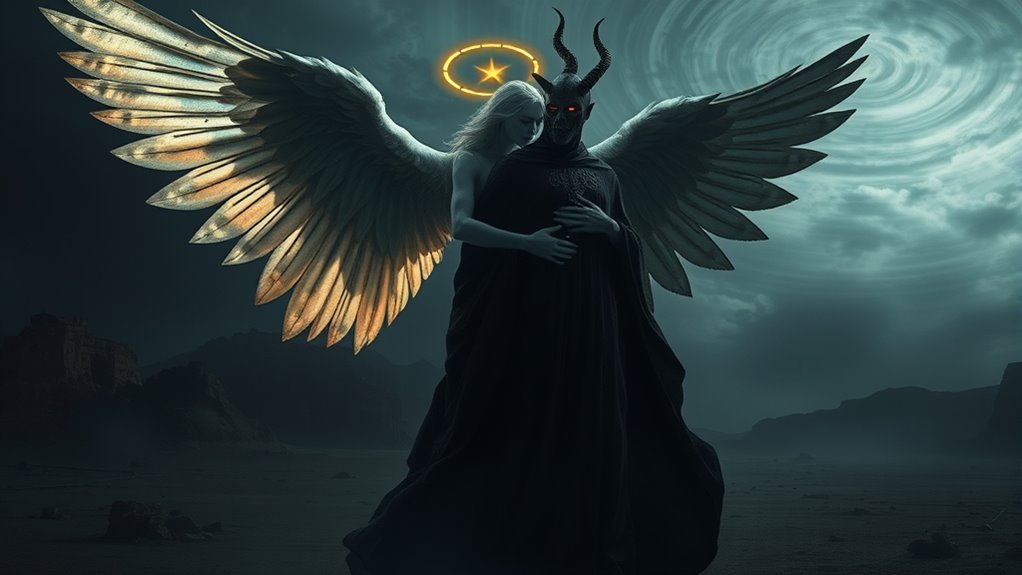
In the Talmudic texts, angel-demon mergers symbolize complex themes of divine and evil forces blending together. These accounts often carry layered meanings, representing moral struggles or spiritual transformations. Exploring these stories reveals how such mergers reflect deeper symbolic interpretations within Jewish tradition.
Merging of Divine Beings
Talmudic texts describe extraordinary events where divine beings, such as angels, sometimes merge with demonic entities, creating hybrid figures that blur the line between good and evil. These mergers challenge the structured angelic hierarchies and deepen the complexity of celestial symbolism. They often serve as cautionary tales or mystical lessons, revealing the fluidity between divine and demonic domains.
- The merging process is seen as a loss of pure divine essence, resulting in ambiguous hybrid forms.
- These figures embody both divine power and demonic influence, confusing moral boundaries.
- Such accounts reflect fears about celestial chaos disrupting established hierarchies.
- They illustrate how divine and demonic traits can coexist within a single entity, complicating spiritual symbolism.
Symbolic Interpretations
Symbolic interpretations of angel-demon mergers in Talmudic texts reveal complex lessons about moral ambiguity and spiritual transformation. These stories use angelic symbolism to represent purity and divine connection, while demon archetypes embody temptation and chaos. When these figures merge, it signifies the blurred boundaries between good and evil, urging you to see moral complexity rather than clear-cut distinctions. The texts suggest that spiritual growth involves confronting these dualities within yourself. By exploring these mergers symbolically, you understand that moral struggles are part of a larger process of inner transformation. Such accounts challenge you to reflect on the nature of righteousness, reminding you that divine and demonic forces often coexist within the human soul.
The Apocalypse of Baruch and Its Visions of Angelic Creatures

The Apocalypse of Baruch vividly depicts angelic creatures that serve as messengers and guardians within its visionary landscape. You observe these beings through rich celestial symbolism, highlighting their place in the angelic hierarchy. Their appearances reveal levels of divine authority and purpose. Key aspects include:
- The Seraphim, burning with celestial fire, symbolize pure divine love and the highest angelic rank.
- The Cherubim, with multiple faces and wings, represent wisdom and the protection of sacred mysteries.
- The Ophanim, wheel-like angels, embody the constellations and divine motion.
- The Archangels, guiding and delivering messages, stand as intermediaries between heaven and earth.
These visions emphasize a structured celestial hierarchy, with each angelic creature embodying specific roles and celestial symbolism that reinforce divine order.
The Myth of Samael as Both Angel and Demon

Samael’s role in mythic traditions blurs the lines between angel and demon, creating a complex figure that embodies both divine authority and destructive power. Within the angelic hierarchy, he is sometimes seen as a fallen angel or an agent of divine intervention gone awry. Unlike traditional angels, Samael is associated with both judgment and chaos, challenging clear distinctions between good and evil. His dual nature reflects the ambiguity of divine forces, showing that divine intervention can have destructive as well as benevolent aspects. This ambiguity fuels stories where Samael acts as a messenger or enforcer, embodying the tension between divine justice and destructive wrath. His myth underscores how apocryphal texts depict angels not just as pure beings but as complex entities with multifaceted roles.
The Origins of the Chimera in Apocryphal Lore
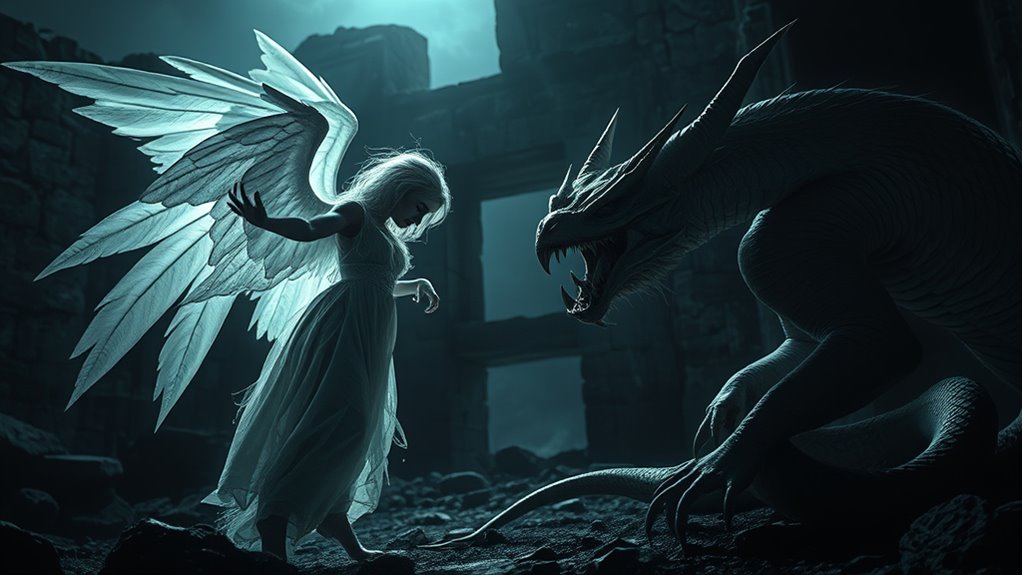
In apocryphal texts, the chimera emerges not merely as a mythic beast but as a creature rooted in divine and demonic origins that blur the boundaries of natural order. Its origins are complex, combining elements of celestial rebellion and infernal chaos. You can see these roots reflected in:
- Medieval art, where chimera-like monsters symbolize divine punishment or demonic influence.
- Apocryphal stories that depict the chimera as a hybrid creature born from angelic corruption.
- Modern fiction, which reimagines the chimera as a symbol of chaos, blending divine and infernal traits.
- The myth’s evolution, highlighting its role as a bridge between angelic beings and monsters, emphasizing its ambiguous origins and symbolic power.
Symbolism and Interpretation of Angel‑Monster Beings in Religious Texts

Apocryphal texts often portray angel‑monster beings as powerful symbols that challenge traditional notions of good and evil. These beings embody complex aspects of the divine symbolism found in religious narratives, blurring the lines between purity and corruption. Their placement within the angelic hierarchy suggests they hold significant, often ambiguous, roles—either as fallen angels or divine messengers with hidden motives. You see, these figures invite deeper interpretation; they serve as representations of cosmic conflict, spiritual transformation, or divine mystery. By examining their symbolism, you gain insight into how ancient texts explore themes like morality, divine justice, and chaos. These angel‑monster beings push you to rethink simplistic binary notions, emphasizing instead the layered, nuanced nature of spiritual and moral realities.
Frequently Asked Questions
How Do Apocryphal Texts Influence Modern Demonology?
You see, apocryphal texts shape modern demonology by introducing rich demonic symbolism that influences how we interpret evil entities. They also challenge theological interpretations, offering alternate views on spiritual battles and the origins of demons. These texts inspire contemporary discussions, helping you understand the complex roles demons play in religious and cultural contexts. As a result, apocryphal stories deepen your understanding of spiritual warfare and the symbolic language of evil.
Are Angel‑Monster Encounters Depicted Differently Across Various Religious Traditions?
Think of angel‑monster encounters as different brushstrokes on a vast spiritual canvas. Across traditions, these stories often depict angelic battles and mythological hybridization uniquely, reflecting cultural beliefs. In some, angels embody divine purity fighting monstrous beings, while others blend human and beastly forms. You’ll find variations in symbolism, emphasizing either divine authority or chaos. These differences shape how each tradition perceives celestial conflicts and spiritual hierarchy.
What Archaeological Evidence Supports These Apocryphal Accounts?
You might wonder what archaeological evidence backs these apocryphal accounts. While direct proof is scarce, ancient artifacts like carved tablets and inscriptions offer clues. Textual analysis reveals references to supernatural beings, aligning with descriptions in texts. These artifacts provide indirect support, suggesting that such encounters held cultural significance. Still, definitive evidence remains elusive, making these accounts fascinating but not conclusively proven through archaeology alone.
How Do These Texts Interpret the Moral Significance of Angel‑Monster Interactions?
You see that these texts explore complex moral implications and ethical dilemmas through angel‑monster interactions. They often portray such encounters as tests of character or warnings about divine justice, prompting you to think about morality and the nature of good versus evil. These stories challenge you to contemplate how divine beings and monsters symbolize moral choices, emphasizing the importance of righteousness and caution in your own ethical decisions.
Do These Stories Reflect Historical Fears or Theological Doctrines?
You might see these stories as reflections of mythological symbolism and cultural fears rather than strict historical accounts. They often symbolize deeper fears of chaos or evil, shaping theological doctrines to explain moral struggles. While they can mirror real fears from specific times, their primary purpose is to communicate spiritual truths, using angel‑monster encounters to embody complex moral and metaphysical concepts that resonate across different cultures and eras.
Conclusion
You’ve uncovered a world where angels turn monstrous, where celestial beings morph into terrifying hybrids that shake the very foundations of heaven and earth. These stories don’t just hint at monsters—they scream of cosmic chaos, divine rebellion, and eternal mysteries. As you explore deeper, you realize that these angel‑monster encounters threaten to unravel the fabric of reality itself, revealing a universe where the divine and the monstrous collide in an endless, breathtaking dance of chaos and creation.