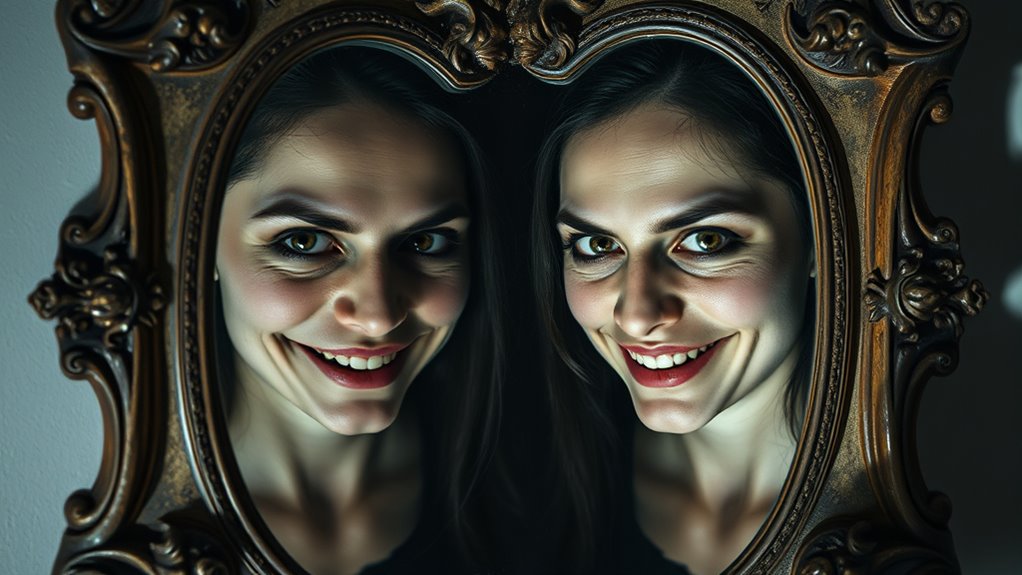
Your reflection in the mirror holds more than your appearance; it reveals a doppelgänger, a hidden double that symbolizes your inner duality. This double can evoke unease, showing the shadow self—those traits you hide or deny. Recognizing this mirror image invites you to explore your layered identity and confront unacknowledged parts. As you explore these reflections further, you’ll discover how understanding your double shapes who you truly are.
Key Takeaways
- Doppelgängers symbolize the hidden, shadow aspects of identity, representing an uncanny double that challenges self-perception.
- The “monster” in the mirror reflects internal duality, revealing suppressed traits or unconscious parts of the self.
- Encountering a doppelgänger prompts introspection, encouraging acceptance and integration of one’s shadow selves.
- Mirrors serve as gateways to understanding layered identities, including unsettling or hidden aspects of personality.
- Recognizing the doppelgänger fosters personal growth through self-awareness and embracing the complexity of one’s true self.
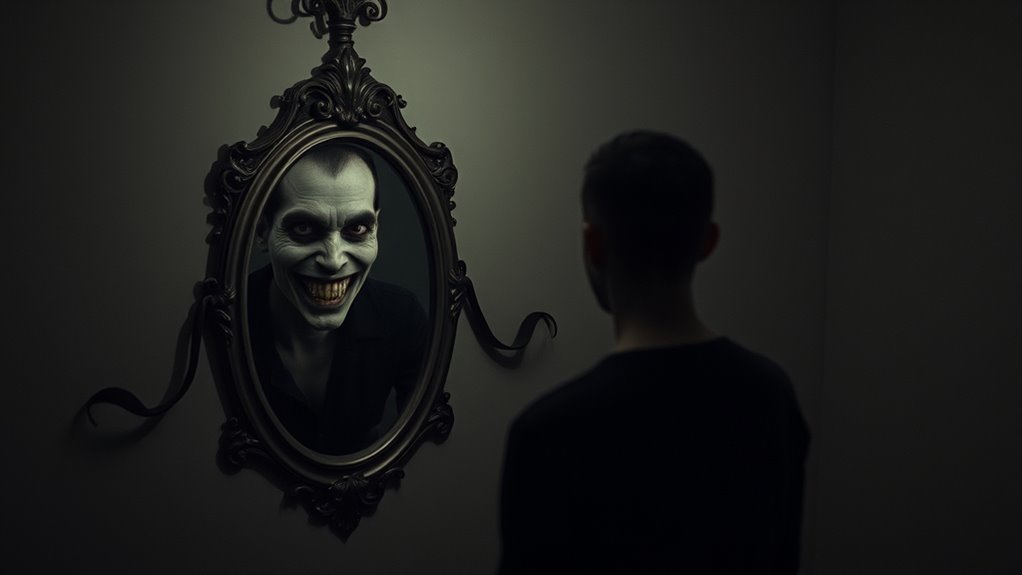
Doppelgängers have long fascinated us because they challenge our understanding of identity and uniqueness. When you catch a glimpse of a mirror reflection that seems just a little too familiar, it sparks an uncanny feeling—like seeing a shadow self staring back at you. These mirror reflections aren’t just images; they embody the idea that within you lies a double, a version of yourself that exists outside your conscious awareness. This shadow self often appears in stories and folklore as a dark counterpart, a hidden part of your personality that you might prefer to ignore. Recognizing this shadow self in a mirror can evoke a sense of unease, as if you’re confronting an aspect of yourself you’ve kept hidden or suppressed. It’s as if your reflection isn’t just a visual replica but a gateway to understanding your deeper, often unacknowledged traits.
Your mirror reflection can sometimes feel like an encounter with your doppelgänger—a double that isn’t just a visual duplicate but a symbol of your inner duality. The idea that there’s another version of you existing simultaneously can lead to questions about what truly makes you unique. Is your identity solely wrapped up in your outward appearance, or does it extend into these shadow selves lurking beneath the surface? When you see a reflection that seems a little off, perhaps a flicker of something unfamiliar, it can make you wonder if there’s more to you than meets the eye. These moments remind you that your sense of self isn’t static but layered, comprising conscious and unconscious elements that shape who you are.
In contemplating shadow selves, you realize that everyone harbors parts of themselves they prefer to hide—traits they might view as negative or undesirable. These shadow selves often emerge in mirror reflections when you’re alone, prompting introspection. Recognizing them doesn’t mean you’re losing your sense of identity; rather, it’s an acknowledgment that you’re a complex being with depths that extend beyond surface appearances. Your doppelgänger, in this sense, becomes a symbol of integration, a reminder that embracing your shadow selves can lead to a more authentic sense of self. The mirror, then, isn’t just a tool for vanity but a mirror for self-awareness—an invitation to explore the dualities within you and understand that your identity is a tapestry woven from both the light and dark aspects of your personality.
Furthermore, understanding identity and duality can foster personal growth by helping you accept all parts of yourself, including those you might find unsettling.
Frequently Asked Questions
Are Doppelgängers Always Malevolent or Can They Be Benign?
Doppelgängers aren’t always malevolent; they can be benign or even good, reflecting different aspects of your identity. Sometimes, they symbolize your inner struggles or hidden strengths, serving as guides or protectors. It’s important to remember that their nature depends on your perception and context. Not all doppelgängers are evil; some can help you gain self-awareness, growth, or balance, making them complex symbols rather than purely malevolent entities.
How Do Different Cultures Interpret the Concept of Mirror Doubles?
Different cultures interpret mirror doubles through rich cultural symbolism rooted in their mythological origins. In some societies, such doubles represent spiritual guides or ancestors, embodying protection and guidance. Others see them as omens or warnings of misfortune. You might find that, across cultures, mirror doubles symbolize reflection on identity, duality, or the boundary between the physical and spiritual worlds, revealing diverse beliefs about self and existence.
Can Witnessing a Doppelgänger Lead to Psychological or Physical Effects?
Seeing a doppelgänger can hit you like a lightning bolt, causing psychological impacts like fear, confusion, or paranoia. You might start to doubt your own identity or feel a sense of dread. In some cases, the experience could lead to physical consequences, such as panic attacks or stress-related symptoms. These effects underscore how powerful the mind is—what you witness can deeply influence both your mental state and physical health.
Are There Any Scientific Explanations for the Phenomenon of Mirror Doubles?
Scientific explanations for mirror doubles mainly involve psychological factors, like pareidolia, where your brain perceives familiar patterns, or visual misperceptions caused by fatigue or stress. Paranormal theories suggest supernatural causes, but these aren’t scientifically supported. You might experience seeing a doppelgänger due to subconscious fears or identity concerns. While intriguing, most evidence points to psychological explanations, emphasizing how your mind interprets and sometimes distorts visual stimuli in the mirror.
How Do Literature and Media Portray Doppelgängers Differently Across Genres?
In literature and media, you see doppelgängers portrayed differently across genres, emphasizing various themes through literary symbolism. In horror, they symbolize evil or inner darkness, while in gothic stories, they highlight duality and identity struggles. Sci-fi often presents them as clones or alternate realities, reflecting genre variations. You notice these portrayals shape your understanding of self and other, revealing complex psychological and cultural insights through diverse narrative lenses.
Conclusion
So, next time you catch a glimpse of your doppelgänger in a mirror, remember—they’re just your personal, creepy stunt double, ready to steal your identity and maybe your lunch. Who knew your mirror’s reflection could double as a mischievous clone plotting to replace you? Embrace the chaos, because in this game of mirror mirror, you’re both the star and the unwitting stunt double—just don’t forget to check who’s really staring back.