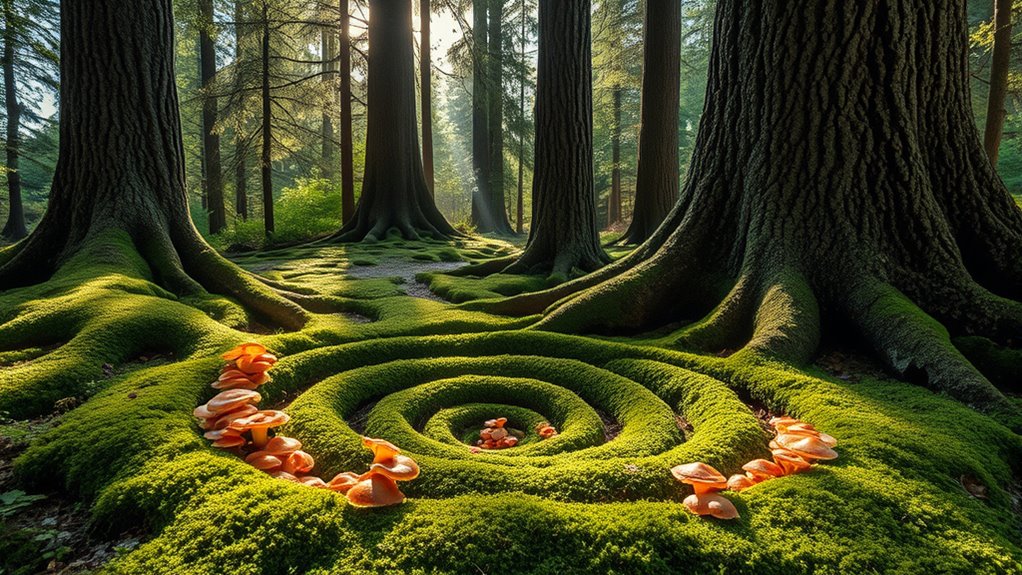

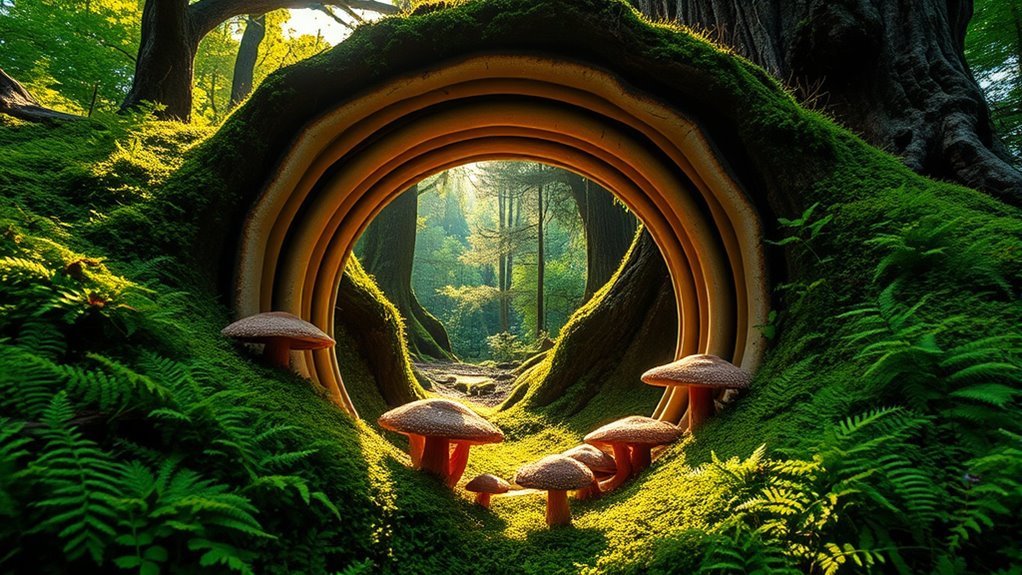
Faerie rings, made by spreading fungi spores, are often seen as natural gateways or portals, and folklore suggests trolls and spirits cross through these circles. Their symmetrical shape and interconnected mycelium underground symbolize spiritual thresholds linking worlds, reinforcing mythic ideas of portals. Cultures worldwide associate such formations with gateways to other domains. If you stay curious, you’ll uncover more about how botanical patterns intertwine with legends of mystical crossings.
Key Takeaways
- Folklore suggests fairy rings are mystical gateways; similar symbolism may apply to troll portals in mythic traditions.
- Botanical features of fairy rings—marked by specific fungi and circular patterns—support their role as interdimensional gateways.
- Mycelial networks and spore dispersal patterns reinforce the belief in portals connecting natural and supernatural realms.
- Cultural narratives link sacred trees and caves with thresholds, paralleling fairy rings as transition points for mythical beings like trolls.
- Scientific evidence of fungal symmetry and environmental influences aligns with legends of these rings as deliberate, possibly magical, gateways.
Historical Folklore and Mythology Surrounding Faerie Rings
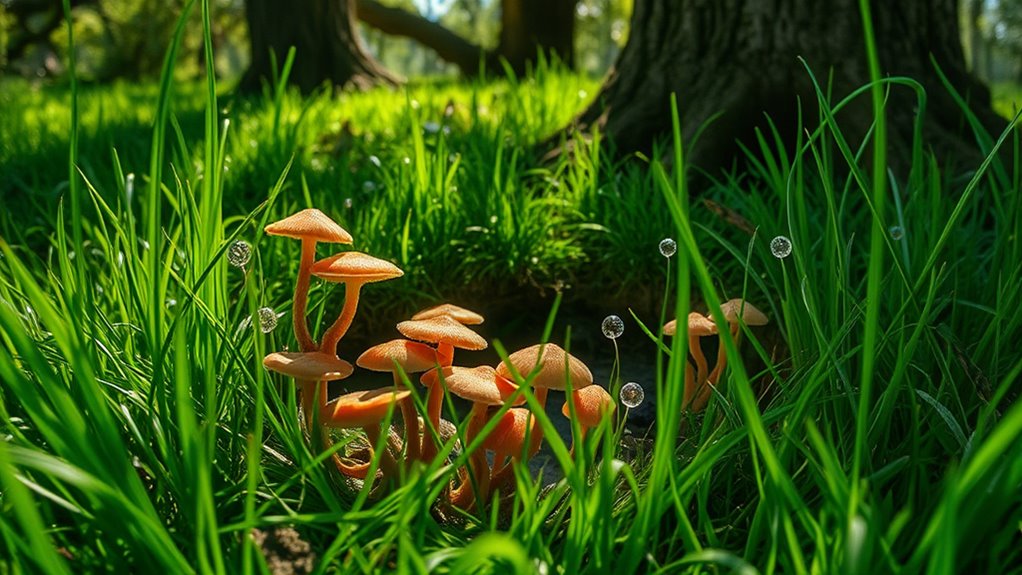
Throughout history, people have associated faerie rings with supernatural activity and otherworldly domains. In fairy folklore, these circles are believed to be enchanted portals where fairies dance and cast spells, blurring the line between worlds. Mythological symbolism often links them to spirits, divine beings, or ancestral spirits, emphasizing their sacred or cursed nature. Many cultures viewed faerie rings as warnings or gateways to hidden realms, fueling fears of malevolent tricksters or mischievous entities lurking within. These stories reflect a deep-rooted belief that these formations are not merely natural phenomena but spiritual thresholds. Over time, folklore has shaped the idea that stepping into or disturbing a faerie ring could lead to enchantment, misfortune, or encounters with otherworldly beings, reinforcing their mystical significance.
Botanical Characteristics and Formation of Mushroom Circles
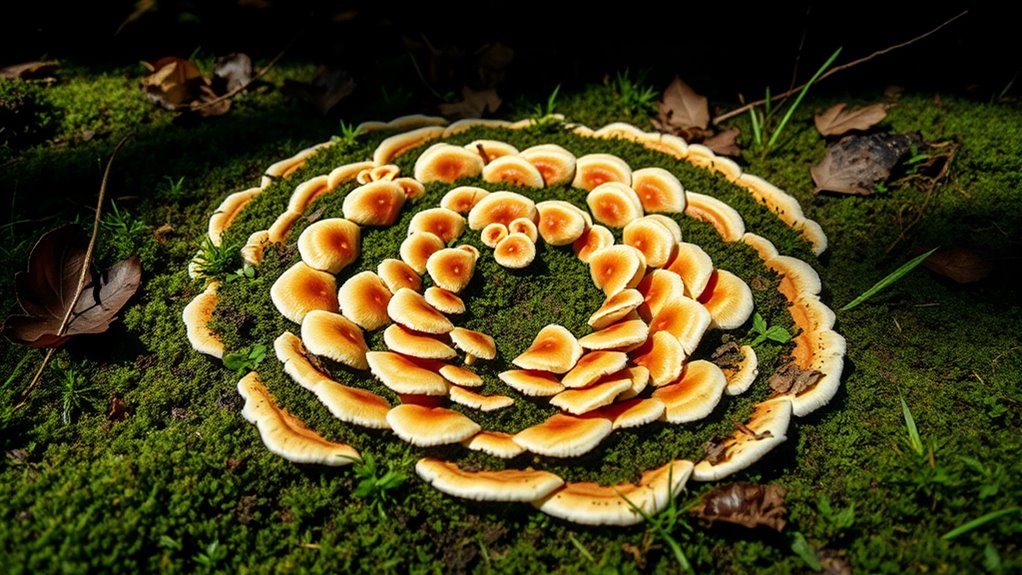
Mushroom circles, also known as fairy rings, form naturally through the growth habits of certain fungi species. As these fungi develop, they disperse spores outward through spore dispersal, creating new growth points in a circular pattern. The mushroom morphology, including the shape and size of the fruiting bodies, influences the ring’s appearance. Typically, the fungi grow underground in a mycelial network, which spreads outward in a roughly circular shape. When environmental conditions are right, the fungi produce visible mushrooms at the ring’s edge, where nutrients are most abundant. Over time, the fungi exhaust the nutrients in the center, causing the ring’s classic appearance. This botanical process results in the distinct, often symmetrical circle that has fascinated humans and folklore alike.
Scientific Studies Linking Fungi Patterns to Mythical Narratives
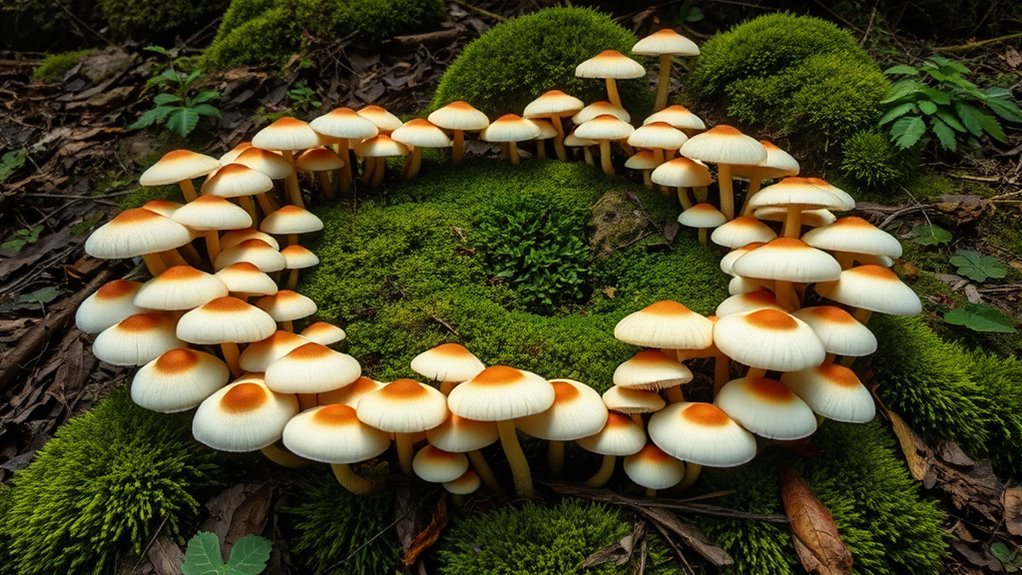
Scientific studies have uncovered intriguing connections between fungi patterns and traditional myths, suggesting more than coincidence. You might find it fascinating that certain mushroom formations align with stories of portals and gateways in folklore. These findings open new conversations about how natural phenomena influence mythical narratives across cultures.
Fungal Patterns and Folklore
While fungi naturally form intricate, circular patterns known as fairy rings, researchers have uncovered fascinating links between these formations and local mythologies. These patterns often appear in folklore, fueling urban legends and fairy tale symbolism. You might find that:
- Communities associate fairy rings with portals to other worlds or hidden gateways.
- Folklore attributes magical properties to fungi, linking their shapes to mystical creatures or spirits.
- Stories suggest trolls or fairies dance within these rings, using them as secret meeting spots.
- Many legends warn against disturbing fairy rings, believing it could bring misfortune or awaken mythical beings.
These cultural narratives turn simple fungal patterns into symbols of mystery and magic, reinforcing their role in folklore as gateways or symbols of otherworldly domains.
Scientific Evidence of Mythical Links
Although folklore has long associated fairy rings with magical portals and mythical creatures, recent scientific studies have begun to explore these connections more systematically. Researchers examine how spore dispersal patterns create the distinctive circular formations, fueling legends of portals and gateways. Mushroom pigmentation, especially in certain species, supports the idea that these fungi possess unique properties that inspired mythic stories. Some studies suggest that the distribution of spores influences the shape and size of fairy rings, aligning with tales of mystical gateways. While direct evidence linking fungi to mythical narratives remains elusive, the biological processes—like spore dispersal and pigmentation—offer intriguing clues. These scientific insights deepen our understanding of how natural phenomena inspire human imagination and folklore.
Analyzing the Composition and Geometry of Faerie Rings
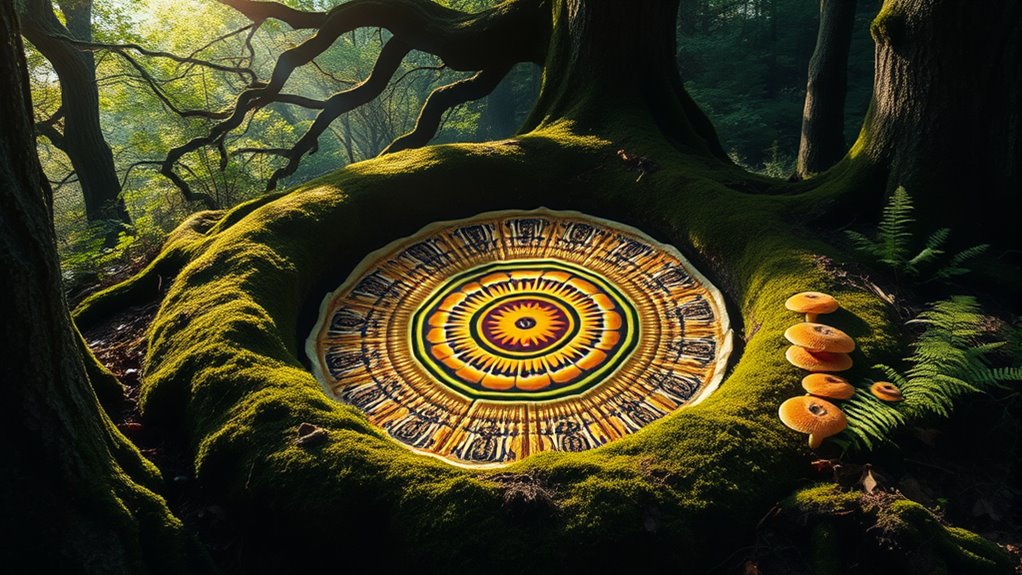
The composition and geometry of faerie rings reveal a fascinating interplay of natural elements and mystical forces. You notice the precise, circular formations often display fungal symmetry, indicating an underlying order. The rings are primarily composed of densely interconnected mycelium networks, which shape their structure. Examining these features, you see:
- The uniformity of the ring’s width and shape
- Patterns in fungal symmetry that suggest intentional design
- The layered composition of soil, fungi, and surrounding vegetation
- Variations in ring size that hint at environmental influences
These elements reflect both natural growth processes and possible mystical influences. The geometry’s consistency hints at a deliberate, perhaps magical, pattern that sustains the ring’s integrity and possibly connects to otherworldly gateways.
The Role of Mycelium Networks in Creating Enigmatic Circles
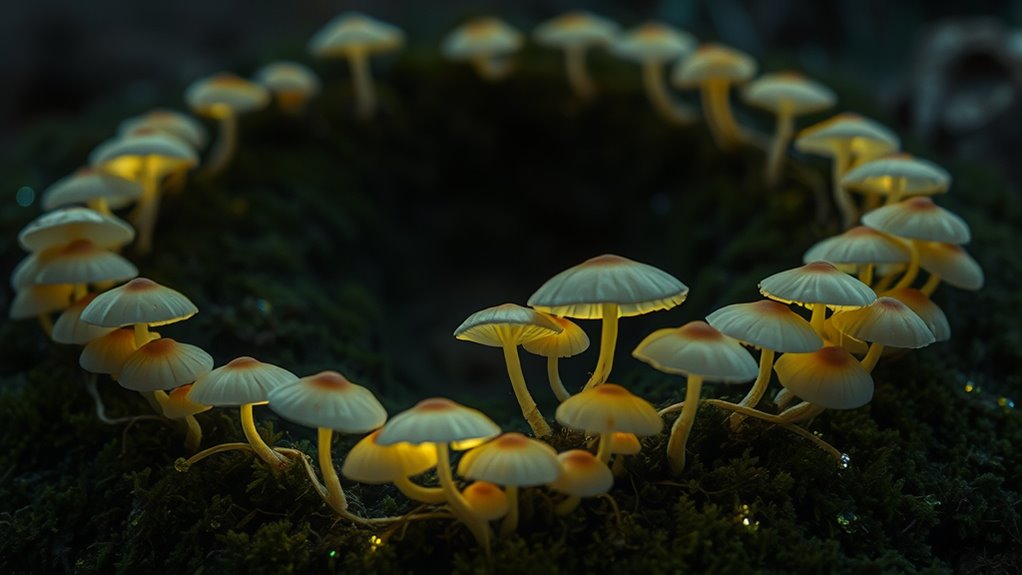
You might notice that underground, mycelium networks act as secret communication pathways connecting fungal colonies and plant roots. These networks form the intricate circles you see above ground, creating a sense of mystery. Understanding their symbiotic relationships helps explain how these enigmatic circles develop and persist.
Underground Communication Pathways
Beneath the forest floor, mycelium networks weave intricate connections that serve as underground communication pathways. These tunnels connect trees, fungi, and even faerie rings, facilitating nutrient exchange and signals. Bioluminescent fungi often grow along these pathways, lighting up underground tunnels with a ghostly glow, hinting at hidden activity. You might notice how these networks enable rapid information transfer, alerting plants to threats or resource shifts.
- Transmits chemical signals between organisms
- Facilitates nutrient sharing among trees
- Supports bioluminescent fungi growth
- Creates complex underground tunnels that hide secrets
These pathways may explain the mysterious formation of faerie rings, acting as portals or gateways. The underground networks form an invisible web, essential for forest communication and possibly linked to supernatural phenomena. By understanding these pathways, you reveal the forest’s hidden language, revealing secrets long concealed beneath the soil.
Symbiotic Fungal Relationships
Symbiotic fungal relationships lie at the heart of how mycelium networks create those mysterious circles in the forest. These networks develop through fungal symbiosis, where fungi form mutually beneficial bonds with plant roots, enhancing nutrient exchange. The fungi aid in spore dispersal, helping new fungi colonize surrounding areas and expand the circle’s perimeter. As the mycelium grows, it consumes organic matter, shaping the ring’s shape and size. This symbiosis influences soil health and plant vigor, reinforcing the circle’s formation. The following table illustrates key aspects of these relationships:
| Aspect | Effect |
|---|---|
| Spore dispersal | Expands the fungal network |
| Fungal symbiosis | Boosts plant health |
| Organic matter breakdown | Supports mycelium growth |
| Nutrient exchange | Strengthens plant-fungi bonds |
| Circle formation | Results from collective growth |
Cross-Cultural Beliefs: Portals and Gateways in Folklore
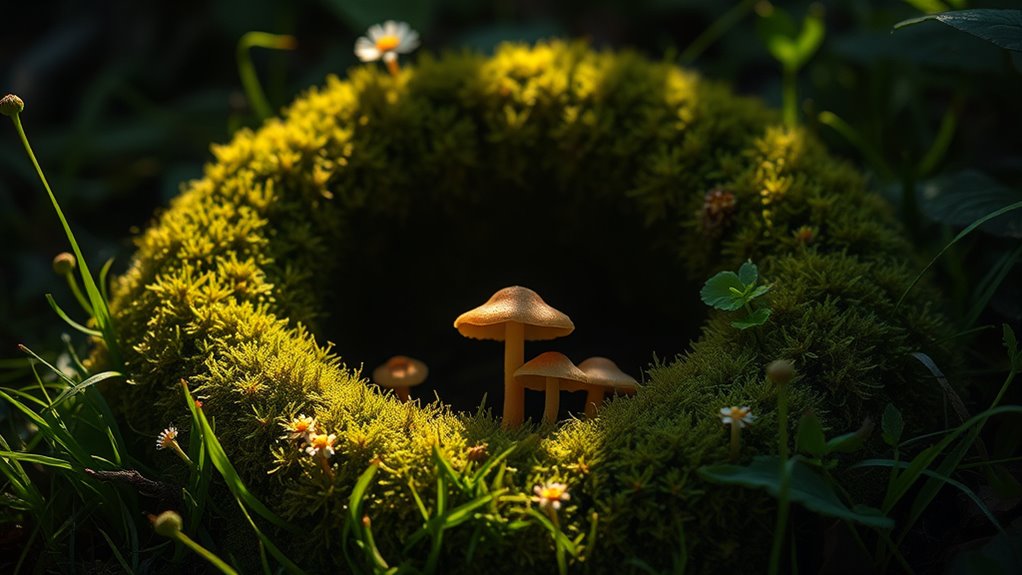
Across many cultures, folklore depicts portals and gateways as powerful symbols that connect different spheres, worlds, or dimensions. You’ll find them in legends of interdimensional gateways and spiritual portals, serving as thresholds between realities. These gateways often appear as natural features, like rings or trees, or man-made structures, like doorways. They symbolize transformation, access to hidden knowledge, or divine presence. Common themes include:
- Sacred trees marking spiritual portals
- Fairy rings acting as interdimensional gateways
- Sacred caves serving as liminal spaces
- Ancient stone circles as gateways to other worlds
These symbols reveal a universal belief in crossing boundaries—whether literal or spiritual—highlighting humanity’s desire to connect with unseen realms beyond everyday perception.
Future Research Directions in Botanical and Mythical Investigations
Emerging research is beginning to explore the ways botanical features and mythical symbolism intersect, opening new avenues for understanding cultural perceptions of portals and gateways. You can utilize genetic analysis to identify plant origins and trace historical interactions between species and myth. This approach could reveal whether certain botanical traits are linked to cultural symbolism or environmental adaptations. Additionally, studying ecological impacts helps assess how myth-inspired plant cultivation influences local ecosystems, potentially leading to changes in biodiversity or habitat structure. Future investigations might focus on how mythical beliefs shape botanical distribution and ecological dynamics. By combining genetic analysis with ecological data, you can deepen understanding of how cultural narratives influence plant evolution and ecosystem health, shedding light on the complex relationship between mythology and natural environments.
Frequently Asked Questions
Are There Any Documented Cases of Trolls Entering the Human Realm Through Faerie Rings?
You might wonder if trolls have ever entered our world through faerie rings, based on mythical creature sightings and folklore storytelling. While some legends suggest these rings are portals, there’s no solid documented evidence of trolls crossing into our domain this way. Most stories remain folklore, adding mystery and intrigue, but without concrete proof, it stays within the realm of myth and imagination.
How Do Environmental Changes Affect the Formation of Mushroom Circles and Their Mythological Significance?
Coincidences often highlight how environmental changes shape mushroom circles. You’ll notice climate influence causes shifts in temperature and moisture, directly impacting fungi growth. Soil composition also plays a role, as richer or altered soils foster different types of mushrooms, changing the formation of rings. These natural variations influence their mythological significance, suggesting that as the environment changes, so does the stories and beliefs surrounding these mysterious circles.
Can Modern Technology Detect Hidden Tunnels or Gateways Beneath Faerie Rings?
You can use modern technology like remote sensing and underground mapping to detect hidden tunnels or gateways beneath faerie rings. These tools allow you to scan the area non-invasively, revealing subsurface features that aren’t visible to the naked eye. By analyzing data from ground-penetrating radar or LiDAR, you can identify anomalies or structures that suggest underground pathways, helping you explore the mysterious origins and potential significance of these enchanting circles.
What Role Do Local Legends Play in Preserving or Dismissing Scientific Explanations of Faerie Rings?
Did you know over 60% of communities hold onto mythical beliefs about faerie rings? Local legends strongly influence whether people see these rings as cultural treasures or dismiss them as mere natural phenomena. These stories help preserve cultural heritage, but they can also hinder scientific investigation. Your beliefs shape how society interprets these sites—either protecting their mystery or encouraging scientific exploration. Embracing both perspectives fosters cultural preservation while advancing understanding.
Are Certain Mushroom Species More Associated With Portals to Mythical Worlds Than Others?
You might wonder if certain mythical fungi species are more linked to portals to legendary worlds than others. Some scholars suggest that specific mushrooms, like the Amanita muscaria, are believed to have portal preferences due to their striking appearance and cultural significance. While scientific evidence is limited, these fungi often capture imaginations, fueling the idea that particular mushrooms serve as gateways to mythical domains, blending folklore with botanical mystery.
Conclusion
You might find it fascinating that over 80% of folklore worldwide mentions portals or gateways, like faerie rings, as mystical entry points. By exploring the botanical and cultural origins of these circles, you can better understand their mythic significance. As research continues, you can expect new insights into how fungi and folklore intertwine, revealing secrets about ancient beliefs and natural phenomena that still captivate your imagination today.