Educational science board games can turn topics such as ecology, chemistry, anatomy, and space into shared play, but the best choice depends on whether you want strategy, hands-on problem-solving, or quick knowledge checks. I rank Cytosis as the best overall pick for players ready to learn cell biology through a more involved board game. Ecosystem: Coral Reef stands out for ecology-focused family play, while Laser Maze suits kids who learn by solving spatial logic challenges. The main tradeoff is between subject depth and easy entry: detailed games can take more time to learn, while trivia and card games are simpler but may offer less strategic play. Read on for the full breakdown and my picks for different ages, interests, and learning styles.

Prime made for students and young adults
- Fast, free delivery for dorm and study essentials
- Prime Video and Amazon Music included
- Member-only deals
Key Takeaways
- Cytosis leads the list for buyers seeking a substantial biology game; its focused cell theme offers more subject depth than the animal trivia and guessing games.
- Ecosystem: Coral Reef and Ecosystem Family Card Game both center on ecology, but the coral reef title gives buyers a more specific habitat focus.
- Periodic and Ion are the chemistry picks: one centers on the periodic table and elements, while the other focuses on combining ions into compounds.
- Laser Maze and the 3D circuit puzzle kit prioritize spatial reasoning and hands-on logic over learning science facts directly.
- Guess in 10: National Geographic Animals, Guess in 10: NASA Space, and MindWare Science Trivia Challenge are easier to bring to the table, but buyers should expect knowledge recall to play a larger role than long-form strategy.
| Ecosystem Family Card Game: Build Habitats and Learn About Ecology |  | Best Overall for Ecology Learning | Game type: Card-drafting strategy game | Players: 2–6 | Play time: 15–20 minutes | VIEW LATEST PRICE | See Our Full Breakdown |
| Laser Maze Reasoning Game for Kids Ages 8–13 |  | Best for Hands-On Optics Puzzles | Brand: VkotaVkoty | Age range: 8–13 years | Challenge levels: More than 60 | VIEW LATEST PRICE | See Our Full Breakdown |
| Skillmatics Guess in 10: National Geographic Animals Card Game |  | Best for Young Beginners | Brand: Skillmatics | Game theme: National Geographic animals | Players: 2 or more | VIEW LATEST PRICE | See Our Full Breakdown |
| The Awkward Yeti Organ Attack Anatomy Card Game |  | Best for Humorous Anatomy Lessons | Brand: The Awkward Yeti | Game type: Anatomy card game | Players: 2–6 | VIEW LATEST PRICE | See Our Full Breakdown |
| Periodic: A Game of the Elements |  | Best for Chemistry-Minded Players | Brand: Genius Games | Game type: Strategy board game | Number of players: 2–6 | VIEW LATEST PRICE | See Our Full Breakdown |
| Ion: A Compound Building Game (2nd Edition) |  | Best for Learning Chemistry Through Play | Game type: Card game | Edition: 2nd Edition | Players: 2–7 | VIEW LATEST PRICE | See Our Full Breakdown |
| Cytosis: A Cell Biology Board Game |  | Best for Strategic Cell Biology | Game type: Educational board game | Players: Listed as 2, 3, 4, or 10+ | Playing time: 90 minutes | VIEW LATEST PRICE | See Our Full Breakdown |
| Genius Games Ecosystem: Coral Reef Family Card Game |  | Best for Marine Food-Web Learning | Game type: Card game | Players: 2–6 | Recommended age: 10 years and up | VIEW LATEST PRICE | See Our Full Breakdown |
| 3D Circuit Puzzle STEM Kit with 60 Challenges and 8 Functional Modules |  | Best Hands-On STEM Challenge | Product type: 3D circuit puzzle and STEM kit | Age guidance: Listing says ages 8–14; manufacturer recommendation is 12 years and up | Challenge cards: 60 | VIEW LATEST PRICE | See Our Full Breakdown |
| MindWare Science Trivia Challenge Game | 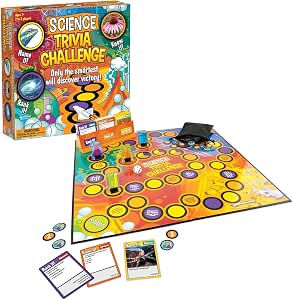 | Best for Mixed-Age Science Trivia | Game type: Board game | Age range: 7 years and up | Listed number of players: 4 | VIEW LATEST PRICE | See Our Full Breakdown |
| Skillmatics Guess in 10: NASA Space Card Game |  | Best for Space-Themed Quick Play | Brand: Skillmatics | Game type: Travel card game | Players: 2–6 | VIEW LATEST PRICE | See Our Full Breakdown |
| educational science board game | Game type | Players | Material | Recommended age |
|---|---|---|---|---|
| Ecosystem Family Card Game: Bu | Card-drafting strategy game | 2–6 | — | — |
| Laser Maze Reasoning Game for | — | — | Polypropylene (PP) | — |
| Skillmatics Guess in 10: Natio | — | 2 or more | Paper | 6 years and up |
| The Awkward Yeti Organ Attack | Anatomy card game | 2–6 | — | 8 years and up |
| Periodic: A Game of the Elemen | Strategy board game | — | — | 10 years and up |
| Ion: A Compound Building Game | Card game | 2–7 | Paper | 8 years and up |
| Cytosis: A Cell Biology Board | Educational board game | Listed as 2, 3, 4, or 10+ | — | — |
| Genius Games Ecosystem: Coral | Card game | 2–6 | — | 10 years and up |
| 3D Circuit Puzzle STEM Kit wit | — | — | ABS plastic | — |
| MindWare Science Trivia Challe | Board game | — | Paper | — |
| Skillmatics Guess in 10: NASA | Travel card game | 2–6 | Paper | 8 years and up |
More Details on Our Top Picks
Ecosystem Family Card Game: Build Habitats and Learn About Ecology
Ecology through strategy gives this game the broadest family appeal in the lineup. Players draft and arrange cards to create habitats, linking animals with environments such as forests and streams. That makes biodiversity and habitat balance part of the decisions, rather than facts delivered separately from play. At 15–20 minutes, it is quicker to bring to the table than Periodic: A Game of the Elements, which asks players to engage with chemistry concepts across a more involved board game. The tradeoff is that card placement and habitat matching may slow younger players at first, and the easy-to-learn rules still leave room for mastery. Choose it for families or classrooms that want repeatable ecology play; skip it if the group prefers a purely quick, low-strategy card game.
Pros:- Connects card-drafting decisions to ecology, biodiversity, and habitat balance.
- Plays in about 15–20 minutes, making it easy to fit into family or classroom sessions.
- Supports 2–6 players and a wide age mix.
- Encourages critical thinking without screens.
Cons:- Players must arrange cards and match animals with suitable habitats, which can take practice.
- Its easy entry rules lead to more demanding strategic decisions that may not suit casual players.
Best for: Families and classroom groups with children, teens, and adults who want a short strategy game focused on habitats and biodiversity.
Not ideal for: Players looking for a simple luck-based card game or children who may find habitat matching and card arrangement frustrating.
- Game type:Card-drafting strategy game
- Players:2–6
- Play time:15–20 minutes
- Card types:11
- Topics:Ecology, biodiversity, and habitats
- Recommended settings:Family game nights and classrooms
Our verdict“Choose Ecosystem for a compact, replayable introduction to ecology; pick Guess in 10: National Geographic Animals instead if animal clues and conversation matter more than building habitats.”
Laser Maze Reasoning Game for Kids Ages 8–13
Light reflection becomes a spatial puzzle here: players adjust mirrors and beam-guiding cubes to solve challenges, linking each move to a visible result. With more than 60 challenges arranged from beginner to expert, it offers a clearer progression than the open-ended strategy of Periodic: A Game of the Elements. It also works solo, so a child can tackle a puzzle without assembling a group. The tradeoff is a narrower science focus: this is chiefly an optics and reasoning activity, not a broad science board game, and the mirror angles may feel confusing at the start. Its recommended ages of 8–13 also make it less suited to mixed-age adult play. Pick it for a child who likes manipulating objects and solving visual problems; skip it for a group seeking a conventional, shared board-game competition.
Pros:- Makes light reflection tangible through adjustable mirrors and beam-guiding cubes.
- More than 60 challenges provide a range of difficulty levels.
- Supports solo solving as well as multiplayer and group activities.
- Requires no assembly and includes visual guides to help players begin.
Cons:- The mirror and angle adjustments may be difficult for beginners to understand.
- Its child-focused age range limits appeal for older mixed-age groups.
- Centers on optics and spatial reasoning rather than a wider range of science topics.
Best for: Children ages 8–13 who enjoy solo STEM challenges, visual logic puzzles, or classroom activities about reflection.
Not ideal for: Families seeking a broad science game for adults and young children to play together, or players who prefer questions and answers over spatial manipulation.
- Brand:VkotaVkoty
- Age range:8–13 years
- Challenge levels:More than 60
- Unit count:37
- Material:Polypropylene (PP)
- Colors:Red, pink, green, and orange
- Assembly required:No
- Laser safety class:Class 1
Our verdict“Choose Laser Maze for a child who learns by manipulating objects and solving visual challenges; choose Periodic for a more social, chemistry-focused strategy game.”
Skillmatics Guess in 10: National Geographic Animals Card Game
Animal facts meet question-building in a format that is easy for younger players to grasp: ask up to 10 yes-or-no questions, use clues, and try to identify the animal. At ages 6 and up, it has a lower suggested starting age than The Awkward Yeti Organ Attack Anatomy Card Game, making it a more approachable choice for early family play. Its portable box and roughly 20-minute rounds also suit travel. The learning is less direct than Ecosystem’s habitat-building: children practice animal knowledge, communication, and deduction, but do not model ecological relationships. A minimum of two players is required, and the paper components may wear with frequent travel. Choose it for conversation-led animal learning; skip it if you need solo play or durable hands-on pieces.
Pros:- Uses yes-or-no questions to combine animal knowledge with deduction.
- Encourages communication and reasoning between players or teams.
- Portable box and roughly 20-minute rounds suit travel and short sessions.
- Can accommodate two or more players.
Cons:- Requires at least two players, so it cannot serve as a solo activity.
- Paper components may be less durable with frequent travel and handling.
- Focuses on identifying animals rather than explaining broader ecological relationships.
Best for: Families with children six and older who want a portable, conversation-based animal game for trips or short game sessions.
Not ideal for: Solo players, groups seeking ecology or habitat lessons, and families who need components built for heavy handling.
- Brand:Skillmatics
- Game theme:National Geographic animals
- Players:2 or more
- Recommended age:6 years and up
- Average playtime:About 20 minutes
- Included components:50 game cards, 6 clue cards, 1 card holder, instruction manual, and travel-friendly box
- Material:Paper
- Model:SKILL1728GNGA
Our verdict“Choose Guess in 10 for younger players who enjoy asking questions and identifying animals; choose Ecosystem for a stronger focus on habitats and biodiversity.”
The Awkward Yeti Organ Attack Anatomy Card Game
Anatomy with a deliberately silly tone sets Organ Attack apart from the more neutral science learning in Ecosystem Family Card Game. Players use affliction and immunity cards to attack and defend organs, while the last player with an organ wins. That conflict-driven structure gives health and body topics a playful hook, and the book-style case is easy to store on a shelf or carry between rooms. The tradeoff is pacing: its stated 30–90-minute playing time is much longer and less predictable than the short rounds of Guess in 10. It also needs at least two players, and jokes about medical afflictions will not suit every family or classroom. Choose it for groups comfortable with irreverent humor; skip it if you want a gentler or tightly timed anatomy activity.
Pros:- Makes human anatomy and health the core of a competitive card game.
- Supports 2–6 players and can involve children and adults.
- Book-style case stores flat and is easy to shelve.
- Affliction and immunity cards create direct strategic choices.
Cons:- Humor and medical-affliction themes may not work for every household or classroom.
- The stated 30–90-minute playtime can be a long commitment.
- Requires at least two players.
Best for: Families or older children who enjoy humorous, competitive card games and want an informal introduction to organs and health.
Not ideal for: Classrooms needing a gentle, focused anatomy lesson, players sensitive to medical-affliction humor, or groups with little time for a game.
- Brand:The Awkward Yeti
- Game type:Anatomy card game
- Players:2–6
- Recommended age:8 years and up
- Playing time:30–90 minutes
- Included components:Cards
- Container type:Book-style case
- Dimensions:8 x 6 inches
- Educational objective:Learn about human anatomy and health
Our verdict“Choose Organ Attack for groups that want anatomy wrapped in irreverent competition; choose Guess in 10 for a shorter, lighter game aimed at younger children.”
Periodic: A Game of the Elements
Chemistry is built into the movement system of Periodic: players use periodic trends to travel across the board, discover elements, and pursue points and achievements. That makes the subject matter more than a trivia theme, and gives this game a deeper chemistry focus than Laser Maze Reasoning Game, which concentrates on light reflection and spatial puzzles. Its support for 2–6 players suits families or classrooms ready for shared strategy. The tradeoff is a higher learning threshold: players need to know, or be willing to learn, chemistry concepts to make sense of the choices. The age recommendation of 10 and up also makes it a less natural fit for younger children than Guess in 10. Choose it for groups interested in periodic-table ideas; skip it if you want science play with little explanation before starting.
Pros:- Uses periodic trends as part of movement and decision-making.
- Connects element discovery with strategy, action economy, and set collection.
- Supports 2–6 players for family or classroom play.
- Designed around STEM and NGSS standards.
Cons:- Players may need to learn chemistry concepts before the strategy clicks.
- The age recommendation of 10 and up makes it less suitable for younger children.
- Its chemistry focus may be too specialized for groups seeking broad science topics.
Best for: Families and educators with players ages 10 and up who want strategic play tied directly to elements, periodic trends, and chemistry.
Not ideal for: Younger children or casual groups who prefer familiar rules and science topics that require little background or explanation.
- Brand:Genius Games
- Game type:Strategy board game
- Number of players:2–6
- Recommended age:10 years and up
- Edition:Standard Edition
- Included components:Game
- Standards:STEM and NGSS
- Model number:GOT1008
Our verdict“Choose Periodic for players ready to connect chemistry concepts with strategic board play; choose Ecosystem for a shorter, more accessible science game about habitats.”
Ion: A Compound Building Game (2nd Edition)
Ion makes ionic bonding the main event: players draft cards and combine positively and negatively charged ions to build neutral compounds and score. That gives chemistry concepts a direct role in each decision, rather than presenting them only as facts to memorize. The included Science Behind booklet adds context, while an advanced mode introduces radioactivity for groups ready for a harder layer. Compared with MindWare Science Trivia Challenge, Ion teaches a narrower subject through constructing combinations, not answering questions across science topics. Its 20–30-minute playtime is also a more manageable fit for a short session than the longer Cytosis. The tradeoff is that the chemistry focus may feel specialized, and the radioactivity mode is recommended for experienced players and groups of four or more.
Pros:- Makes ionic bonding and neutral compound formation central to play.
- Includes a science booklet that connects the game to real-world concepts.
- Advanced radioactivity mode adds another level for experienced groups.
- Plays in 20–30 minutes and supports two to seven players.
Cons:- Its chemistry focus is narrower than the varied subject matter in MindWare Science Trivia Challenge.
- The radioactivity mode is aimed at more experienced players and groups of four or more.
- Does not support solo play or groups larger than seven.
Best for: Families, science clubs, or classrooms seeking a short chemistry game for players ages 8 and up, especially those who want to practice ionic compounds rather than general science trivia.
Not ideal for: Solo players, groups larger than seven, or beginners looking for a broad survey of science topics; the advanced radioactivity mode may also be a poor fit for newer players.
- Game type:Card game
- Edition:2nd Edition
- Players:2–7
- Playing time:20–30 minutes
- Recommended age:8 years and up
- Included component:1 Science Behind booklet
- Material:Paper
Our verdict“Choose Ion for a focused, relatively short chemistry lesson built around forming compounds; choose MindWare Science Trivia Challenge for broader science questions.”
Cytosis: A Cell Biology Board Game
Cytosis turns the inside of a human cell into a worker-placement strategy game: players collect resources and use them to build enzymes, hormones, and receptors. That structure links choices to cell biology, making it a deeper fit for learners who want to explore how cellular parts and processes relate. A fact-based booklet reviewed by scientists supports the lesson. Compared with Ion, which centers on a specific chemistry task in a 20–30-minute session, Cytosis covers cell biology through a much longer game listed at 90 minutes. It asks for more time and attention, but offers a more involved strategic experience than a quick concept game. The supplied player information is unclear, listing 2, 3, 4, or 10+ players, so groups should check that fit before choosing it.
Pros:- Uses worker placement and resource gathering to connect strategy with cell biology.
- Covers enzymes, hormones, and receptors within a human-cell setting.
- Includes a science-focused booklet reviewed by PhDs and doctors.
- Offers a more extended strategic experience than short games such as Ion.
Cons:- The listed 90-minute playing time may be too long for a brief family session.
- Player-count information is unclear, combining specific counts with 10+.
- Its strategic format and age recommendation of 10 years and up may not suit younger learners.
Best for: Science-minded families, older children, and classroom groups with time for a roughly 90-minute strategy game about cell biology.
Not ideal for: Families seeking a quick game for younger children, or groups that need a clearly stated player range before planning a session.
- Game type:Educational board game
- Players:Listed as 2, 3, 4, or 10+
- Playing time:90 minutes
- Minimum age:10 years
- Edition:Cytosis
- Included component:Cytosis: A Cell Biology Game
- Manufacturer:FLAHC
Our verdict“Pick Cytosis when your group wants an extended, strategic cell-biology game and can accommodate its long playtime and unclear player-count listing.”
Genius Games Ecosystem: Coral Reef Family Card Game
Ecosystem: Coral Reef teaches marine biology by having players arrange cards for aquatic animals, habitats, and food sources into a working food web. The central challenge is to build a balanced system of producers, prey, and predators, so the science is tied to the way the cards interact rather than presented as trivia. Its 20-minute playtime and two-to-six-player range make it an accessible family option. Compared with Cytosis, which uses longer worker-placement play to explore processes inside a cell, this game keeps its subject on reef ecology and uses a quicker card format. That narrower setting is a strength for learners interested in ecosystems, but it offers less coverage of other scientific fields. The age recommendation of 10 and up may also put it beyond younger children who could enjoy simpler animal games.
Pros:- Makes relationships among predators, prey, and producers part of the gameplay.
- Focuses on marine biology and Great Barrier Reef habitats.
- Supports two to six players, allowing a range of family group sizes.
- A 20-minute playtime suits shorter game sessions.
Cons:- Its subject is limited to marine ecosystems rather than multiple science topics.
- The recommended age is 10 years and up.
- Designed for indoor play, so it is not an outdoor activity option.
Best for: Families and school groups with players ages 10 and up who want a quick, hands-on introduction to marine habitats and food chains.
Not ideal for: Buyers seeking a broad science game, a solo activity, or an option specifically recommended for children under 10.
- Game type:Card game
- Players:2–6
- Recommended age:10 years and up
- Playing time:20 minutes
- Edition:Coral Reef
- Included components:6 player aids
- Educational objective:Marine biology, aquatic animals, habitats, and food chains
Our verdict“Choose Ecosystem: Coral Reef for a short group game centered on marine food webs, rather than Cytosis’s longer cell-biology strategy.”
3D Circuit Puzzle STEM Kit with 60 Challenges and 8 Functional Modules
This 3D Circuit Puzzle STEM Kit is the hands-on outlier in a lineup dominated by card and board games. Its 60 progressive challenges ask children to build circuits across up to three vertical layers, while a separate build mode leaves room for experimenting with original designs. The eight functional modules add visible effects—including lights, mist, music, and a rotating fan—that can make circuit connections easier to observe than the abstract scoring in Ion or MindWare Science Trivia Challenge. The tradeoff is a more setup-driven activity: players must assemble and connect components, rather than simply deal cards and begin. Age guidance also varies, with the listing giving ages 8–14 and the manufacturer recommending 12 and up, so adult buyers may need to judge readiness themselves.
Pros:- Provides 60 progressive logic challenges as well as a free-build mode.
- Three-layer stacking makes spatial construction part of the circuit activity.
- Eight interactive modules offer visible and audible feedback.
- Modular construction is described as sealed with no exposed metal parts.
Cons:- Age guidance conflicts between the listed 8–14 range and the manufacturer recommendation of 12 and up.
- Requires assembly and circuit connections before challenges and effects work.
- Its build-kit format differs from a conventional board game and may not suit buyers seeking simple turn-based play.
Best for: Children who enjoy building and logic challenges, and adults seeking a screen-free STEM activity with structured puzzles plus open-ended circuit play.
Not ideal for: Families wanting a conventional, quick-start board game or buyers who need consistent age guidance; assembly and circuit connections are part of the activity.
- Product type:3D circuit puzzle and STEM kit
- Age guidance:Listing says ages 8–14; manufacturer recommendation is 12 years and up
- Challenge cards:60
- Functional modules:8
- Build modes:Puzzle Mode and Build Mode
- Design:Up to 3 layers of vertical stacking
- Material:ABS plastic
Our verdict“Choose this kit for children who want to construct and troubleshoot circuits, not for groups seeking a ready-to-play science board game like Ion.”
MindWare Science Trivia Challenge Game
MindWare Science Trivia Challenge is the broadest knowledge-check option here: its double-sided cards offer beginner and advanced questions, allowing players with different levels of science familiarity to join the same activity. Observation tokens, a die, and pawns support play beyond simply answering questions. Compared with Ion, which teaches one chemistry concept through card drafting and compound building, this game spans science knowledge and also emphasizes logic, deduction, and observation. It can be played alone or in a group according to the description, though the specification lists four players, leaving the supported group size unclear. The paper components keep the format portable, but they lack the construction and visual feedback of the 3D Circuit Puzzle STEM Kit. This is better for question-led learning than hands-on experimentation.
Pros:- Double-sided cards provide beginner and advanced questions for varied knowledge levels.
- The description supports both individual and group play.
- Includes observation tokens, a die, and pawns alongside the cards.
- Combines science knowledge with logic, deduction, and observation.
Cons:- The description says solo or group play, while the listed player count specifies four.
- Paper components do not provide the hands-on construction of the 3D Circuit Puzzle STEM Kit.
- Question-based play offers less subject-specific practice than Ion’s compound-building mechanics.
Best for: Households or educators who want a question-based science activity with beginner and advanced prompts for learners at different knowledge levels.
Not ideal for: Buyers who want a clearly specified group size, tactile science experiments, or a game focused deeply on one subject such as chemistry or cell biology.
- Game type:Board game
- Age range:7 years and up
- Listed number of players:4
- Card count:216
- Included components:Cards, die, 50 observation tokens, token bag, and 4 pawns
- Material:Paper
- Language:English
Our verdict“Choose MindWare for broad, question-led science play across different knowledge levels, but choose Ion or the circuit kit for more focused, hands-on learning.”
Skillmatics Guess in 10: NASA Space Card Game
For families who want science learning in a short, social format, Guess in 10: NASA Space turns space topics into a question-and-clue challenge. Players can ask up to 10 questions, use clue cards and bonus questions, and race to collect seven cards; that structure encourages deduction and clear communication without the longer setup of a board game such as Cytosis. NASA imagery gives the subject a recognizable hook, while the compact box and roughly 20-minute rounds suit travel or a weeknight game. The tradeoff is that this is a lightweight space-themed guessing game, not a detailed science lesson: players looking for sustained biology or chemistry concepts may get more from Periodic: A Game of the Elements. It also requires at least two players and is aimed at ages eight and up.
Pros:- NASA imagery and space topics give the guessing rounds an engaging science theme.
- Question limits, clue cards, and bonus questions encourage deduction and decision-making.
- Portable box and roughly 20-minute rounds work well for travel and brief family game sessions.
- Supports communication, problem-solving, and creative thinking through shared play.
Cons:- Requires at least two players, so it does not work for solo play.
- The age recommendation of 8 and up limits its fit for younger science learners.
- Its quick guessing format offers less subject depth than focused science games such as Cytosis or Periodic.
Best for: Families with children ages 8 and up who want a portable, short space-themed game that prompts questions and deduction.
Not ideal for: Solo players, younger children, or families seeking a deeper science curriculum or a board-game-length strategy session.
- Brand:Skillmatics
- Game type:Travel card game
- Players:2–6
- Recommended age:8 years and up
- Average playtime:About 20 minutes per round
- Included components:50 game cards, 6 clue cards, portable box, instruction manual
- Material:Paper
- Skills:Communication, decision-making, problem-solving, creative thinking
- Model number:SKILL579GNS
Our verdict“Choose this for portable, quick space-themed deduction with school-age players, but pick a subject-focused game for deeper science learning.”
How We Picked
I compared these games by how clearly their play connects to a science subject, how easily a group can understand the core activity, and how well the format suits its likely audience. I also looked at the kind of learning each encourages: building subject knowledge, applying logic, recognizing relationships, or recalling facts. A game that uses scientific ideas as part of its decisions ranks ahead of one that mainly quizzes players, while accessibility and a clear age fit still matter.
The order reflects those tradeoffs rather than treating every science-themed game as equivalent. Cytosis ranks first for combining a defined biology topic with sustained game decisions; ecology and chemistry titles follow for their subject focus and playable structure. Faster card games, trivia, and puzzle kits fill more specific roles: they may be a better fit for younger players, short sessions, or hands-on reasoning, but they do not provide the same kind of board-game strategy or science depth.
| educational science board game | Material |
|---|---|
| Ecosystem Family Card Game: Bu | — |
| Laser Maze Reasoning Game for | Polypropylene (PP) |
| Skillmatics Guess in 10: Natio | Paper |
| The Awkward Yeti Organ Attack | — |
| Periodic: A Game of the Elemen | — |
| Ion: A Compound Building Game | Paper |
| Cytosis: A Cell Biology Board | — |
| Genius Games Ecosystem: Coral | — |
| 3D Circuit Puzzle STEM Kit wit | ABS plastic |
| MindWare Science Trivia Challe | Paper |
| Skillmatics Guess in 10: NASA | Paper |
Factors to Consider When Choosing Educational Science Board Games
Before choosing, decide what you want the game to teach and how your group prefers to learn. A science label alone does not tell you whether play will involve strategy, recall, discussion, or physical problem-solving.
Choose the learning activity before the science subject
Start by asking what players should be doing during the game: making decisions with science concepts, answering questions, or solving a puzzle. These activities create different learning experiences, even when the topics overlap. A player who enjoys deduction may stay engaged with a logic challenge, while a fact-focused player may prefer trivia or a guessing game. One common mistake is buying for a subject a child likes without checking whether they enjoy the game format. Match both the topic and the activity to the players, or the educational theme may not be enough to keep the game in rotation.
Match complexity to the group, not just the youngest player
Age guidance can help narrow the field, but it does not capture every group’s reading comfort, patience, or experience with strategy games. For mixed-age play, consider whether younger participants can make meaningful choices without an adult translating rules or concepts at every turn. A game that is too simple for older players may lose their interest, while a dense ruleset can make a promising science subject feel like homework. Check how much reading and explanation the game appears to require before choosing it for independent play. If the group varies widely, a shorter, flexible format may work better than a game selected only for its maximum subject depth.
Separate science learning from science-themed entertainment
Some games ask players to use scientific relationships; others mainly use science as the topic for questions, clues, or illustrations. Neither approach is automatically better, but they serve different goals. If you want players to practice applying concepts, favor mechanics that reward reasoning about the subject rather than simply recalling a name or fact. For a casual family game, accessible questions can be a strength because players can join in quickly. Avoid assuming that a science theme guarantees a lesson: look for a clear link between what players do and what they might learn.
Think about session length and setup habits
A game that needs a longer explanation or careful setup can be a poor fit for households that play in short bursts, even if its subject is a strong match. Quick card games are easier to bring out spontaneously, while more involved board games can reward groups willing to settle in and learn the system. Puzzle kits may suit solo exploration, but they offer a different kind of shared play from a game designed for a table of competitors. Consider where the pieces will be stored and whether the group is likely to finish a session once it starts. Frequent, short play can build a stronger habit than an ambitious game that rarely leaves the shelf.
Pay for depth only when players will use it
A more involved game can make sense when its rules and subject matter give players new decisions to explore over repeated sessions. But a larger or more elaborate format is not automatically a better learning tool for a casual group. If players mainly want a quick introduction to a topic, a simple card game may meet that need with less teaching overhead. For a classroom or family that revisits games, consider whether the science concepts support discussion after play and whether the mechanics remain engaging once the rules are familiar. Choose depth when it serves the group’s habits, not just because the topic sounds advanced.
Check whether the game fits your teaching goal
Parents, teachers, and gift buyers may want different outcomes from the same game. A family may value easy participation, while a teacher may need a clear connection to a unit or a format that supports small groups. Before buying, name one practical goal, such as introducing vocabulary, encouraging reasoning, or creating a low-pressure science-themed activity. Then check whether the game can meet that goal without extensive preparation or outside materials. A mismatch between the intended lesson and the actual play style is a more common disappointment than choosing the wrong branch of science.
Frequently Asked Questions
Which game is the strongest choice if I want players to learn science through strategy rather than trivia?
Cytosis is the clearest fit in this lineup for buyers seeking a board game built around a specific science subject and sustained decisions. Periodic and Ion are also better matches for concept-driven play than a straightforward question-and-answer format, though they focus on different areas of chemistry. By contrast, the two Guess in 10 titles and MindWare Science Trivia Challenge lean more heavily on identifying or recalling information. Choose based on whether you want players to practice relationships and decisions or demonstrate what they already know.
Are science trivia and guessing games useful for children who are still learning the subject?
They can be useful as light introductions, especially when players enjoy clues and questions, but they may reward prior knowledge more than teach a concept from scratch. A child who misses many answers could find a recall-heavy game discouraging unless another player helps explain the answers. For a more guided learning experience, consider a game whose central decisions involve a science idea or a puzzle that develops reasoning. You can also use trivia as a conversation starter by pausing to explain unfamiliar answers. The best fit depends on whether the goal is practice, discovery, or simply a science-themed activity.
What should I choose for a family with different ages and science experience?
Prioritize a format that lets less experienced players participate without needing to master a large set of facts or rules. Ecology card games and short guessing games may be easier to introduce than a more involved strategy title, while a logic puzzle can suit players who prefer solving challenges at their own pace. Check that older players still have something to think about; a game that is accessible but too predictable may not hold the whole group. Adult guidance can help bridge differences in background knowledge, but it should not be required for every turn. If possible, choose the style the group already enjoys, then let the science theme add interest.
Is a hands-on science puzzle a good substitute for a board game?
It can be a strong choice when a player prefers manipulating pieces and solving problems independently, but it does not replace the social competition or discussion of a multiplayer board game. The 3D circuit puzzle kit and Laser Maze focus on spatial reasoning and challenge-solving rather than the same kind of group strategy found in titles such as Cytosis. Think about whether the recipient wants a solo activity, a shared table game, or both. A puzzle can also be a useful complement to a board game when you want varied ways to engage with STEM. Choose the format that matches how the player likes to spend time, not just the science label.
How do I choose between the two ecology games and the two chemistry games?
For ecology, compare a broad habitat-building focus with the more specific coral reef setting, then choose the theme that is likelier to prompt questions and discussion in your group. For chemistry, Periodic centers on elements and the periodic table, while Ion focuses on building compounds from ions; the distinction matters if you have a particular topic in mind. Do not pick solely by which subject sounds harder or more impressive. Consider the players’ current interests and whether they want to explore a broad system or a narrower concept. A focused match can make the game easier to connect to lessons or follow-up reading.
Conclusion
Best overall: I recommend Cytosis for buyers who want science concepts woven into a substantial board-game experience. Best value in play style: choose one of the Guess in 10 titles for quick, approachable sessions, selecting animals or NASA space to match the player’s interests. Best premium-style pick: Periodic or Ion suits groups seeking a more focused chemistry game, with the choice guided by whether elements or compounds are the better fit. Best for beginners: the Ecosystem Family Card Game offers an accessible entry into ecology, while the trivia and guessing games work well for players who enjoy quick prompts. For specific needs, pick Laser Maze or the 3D circuit puzzle kit for hands-on logic, Ecosystem: Coral Reef for a defined marine habitat theme, and The Awkward Yeti Organ Attack for anatomy-centered card play. The right choice is the one whose subject and play style both fit the people who will actually sit down with it.