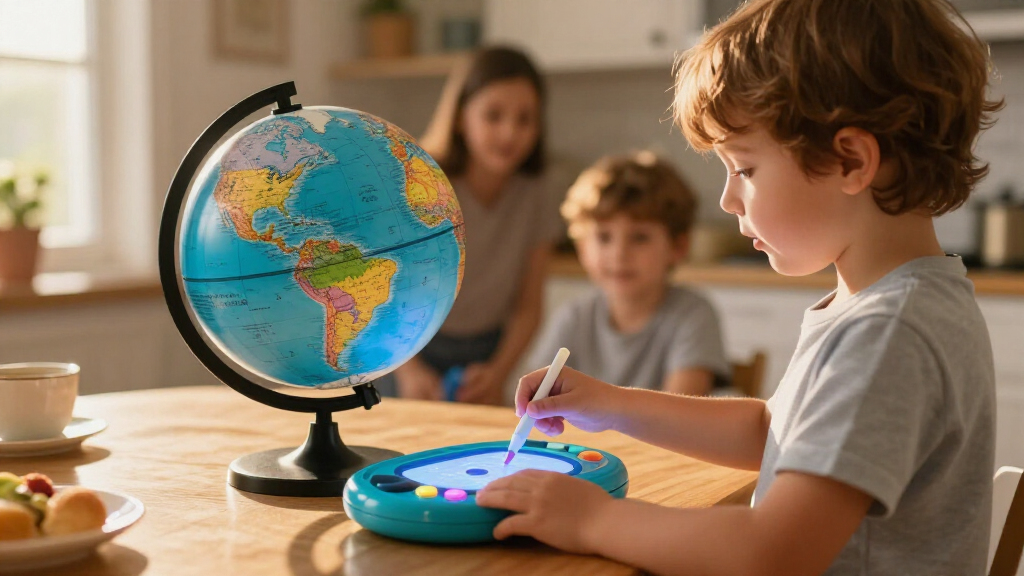

For most families, the LeapFrog Magic Adventures Globe is the best overall interactive science globe for kids, pairing globe-based exploration with varied learning activities. The PlayShifu Orboot Earth Explorer stands out for children drawn to augmented-reality activities, while the Replogle Intelliglobe offers a more traditional talking-globe approach. The main tradeoffs are screen-based interaction versus an independent physical globe, and broad entertainment versus focused geography practice. Age fit, audio clarity, language options, and whether an adult needs to set up an app can change which model makes sense. Read on for the full comparison, buying advice, and recommendations by child and household.

Prime made for students and young adults
- Fast, free delivery for dorm and study essentials
- Prime Video and Amazon Music included
- Member-only deals
Key Takeaways
- Interaction style separates the field: the lineup includes talking globes with smart pens, light-up or audio-led models, and Orboot globes that add app-based AR activities.
- App dependence is a real dividing line: PlayShifu Orboot options suit children who enjoy tablet-linked exploration, while a talking globe may work better for families seeking more direct, hands-on use.
- There are several ways to introduce globe learning: LeapFrog, Orboot Core, and other models are positioned for younger users, but families should still match the activities and controls to the child.
- Size and presentation affect everyday use: the 8- and 9-inch models take less space, while the 12-inch Replogle offers a larger map surface at the cost of a bigger footprint.
- Specialized features are not interchangeable: the bilingual globe is the clear language-focused option, while Bindi Irwin’s GeoSafari globe adds a distinctive animal-and-nature angle.
| LeapFrog Magic Adventures Globe |  | Best Overall for Screen-Based Exploration | Brand: LeapFrog | Age range: 5–12 years | Globe size: 10 inches | VIEW LATEST PRICE | See Our Full Breakdown |
| PlayShifu Orboot Earth Explorer Interactive AR Globe for Kids |  | Best for App-Based Augmented Reality | Brand: PlayShifu | Model: Shifu072 | Age range: 4 years and up | VIEW LATEST PRICE | See Our Full Breakdown |
| Science Can 8-Inch Interactive Talking Globe for Kids |  | Best for Earth Science Beginners | Brand: Science Can | Diameter: 8 inches | Material: Plastic | VIEW LATEST PRICE | See Our Full Breakdown |
| Replogle Intelliglobe Interactive Talking World Globe for Children, 12-Inch |  | Best for In-Depth Reference Learning | Brand: Replogle | Globe diameter: 12 inches | Included accessories: World Discovery Book and rechargeable Intelliglobe II pen | VIEW LATEST PRICE | See Our Full Breakdown |
| PlayShifu Orboot Earth Interactive AR Globe for Kids |  | Best for Imaginative Geography Play | Brand: PlayShifu | Model: Shifu014 | Age range: 4–10 years | VIEW LATEST PRICE | See Our Full Breakdown |
| LeapFrog LeapGlobe Light-Up Interactive Globe for Kids |  | Best for Preschool Beginners | Brand: LeapFrog | Age range: 3 years and up | Touch points: 48 | VIEW LATEST PRICE | See Our Full Breakdown |
| Educational Insights GeoSafari Talking Globe Featuring Bindi Irwin |  | Best for Audio-Rich Learning | Brand: Educational Insights | Globe diameter: 12 inches | Recommended age: 4–8 years | VIEW LATEST PRICE | See Our Full Breakdown |
| Dr. STEM Toys Interactive Talking Globe with Smart Pen |  | Best for Adjustable Quizzing | Brand: Dr. STEM Toys | Recommended age: 6 years and up | Quiz questions: 300+ | VIEW LATEST PRICE | See Our Full Breakdown |
| Little Experimenter Interactive Talking Globe with Smart Pen, 9 Inch |  | Best Compact Pick for Older Kids | Brand: Little Experimenter | Diameter: 9 inches | Age range: 8–12 years | VIEW LATEST PRICE | See Our Full Breakdown |
| 8-Inch Interactive Bilingual Talking Globe with LED Core |  | Best for Hands-On Geology | Brand: Science Can | Diameter: 8 inches | Languages: English and French | VIEW LATEST PRICE | See Our Full Breakdown |
| PlayShifu Orboot Core Interactive Globe for Kids, Ages 4–10 |  | Best for Earth’s Layers | Recommended age: 4–10 years | Earth layers: 3 | App content: 1,000+ facts | VIEW LATEST PRICE | See Our Full Breakdown |
| interactive science globes for kid | Brand | Age range | Material |
|---|---|---|---|
| LeapFrog Magic Adventures Glob | LeapFrog | 5–12 years | — |
| PlayShifu Orboot Earth Explore | PlayShifu | 4 years and up | — |
| Science Can 8-Inch Interactive | Science Can | — | Plastic |
| Replogle Intelliglobe Interact | Replogle | — | — |
| PlayShifu Orboot Earth Interac | PlayShifu | 4–10 years | Plastic |
| LeapFrog LeapGlobe Light-Up In | LeapFrog | 3 years and up | Plastic |
| Educational Insights GeoSafari | Educational Insights | — | — |
| Dr. STEM Toys Interactive Talk | Dr. STEM Toys | — | Plastic |
| Little Experimenter Interactiv | Little Experimenter | 8–12 years | Plastic |
| 8-Inch Interactive Bilingual T | Science Can | 6+ | — |
| PlayShifu Orboot Core Interact | — | — | Plastic |
More Details on Our Top Picks
LeapFrog Magic Adventures Globe
The LeapFrog Magic Adventures Globe is a strong fit for kids who learn best by moving between short videos, facts, and hands-on play. Its 2.8-inch screen presents BBC videos and animated activities across geography, cultures, animals, and habitats, while the stylus also lets children try three games. Compared with the Replogle Intelliglobe, it puts more emphasis on video content than on a narrated book and reference-style features. The compact screen keeps the globe itself focused on interactive prompts, but it is less suited to children who want to watch content on a larger display. Regular use also means keeping four AA batteries on hand. I’d choose it for a child who enjoys guided, varied discovery, rather than for families seeking a rechargeable pen or app-based augmented reality.
Pros:- BBC videos and animated activities cover geography, cultures, animals, and habitats.
- The stylus gives children a direct way to explore facts and start activities.
- Three games add interactive practice beyond browsing facts.
- A USB cord is included alongside the globe and parent’s guide.
Cons:- The 2.8-inch screen is small for children who prefer watching content on a larger display.
- Regular use requires four AA batteries.
- Compared with the 12-inch Replogle Intelliglobe, the 10-inch globe offers a smaller physical map.
Best for: Families with children ages 5–12 who want geography lessons mixed with video, animated activities, and simple games.
Not ideal for: Buyers who want a large viewing screen, rechargeable power, or app-based augmented reality; the display is 2.8 inches and the globe requires four AA batteries.
- Brand:LeapFrog
- Age range:5–12 years
- Globe size:10 inches
- Screen size:2.8 inches
- Games:3
- Power:4 AA batteries
- Included components:Globe, USB cord, parent’s guide
- Dimensions:11 × 10 × 14 inches
Our verdict“Choose this globe for ages 5–12 who want video-led, stylus-based discovery and can live with a small screen and AA batteries.”
PlayShifu Orboot Earth Explorer Interactive AR Globe for Kids
The PlayShifu Orboot Earth Explorer suits children who want a globe to lead into app-based quests, quizzes, and augmented reality rather than stop at printed map details. Its companion app offers more than 400 wonders and 1,000 facts, with a magic stylus, scavenger hunts, and constellation lighting adding variety. Compared with the original PlayShifu Orboot Earth, this version adds a constellation feature and includes two Zap-on panels, making it the more astronomy-minded of the pair. That extra scope comes with a practical condition: a compatible device is required and not included. The globe is a better match for households willing to provide a phone or tablet than for families seeking a self-contained learning toy. I’d also factor in the lack of a clearly specified warranty in the product details.
Pros:- App-based exploration combines augmented reality with games, quizzes, quests, and scavenger hunts.
- Includes more than 400 wonders and 1,000 facts.
- Constellation lighting covers more than 60 constellations.
- Includes a magic stylus, two Zap-on panels, passport, stamp, and sticker book.
Cons:- A compatible phone or tablet is required and not included.
- The app-based experience depends on having a device available during play.
- The product details direct buyers to customer service for warranty information rather than specifying coverage.
Best for: Families with children age 4 and up who already have a compatible phone or tablet and want app-based geography plus constellation activities.
Not ideal for: Households seeking a screen-free or self-contained globe; interactive app features require a separate compatible device.
- Brand:PlayShifu
- Model:Shifu072
- Age range:4 years and up
- Globe diameter:10 inches
- Constellations:60+
- Materials:Plastic, resin
- Included items:Globe, 2 Zap-on panels, magic stylus with black light, passport, stamp, sticker book, USB cable, quick start guide
- App device:Not included
Our verdict“Pick the Earth Explorer for a device-ready family that wants app-led geography and constellation play in one globe.”
Science Can 8-Inch Interactive Talking Globe for Kids
The Science Can 8-Inch Interactive Talking Globe stands apart by turning the planet itself into the lesson: children can open it to see the crust, mantle, and inner core, with an LED illuminating the layers. That makes it a more focused earth-science choice than the LeapFrog Magic Adventures Globe, which spreads its attention across videos, cultures, habitats, and games. This model keeps geography learning direct with 48 facts and a quiz mode, and its English-and-French content can support bilingual practice. The tradeoff is breadth: it does not offer the larger library of video or app-based activities found in other picks. Opening the globe also requires matching markers, so younger children may need help at first. Its listed age range is 6–12, making it a better fit for school-age learners than preschool beginners.
Pros:- Opens to reveal Earth’s crust, mantle, and inner core.
- An LED lights the layered core for a clear visual demonstration.
- Includes 48 geography and landmark facts in English and French.
- Knowledge and quiz modes give children two ways to engage with the content.
Cons:- The 8-inch diameter is smaller than the 10-inch LeapFrog and PlayShifu globes in this roundup.
- The learning content is more focused than the broader video and app libraries offered by other picks.
- Markers must be matched to open the globe, which may frustrate some children without help.
Best for: Children ages 6–12 who are curious about Earth’s internal structure and benefit from simple facts, quiz practice, or English-and-French learning.
Not ideal for: Preschoolers or children who want a broad library of videos, quests, or app-based activities; opening the globe may also require adult help initially.
- Brand:Science Can
- Diameter:8 inches
- Material:Plastic
- Map type:Geological, world globe
- Languages:English and French
- Learning modes:Knowledge and quiz
- Geography facts:48
- Lighting:LED-lit Earth core
- Recommended age:6–12 years
Our verdict“Choose this compact globe for a school-age child whose main interest is Earth’s layers and straightforward bilingual geography practice.”
Replogle Intelliglobe Interactive Talking World Globe for Children, 12-Inch
The Replogle Intelliglobe is the reference-focused choice for families who want a larger map and a broad range of topics, including countries, politics, populations, plants, animals, and landmarks. Its 60-page narrated discovery book, supplemental maps, games, and comparison features make it feel more like a guided geography resource than a video-first toy such as the LeapFrog Magic Adventures Globe. The 12-inch diameter gives children more map area to explore, while the rechargeable pen avoids the AA-battery routine required by the LeapFrog. The tradeoff is that the pen’s battery life is listed at up to 2.5 hours per charge, and the product’s troubleshooting guidance indicates a replacement may be needed if the pen cannot read information. Choose it for structured, varied reference learning, not for app-based augmented reality or long sessions without recharging.
Pros:- Covers geography and general knowledge, including politics, populations, plants, animals, and landmarks.
- Includes a narrated 60-page discovery book and supplemental United States and Europe maps.
- Offers games, trivia, challenges, time features, and comparison features.
- The 12-inch diameter provides more map area than the 8-inch Science Can globe.
Cons:- The pen battery lasts up to 2.5 hours per charge.
- Troubleshooting guidance indicates the pen may need replacement if it cannot read globe information.
- The English narrated book may be less suitable for children who need narration in another language.
Best for: Families with school-age children who want a larger globe, broad world-knowledge topics, and a narrated book to guide independent exploration.
Not ideal for: Buyers who want app-based augmented reality or uninterrupted long sessions; the rechargeable pen is listed for up to 2.5 hours per charge.
- Brand:Replogle
- Globe diameter:12 inches
- Included accessories:World Discovery Book and rechargeable Intelliglobe II pen
- Book length:60 pages
- Pen battery life:Up to 2.5 hours
- Book narration language:English
- Interactive features:20 Touch & Explore features, time features, comparison features, games, trivia, and challenges
- Supplemental maps:United States and Europe
- Made in:USA
Our verdict“Choose the Replogle for children who will use a large, book-supported globe as a broad geography reference rather than an AR toy.”
PlayShifu Orboot Earth Interactive AR Globe for Kids
The original PlayShifu Orboot Earth combines a physical globe with an app built around animals, cultures, places, and landmarks. Its 1,000-plus facts, games, and quizzes give curious children plenty of digital material to explore, while the passport, visa stamp, and stickers turn that exploration into pretend travel. Compared with the Orboot Earth Explorer, this version is the more straightforward pick: its listed extras focus on geography-themed app play rather than constellation lighting and Zap-on panels. That simpler setup may suit families mainly interested in world discovery, but it still depends on a device because interactive features run through the free app. Buyers wanting a globe that works independently of a phone or tablet should look instead at the Replogle Intelliglobe, with its pen and narrated book. This Orboot is best when screen-supported play is welcome.
Pros:- App content includes more than 1,000 facts, games, and quizzes.
- Explores animals, cultures, places, and landmarks through augmented reality.
- Passport, visa stamp, and stickers give children props for imaginative travel play.
- The listed one-year manufacturer-defect warranty is specified in the product details.
Cons:- Interactive features require the Orboot app and a compatible device.
- The app-led format is less self-contained than the Replogle Intelliglobe’s pen-and-book setup.
- The listed product details do not specify how many facts or activities are available without the app.
Best for: Families with children ages 4–10 who enjoy pretend travel and have a compatible device available for app-based geography activities.
Not ideal for: Families seeking screen-free learning or a globe that provides interactive features without an app.
- Brand:PlayShifu
- Model:Shifu014
- Age range:4–10 years
- Globe diameter:10 inches
- Weight:1200 g
- Material:Plastic
- App:Free Orboot app
- Included components:10-inch globe, booklet, flag sticker booklet with boarding passes, passport, visa stamp
- Warranty:1 year against manufacturer defects
Our verdict“Pick this Orboot for ages 4–10 who like pretend travel and app-based exploration, but skip it if you want screen-free interaction.”
LeapFrog LeapGlobe Light-Up Interactive Globe for Kids
For younger children, I’d favor the LeapFrog LeapGlobe over the more quiz-heavy Educational Insights GeoSafari Talking Globe Featuring Bindi Irwin. Its 48 touch points introduce animals, landmarks, foods, and greetings through three straightforward modes, giving preschoolers several ways to explore without making quiz performance the main event. Colorful lights and songs add an inviting, play-first layer, while Find-It gives an adult an easy way to turn a session into a shared game. The tradeoff is depth: its listed content is broad but less fact- and question-dense than GeoSafari’s more than 1,000 audio facts and quizzes. I’d choose this for early, varied exposure to geography, not for children ready to work through detailed country facts. It also needs two AA batteries, and the included batteries are for demonstration only.
Pros:- 48 touch points cover animals, landmarks, foods, and greetings
- Exploration, Music, and Find-It modes provide different ways to play
- Colorful lights and songs suit short, playful learning sessions
- Age guidance starts at 3 years
Cons:- Requires two AA batteries, and included batteries are for demonstration only
- Its described activities offer less depth than fact- and quiz-focused alternatives such as GeoSafari
Best for: Families with children aged 3 and up who want a light-and-music introduction to geography, animals, and world cultures.
Not ideal for: Older children seeking extensive spoken facts or challenging quiz content; the GeoSafari globe offers a much larger stated audio library.
- Brand:LeapFrog
- Age range:3 years and up
- Touch points:48
- Modes:Exploration, Music, Find-It
- Power:2 AA batteries
- Material:Plastic
- Included components:LeapGlobe Touch, Quick Start Guide
- Model number:80-615935
Our verdict“Choose the LeapFrog for preschoolers who learn best through music, lights, and simple touch-based exploration rather than a large bank of quiz content.”
Educational Insights GeoSafari Talking Globe Featuring Bindi Irwin
I’d rank the GeoSafari Talking Globe for children who want more than short prompts: its smart stylus plays over 1,000 facts and quiz questions across Explore, Find It, and Measure It. That gives it a stronger case for repeated use than the LeapFrog LeapGlobe, whose appeal leans more on songs, lights, and introductory touch points. The 12-inch globe also gives children a larger map to work with than the compact Little Experimenter 9-inch model. Audio voiced by Bindi Irwin adds a recognizable nature focus, fitting its mix of geography, science, and wildlife. The tradeoff is that interaction depends on a separate stylus, so this is less of a simple, hands-on light-and-music toy than LeapFrog. The pen also requires two AAA batteries, which are not included.
Pros:- More than 1,000 facts and quiz questions support repeat exploration
- Three modes include Explore, Find It, and Measure It
- 12-inch diameter provides a larger map than the Little Experimenter 9-inch globe
- Audio is voiced by Bindi Irwin and covers geography, science, and nature
Cons:- Smart stylus requires two AAA batteries, which are not included
- Stylus-based interaction is less direct than touching the LeapFrog globe itself
Best for: Families with children aged 4–8 who want a larger globe and a substantial spoken library of geography, science, and nature facts.
Not ideal for: Buyers seeking a self-contained, light-up globe for very young children or a model that includes its required batteries.
- Brand:Educational Insights
- Globe diameter:12 inches
- Recommended age:4–8 years
- Audio content:Over 1,000 facts and quiz questions
- Play modes:Explore, Find It, Measure It
- Included components:Rotating globe, stand, smart stylus pen with built-in speaker
- Battery requirement:2 AAA batteries for the pen; not included
- Warranty:1 year against manufacturer defects
- Model number:8888
Our verdict“Pick GeoSafari for ages 4–8 when spoken content and a larger map matter more than lights, songs, or the simplest touch-based play.”
Dr. STEM Toys Interactive Talking Globe with Smart Pen
The Dr. STEM Toys Interactive Talking Globe stands out for children who want geography practice that can change in difficulty: its 300-plus questions and 30 levels provide more structured progression than the Little Experimenter globe’s 300 trivia questions, which have no difficulty range listed. Touching countries brings up details such as capitals, languages, population, currency, and climate, so the questions connect to useful reference facts rather than geography alone. Music and a game panel broaden the activity beyond listening to the smart pen. Compared with the 12-inch GeoSafari, this model has a smaller 9.25-inch width, but its stated quiz levels may suit a child who likes steadily harder challenges. Its main limitation is age fit: it is recommended for ages 6 and up, and two AAA batteries are not included.
Pros:- More than 300 quiz questions span 30 difficulty levels
- Country prompts cover capitals, languages, population, currency, and climate
- Combines smart-pen interaction with a game panel and music
- Listed dimensions and 1.7-pound weight make its footprint easy to gauge for home or classroom use
Cons:- Requires two AAA batteries, which are not included
- Recommended for ages 6 and up, making it a less suitable early-childhood pick
- Its 9.25-inch width is smaller than the GeoSafari globe’s 12-inch diameter
Best for: Families or classrooms with children aged 6 and up who want country facts paired with quizzes at varied difficulty levels.
Not ideal for: Preschool buyers, or anyone prioritizing a larger globe surface like GeoSafari’s 12-inch model.
- Brand:Dr. STEM Toys
- Recommended age:6 years and up
- Quiz questions:300+
- Difficulty levels:30
- Dimensions:9.25 in wide × 12.75 in tall
- Weight:1.7 pounds
- Material:Plastic
- Batteries:2 AAA batteries required; not included
- Part number:D104
Our verdict“Choose Dr. STEM Toys for school-age children who want varied quiz difficulty and country-reference facts more than a large globe.”
Little Experimenter Interactive Talking Globe with Smart Pen, 9 Inch
For ages 8–12, the Little Experimenter 9-inch globe is a compact way to revisit country facts with a smart pen and spoken audio. Its 300 trivia questions give it more game-like practice than the LeapFrog LeapGlobe’s early-learning focus, while its coverage of capitals, languages, and currencies supports more detailed geography study. At 0.77 kg, it is a relatively manageable option for moving between home and classroom use, and the built-in speaker means the pen can deliver information aloud. The tradeoff is map size: the 9-inch diameter may make labels harder to read than on GeoSafari’s 12-inch globe. Its stated age range also makes it a less natural fit for preschoolers, who may get more out of LeapFrog’s songs and lights. Battery requirements are not specified in the supplied product data.
Pros:- Covers country facts including capitals, languages, and currencies
- Wireless smart pen and built-in speaker provide spoken information
- Includes 300 trivia questions for active practice
- 0.77 kg weight is suitable for moving between home and classroom
Cons:- 9-inch diameter may limit map readability
- Its 8–12 age range may not suit younger children or appeal to older learners
- Battery requirements are not stated in the supplied product information
Best for: Families and teachers seeking a portable, spoken geography aid for children aged 8–12 who can work with a smaller map.
Not ideal for: Children who need larger, easier-to-read map details, or younger learners better matched to LeapFrog’s age-3-and-up activities.
- Brand:Little Experimenter
- Diameter:9 inches
- Age range:8–12 years
- Included features:Wireless smart pen, built-in speaker, 300 trivia questions
- Map type:Interactive world map
- Color:Blue
- Material:Plastic
- Weight:0.77 kg
- Model number:LE-2602
Our verdict“Choose this model for an older child who wants spoken geography facts and quizzes in a smaller, moveable format, not for a large shared map.”
8-Inch Interactive Bilingual Talking Globe with LED Core
Unlike the country-quiz emphasis of the Dr. STEM Toys globe, this Science Can bilingual globe makes Earth’s interior the main attraction. Children can open it to see the crust, mantle, and glowing LED core, turning geology into something they can handle rather than only hear about. English and French facts plus quiz mode add a geography component, though 48 facts is a more limited stated library than the hundreds of questions offered by Dr. STEM Toys or Little Experimenter. The included internal structure pieces and cards support tabletop exploration, but the 8-inch globe is smaller than GeoSafari’s 12-inch model and less suited to reading map details across a group. I’d choose it for a child curious about how Earth is built, not as the strongest option for broad country-by-country practice.
Pros:- Openable design reveals Earth’s crust, mantle, and core
- LED core adds a visual element to geology learning
- Provides facts in English and French with a quiz mode
- Includes two internal structure pieces and two sets of cards
Cons:- Its 48 facts are fewer than the 300-plus questions listed for Dr. STEM Toys and Little Experimenter
- 8-inch diameter offers less map area than GeoSafari’s 12-inch globe
- Age guidance starts at 6 years, limiting fit for younger children
Best for: Families with children aged 6 and up who want a tactile introduction to Earth’s layers alongside bilingual geography facts.
Not ideal for: Buyers seeking extensive country quizzes, a larger map for group use, or a globe suited to children under 6.
- Brand:Science Can
- Diameter:8 inches
- Languages:English and French
- Age range:6+
- Features:Openable globe, LED core, 48 geography facts, quiz mode
- Map type:Geological
- Item weight:2.3 pounds
- Included components:Globe, 2 internal structure pieces, 6 circular cards, 6 square cards
Our verdict“Pick this globe for hands-on Earth science and English-French learning, but choose a quiz-focused alternative for a broader country-facts library.”
PlayShifu Orboot Core Interactive Globe for Kids, Ages 4–10
The Orboot Core earns its place for making Earth science tangible: children can open the globe’s three layers to explore the surface, fossil-filled crust, mineral-rich mantle, and glowing core. That gives it a geology focus that sets it apart from the LeapFrog Magic Adventures Globe, which is a better fit for broader globe-based activities. The free Orboot app adds more than 1,000 facts, and offline access after setup makes it easier to use without a steady connection. There are no ads, subscriptions, or in-app purchases, while the included passport, stamp, and sticker book add hands-on activities beyond the screen. The tradeoff is that this is not a screen-free globe: setup and app content require a compatible device. I’d choose it for geology-curious kids, not families seeking a standalone talking globe.
Pros:- Three physical layers make Earth’s structure easier for children to explore.
- The free app provides more than 1,000 facts without ads, subscriptions, or in-app purchases.
- Offline app use is available after initial setup.
- Passport, stamp, and sticker book add tactile activities.
Cons:- A compatible phone or tablet is required to access app content.
- Initial app setup is needed before offline use.
Best for: Families with children ages 4–10 who want hands-on lessons about Earth’s structure alongside app-based geography facts.
Not ideal for: Families avoiding tablets or phones, or buyers seeking a fully self-contained talking globe that works without app setup.
- Recommended age:4–10 years
- Earth layers:3
- App content:1,000+ facts
- App access:Free; no subscriptions or in-app purchases
- Offline use:Yes, after initial setup
- Map type:Political and physical
- Batteries required:No
- Material:Plastic
- Weight:0.8 kg
Our verdict“Choose the Orboot Core for young learners drawn to geology and hands-on Earth layers; pick a talking globe instead if you want learning without a companion device.”
How We Picked
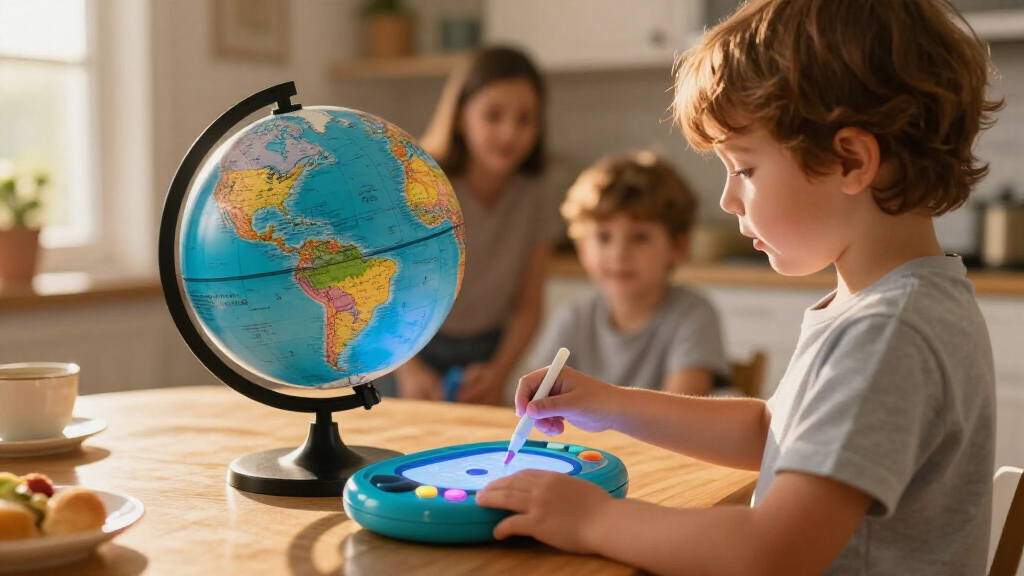
I compared the 11 globes by how well their interaction supports learning, not by feature count alone. I looked at the differences between talking audio, smart-pen controls, light-up elements, and app-based AR, then considered whether those formats seem suited to independent play or adult-supported activities. I also weighed age guidance, language options, map size, setup needs, and the likely space required at home.
The ranking favors options with a clear learning identity, accessible interaction, and a useful balance between play and geography. Models with a distinctive strength—such as AR, bilingual audio, or a larger traditional globe—remain strong choices for specific households, but they rank below more broadly useful picks when their format or setup narrows the audience. Product names and features are compared as listed; I do not treat every interactive feature as equally valuable if it adds complexity without changing how a child learns.
Factors to Consider When Choosing Interactive Science Globes For Kids
Before choosing a globe, decide what you want a child to do with it after the first burst of novelty. The right format depends on how they learn, whether a tablet fits your household, and how much adult setup you are willing to handle. These broader checks can prevent a feature-rich globe from becoming a toy that is rarely used.
Choose the Interaction That Fits Your Child
Some children enjoy listening and pressing controls, while others prefer a pen-like tool or activities linked to a screen. Match the interaction to a child’s habits rather than assuming more modes mean more learning. A child who likes independent exploration may find audio prompts easier to revisit than a sequence that needs an adult to start an app. A tablet-oriented child may respond well to AR, but that format brings another device into the activity. If possible, check whether controls are easy to hold and operate for the intended age. The common mistake is buying for novelty instead of the way the child already chooses to play.
Check App, Device, and Internet Expectations
App-linked globes can add animation and interactive layers, but they also make compatibility part of the purchase decision. Check the current app requirements, supported devices, and whether the activities work offline before choosing an AR model. A household with a shared tablet may need to schedule globe time or supervise handling, while a dedicated device can make setup simpler. Ask whether the child can use the main learning features without a phone or tablet. Do not assume that an app is a drawback for every family: for a child who enjoys digital exploration, it may be the feature that sustains interest. The tradeoff is between richer screen-linked content and a more self-contained activity.
Match Size to the Child and the Room
A larger globe gives a child more room to locate labels and follow borders, but it also takes up more desk or shelf space. Compact models can be easier to store and move, though smaller lettering may be harder for young readers to inspect. Think about where the globe will live and whether the child will use it seated at a desk or carry it between rooms. A model that is awkward to reach or put away may see less use regardless of its features. Also check whether the stand feels stable for the kind of handling the child is likely to give it. The best size is the one that stays accessible without crowding the play area.
Treat Age Guidance as a Starting Point
Age labels help narrow a shortlist, but children of the same age can have very different reading, attention, and motor skills. A younger child may enjoy short audio facts but need help finding a location; an older child may want more detailed geography or independent quizzes. Look for the complexity of the activities, not just the age range printed on the package. If several siblings will share one globe, choose a model with interaction that can hold the interest of more than one developmental stage. A common mistake is buying a model that is either too simple to grow with the child or too demanding to use without adult help. Consider whether the globe can remain useful as curiosity shifts from animals and countries to broader science topics.
Decide Which Learning Content Matters Most
Interactive globes can emphasize country facts, quizzes, animals, languages, or general discovery, and those are different learning goals. Choose based on what the child asks about already rather than treating all educational content as equivalent. A nature-focused child may value animal facts more than a larger collection of country prompts, while a family practicing another language may prioritize bilingual audio. Compare what the child can revisit: repeatable questions and exploration often last longer than a single guided sequence. Check whether facts are spoken, displayed, or both, since that changes how useful the globe is for early readers. The strongest match is a content focus that connects to the child’s existing interests while still opening up new subjects.
Think About Durability and Ongoing Use
Interactive toys may rely on batteries, a stylus, a speaker, or a companion app, so small practical details can affect how often they get used. Check what is included, whether the required power source is easy to replace, and how the pen or accessories are stored. A globe with a missing stylus or drained batteries can quickly lose its appeal, especially for a child who expects it to work independently. For younger users, a stable base and controls that tolerate repeated handling may matter more than extra activities. Consider whether the globe can also serve as a reference object when its electronic features are off. That kind of everyday usefulness can make a simpler model a better long-term fit than a more elaborate one.
Frequently Asked Questions
Should I choose an AR globe or a talking globe?
Choose an AR globe if the child enjoys tablet activities and you are comfortable managing an app as part of play. It can make exploration feel more visual, but device compatibility and setup become part of the experience. A talking globe is a better fit when you want audio interaction without making a tablet central to every session. Check whether the child can use the features independently and whether app content works in your household’s usual setup. The choice is less about which format is universally better and more about whether screen-linked play is a benefit or a complication for your family.
Can an interactive globe work for children who cannot read yet?
It can, particularly when the globe uses spoken prompts or simple controls rather than expecting a child to read map labels independently. A younger child may still need an adult to help locate a country or understand how a quiz works. Check whether the audio can be replayed and whether controls are easy for small hands. A model with lots of written information may be more rewarding later, but could be frustrating at first without help. For a pre-reader, prioritize accessible audio and short activities over a large amount of text.
Is a smaller globe a poor choice for learning geography?
No, but size affects how comfortably a child can explore labels and borders. A compact globe can be easier to keep on a desk or put away after play, which may make it more available day to day. A larger model gives more room to inspect the map and may be easier for siblings to share. Think about the child’s eyesight, reading ability, and available space rather than choosing by diameter alone. If the globe will mostly be used for quick audio facts, compact size may be a sensible tradeoff; detailed map study favors more surface area.
Do I need to buy a globe with a smart pen?
A smart pen can make it easier for a child to select places or trigger facts without searching for small buttons. It may suit children who like a clear point-and-listen routine, but it also adds an accessory that can be misplaced or need care. A globe with built-in controls or audio interaction may be simpler for a household that prefers fewer parts. Consider the child’s coordination and whether they tend to keep track of small items. The pen is useful when its interaction is easier for that child, not simply because it is an extra feature.
Which features matter most if siblings of different ages will share one globe?
Look for more than one level of engagement: younger children may enjoy short facts and easy controls, while older siblings may want quizzes, detailed maps, or broader content. A globe that offers varied activities is more likely to remain useful across age gaps than one built around a single type of prompt. Check whether children can take turns without needing repeated adult setup, especially for app-based models. A bilingual option or a nature-focused feature may add shared interest if it matches the household. If one child is much older, make sure the content still offers enough depth for that child rather than relying on the younger sibling’s enjoyment.
Conclusion
For the broadest mix of interactive learning, I recommend the LeapFrog Magic Adventures Globe as the best overall choice. The best value depends on which features a family will actually use; a compact talking globe may be the more practical pick than paying for app-based activities that will stay untouched. For a premium, screen-linked experience, consider the PlayShifu Orboot Earth Explorer, while the best beginner fit is a globe with simple audio prompts and controls suited to the child’s age. Choose the 8-Inch Interactive Bilingual Talking Globe for language practice, the GeoSafari model for a nature-centered interest, and the 12-inch Replogle for buyers who prefer a larger traditional talking globe. In short, start with the interaction style your child will use, then narrow the choice by space, age, and content.
Halloween Picks
halloween
As an affiliate, we earn on qualifying purchases.