For most families, the HEWEIMEI 1600x Digital Microscope is the strongest overall choice because its 4-inch screen and high stated magnification favor shared viewing, while the BEBANG PM1000 STEM Kit suits children who want slides and activities alongside the microscope. For a more portable option, the Edubini 1000x pairs a handheld format with a 2-inch IPS screen. The main tradeoff is between a larger, easier-to-share display and a compact design that is simpler for small hands to carry; included slides and storage also vary. Read on for the full comparison, buying advice, and picks for different ages and uses.

Prime made for students and young adults
- Fast, free delivery for dorm and study essentials
- Prime Video and Amazon Music included
- Member-only deals
Key Takeaways
- Screen size is a meaningful separator: the HEWEIMEI and BEAVERLAB models offer 4-inch screens, while many handheld picks use screens around 2 inches.
- High magnification claims do not tell the whole story: most listed models reach 1000x, but usability also depends on lighting, focus control, and a steady setup.
- Ready-to-use kits differ from bare handheld microscopes: the BEBANG STEM Kit and Odatay kit with 12 slides give beginners material to examine right away.
- Storage and image capture vary: the Odatay 4K model lists a 32GB card, a useful distinction for families who want to save images and videos.
- Special formats serve narrower needs: the Starpark detachable borescope is the unusual pick for viewing hard-to-reach spaces, not the simplest first microscope.




| digital microscopes for kid | Magnification | Lighting | Screen | Camera |
|---|---|---|---|---|
| Pozifu 1000X Handheld Digital | 50X–1000X | 8 adjustable LED lights | — | 1080P, 2MP |
| Edubini Kids Digital Microscop | Up to 1000x | — | 2.0-inch IPS, 4K HD | — |
| BEBANG PM1000 Kids Digital Mic | 200x–1000x, five levels | — | 4K screen | — |
| Alotwan 1000X Handheld Digital | Up to 1000X | 8 adjustable built-in LED lights | 2-inch 4K HD | — |
| HEWEIMEI 1600x Digital Microsc | 100x–1600x | 6 LED lights with 3 brightness modes | 4-inch IPS | 48 MP; 1080p video |
| Vorth 1000X Handheld Digital M | Up to 1000X | — | — | — |
| BMDSAE 1000X Handheld Digital | Up to 1000X | 8 LEDs with 3 brightness settings | 2.0-inch IPS | 2MP |
| Odatay 1000X Digital Microscop | 100X–1000X | 8 LED fill lights | 2.0-inch IPS | 2-megapixel, 1080P |
| Ashfly 1000X Handheld Digital | 100X–1000X | 8 LEDs with 4 brightness levels | — | 2MP |
| EMIADY 1000X Handheld Digital | 200X–1000X, optical and digital | 8 LEDs with 3 brightness levels | — | 2MP |
| Odatay 4K Digital Microscope f | 200x–1000x | 8 built-in LEDs; 3 brightness levels | 2.4 inches | 4K HD |
| BEAVERLAB Finder 4.0-Inch Hand | 100X–1600X | 8 adjustable lights | — | — |
| 4K Handheld Digital Microscope | 200–1000x | 8 built-in LEDs; 3 brightness levels | 2.0-inch IPS | 4K HD |
| BMDSAE 1000X Handheld Digital | Up to 1000X | 8 adjustable LEDs; 3 brightness modes | 2.0-inch IPS | 2MP |
| Starpark Handheld Digital Micr | — | LED lights; 3 adjustable brightness levels | 2.4-inch IPS | — |
More Details on Our Top Picks
Pozifu 1000X Handheld Digital Microscope for Kids
The Pozifu is my pick for families who want a microscope children can carry between the kitchen table, garden, and classroom. Its 2-inch IPS display lets kids inspect a specimen without a separate computer, while the 50X–1000X range and eight adjustable LEDs give them room to try different objects and lighting. It also captures photos and video, and USB connectivity lets discoveries move to a computer. Compared with the BEBANG PM1000, it is lighter on supplied learning materials: the BEBANG includes prepared slides and a 32GB card, while Pozifu requires buyers to provide a TF card. The Pozifu instead offers a protective case and Type-C charging. Its small screen is less suited to a group gathered around one view, and the card omission adds a setup step.
Pros:- 50X–1000X magnification range with eight adjustable LED lights
- Captures photos and video and connects to a computer by USB
- Lightweight design includes a lanyard and protective case
- Rechargeable battery charges through USB Type-C
Cons:- TF card needed for photo storage is not included
- The 2-inch display can feel cramped when several children are viewing together
Best for: Families seeking a lightweight handheld microscope for children to use at home and outdoors, with a case for carrying it between activities.
Not ideal for: Teachers or families who want ready-to-view prepared slides, included photo storage, or a larger screen for shared viewing.
- Magnification:50X–1000X
- Display:2.0-inch IPS
- Camera:1080P, 2MP
- Lighting:8 adjustable LED lights
- Storage:Up to 200 pictures; TF card required and not included
- Connectivity:USB to PC
- Battery and charging:Built-in 600mAh rechargeable battery; USB Type-C
- Included accessories:Lanyard and protective case
Our verdict“Choose the Pozifu for portable, flexible exploration, but pick the BEBANG PM1000 if included slides and memory matter more.”
Edubini Kids Digital Microscope with 1000x Zoom and 2.0-Inch IPS Screen
For a child who is just starting to explore magnified images, the Edubini keeps the process uncomplicated: it has a built-in 2-inch screen, photo and video capture, and no app requirement. That makes it easier to begin observing without first pairing a phone or installing software. Its handheld format and included neck strap also suit short outdoor investigations. Compared with the Pozifu 1000X, the Edubini description gives less detail about lighting and photo-storage capacity, so I would favor Pozifu when adjustable illumination and a specified storage limit matter. Edubini’s advertised 4K HD screen is still only two inches across, and computer viewing depends on a compatible PC. The plastic body and short 30-day warranty also make it a less reassuring choice for rough, frequent use.
Pros:- Works without an app or complicated setup
- Records photos and videos for later viewing
- Portable design includes a neck strap
- USB cable is included for charging
Cons:- Computer viewing requires a compatible PC
- Plastic enclosure may be less suited to rough handling
- Warranty is 30 days
Best for: First-time microscope users aged five and up who want a straightforward handheld device for casual home or outdoor observations.
Not ideal for: Families seeking a long warranty, detailed storage specifications, or a microscope with a larger screen for group viewing.
- Magnification:Up to 1000x
- Screen:2.0-inch IPS, 4K HD
- Recording:Photo and video
- Light source:LED
- Real angle of view:110 degrees
- Power:Battery-powered, 3.7 volts
- Compatible devices:Laptop and personal computer
- Included items:USB cable, neck strap, and instruction manual
- Recommended age:5 years and up
Our verdict“Choose Edubini for a simple first microscope, but favor the Pozifu if defined lighting and storage details are higher priorities.”
BEBANG PM1000 Kids Digital Microscope STEM Kit
The BEBANG PM1000 is the most ready-to-explore package in this group. A 32GB memory card, five prepared glass slides, and a fitted EVA case give children a place to start observing and a way to save discoveries without buying those essentials separately. Its five magnification levels from 200x to 1000x encourage changing views rather than relying on a single setting. Compared with the Alotwan 1000X, which has a 2-inch screen and built-in storage for about 200 photos, the BEBANG puts more emphasis on supplied learning materials and a larger-capacity card. The tradeoff is a stated battery runtime of about 2.5 hours, plus a learning curve: a clear image depends on adjusting focus, distance, and light. It is a stronger starter kit than a grab-and-go pick for users who want instant, effortless viewing.
Pros:- Includes a 32GB memory card for saving photos and videos
- Five prepared glass slides provide immediate subjects to inspect
- Five magnification levels support varied observations
- Fitted EVA case, neck strap, and Type-C cable are included
Cons:- Approximately 2.5 hours of continuous use per charge
- Getting a clear image requires manual focus, distance, and lighting adjustments
Best for: Families buying a child’s first STEM microscope who want prepared slides, storage, and a protective case included.
Not ideal for: Children who need very simple point-and-view operation, or families wanting the longest possible session between charges.
- Magnification:200x–1000x, five levels
- Screen:4K screen
- Memory:32GB card included
- Prepared slides:5 glass specimens
- Battery life:Approximately 2.5 hours of continuous use
- Charging:Rechargeable; Type-C cable included
- Weight:0.34 lb
- Included accessories:EVA case, neck strap, memory card, slides with case, and user manual
- Warranty:1 year
Our verdict“Pick the BEBANG when a complete, organized STEM kit matters more than the simplest controls or extended battery sessions.”
Alotwan 1000X Handheld Digital Microscope for Kids with 2-Inch Screen
Alotwan suits families who want a handheld microscope that can save a small batch of discoveries without an immediate memory-card purchase. Its built-in storage holds about 200 photos, and the device also supports an optional card up to 64GB for added image storage. Eight adjustable LEDs help children adapt illumination to different specimens, while the compact body and neck strap make it easy to carry outdoors. Compared with the Pozifu 1000X, Alotwan specifies its built-in photo capacity and adds memory-card expansion; both use a 2-inch screen and offer Type-C charging. The limit is that extra storage requires a card that is not included, and the 600mAh battery lasts up to two hours per charge. The small display also makes this a personal-viewing tool, not an ideal shared classroom screen.
Pros:- Built-in storage holds about 200 photos
- Supports memory-card expansion up to 64GB
- Eight adjustable LEDs provide control over specimen lighting
- Compact 136 g body includes a neck strap
Cons:- Memory card is not included for additional storage or video recording
- Battery runtime is up to two hours per charge
- Two-inch screen is limiting for group viewing
Best for: Families who want children to save a modest set of microscope photos internally and add a memory card later if needed.
Not ideal for: Children who need long uninterrupted sessions, or groups that need a large display to share observations.
- Magnification:Up to 1000X
- Screen:2-inch 4K HD
- Lighting:8 adjustable built-in LED lights
- Weight and dimensions:136 g; about 4 x 3.15 inches
- Battery:600 mAh rechargeable; up to 2 hours per charge
- Charging:Type-C
- Photo storage:About 200 photos built in
- Memory-card support:Up to 64 GB; card not included
- Functions:Microscope viewing, distant-object observation, photo and video capture
Our verdict“Choose Alotwan for built-in photo saving and expandable storage, but consider the BEBANG if included card storage and slides are more useful.”
HEWEIMEI 1600x Digital Microscope for Kids with 4-Inch Screen
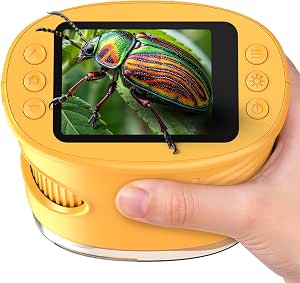
Among these five, the HEWEIMEI is the clear choice when screen size matters most. Its 4-inch IPS display gives children more room to inspect a specimen than the 2-inch screens on the Pozifu, Edubini, and Alotwan, making it easier to share a view without crowding around a tiny panel. The detachable design also supports desktop, handheld, and portable use, so it can shift from a steady table setup to outdoor exploration. Its 100x–1600x range exceeds the 1000x maximum of the BEBANG PM1000, though the higher ceiling alone does not make observations easier. Six LEDs have three brightness modes, and the camera records 1080p video. The tradeoffs are a non-removable battery and fewer supplied usage details, including no stated runtime or included storage card.
Pros:- Large 4-inch IPS screen is more comfortable for shared viewing
- 100x–1600x magnification range
- Detachable design supports desktop, handheld, and portable modes
- Six LEDs offer three brightness modes
Cons:- Built-in lithium-polymer battery is non-removable
- Battery runtime is not specified in the supplied product details
- No memory card or storage capacity is specified
Best for: Families who want a larger screen for shared viewing and a microscope that can switch between tabletop and handheld use.
Not ideal for: Buyers who prioritize a removable battery, clearly specified battery runtime, or included digital storage.
- Magnification:100x–1600x
- Screen:4-inch IPS
- Camera:48 MP; 1080p video
- Lighting:6 LED lights with 3 brightness modes
- Modes:Desktop, handheld, and portable
- Real angle of view:45 degrees
- Battery:Built-in, non-removable lithium-polymer pouch cell
- Included items:Instruction manual, lanyard, sample-preparation kit, and slides
- Intended age range:3–14 years
Our verdict“Choose the HEWEIMEI for a larger, more shareable screen and flexible setup, but pick a smaller handheld model if portability and specified storage matter more.”
Vorth 1000X Handheld Digital Microscope for Kids with 2.4-Inch IPS Screen
The Vorth pairs a 2.4-inch IPS display with a cat-shaped ABS and silicone body, giving younger children a larger viewing area and a more tactile grip than the BMDSAE’s 2-inch-screen design. Its oversized textured focus wheel is a practical advantage for small hands learning to bring a specimen into focus. It also captures photos and videos, with built-in capacity for about 200 photos and optional SD-card expansion. That storage comes with a catch: the card is sold separately, and files saved internally cannot be transferred directly to another device. Computer viewing uses Type-C, but requires compatible software. The listed battery life of up to three hours is longer than the BMDSAE’s two hours, making this a stronger fit for extended exploration, though neither display replaces a computer for group viewing.
Pros:- Larger 2.4-inch IPS display than the BMDSAE’s 2-inch screen
- Textured oversized focus wheel is designed for small hands
- Captures photos and videos, with computer connection and optional SD-card support
- Up to three hours of listed battery life
Cons:- Optional SD card is not included
- Built-in photos cannot be transferred directly to other devices
- Computer viewing requires compatible software
Best for: Younger children who need an easy-to-grip body and a larger onboard screen for independent close-up exploration.
Not ideal for: Families who want simple file transfers or ready-to-use video storage; the optional SD card is not included, and built-in files cannot be transferred directly.
- Magnification:Up to 1000X
- Display:2.4-inch IPS HD
- Battery:600mAh; up to 3 hours
- Connection:Type-C
- Storage:About 200 photos built in; optional SD card not included
- Materials:ABS and food-grade silicone
- Recommended age:3–12 years
- Included items:Microscope, instructions, charging cable, lanyard
Our verdict“Choose the Vorth for a more child-friendly grip and larger screen, but skip it if straightforward file transfer matters most.”
BMDSAE 1000X Handheld Digital Microscope for Kids with 2.0-Inch IPS Screen
The BMDSAE stands out for children who want to tune the view rather than simply point and look: its eight LEDs and three brightness settings let them adjust illumination for different specimens. Manual focus adds a hands-on learning step, though younger children may need help at first. Compared with the Ashfly, which offers four brightness levels and up to three hours of battery life, the BMDSAE has fewer lighting steps and a shorter listed runtime of two hours. Its 2MP camera saves photos and AVI videos to 32M of storage, and USB-C supports connection to Windows and newer Mac systems. That makes sharing possible, but the modest 2-inch screen is less comfortable for showing details to a group than the Vorth’s 2.4-inch display.
Pros:- Eight LEDs with three brightness settings for adjusting specimen illumination
- Manual focus gives children a hands-on way to sharpen the image
- Saves photos and AVI videos and connects to compatible computers via USB-C
- Lanyard and USB-C data cable are included
Cons:- Up to two hours of listed battery life is shorter than the Ashfly’s three hours
- Manual focus can take practice for younger children
- The 2-inch screen offers less viewing space than the Vorth’s 2.4-inch display
Best for: Children ready to practice manual focusing and experiment with lighting, with an adult nearby to help younger beginners.
Not ideal for: Families planning long outdoor sessions or group viewing; battery life is listed at two hours, and the screen is only 2 inches.
- Magnification:Up to 1000X
- Screen:2.0-inch IPS
- Camera:2MP
- Lighting:8 LEDs with 3 brightness settings
- Battery:600mAh; up to 2 hours
- Storage:32M; supports 200+ photos or AVI videos
- Connectivity:USB-C
- Compatible systems:Windows XP/Vista/7/8/10/11; Mac 11.0 or later
Our verdict“Pick the BMDSAE for adjustable lighting and hands-on focusing, not for longer sessions or a roomier built-in screen.”
Odatay 1000X Digital Microscope Kit for Kids with 12 Slides and 2-Inch Screen, Blue
The Odatay is the easiest pick here for getting a child started with prepared specimens: 12 included plastic slides mean there are ready-made subjects to inspect before anyone has to find and mount samples. Its 100X–1000X range, 1080P camera, and eight LED lights provide a familiar handheld setup, while computer connection can move viewing to a larger display. Compared with the Ashfly, the Odatay offers slides and capacity for up to 500 photos, but the Ashfly has a larger listed built-in photo-and-video capacity and does not depend on a separate memory card for its stated storage. The Odatay’s 2-inch screen is compact, and expandable Micro SD storage is not included. Its rechargeable battery is listed without a runtime, so I would not choose it over the Ashfly for a trip where session length is a deciding factor.
Pros:- Includes 12 plastic slides with plants, vegetables, insects, and animals
- Offers 100X–1000X magnification and a 1080P camera
- Eight LED lights support viewing in dimmer settings
- Can connect to a computer for larger-screen viewing
Cons:- Micro SD card for expandable storage is not included
- The 2-inch display is smaller than the Vorth’s 2.4-inch screen
- Battery runtime is not stated in the product details
Best for: Families buying a child’s first digital microscope who want prepared plant, insect, and animal slides included in the box.
Not ideal for: Buyers who want a larger built-in display or clearly stated battery runtime; its screen is 2 inches and runtime is not specified.
- Magnification:100X–1000X
- Camera:2-megapixel, 1080P
- Screen:2.0-inch IPS
- Lighting:8 LED fill lights
- Storage:Up to 500 photos; expandable with Micro SD card not included
- Media:Photos and videos
- Included slides:12 plastic slides
- Warranty:2 years
Our verdict“Choose the Odatay when ready-to-view slides matter more than a larger screen or a specified battery runtime.”
Ashfly 1000X Handheld Digital Microscope for Kids
Among these five, the Ashfly is the most straightforward choice for taking a microscope outside: it weighs 200g, includes a detachable neck strap, and lists up to three hours of battery life. Its eight LEDs have four brightness levels, one more than the BMDSAE, giving children more control when lighting changes. The 2-inch display is no larger than the BMDSAE’s, but the Ashfly avoids a separate card for its stated onboard capacity of over 200 photos and AVI videos; files transfer over USB-C. Compared with the Odatay, it does not include starter slides, so families will need to find their own specimens. Storage is still limited, and the three-hour figure is a maximum rather than a reason to leave a charging cable behind for a full day of exploration.
Pros:- Lightweight 200g body with a detachable neck strap
- Eight LEDs offer four brightness levels
- Stores over 200 photos and AVI videos without requiring an SD card for that capacity
- Up to three hours of listed battery life
Cons:- Built-in storage is limited for families who record frequently
- The 2-inch screen is smaller than the Vorth’s 2.4-inch display
- No prepared slides are included, unlike the Odatay kit
Best for: Children who want a lightweight handheld microscope for backyard or travel use, with onboard photo and video storage.
Not ideal for: Families looking for a ready-made slide activity kit or a larger screen; it includes no prepared slides and has a 2-inch display.
- Magnification:100X–1000X
- Camera:2MP
- Display:2-inch IPS color screen
- Lighting:8 LEDs with 4 brightness levels
- Storage:Over 200 photos and AVI videos built in
- Connectivity:USB-C charging and file transfer
- Battery:600mAh; up to 3 hours
- Weight:200g
Our verdict“Pick the Ashfly for portable, card-free recording and longer listed runtime, but choose the Odatay if prepared slides are a priority.”
EMIADY 1000X Handheld Digital Microscope for Kids with 2.4-Inch IPS Screen, 2MP Camera, and 8 LEDs, Yellow
The EMIADY suits families who plan to use a computer as part of the activity: it supports viewing and recording on compatible Windows and macOS systems, while its 2.4-inch IPS, 1080P display remains useful for quick handheld checks. That screen matches the Vorth’s size, but the recording setup is less ready to use: video requires a microSD card, which is not included, and built-in storage holds about 200 photos. The Ashfly, by comparison, lists onboard photo and AVI-video storage without requiring a separate card for its stated capacity. The EMIADY adds eight LEDs with three brightness levels and a neck strap, but its listed two-hour battery life is shorter than both the Vorth and Ashfly. Its combined optical and digital magnification also makes the maximum figure less informative than a purely optical specification.
Pros:- 2.4-inch IPS 1080P display is larger than the 2-inch screens on the BMDSAE and Ashfly
- Compatible Windows and macOS computers support viewing and recording
- Eight LEDs offer three brightness levels
- Neck strap and Type-C charging cable are included
Cons:- Video recording requires a microSD card, which is not included
- Built-in storage holds approximately 200 photos
- Up to two hours of listed battery life is shorter than the Vorth’s and Ashfly’s
Best for: Families with a compatible Windows or Mac computer who want to view or record microscope activity on a larger display.
Not ideal for: Children who need standalone video capture or longer outings; video needs a separately purchased microSD card, and battery life is listed at up to two hours.
- Magnification:200X–1000X, optical and digital
- Display:2.4-inch IPS, 1080P
- Camera:2MP
- Lighting:8 LEDs with 3 brightness levels
- Battery:600mAh rechargeable; up to 2 hours
- Charging:Type-C
- Storage:About 200 photos built in; microSD card not included
- Computer compatibility:Windows XP/Vista/7/8/10/11 and macOS 11.0 or later
- Dimensions:4.13 x 3.74 inches
Our verdict“Choose the EMIADY for computer-supported viewing and its larger screen, but skip it if you want video recording without buying a memory card.”
Odatay 4K Digital Microscope for Kids, 200–1000x Magnification, 2.4-Inch Screen, 32GB Card, Blue
The Odatay makes a strong case for families who want a child to start exploring without collecting accessories first. Its 12 prepared slides offer immediate subjects to examine, while the included 32GB card gives photos and videos room to accumulate. Compared with the BEAVERLAB Finder, its stated 4K camera and larger included storage favor capturing and keeping media, but the Finder has a roomier 4.0-inch screen for viewing specimens. The Odatay’s 2.4-inch display is compact, and its 200–1000x range is not as broad on paper as the Finder’s 100–1600x. Eight LEDs with three brightness levels help adjust illumination, and its handheld design suits exploration away from a desk. File transfer requires a PC connection, so it is less convenient for children who want to share images directly.
Pros:- Includes 12 prepared slides for getting started right away
- 32GB TF card provides included space for photos and videos
- Eight LEDs with three brightness levels help illuminate different specimens
- Lightweight handheld design includes a lanyard and tripod hole
Cons:- The 2.4-inch screen offers less viewing space than the BEAVERLAB Finder’s 4.0-inch display
- File transfer and extended use require a PC connection
- The listed magnification range tops out below the BEAVERLAB Finder’s 1600x
Best for: Families seeking a portable first microscope with prepared slides and storage included for documenting discoveries.
Not ideal for: Children who need a large screen for shared viewing or families who want simple wireless image sharing without connecting a PC.
- Magnification:200x–1000x
- Camera:4K HD
- Screen:2.4 inches
- Lighting:8 built-in LEDs; 3 brightness levels
- Storage:32GB TF card included
- Included accessories:12 prepared slides, cable, lanyard, slide viewing cover, protective screen case
- Connectivity:PC connection for file transfer
- Weight:0.25 kg (0.5 lbs)
Our verdict“Choose the Odatay for a portable, accessory-rich starter setup, but pick the BEAVERLAB Finder if screen size and image sharing matter more.”
BEAVERLAB Finder 4.0-Inch Handheld Digital Microscope for Kids, 100X–1600X
The BEAVERLAB Finder is the clearest fit here for children who want to see their discoveries on the device rather than squint at a small screen. Its 4.0-inch IPS display gives siblings or an adult more room to follow along than the 2.4-inch Odatay, while the built-in hotspot adds a sharing option absent from that model. Its 100X–1600X range is also the broadest stated range among these five picks, though magnification alone does not guarantee clearer detail; the camera is listed as 2 MP with 1080p imaging. Eight adjustable lights help with specimens of different brightness and texture. The tradeoff is a modest 8 GB card, less included starter material than the Odatay’s prepared slides, and no charging adapter in the box. Its stated age range, 36 months–8 years, may also be limiting for older students.
Pros:- Large 4.0-inch IPS screen is easier to share and view than the smaller screens on the other picks
- Built-in hotspot supports image and video sharing
- 100X–1600X stated magnification range covers a broad range of close-up exploration
- Eight adjustable lights help adapt illumination to different specimens
Cons:- Included 8 GB TF card offers less storage than the Odatay’s 32GB card
- Charging adapter is not included
- Listed recommended age range ends at 8 years
Best for: Younger children and families who value a larger on-device screen and want to share captured images without relying only on a PC.
Not ideal for: Older children seeking a microscope to grow with them, or buyers who want prepared slides, a larger included memory card, or a charging adapter in the package.
- Display:4.0-inch IPS
- Magnification:100X–1600X
- Image resolution:1920 × 1080
- Camera sensor:2 MP CMOS
- Lighting:8 adjustable lights
- Connectivity:Built-in hotspot
- Storage:8 GB TF card included
- Power:Battery powered; lithium-ion battery included
- Recommended age:36 months–8 years
Our verdict“Pick the BEAVERLAB Finder if a roomy screen and sharing features matter more than extensive included accessories or storage.”
4K Handheld Digital Microscope for Kids, 200–1000x Magnification, 2.0-Inch IPS Screen, Blue
This ASPOVEN model suits children who want a simple handheld way to capture and replay what they find. It combines a 4K camera with photo, video, playback, and file-management functions, so a young explorer can review discoveries without treating the microscope as just a live viewer. At 0.5 lbs, it is easy to carry with the included neck strap; the Odatay is similarly portable but gives buyers a 32GB card and prepared slides, neither of which is listed here. Both share a 200–1000x range and eight lights with three brightness levels. The main compromise is the 2.0-inch screen, smaller than the Odatay’s 2.4-inch display and far smaller than the BEAVERLAB Finder’s. USB power is required for operation or charging, which makes uninterrupted outdoor use less straightforward.
Pros:- 4K camera supports photo and video capture
- Playback and file-management functions let children revisit their finds
- Lightweight 0.5 lb design includes a neck strap
- Eight LEDs offer three brightness levels
Cons:- The 2.0-inch screen is smaller than the Odatay’s 2.4-inch display
- USB power is required for operation or charging
- No TF card or prepared slides are listed among the included items
Best for: Children ages 3–12 who want a light carry-along microscope with built-in photo and video review features.
Not ideal for: Families prioritizing a larger screen, included memory card, or prepared specimens, or children who need to explore far from USB power for long stretches.
- Magnification:200–1000x
- Camera:4K HD
- Screen:2.0-inch IPS
- Lighting:8 built-in LEDs; 3 brightness levels
- Media functions:Photo taking, video recording, playback, file management
- Connectivity:PC connection for file transfer or extended use
- Power:USB; Type-C charging cable included
- Weight:0.5 lbs
- Recommended age:3–12 years
Our verdict“Choose this ASPOVEN for lightweight capture and replay, but favor the Odatay if you want slides and storage included.”
BMDSAE 1000X Handheld Digital Microscope for Kids with 2.0-Inch IPS Screen, Purple
The BMDSAE is the pick for a child ready to take a more active role in lining up a specimen. Its manual focus asks the user to adjust the image rather than relying only on a quick point-and-view approach; that can make focusing part of the activity, but it also means younger children may need help. The 2MP camera and 2.0-inch IPS screen make this a more modest capture setup than the 4K Odatay or ASPOVEN. It stores 32M of media, stated as enough for 200+ photos or AVI videos, so it can save discoveries without a separate card. That is convenient, though the Odatay’s included 32GB card offers much more stated capacity. Eight adjustable LEDs and USB-C support round out a compact package; battery life is limited to up to two hours.
Pros:- Manual focus gives children direct control over image adjustment
- Built-in 32M storage is specified for 200+ photos or AVI videos
- Eight adjustable LEDs provide three brightness modes
- USB-C connection supports charging and computer transfer
Cons:- Manual focusing may frustrate younger users or require adult help
- Up to two hours of battery life can limit longer exploration sessions
- 2MP camera and 2.0-inch screen are more modest than the Odatay’s 4K camera and 2.4-inch display
Best for: Children who enjoy adjusting equipment themselves and want a compact microscope for short sessions with basic photo and video storage.
Not ideal for: Younger children who need effortless focusing, or families planning long outings without access to charging.
- Magnification:Up to 1000X
- Camera:2MP
- Screen:2.0-inch IPS
- Focus:Manual
- Lighting:8 adjustable LEDs; 3 brightness modes
- Storage:32M; supports 200+ photos or AVI videos
- Battery:600mAh; up to 2 hours
- Connectivity:USB-C
- Weight:200g
Our verdict“Choose the BMDSAE for a child who wants to practice focusing, not for families seeking the longest runtime or highest-resolution capture.”
Starpark Handheld Digital Microscope and Detachable Borescope Camera for Kids
The Starpark takes a different route from the other picks: its detachable flexible borescope lets children look into spaces that a conventional handheld microscope cannot easily reach, adding variety beyond close-up views of leaves or fabric. That makes it a more general exploration tool than the Odatay, which is better equipped for prepared-slide sessions with its included 12 slides. Starpark has a 2.4-inch IPS screen and three brightness settings, plus built-in memory for up to 100 photos, so basic image saving does not depend on buying a card. Video is a separate matter: a compatible memory card is required and is not included. The USB-C rechargeable design and soft silicone cover suit younger users, but the device must be kept dry, which limits wet-area exploration.
Pros:- Detachable flexible borescope adds access to hard-to-reach spaces
- Built-in memory stores up to 100 photos without a card
- 2.4-inch IPS screen is larger than the 2.0-inch screens on the ASPOVEN and BMDSAE
- Soft silicone cover and USB-C rechargeable battery suit portable use
Cons:- Video recording requires a compatible memory card that is not included
- The unit must be kept dry
- Does not include prepared slides like the Odatay
Best for: Children ages 3–10 who want one handheld device for both close-up viewing and peeking into narrow, hard-to-reach spaces.
Not ideal for: Families focused on recording video from the outset, or children who will use the device around water or damp outdoor conditions.
- Product type:Handheld digital microscope with detachable borescope camera
- Screen:2.4-inch IPS
- Lighting:LED lights; 3 adjustable brightness levels
- Photo storage:Built-in memory for up to 100 photos
- Video recording:Requires a compatible memory card, not included
- Charging:USB-C rechargeable battery
- Recommended age:3–10 years
- Included items:Microscope camera, detachable borescope, charging cable, user manual
Our verdict“Pick the Starpark for two kinds of exploration in one device, but choose the Odatay if prepared slides and ready-to-record media are higher priorities.”

How We Picked
I compared these digital microscopes for kids by how well their listed features support real family use: viewing comfort, handheld usability, stated magnification range, lighting, image capture and included learning materials. A larger screen can make group viewing and fine positioning easier, while a compact body can be more manageable for a child exploring objects around the house. I also gave weight to complete kits and storage features because they can reduce setup friction for beginners.
The ranking favors products with a clearer practical advantage for a broad range of children, not simply the highest magnification number. That puts the HEWEIMEI 4-inch model near the top for its display and stated range, with the BEBANG STEM Kit and slide-included Odatay kit standing out for guided first use. Compact models remain useful alternatives, but similar 1000x claims and small screens make their differences harder to judge from specifications alone. Product details supplied here do not establish hands-on performance, so I treat advertised features as claims rather than verified results.
Factors to Consider When Choosing Digital Microscopes For Kids
Choosing a microscope for a child is less about chasing the biggest number on the box and more about matching the format to how they will explore. These factors can help you avoid paying for features that will go unused or choosing a setup that feels fiddly from the first session.
Choose a Screen That Fits the Way Your Child Will Explore
A built-in display lets a child watch the sample while holding or positioning the microscope, rather than having to look through a separate eyepiece. Larger screens can help when siblings or an adult want to share the view, but a larger unit may be less convenient to carry outdoors or pack away. Small screens keep handheld models compact, though children may need more help framing the sample. Check whether the screen angle and controls look easy to manage from the product details and setup instructions. Do not assume screen size alone means a clearer image; display resolution and camera quality are separate specifications. Match the screen to the setting: a desk-based activity favors shared viewing, while roaming around the yard favors portability.
Treat Magnification as a Starting Point, Not a Guarantee
Magnification figures can be presented differently across products, and a high maximum does not automatically produce a useful view. At greater magnification, a tiny movement can shift the subject out of frame, making stable support and responsive focus controls more important. Children often get more satisfaction from a clear, well-lit view at a moderate setting than from a difficult maximum setting. Look for an explained range and practical guidance on focusing rather than choosing by the largest printed number. If the product description does not explain how magnification is achieved, treat comparisons between headline figures with caution. A microscope’s usefulness also depends on what it can focus on, such as prepared slides or everyday objects.
Check What Comes in the Box Before Buying Extras
A microscope with prepared slides can give a beginner an immediate first activity and help them learn how to position a sample. A more basic handheld model may leave families to find suitable objects, which can be fun for curious children but less structured for a first session. Count the listed slides and accessories, then check whether they are reusable and whether replacement materials are easy to obtain. Avoid assuming that a STEM label means a full curriculum or detailed instructions are included. For a child who likes open-ended discovery, a simple setup may be enough; a child who benefits from guided tasks may appreciate a kit. The right bundle is the one that suits the child’s attention and interests, not the one with the longest accessory list.
Separate Image Quality From Storage and Connectivity
Some models advertise 4K recording, a camera resolution, or a memory card, but those details describe different parts of the experience. A memory card provides room to save files; it does not by itself make images sharper. Likewise, a video-resolution claim may not explain how the microscope performs at every magnification or under different lighting. Check what file formats are supported, whether a card is included, and how images transfer to a computer or phone if sharing matters to your family. If children mainly want to look at samples on the built-in screen, storage may be a lower priority than simple controls. For a science project or digital scrapbook, saving and exporting files deserves more weight.
Prioritize Stability, Lighting, and Child-Friendly Controls
Handheld use gives children freedom to inspect objects, but it can make focusing harder when their hands move. A table, stand, or steady grip can improve the viewing experience, especially at higher magnification. Check how the LEDs are powered and controlled, whether brightness can be adjusted, and whether the buttons are easy for the intended age group. A child who needs frequent adult help may lose interest even if the feature list looks impressive. Look for clear setup instructions and a body that seems manageable for small hands, while checking manufacturer guidance on age and supervision. If the microscope will travel, consider how well the screen and lens are protected between sessions.
Spend More Only for a Feature Your Child Will Use
A premium-format microscope makes sense when its larger display, broader stated range, recording features, or unusual camera design solves a real need. For a first-time user, a straightforward device with a few ready-made samples may be more rewarding than a feature-heavy model. Think about where the child will use it, whether they want to save images, and how often they will share the screen with others. Specialized options such as a detachable borescope suit a child interested in inspecting narrow spaces, but they are less direct as an all-purpose first microscope. Compare the included accessories and support information before focusing on branding or magnification claims. The best fit is the one that makes repeated exploration easy, not the one with the most specifications.
Frequently Asked Questions
Is a 1600x microscope a better choice than a 1000x model for a child?
Not automatically. A higher advertised maximum can be useful for particular small details, but children also need a stable image, manageable focus, and enough light. At high magnification, keeping a subject centered can become harder, especially with a handheld microscope. Compare the full range and controls, not just the maximum figure. For a first microscope, an easier viewing experience may matter more than reaching the highest stated magnification.
Should I choose a 4-inch screen or a smaller handheld model?
A 4-inch screen is more comfortable for shared viewing and can make it easier for a child to see what they are adjusting. A smaller-screen model is usually a better match when portability and compact storage matter most. Consider whether the microscope will mostly stay on a desk or travel between rooms, outdoors, or on trips. Also check the complete device size and weight, since screen dimensions alone do not determine how manageable it is. If siblings will take turns, a larger display may make the activity easier to share.
Do kids need a microscope kit with prepared slides?
Prepared slides are helpful when a child wants to start exploring without first finding and preparing samples. They can also provide a more repeatable way to learn focusing and compare what appears on screen. A kit is not necessary for children who enjoy investigating everyday objects and are happy with open-ended activities. Check whether slides are actually listed in the package and whether instructions explain how to use them. If a child tends to lose interest during setup, ready-to-view materials can make the first session smoother.
Does a 4K label or included memory card mean the microscope takes better pictures?
Those features can help with saving and sharing, but they do not establish overall image quality on their own. A memory card gives files a place to go, while a 4K claim relates to video output under the manufacturer’s stated conditions. Lighting, focus, stability, and the camera itself also affect the result. Check whether the listing explains photo and video formats, card compatibility, and how files transfer to another device. If saving images is not part of the child’s activities, an easy-to-use screen may matter more.
Is a detachable borescope a good first digital microscope for a child?
It can be a good match for a child who is specifically curious about narrow or hard-to-reach spaces, since the camera format serves a different purpose from a standard handheld microscope. It is less direct as a general first pick for viewing prepared slides or small objects on a table. Before choosing it, check how the camera attaches, how it is powered, and whether adult help is needed for setup. A conventional screen-based microscope is likely easier for broad, everyday exploration. Choose the borescope when its specialized access is the main reason for buying.
Conclusion
For a broad family pick, I would start with the HEWEIMEI 1600x model, whose 4-inch screen makes it the clearest fit for shared viewing; the BEAVERLAB Finder is another large-screen option to compare. For best value in practical features, the Odatay kit with 12 slides gives a beginner ready-made material to examine, while the BEBANG PM1000 STEM Kit is my choice for a more activity-led start. The Edubini is the best beginner-friendly compact pick for families who want a straightforward handheld format, and the Odatay 4K with 32GB card suits children who want to save their observations. For a specific job rather than general microscopy, choose the Starpark detachable borescope for inspecting hard-to-reach spaces. If portability is the priority, compare the smaller-screen handheld models; if shared viewing matters more, favor a 4-inch display.