For most families, the Celestron StarSense Explorer 130AZ is the strongest overall pick among kids’ beginner astronomy telescopes because its larger aperture and guided sky-finding app offer room to grow. The Gskyer 70mm Refractor is a more portable choice with a carry bag and phone accessories, while the Celestron Travel Scope 60 suits families who value a compact kit. The main tradeoff is between easy setup and portability on one side, and steadier views with more light-gathering capacity on the other. Small, high-magnification claims do not guarantee clear views, so matching the telescope to a child’s patience and an adult’s willingness to help matters. Read on for the full comparison, buying advice, and picks for different needs.

Prime made for students and young adults
- Fast, free delivery for dorm and study essentials
- Prime Video and Amazon Music included
- Member-only deals
Key Takeaways
- The Celestron StarSense Explorer 130AZ leads on growth potential: its 130mm aperture gives it a clear advantage in light gathering over the 50mm and 60mm options, but its tabletop format calls for a sturdy surface and more adult involvement.
- Most 70mm refractors occupy the practical middle ground: models such as the Gskyer, Vvnonix, National Geographic, and ToyerBee offer a familiar beginner format, but included phone accessories do not replace a stable mount or careful focusing.
- Compact 50mm models trade capability for approachability: the Sobrzy and Luzsco options are easier to handle, yet their limited aperture makes them better suited to simple first looks than to ambitious observing.
- Phone features vary in usefulness: an adapter or remote can help with capturing or sharing a view, but it does not make an instrument easier to aim or improve the telescope’s optical performance.
- There are two Luzsco 50mm entries in the lineup: compare the listed package details carefully, since the shared name and basic configuration make accessories and seller-provided specifications especially relevant.
| Educational Insights GeoSafari Starview Beginner Telescope for Kids |  | Best for Screen-Free Learning | Magnification: 10x and 50x | Mount: Altazimuth | Focus: Manual | VIEW LATEST PRICE | See Our Full Breakdown |
| Gskyer 70mm Refractor Telescope with Carry Bag, Smartphone Adapter, and Wireless Remote |  | Best Portable Photography Kit | Telescope type: Refractor | Objective lens: 70mm | Focal length: 400mm (f/5.7) | VIEW LATEST PRICE | See Our Full Breakdown |
| Vvnonix 70/500 Refractor Telescope for Beginners |  | Best for Lunar Viewing | Model: VX-70-500 | Telescope type: Refractor | Objective lens diameter: 70mm | VIEW LATEST PRICE | See Our Full Breakdown |
| 70mm Refractor Telescope for Beginners with Phone Adapter |  | Best Short-Focal-Length Starter | Telescope type: Refractor | Objective lens diameter: 70mm | Focal length: 300mm | VIEW LATEST PRICE | See Our Full Breakdown |
| Celestron StarSense Explorer 130AZ 130mm Tabletop Telescope |  | Best Overall for Guided Sky Exploration | Aperture: 130mm | Optical design: Newtonian reflector | Focal length: 650mm | VIEW LATEST PRICE | See Our Full Breakdown |
| Celestron Travel Scope 60 Refractor Telescope |  | Best for Travel | Telescope type: Refractor | Aperture: 60 mm | Focal length: 360 mm | VIEW LATEST PRICE | See Our Full Breakdown |
| National Geographic 70mm Refractor Telescope with Tripod and Eyepieces |  | Best for Lunar and Planetary Viewing | Objective lens diameter: 70 mm | Focal length: 700 mm | Mount: Alt-azimuth | VIEW LATEST PRICE | See Our Full Breakdown |
| Sobrzy Beginner Telescope for Kids, 20x–100x Magnification, 50mm Aperture |  | Best Age-Specific Starter Kit | Age range: 8–12 years | Aperture: 50 mm | Focal length: 400 mm | VIEW LATEST PRICE | See Our Full Breakdown |
| ToyerBee 70mm Refractor Telescope with Phone Adapter and Tripod |  | Best for Smartphone Experiments | Telescope type: Refractor | Objective lens diameter: 70 mm | Focal length: 300 mm | VIEW LATEST PRICE | See Our Full Breakdown |
| CLAVOLO Refractor Telescope for Beginners with Finder Scope and 3 Eyepieces |  | Best Compact Tabletop Pick | Optical design: Refractor | Objective diameter: 50 mm | Focal length: 360 mm | VIEW LATEST PRICE | See Our Full Breakdown |
| Luzsco 50mm Beginner Telescope for Kids with Tripod |  | Best for Screen-Free Starter Play | Objective lens diameter: 50 mm | Focal length: 400–600 mm | Optical tube length: 40 cm | VIEW LATEST PRICE | See Our Full Breakdown |
| Fuoibl BY-001 70mm Refracting Telescope with Phone Adapter |  | Best for Phone-Assisted Family Viewing | Optical type: Refracting | Objective lens diameter: 70 mm | Focal length: 300 mm | VIEW LATEST PRICE | See Our Full Breakdown |
| Jvcla Kids Telescope with Compass, Tripod, and 3 Eyepieces |  | Best Lightweight Kit for Ages 8–12 | Model: JSD145 | Objective lens diameter: 32 mm | Magnification: 20X–40X | VIEW LATEST PRICE | See Our Full Breakdown |
| Luzsco 50mm Beginner Telescope for Kids with Tripod |  | Best for Moon-Learning Activities | Objective lens diameter: 50 mm | Magnification range: 20x–100x | Eyepieces: 6 mm and 20 mm | VIEW LATEST PRICE | See Our Full Breakdown |
| NASA Lunar Telescope for Kids with Tripod and Finder Scope |  | Best Moon-Focused Starter | Brand: Blue Marble | Model number: NALUNARSCOPE | Recommended age: 8 years and up | VIEW LATEST PRICE | See Our Full Breakdown |
| kids beginner astronomy telescope | Eyepieces | Included accessories | Focal length | Magnification |
|---|---|---|---|---|
| Educational Insights GeoSafari | — | Tabletop tripod, two lenses, and activity journal | — | 10x and 50x |
| Gskyer 70mm Refractor Telescop | 25mm (16×) and 10mm (40×) | Carry bag, smartphone adapter, and wireless camera remote | 400mm (f/5.7) | — |
| Vvnonix 70/500 Refractor Teles | H20mm, H12mm, and H6mm | 3× Barlow lens, 1.5× erecting lens, Moon filter, phone adapter, and adjustable aluminum tripod | 500mm | — |
| 70mm Refractor Telescope for B | 20mm and 6mm | Tripod, phone adapter, and wireless remote | 300mm | 15×–150× |
| Celestron StarSense Explorer 1 | 10mm and 25mm | — | 650mm | — |
| Celestron Travel Scope 60 Refr | 20 mm and 8 mm | 45° erect image diagonal, 3x Barlow lens, 5×20 finderscope, Moon filter, tripod, travel backpack, Starry Night software | 360 mm | 54x and 135x |
| National Geographic 70mm Refra | Two Plössl eyepieces | 2x Barlow lens, full-size tripod, diagonal, smartphone adapter | 700 mm | — |
| Sobrzy Beginner Telescope for | — | Adjustable tripod, finder scope, two eyepieces, 1.5x erecting eyepiece, lunar filter | 400 mm | 20x–100x |
| ToyerBee 70mm Refractor Telesc | 20 mm and 6 mm | 3x Barlow lens, 5×24 finderscope, tripod, phone adapter, wireless camera remote, star chart | 300 mm | 15x–150x |
| CLAVOLO Refractor Telescope fo | H20 mm, H12.5 mm, SR4 mm | Erecting eyepiece, moon mirror, moon map, star map | 360 mm | 18x–135x |
| Luzsco 50mm Beginner Telescope | 6 mm and 20 mm | Tripod, finderscope, two eyepieces, and Barlow lens | 400–600 mm | — |
| Fuoibl BY-001 70mm Refracting | 6 mm and 20 mm | — | 300 mm | 15X–150X |
| Jvcla Kids Telescope with Comp | Three | — | — | 20X–40X |
| Luzsco 50mm Beginner Telescope | 6 mm and 20 mm | Tripod, finderscope, two eyepieces, Barlow lens, and moon observation guide | — | — |
| NASA Lunar Telescope for Kids | Low-power and high-power | — | — | Up to 90x |
More Details on Our Top Picks
Educational Insights GeoSafari Starview Beginner Telescope for Kids
The GeoSafari Starview is the most activity-led choice here: its journal gives kids a way to connect looking through the telescope with guided, screen-free exploration. The two eyepieces offer 10x and 50x magnification, so a child can switch between a wider view and a closer look without the extra lens combinations supplied with the Vvnonix 70/500. Its tabletop tripod also keeps the setup portable for indoor use or a quick trip outside. The tradeoff is a simpler beginner setup: manual focusing takes practice, and this model is not the best fit for families seeking a more capable telescope for detailed astronomical viewing. Choose it for hands-on learning rather than a large accessory kit or app-guided sky navigation.
Pros:- Two eyepieces provide 10x and 50x magnification for different viewing needs.
- Activity journal encourages guided, screen-free exploration.
- Tabletop tripod supports a compact setup for indoor and outdoor use.
Cons:- Manual focusing may take practice for children new to telescopes.
- Its beginner-focused design offers less scope for more advanced observing than the Celestron StarSense Explorer 130AZ.
Best for: Families with younger beginners who want a portable telescope and a journal-led, screen-free introduction to observing.
Not ideal for: Buyers seeking app-guided object locating, a full-height adjustable tripod, or more advanced viewing capability.
- Magnification:10x and 50x
- Mount:Altazimuth
- Focus:Manual
- Eyepiece lens description:Plossl
- Included accessories:Tabletop tripod, two lenses, and activity journal
- Use:Indoor and outdoor
Our verdict“Choose the GeoSafari Starview for a portable, journal-supported first telescope, but pick the Celestron StarSense Explorer 130AZ for guided sky-finding and more capable optics.”
Gskyer 70mm Refractor Telescope with Carry Bag, Smartphone Adapter, and Wireless Remote
The Gskyer 70mm refractor stands out for families who want one kit to carry between home and observing spots. Its carry bag, adjustable aluminum tripod, phone adapter, and wireless remote make transport and smartphone snapshots easier than with the GeoSafari Starview, which has a more compact tabletop setup but no photography accessories. Two eyepieces and a 3× Barlow add viewing combinations, though the stated 120× maximum is not a promise of equally clear views at every magnification. The 400mm focal length makes this a compact option for the Moon, planets, and terrestrial targets, while manual focusing and a separate finder scope still ask beginners to learn basic setup. It suits a family that values portability and phone photography more than the Vvnonix’s longer 500mm focal length or lunar filter.
Pros:- Carry bag and adjustable aluminum tripod support transport and setup.
- Two eyepieces and a 3× Barlow provide multiple magnification combinations.
- Phone adapter and wireless remote support smartphone photography.
- Fully coated optics are specified for lunar, planetary, and terrestrial viewing.
Cons:- Manual focus requires the user to adjust the image by hand.
- The 400mm focal length is shorter than the Vvnonix 70/500’s 500mm focal length.
- The stated 120× maximum magnification does not indicate how clear views will be at that level.
Best for: Families who want a portable 70mm telescope with a carry bag and phone accessories for casual lunar viewing and snapshots.
Not ideal for: Beginners who want guided, app-based sky navigation or those who prefer a longer focal length and included Moon filter.
- Telescope type:Refractor
- Objective lens:70mm
- Focal length:400mm (f/5.7)
- Mount:Altazimuth
- Eyepieces:25mm (16×) and 10mm (40×)
- Barlow lens:3×
- Maximum magnification:120×
- Finderscope:5×24 with crosshair lines
- Included accessories:Carry bag, smartphone adapter, and wireless camera remote
Our verdict“Pick the Gskyer if portability and smartphone photography matter most; choose the Celestron StarSense Explorer 130AZ for app-guided locating and a larger aperture.”
Vvnonix 70/500 Refractor Telescope for Beginners
The Vvnonix 70/500 makes the most sense for a beginner who expects the Moon to be a frequent target. Its included Moon filter can help reduce glare during lunar observing, while the 70mm aperture and 500mm focal length give it a longer setup than the compact 300mm 70mm refractor in this lineup. Three eyepieces, a 3× Barlow, and an erecting lens offer plenty of combinations, but that abundance can mean more trial and error for a child than the GeoSafari Starview’s simpler two-eyepiece approach. The adjustable aluminum tripod and finder scope support outdoor setup and target locating; manual focus still requires patient adjustment. This is an accessory-rich starter rather than an advanced instrument, so the Celestron StarSense Explorer 130AZ is the stronger match for families seeking a larger aperture and app guidance.
Pros:- Included Moon filter helps reduce glare during lunar viewing.
- 70mm aperture and 500mm focal length suit beginner astronomy and landscape viewing.
- Three eyepieces, a 3× Barlow, and a 1.5× erecting lens provide multiple viewing combinations.
- Adjustable aluminum tripod and 5×24 finder scope support setup and target locating.
Cons:- Manual focusing requires repeated adjustment by the user.
- The selection of eyepieces and lenses may feel less straightforward than the GeoSafari Starview’s two-eyepiece setup.
- Beginner-level optics may not satisfy users seeking more advanced observing.
Best for: Families whose young observer is especially interested in the Moon and wants a filter plus several eyepiece options.
Not ideal for: Children who need the simplest possible setup, or families seeking app-based guidance and a larger aperture.
- Model:VX-70-500
- Telescope type:Refractor
- Objective lens diameter:70mm
- Focal length:500mm
- Optics:Multi-coated glass
- Focus type:Manual
- Finder scope:5×24
- Eyepieces:H20mm, H12mm, and H6mm
- Included accessories:3× Barlow lens, 1.5× erecting lens, Moon filter, phone adapter, and adjustable aluminum tripod
Our verdict“Choose the Vvnonix for lunar-focused beginners who value a Moon filter and accessory variety, but opt for the Celestron StarSense Explorer 130AZ for a larger aperture and guided locating.”
70mm Refractor Telescope for Beginners with Phone Adapter
This 70mm refractor with a 300mm focal length is the short, accessory-packed alternative for families who want a beginner telescope that can also point toward nature and distant scenery. Its fully multi-coated optics, interchangeable eyepieces, Barlow lens, and erecting eyepiece create several ways to adjust a view, while the phone adapter and wireless remote invite simple image capture. Compared with the Vvnonix 70/500, this model has a shorter focal length and a stated 15×–150× range, rather than a 500mm focal length and included Moon filter; families focused on lunar observing may prefer the Vvnonix. Manual focus and an inverted finder image can make locating and centering targets less intuitive for a child. Its tool-free setup is appealing, but the accessory mix does not replace the Celestron StarSense Explorer 130AZ’s app-based guidance.
Pros:- 70mm objective and fully multi-coated optics are specified for Moon and nature viewing.
- 20mm and 6mm eyepieces plus a 3× Barlow and 1.5× erecting eyepiece offer multiple configurations.
- Phone adapter and wireless remote support smartphone image capture.
- Tool-free setup is intended to make initial assembly more approachable.
Cons:- Manual focus requires the user to adjust the image.
- The finder scope displays an inverted image, which may make aiming less intuitive.
- Its 300mm focal length is shorter than the Vvnonix 70/500, and it does not include a Moon filter.
Best for: Families seeking a compact 70mm beginner refractor with phone photography accessories for astronomy and daytime scenery.
Not ideal for: Children who need straightforward target-finding, or families prioritizing a Moon filter or app-guided navigation.
- Telescope type:Refractor
- Objective lens diameter:70mm
- Focal length:300mm
- Magnification:15×–150×
- Eyepieces:20mm and 6mm
- Additional optics:1.5× erecting eyepiece and 3× Barlow lens
- Finderscope:5×24
- Focus type:Manual
- Included accessories:Tripod, phone adapter, and wireless remote
Our verdict“Pick this model for a short-focal-length starter with phone accessories, but choose the Vvnonix for its Moon filter or the Celestron for guided sky-finding.”
Celestron StarSense Explorer 130AZ 130mm Tabletop Telescope
The Celestron StarSense Explorer 130AZ ranks first for families ready to move beyond a small refractor because its 130mm aperture is larger than the 70mm options here, and its smartphone app uses sky recognition to help locate observing targets. That guidance gives it a distinct advantage over the Gskyer and Vvnonix, which rely on their finder scopes and the user’s own aiming. The tabletop Dobsonian-style base keeps the package compact, but this remains a manual telescope: the user moves it and tracks objects by hand once located. App guidance also depends on a compatible phone, so it is not the best pick for a screen-free household; the GeoSafari Starview is better for that purpose. Two eyepieces, a red-dot finder, and a smartphone dock round out a more astronomy-focused setup than the phone-photography kits in this group.
Pros:- 130mm aperture offers a larger light-gathering opening than the 70mm refractors in this batch.
- StarSense sky recognition app helps users locate stars, planets, and deep-sky objects.
- Tabletop Dobsonian-style base and smartphone dock keep the setup compact.
- Includes 10mm and 25mm eyepieces plus a red-dot finder.
Cons:- StarSense guidance requires a compatible Android or iOS smartphone.
- The manual altazimuth mount requires users to move and track the telescope themselves.
- Its tabletop base requires a stable surface at a suitable viewing height.
Best for: Families with a compatible smartphone who want a larger-aperture beginner telescope and app assistance locating celestial targets.
Not ideal for: Screen-free households, buyers without a compatible phone, or children who need an automatic mount to track objects.
- Aperture:130mm
- Optical design:Newtonian reflector
- Focal length:650mm
- Mount:Manual altazimuth tabletop Dobsonian-style base
- Eyepieces:10mm and 25mm
- Finderscope:StarPointer red-dot finderscope
- Field of view:1.3 degrees
- Smartphone compatibility:Android 12 and later; iOS 18 and later, including iPhone XR and newer
- Warranty:2 years
Our verdict“Choose the StarSense Explorer 130AZ for app-guided locating and a larger aperture, unless you need a screen-free or automatically tracking setup.”
Celestron Travel Scope 60 Refractor Telescope
The Celestron Travel Scope 60 is the strongest fit here for families who want one compact telescope for both daytime outings and casual night-sky viewing. Its 3.3-pound kit includes a backpack, tripod, erect-image diagonal, Moon filter, and Starry Night software, giving it a more travel-ready setup than the full-size tripod bundled with the National Geographic 70mm. The 60mm aperture is suited to the Moon and brighter targets, but it gathers less light than that 70mm model, so faint objects are a poor match. Its 54x and 135x options offer a useful starting range, though the manual alt-azimuth mount means a child must keep aiming and tracking by hand. I’d choose it for portability, not as the most capable backyard telescope.
Pros:- Lightweight kit includes a travel backpack
- Can be used for terrestrial and celestial viewing
- Includes a Moon filter, two eyepieces, and a 3x Barlow lens
- Quick assembly suits casual family outings
Cons:- Manual alt-azimuth controls require the user to aim and track targets
- 60mm aperture favors the Moon and bright objects over faint deep-sky viewing
Best for: Families who want a lightweight telescope to take camping or use for both daytime viewing and bright night-sky targets.
Not ideal for: Children expecting easy tracking or families prioritizing brighter views of faint deep-sky objects; the mount is manual and the aperture is modest.
- Telescope type:Refractor
- Aperture:60 mm
- Focal length:360 mm
- Mount:Manual alt-azimuth
- Magnification:54x and 135x
- Eyepieces:20 mm and 8 mm
- Included accessories:45° erect image diagonal, 3x Barlow lens, 5×20 finderscope, Moon filter, tripod, travel backpack, Starry Night software
- Kit weight:3.3 lbs (approximately 1.5 kg)
Our verdict“Choose the Celestron if portability and daytime versatility matter more than the larger aperture of the National Geographic 70mm.”
National Geographic 70mm Refractor Telescope with Tripod and Eyepieces
For a child whose main targets are the Moon and planets, this National Geographic model offers a more focused choice than the travel-minded Celestron Travel Scope 60. Its 70mm objective and 700mm focal length support a longer focal-length setup, while two Plössl eyepieces and a 2x Barlow provide several magnification combinations. The full-size tripod gives it a more conventional backyard setup than the tabletop CLAVOLO, though it takes more space to store and carry. A red dot viewfinder can make initial aiming more intuitive, and the phone adapter gives families a basic way to try smartphone imaging. Manual aiming and focusing remain part of the learning process, and magnification alone cannot guarantee sharp views. I’d pick it for planned backyard sessions rather than quick trips.
Pros:- 70mm objective offers more light gathering than the 50mm and 60mm models in this batch
- Two Plössl eyepieces and a 2x Barlow provide multiple magnification combinations
- Full-size tripod suits standing backyard observations
- Red dot viewfinder and smartphone adapter add useful beginner tools
Cons:- Full-size tripod is less compact to store and carry than the Celestron Travel Scope 60 kit
- Manual mount and focus require the child or adult to aim, track, and adjust
- Smartphone adapter supports basic imaging but does not remove the challenge of holding a target in view
Best for: Families setting up in a backyard who want a 70mm refractor, a full-size tripod, and eyepiece options for observing the Moon and planets.
Not ideal for: Families seeking a compact travel kit or a telescope that tracks objects automatically; this model has a full-size tripod and manual controls.
- Objective lens diameter:70 mm
- Focal length:700 mm
- Mount:Alt-azimuth
- Focus type:Manual
- Eyepieces:Two Plössl eyepieces
- Magnification options:26.9x, 53.8x, 72x, 144x
- Finderscope:Reflex red dot
- Included accessories:2x Barlow lens, full-size tripod, diagonal, smartphone adapter
Our verdict“Choose this National Geographic model for backyard Moon and planet sessions with a full-size tripod, rather than for compact travel.”
Sobrzy Beginner Telescope for Kids, 20x–100x Magnification, 50mm Aperture
The Sobrzy is explicitly aimed at children ages 8–12, making it a straightforward option for families buying a first telescope for a school-age beginner. Its 50mm aperture and 400mm focal length are geared toward the Moon and bright planets, not ambitious deep-sky viewing. The kit includes a finder scope, two eyepieces, a lunar filter, and an adjustable tripod, so it covers basic setup needs more fully than the stripped-down tabletop CLAVOLO, which instead offers three eyepieces and map accessories. Sobrzy’s stated 20x–100x range sounds flexible, but the manual focus and aiming still require patience, and the listed 1.5-degree field of view may make finding targets less forgiving than a wider view. I’d choose it as a child-oriented starter, not for families seeking a longer-term step-up instrument.
Pros:- Designed for children ages 8–12
- Starter kit includes an adjustable tripod, finder scope, two eyepieces, and lunar filter
- Portable format suits backyard use, camping, and outdoor sessions
- Two-year manufacturer warranty is specified
Cons:- 50mm aperture limits its usefulness for faint celestial targets
- Manual focus and aiming require hands-on adjustments
- Listed 1.5-degree field of view may make locating targets less forgiving than a broader view
Best for: Families buying a first telescope for an 8–12-year-old who will explore the Moon and bright planets with adult help.
Not ideal for: Older beginners seeking more light gathering or families expecting easy target tracking; its 50mm aperture and manual controls set a modest starting point.
- Age range:8–12 years
- Aperture:50 mm
- Focal length:400 mm
- Magnification:20x–100x
- Mount:Altazimuth
- Focus type:Manual
- Field of view:1.5 degrees
- Included accessories:Adjustable tripod, finder scope, two eyepieces, 1.5x erecting eyepiece, lunar filter
- Warranty:2-year manufacturer warranty
Our verdict“Choose the Sobrzy as an age-targeted first kit for a child focused on the Moon and bright planets, not as a deep-sky telescope.”
ToyerBee 70mm Refractor Telescope with Phone Adapter and Tripod
The ToyerBee makes the most sense for a beginner who wants to pair observing with simple phone-based experiments. Its 70mm aperture gives it a larger objective than the Sobrzy and CLAVOLO, while the phone adapter, wireless remote, and star chart make it the most imaging-oriented kit in this five-product group. The 300mm focal length makes it a short-tube design, and the advertised 15x–150x range should not be read as a promise of crisp detail at the top end. Compared with the National Geographic 70mm, ToyerBee includes more phone accessories, while that model’s 700mm focal length is longer. Manual focus and tracking still demand steady hands, so the phone setup is best treated as a learning aid rather than an effortless way to capture planets.
Pros:- 70mm objective gathers more light than the 50mm beginner models in this batch
- Phone adapter and wireless remote support basic smartphone imaging
- Fully multi-coated optics are specified
- Lightweight design suits outdoor and travel use
Cons:- Manual focus and aiming require continued adjustments while observing
- The stated 15x–150x range does not guarantee clear views at maximum magnification
- Its 300mm focal length is shorter than the National Geographic 70mm’s 700mm focal length
Best for: Families who want a lightweight beginner telescope for bright targets and want to experiment with smartphone photos or videos.
Not ideal for: Children who expect automatic tracking or buyers choosing mainly for high-magnification planetary detail; the short focal length and manual controls require realistic expectations.
- Telescope type:Refractor
- Objective lens diameter:70 mm
- Focal length:300 mm
- Magnification:15x–150x
- Optics:Fully multi-coated
- Eyepieces:20 mm and 6 mm
- Mount and focus:Manual focus; mount type not specified
- Included accessories:3x Barlow lens, 5×24 finderscope, tripod, phone adapter, wireless camera remote, star chart
- Weight:3.5 lb
Our verdict“Choose ToyerBee if phone-based observing experiments matter more than a longer-focal-length setup or automatic tracking.”
CLAVOLO Refractor Telescope for Beginners with Finder Scope and 3 Eyepieces
CLAVOLO is the most compactly focused choice here for a child observing from a stable table or bench. At 1 kg, it is easy to carry, and its three eyepieces offer more direct magnification choices than the two-eyepiece Sobrzy kit. The included erecting eyepiece also supports landscape viewing, while the moon mirror and maps give a beginner a few practical ways to explore. Its tabletop tripod is the defining tradeoff: it avoids the bulk of the National Geographic model’s full-size tripod, but limits where the telescope can be placed and may need a sturdy, appropriately positioned surface. With a 50mm objective, it is best matched to the Moon and bright targets. I’d pick it for compact sessions, not for families who need flexible standing-height setup.
Pros:- Three interchangeable eyepieces offer several magnification choices
- Finder scope helps with initial target aiming
- Erecting eyepiece supports terrestrial viewing
- Lightweight 1 kg design is easy to carry
Cons:- Tabletop tripod limits viewing positions and requires a stable surface
- 50mm aperture is better suited to bright objects than faint deep-sky targets
- Manual focusing and aiming require hands-on adjustments
Best for: Families with a sturdy table or bench who want a lightweight first telescope for lunar, bright-target, and occasional landscape viewing.
Not ideal for: Children who need a full-height tripod or families without a stable viewing surface; the tabletop mount restricts placement options.
- Optical design:Refractor
- Objective diameter:50 mm
- Focal length:360 mm
- Magnification:18x–135x
- Eyepieces:H20 mm, H12.5 mm, SR4 mm
- Mount:Altazimuth tabletop tripod
- Finder scope:5×24
- Included accessories:Erecting eyepiece, moon mirror, moon map, star map
- Weight:1 kg
Our verdict“Choose CLAVOLO for compact observing from a stable surface, but pick the National Geographic model if a full-size tripod matters more.”
Luzsco 50mm Beginner Telescope for Kids with Tripod
For a child ages 6–12 who wants to learn by pointing and focusing rather than using a phone, this Luzsco kit keeps the experience hands-on. Its 50 mm objective, manual focus, finderscope, two eyepieces, and Barlow lens provide basic ways to explore the Moon and distant scenery. At 600 g, it is lighter than the Jvcla Kids Telescope, which may make it easier for a child to help set up. The tradeoff is a small aperture and a manual focusing process that can take patience, especially with a young beginner. Unlike the NASA Lunar Telescope, this listing emphasizes a broad starter kit rather than a Moon-learning guide. I’d choose it for supervised first sessions, not for families expecting detailed astronomical views or performance information beyond the listed specs.
Pros:- Includes a tripod, finderscope, two eyepieces, and a Barlow lens
- Manual, screen-free setup encourages hands-on learning
- Designed for children ages 6–12
- Lightweight at 600 g
Cons:- Manual focusing may frustrate younger children without adult help
- The 50 mm objective limits light gathering compared with 70 mm options such as the Fuoibl BY-001
- The supplied description gives little detail about viewing performance
Best for: Families with children ages 6–12 who want a lightweight, screen-free first telescope for short, supervised observing sessions.
Not ideal for: Buyers seeking detailed planetary views or a telescope with documented performance; the 50 mm aperture and limited product information make it a modest starter.
- Objective lens diameter:50 mm
- Focal length:400–600 mm
- Optical tube length:40 cm
- Eyepieces:6 mm and 20 mm
- Focus type:Manual focus
- Included accessories:Tripod, finderscope, two eyepieces, and Barlow lens
- Recommended age:6–12 years
- Item weight:600 g
Our verdict“Choose this Luzsco for a light, accessory-rich introduction to hands-on observing, but not for children who need detailed views or minimal adult assistance.”
Fuoibl BY-001 70mm Refracting Telescope with Phone Adapter
The Fuoibl BY-001 is the strongest fit in this group for families who want a larger aperture and the option to share a view through a phone. Its 70 mm objective gathers more light than the 50 mm Luzsco models, while the phone adapter and wireless remote add a way to capture or show observations. The kit also includes two eyepieces and a 3X Barlow lens, though the stated 15X–150X range should not be mistaken for equally useful detail at every setting. Setup is described as tool-free, but the manual focus still asks the child or adult to make adjustments. Its 5×24 finderscope shows an inverted image, which can make aiming less intuitive than the Jvcla’s reflex finder. I’d pick it for family sessions, while skipping it if a child needs the simplest possible aiming experience.
Pros:- 70 mm objective and fully multi-coated optics
- Includes two eyepieces and a 3X Barlow lens
- Phone adapter and wireless remote support shared viewing and capture
- Adjustable tripod reaches up to 45 inches and setup is described as tool-free
Cons:- Manual focusing requires user adjustment
- The finderscope displays an inverted image, which can complicate aiming
- A 300 mm focal length and advertised magnification range do not guarantee clear detail at the highest setting
Best for: Families with school-age children who want a larger-aperture starter scope and plan to use a smartphone adapter for shared viewing or simple captures.
Not ideal for: Young beginners who need especially intuitive aiming; the inverted finderscope image and manual focus add steps.
- Optical type:Refracting
- Objective lens diameter:70 mm
- Focal length:300 mm
- Magnification:15X–150X
- Eyepieces:6 mm and 20 mm
- Mount:Altazimuth
- Finderscope:5×24
- Tripod height:Adjustable up to 45 inches
- Included phone accessory:Smartphone adapter with wireless remote
Our verdict“Choose the Fuoibl BY-001 for a feature-rich family setup with phone sharing, but favor a simpler finder if easy aiming matters most.”
Jvcla Kids Telescope with Compass, Tripod, and 3 Eyepieces
The Jvcla JSD145 keeps the kit light and straightforward for children ages 8–12 who want to practice locating objects on their own. It weighs 1.3 lb and includes a compass, adjustable tripod, reflex finderscope, and three eyepieces, giving beginners several ways to learn basic aiming and magnification. Its stated 20X–40X range is modest beside the Fuoibl BY-001’s advertised range, but lower magnification can be more manageable when a child is learning to keep an object in view. The major compromise is its 32 mm objective, which gathers less light than the 50 mm Luzsco or 70 mm Fuoibl scopes. I’d treat this as a simple daytime and Moon-viewing learning tool rather than a choice for detailed sky observation. The five-year warranty is a useful listed support feature, though it cannot compensate for the limited aperture.
Pros:- Lightweight at 1.3 lb
- Includes three eyepieces, a compass, and an adjustable tripod
- Reflex finderscope supports straightforward aiming
- Listed five-year warranty
Cons:- 32 mm objective gathers less light than the 50 mm Luzsco and 70 mm Fuoibl scopes
- 20X–40X magnification range limits how much detail it can show
- Manual focus still requires practice
Best for: Children ages 8–12 who want a light, simple kit with a compass and reflex finder for learning to aim and explore nearby scenery or the Moon.
Not ideal for: Families prioritizing brighter or more detailed astronomical views; its 32 mm objective is smaller than the apertures on the Luzsco and Fuoibl models.
- Model:JSD145
- Objective lens diameter:32 mm
- Magnification:20X–40X
- Eyepieces:Three
- Focus type:Manual focus
- Finderscope:Reflex
- Item weight:1.3 lb
- Recommended age:8–12 years
- Warranty:5 years
Our verdict“Pick the Jvcla for a light, basic learning kit for ages 8–12, but choose a larger-aperture telescope if brighter sky views are the priority.”
Luzsco 50mm Beginner Telescope for Kids with Tripod
This Luzsco version earns its place through the included moon observation guide, which gives families a learning activity to pair with basic viewing. It shares a 50 mm objective and manual operation with the other Luzsco in this batch, but its listed 20x–100x magnification, multi-coated lens, and altazimuth mount make its feature set more explicit. Compared with the NASA Lunar Telescope, it offers a Barlow lens and two eyepieces rather than a stated smooth mount and tabletop setup; the NASA option may suit a child who wants a Moon-focused package, while this one adds a guide and broader accessory mix. The 50 mm aperture remains a beginner-level limit, and manual focusing may need adult help for younger children. I’d favor this model for parent-child learning sessions, not for buyers seeking advanced optics or independently easy operation.
Pros:- Moon observation guide supports structured, hands-on learning
- Includes tripod, finderscope, two eyepieces, and Barlow lens
- Multi-coated lens and altazimuth mount are specified
- Designed for parent-child exploration with ages 6–12
Cons:- Manual focus may require adult help for younger children
- 50 mm objective is a modest choice for detailed astronomical viewing
- Positioned as a beginner telescope rather than an advanced instrument
Best for: Parents and children ages 6–12 who want a beginner telescope paired with a Moon observation activity for guided learning.
Not ideal for: Experienced young observers seeking more light gathering or children expected to set up and focus independently; the 50 mm aperture and manual focus are limiting.
- Objective lens diameter:50 mm
- Magnification range:20x–100x
- Eyepieces:6 mm and 20 mm
- Mount:Altazimuth
- Focus type:Manual
- Lens coating:Multi-coated
- Item weight:1.3 pounds
- Recommended age:6–12 years
- Included accessories:Tripod, finderscope, two eyepieces, Barlow lens, and moon observation guide
Our verdict“Choose this Luzsco when the Moon guide and family learning activities matter more than a larger aperture or advanced viewing capability.”
NASA Lunar Telescope for Kids with Tripod and Finder Scope
The Blue Marble NASA Lunar Telescope has the clearest purpose in this batch: helping children start with the Moon. Its educational learning guide, straight-through finder, two eyepieces, and smooth mount support a guided first look without the phone adapter or extra emphasis on accessories found with the Fuoibl BY-001. The telescope reaches up to 90x magnification, though the supplied data does not list aperture, so I would not compare its light-gathering ability directly with the 70 mm Fuoibl or the 50 mm Luzsco. Its tabletop tripod can steady a view on a suitable surface, but it restricts where a child can observe compared with an adjustable-height tripod. Battery power is listed, though no power-related feature is described. I’d choose it for Moon-centered learning at home, not for flexible standing observations or broad performance comparisons.
Pros:- Educational learning guide supports beginner astronomy activities
- Includes a straight-through finder and two eyepieces
- Smooth mount is intended to help steady and scan views
- Designed specifically for beginner Moon observation
Cons:- Tabletop tripod limits viewing positions and observing height
- Aperture is not provided, making light-gathering comparisons difficult
- Manual focus requires user adjustment
Best for: Families seeking a guided, Moon-centered first telescope for children ages 8 and up who can observe from a table or other stable surface.
Not ideal for: Children who need a full-height tripod or families wanting a clearly specified aperture for comparing light-gathering potential with models such as the Fuoibl BY-001.
- Brand:Blue Marble
- Model number:NALUNARSCOPE
- Recommended age:8 years and up
- Magnification:Up to 90x
- Eyepieces:Low-power and high-power
- Finderscope:Straight-through
- Field of view:0.85 degrees
- Focus type:Manual
- Included tripod:Tabletop tripod
Our verdict“Choose the NASA Lunar Telescope for guided Moon viewing from a stable surface, but select a taller tripod model for more flexible observing positions.”
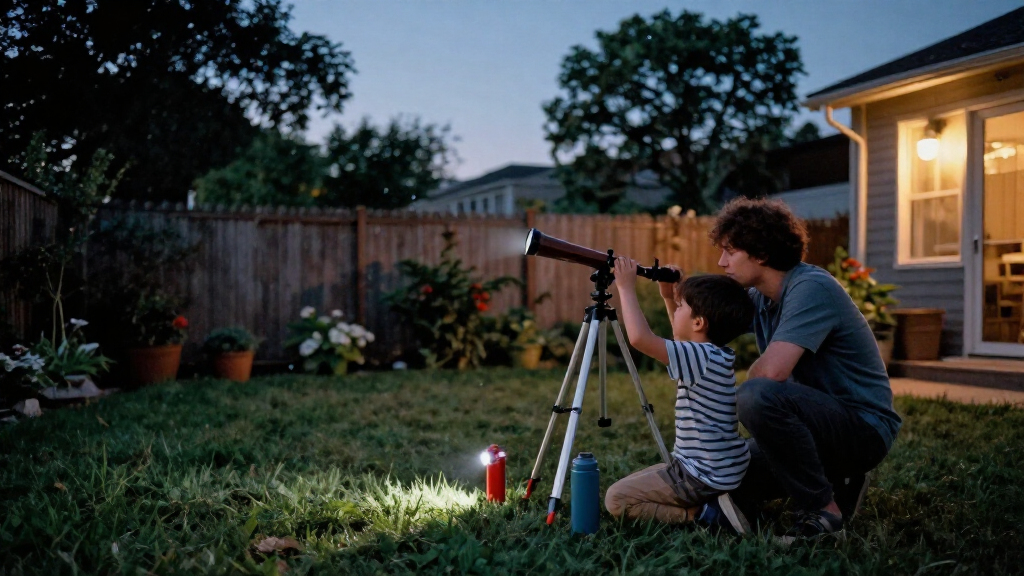
How We Picked
I ranked these telescopes for the needs of a child learning the night sky, weighing usable viewing potential alongside setup, aiming, and handling. Aperture and optical format help indicate what an instrument may show, while mount stability, finder aids, included eyepieces, and practical accessories affect whether a young beginner can use it without constant frustration. Portability and straightforward assembly matter too, but I did not treat advertised magnification or a phone adapter as proof of better views.
The order reflects the balance of those factors, not a claim that every child needs the largest telescope. The StarSense Explorer 130AZ ranks first for its greater aperture and guided aiming support, while compact and smaller-aperture models can make better first steps for younger children or families prioritizing easy handling. Where product information is limited or several models share a similar format, I avoid assuming differences that are not supported by the listed features; buyers should check the exact kit contents and setup instructions.
| kids beginner astronomy telescope | Mount | Focus type |
|---|---|---|
| Educational Insights GeoSafari | Altazimuth | — |
| Gskyer 70mm Refractor Telescop | Altazimuth | — |
| Vvnonix 70/500 Refractor Teles | — | Manual |
| 70mm Refractor Telescope for B | — | Manual |
| Celestron StarSense Explorer 1 | Manual altazimuth tabletop Dobsonian-style base | — |
| Celestron Travel Scope 60 Refr | Manual alt-azimuth | — |
| National Geographic 70mm Refra | Alt-azimuth | Manual |
| Sobrzy Beginner Telescope for | Altazimuth | Manual |
| ToyerBee 70mm Refractor Telesc | — | — |
| CLAVOLO Refractor Telescope fo | Altazimuth tabletop tripod | — |
| Luzsco 50mm Beginner Telescope | — | Manual focus |
| Fuoibl BY-001 70mm Refracting | Altazimuth | — |
| Jvcla Kids Telescope with Comp | — | Manual focus |
| Luzsco 50mm Beginner Telescope | Altazimuth | Manual |
| NASA Lunar Telescope for Kids | — | Manual |
Factors to Consider When Choosing Kids Beginner Astronomy Telescopes
Before choosing, decide what a child will actually do with the telescope: carry it outdoors, use it with an adult, or keep it set up in one place. The points below help separate useful beginner features from specifications that can sound more meaningful than they are.
Match Aperture to Patience and Expectations
Aperture is the diameter of the telescope’s light-gathering opening, and it affects how much detail can be seen in dim objects. A larger opening can offer more viewing potential, but it does not automatically make a telescope easier for a child to use. Smaller 50mm and 60mm instruments can be manageable first tools, while a 130mm tabletop reflector can reward a child who is ready to learn basic setup and aiming. A common mistake is choosing by the biggest magnification number on the box; high magnification also enlarges blur, vibration, and focusing errors. Think about whether a young observer will enjoy learning to center a target before paying for extra optical capacity.
Treat the Mount as Part of the Telescope
A wobbly mount can make even a capable optical tube frustrating, especially when a child is trying to keep a small target in view. Check how the telescope stands, how smoothly it moves, and whether it can be placed at a comfortable height or on a solid table. A tabletop design may be stable when used on a firm surface, but it is less convenient if the family expects to observe from uneven ground. Lightweight tripods are easier to carry, though their legs can transmit movement when touched. If a child will observe alone, prioritize simple, controlled movement over a long list of accessories. For shared use, an adult can help steady the setup and guide the first aiming attempts.
Choose Aiming Help That Fits the Child
Finding an object is often harder for a beginner than looking through the eyepiece, so consider what guidance the child can follow. A finder scope gives a separate aiming view and takes practice to align with the main tube. App-based guidance can point toward targets, but it may require a compatible phone, a suitable viewing location, and an adult to manage setup. A compass can help with direction, yet it does not identify a specific object in the sky. Avoid assuming that a phone adapter solves the aiming problem: it is mainly for attaching a device to the eyepiece. Pick the aid that matches the child’s reading ability, attention span, and access to a helpful adult.
Check What the Kit Requires Beyond the Box
Included eyepieces, a finder, a tripod, a carry bag, and phone accessories can change how ready a telescope is for family use. Still, bundled parts are useful only if they are compatible, sturdy enough for repeated handling, and simple to assemble. Look for clear instructions and check whether the product listing specifies any items that are needed but not included. Phone-based features may depend on a family device, while an app may need installation and setup before an observing session. Avoid paying extra attention to accessory count without checking whether the core mount and optics suit the child. A less elaborate kit can be the better choice when it is easier to set up and put away.
Plan for the Observing Location
The best telescope for a backyard differs from the best one for a family that drives to darker skies. A compact refractor is easier to transport and can suit casual viewing, while a larger telescope takes more room and may need a stable surface. City lights limit the visibility of many faint targets regardless of the telescope, so a child’s first sessions may be more rewarding when focused on bright, easy-to-find objects. Consider storage too: a kit that stays assembled or packs neatly is more likely to be used regularly. Check that the child can carry the parts safely, or plan for an adult to handle transport. Frequent use matters more than buying a telescope whose size or setup discourages spontaneous observing.
Pay More for a Clear Reason
A higher-priced telescope can make sense when it adds a meaningful benefit, such as more aperture, more reliable aiming support, or a sturdier and more useful mount. It is a poor fit if the child is not ready for the extra setup or if the family expects phone accessories to create better images automatically. For a first telescope, the adult’s role is part of the decision: some children enjoy learning alignment and focusing, while others need a quick, simple routine to stay interested. Set expectations around what a beginner instrument can show rather than expecting professional-looking views. If interest is uncertain, choose a manageable kit and spend time learning the sky before moving to a larger setup.
Frequently Asked Questions
Is a 70mm telescope a better first choice than a 50mm model?
A 70mm telescope has a larger aperture than a 50mm model, which can give it more light-gathering potential. That advantage does not guarantee an easier experience: mount movement, focus control, and how well the child can aim all matter. A 50mm option may suit a younger child who needs a lighter, simpler kit for short sessions. Choose 70mm when the child is ready to handle a little more setup and the family wants more room to explore. In either case, realistic expectations matter more than a headline magnification figure.
Should I choose the StarSense Explorer 130AZ if my child is new to astronomy?
It can be a good choice for a beginner when an adult can help with setup and the child is interested in learning to locate targets. Its larger aperture and app-based guidance offer more capability than the smaller refractors in this roundup, but a tabletop telescope needs a firm, level surface. The app also adds a setup step and may require access to a compatible phone. If simplicity and easy transport matter more than room to grow, a smaller refractor may be less demanding. Think about the child’s patience and your family’s observing space before choosing the larger model.
Do phone adapters make a beginner telescope easier to use?
A phone adapter can hold a device near the eyepiece for sharing or attempting basic images, but it does not help aim the telescope at a target. Aligning a phone camera with the eyepiece can take patience, and small movements may spoil the view. A wireless remote can reduce movement when taking a photo, but it does not improve the telescope’s optics or mount stability. For a child’s first sessions, learning to find and focus on an object is usually more useful than trying to capture it. Treat phone accessories as an optional extra rather than a deciding feature.
Is a tabletop telescope practical if we do not have a sturdy table outdoors?
A tabletop model needs a firm, level surface to keep the viewing position stable. If your observing spots are mostly grass, gravel, or uneven ground, carrying a sturdy table or finding a safe, solid platform may become inconvenient. A tripod-mounted refractor can be easier to place in different locations, though a light tripod may move when touched. Consider where the telescope will be used most often, not just where it will be stored. If a suitable surface is hard to find, favor a setup that stands securely without one.
What should I check when two listings use the same telescope name?
Compare the exact model identifier, included accessories, tripod details, eyepieces, and any differences in the seller’s specifications. In this roundup, two entries share the Luzsco 50mm Beginner Telescope name, so the title alone may not distinguish their packages. Check whether each listing shows the same product configuration and whether the included parts match the child’s needs. Product photos and descriptions can vary between listings, so do not assume that one includes an accessory just because another version does. When the details appear identical, treat them as the same basic option rather than expecting a performance difference.
Conclusion
For the strongest balance of viewing potential and guided aiming, I recommend the Celestron StarSense Explorer 130AZ as best overall, especially for families with a stable tabletop and an adult available to help. The Gskyer 70mm Refractor is my best value-style pick for shoppers who want a portable kit with a carry bag and phone accessories, while the StarSense Explorer 130AZ is also the best premium-style choice for buyers prioritizing greater aperture and guided sky-finding. For a straightforward first step, choose a compact refractor such as the Celestron Travel Scope 60; it is a better match for portability than for maximum light gathering. If your child is very young or you want a simpler, smaller instrument, look at the 50mm Sobrzy or Luzsco models, and compare the exact package details where names repeat. The right pick is the one your child can set up, aim, and use often—not the one with the biggest number on the box.
Evergreen bestsellers Picks

Ninja Luxe Café Mini Plus Espresso and Drip Coffee Machine with AutoFroth, Stainless Steel (ES351)

Vitamix Propel Series 510 Professional-Grade Blender, 3 Programs, Black

Dyson Ball Animal 3 Upright Vacuum
As an affiliate, we earn on qualifying purchases.