

Cryptozoologists borrow scientific language to make their claims seem more credible and convincing. By using technical terms and classifications, they aim to position elusive creatures within familiar scientific frameworks. This approach helps them legitimize their investigations and appeal to skeptics. Employing precise language also creates an aura of objectivity, masking the lack of solid evidence. If you’re curious about how this strategy shapes perceptions, exploring further reveals surprising insights about their methods.
Open a free Amazon Business account
Business pricing, bulk buying and tax-exempt orders.
As an affiliate, we earn on qualifying purchases.
Key Takeaways
- To legitimize claims and gain credibility among skeptics and enthusiasts.
- To frame elusive creatures within familiar scientific categories, making them more acceptable.
- To obscure the lack of concrete evidence with technical, scientific-sounding language.
- To position cryptozoological investigations as rigorous scientific research.
- To differentiate their narratives from myth or folklore by adopting scientific terminology.
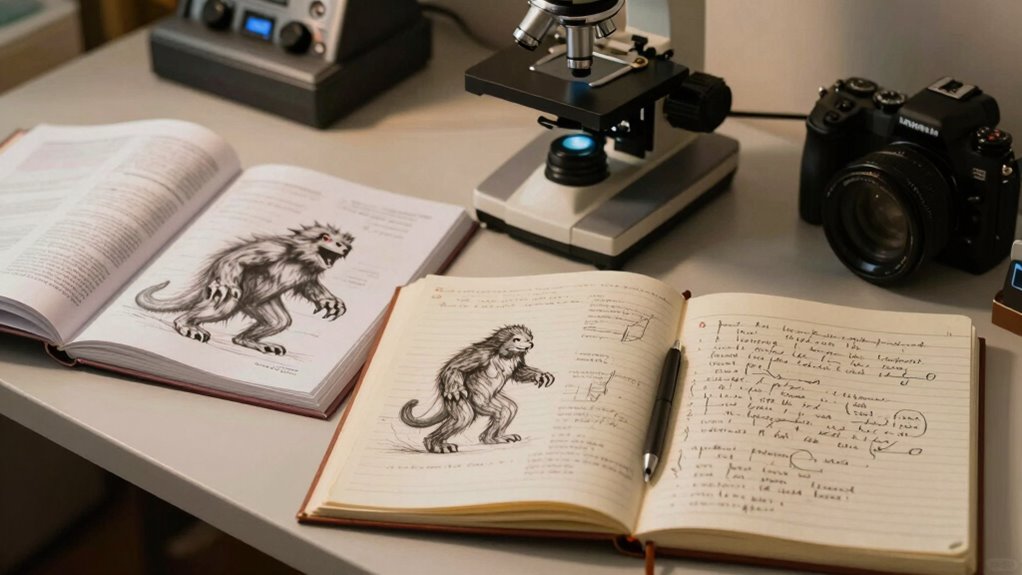
Cryptozoology often walks a fine line between scientific inquiry and mythmaking, which can make its language seem at odds with established scientific standards. To bridge this gap, practitioners frequently borrow terminology and methods from mainstream science, giving their claims a veneer of credibility. When discussing elusive creatures like the Loch Ness Monster or Bigfoot, they often employ *mythical creature classifications*—terms that suggest these beings are part of a broader, scientifically recognizable taxonomy. This classification helps frame these entities within a context that feels familiar, even if the evidence remains speculative. It’s a deliberate choice to elevate their narratives, making them more palatable to skeptics and enthusiasts alike.
Cryptozoologists use scientific language and classifications to legitimize and elevate their elusive creature claims.
At the same time, cryptozoologists often engage in *fossil interpretation debates*, echoing the contentious discussions that paleontologists face when analyzing ancient remains. These debates revolve around whether certain fossils or ambiguous bones represent real species or are misinterpretations, hoaxes, or natural anomalies. Cryptozoologists adopt this scientific discourse to support their claims, arguing that the absence of fossil evidence doesn’t negate the existence of a creature. Instead, they suggest that fossil interpretation debates are part of the scientific process—an ongoing dialogue that can eventually lead to discoveries. By framing their investigations this way, they lend a sense of legitimacy to their pursuit, implying that their work is just as rigorous as mainstream science. Additionally, they often emphasize the importance of scientific methodology to bolster their claims.
You’ll notice that cryptozoologists often use precise, scientific-sounding language to describe their findings, even when the evidence is lacking or ambiguous. This practice isn’t accidental; it’s a strategic move to position their claims within a scientific framework. When they speak of “possible evidence,” “anomalous sightings,” or “unverified specimens,” they’re subtly aligning themselves with the language used by credible scientists. This approach helps them appeal to a broader audience, including those skeptical of myth and folklore, by suggesting that their work is rooted in empirical investigation. Additionally, they often rely on scientific language to lend credibility to their ambiguous claims, even when empirical support remains elusive. Moreover, their reliance on scientific terminology helps create an aura of objectivity, making their narratives more convincing to the uninformed reader. Recognizing how scientific classifications are employed reveals how language can be used to shape perceptions of credibility. Furthermore, the strategic use of scientific jargon can obscure the lack of solid evidence, creating an illusion of scientific rigor. Ultimately, the reason cryptozoology keeps borrowing scientific language is to legitimize a field that exists on the fringes of mainstream science. By adopting scientific classifications and engaging in fossil debates, cryptozoologists aim to bridge the gap between myth and reality. They understand that credible language can elevate their claims, even if the evidence doesn’t yet fully support them. So, they use science not only as a tool for discovery but also as a shield, protecting their narratives from outright dismissal.
cryptozoology scientific classification book
As an affiliate, we earn on qualifying purchases.
As an affiliate, we earn on qualifying purchases.
Frequently Asked Questions
How Do Cryptozoologists Verify Their Claims Scientifically?
You might think cryptozoologists verify their claims scientifically by using fossil evidence and evolutionary theory. They often seek physical evidence, like fossils or DNA samples, to support their discoveries. While their methods aren’t always rigorous, some do attempt to apply scientific principles, examining fossil records or genetic data to establish evolutionary links. Still, many findings remain unconfirmed, making scientific verification a challenge in cryptozoology.
Are There Any Peer-Reviewed Studies in Cryptozoology?
You won’t find many peer-reviewed studies in cryptozoology focusing on mythical creatures, as it’s mostly regarded as folklore research rather than rigorous science. Most evidence is anecdotal or based on eyewitness reports, which don’t meet scientific standards. While some researchers attempt to apply scientific language, the lack of empirical data keeps cryptozoology outside mainstream scientific journals. This limits its credibility and makes peer-reviewed studies very rare in the field.
Why Do Cryptozoologists Avoid Using Standard Scientific Methods?
You might find it interesting that 60% of cryptozoology claims use speculative terminology, often blending pseudoscientific language with genuine scientific terms. Cryptozoologists avoid standard scientific methods because they rely on anecdotal evidence and sensationalism, which don’t meet rigorous scientific standards. Using scientific language gives their claims a veneer of credibility, even though they lack empirical support, making their approach more about persuasion than scientific discovery.
How Does Scientific Language Influence Public Perception of Cryptozoology?
Scientific language influences your perception of cryptozoology by making mythical creatures seem more credible, even if scientific skepticism remains. When cryptozoologists use technical terms, you might think they’re conducting rigorous research, but it often masks the lack of solid evidence. This language can boost interest and curiosity, yet it also risks misleading you into believing in creatures that lack scientific validation, blurring the line between myth and reality.
What Are the Main Challenges in Applying Scientific Language to Cryptids?
You might think applying scientific language to cryptids is straightforward, but linguistic ambiguity and a lack of terminological precision pose major challenges. When researchers use vague terms or inconsistent definitions, it muddles understanding and credibility. This confusion makes it hard to distinguish between real evidence and myth, undermining scientific rigor. To improve, you’d need clear, precise language that accurately reflects cryptid studies without overstepping scientific boundaries.
As an affiliate, we earn on qualifying purchases.
Conclusion
So, as you see, cryptozoology cleverly clings to scientific speech, creating a mesmerizing curtain of credibility. By borrowing biological buzzwords and zoological jargon, it blurs boundaries, beckoning believers and baffling skeptics alike. This linguistic layering lends a layer of legitimacy, luring listeners into a labyrinth of legend and language. In this game of grand gestures and ghostly guesses, cryptozoology’s clever use of scientific speech keeps its curious creatures cloaked in a captivating, convincing cloak.

Official Cryptid Research Team | Cryptids Folklore Mothman Adjustable Printed Baseball Hat, Black
- Official Cryptid Research Team: Mothman design for paranormal enthusiasts
- Perfect for Ghosthunters: Enhances paranormal investigation gear
- Stylish Baseball Cap: Five-panel structured with high-profile crown
As an affiliate, we earn on qualifying purchases.
As an affiliate, we earn on qualifying purchases.
scientific terminology reference
As an affiliate, we earn on qualifying purchases.
As an affiliate, we earn on qualifying purchases.
Labor Day sales Picks
labor day deals
As an affiliate, we earn on qualifying purchases.