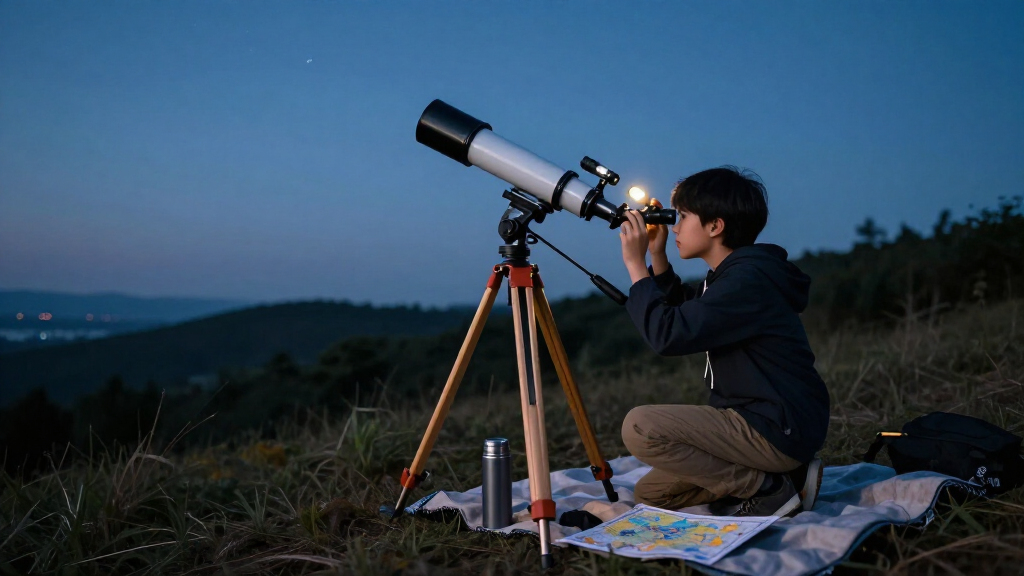

Choosing a telescope for beginners comes down to one central tradeoff: aperture versus usability. Cheap 50mm and 70mm models are tempting and portable, but many disappoint under real night skies because their mounts wobble and their eyepieces are poor. My top pick, the Celestron StarSense Explorer LT 114AZ, stands out because its smartphone-guided navigation solves the single biggest beginner frustration — actually finding objects in the sky. If budget rules, the Gskyer 70mm offers solid glass and accessories for the price, while the MEEZAA 80mm makes the most sense for beginners who want a serious step up in light-gathering power. Below, I break down all 15 models by aperture, mount quality, and long-term learning value so you can pick the right fit for your first year of stargazing.

Prime made for students and young adults
- Fast, free delivery for dorm and study essentials
- Prime Video and Amazon Music included
- Member-only deals
Key Takeaways
- Smartphone guidance was the single biggest differentiator in this lineup — the Celestron StarSense Explorer LT 114AZ earned the top spot because it removes the ‘I can’t find anything’ problem that makes most beginners quit within months.
- Aperture mattered more than magnification claims across the board: the 80mm models (MEEZAA, Celticbird, Koolpte 80mm) delivered visibly brighter views of planets and deep-sky objects than the numerous 70mm and 50mm options, despite similar advertised zoom ranges.
- Magnification numbers like ‘150X’ on the 70mm boxes are marketing, not capability — a 70mm aperture realistically tops out around 140x, and pushing beyond that produces dim, blurry images.
- Mount stability separated usable telescopes from frustrating ones more than optics did; several budget 70mm refractors have acceptable glass but tripods that shake with every touch.
- The 50mm kids’ models (the generic 50mm Beginner Telescope and NASA Lunar Telescope) are fine as toys for lunar viewing but should not be bought by anyone over roughly age 10 who wants to see planets.




| telescopes for beginner | Eyepieces | Aperture | Focal Length | Magnification |
|---|---|---|---|---|
| Celestron Travel Scope 70mm Po | 20mm and 10mm | 70mm | — | — |
| Celestron StarSense Explorer L | — | 114 mm (4.5 in) | — | — |
| 70mm Refractor Telescope for B | 20mm and 6mm | 70mm | 300mm | 15x–150x |
| 70mm Aperture Refracting Teles | 6 mm and 20 mm | 70 mm | 300 mm | 15x–150x |
| Koolpte 80mm/600mm AZ Refracto | 25 mm, 10 mm | 80 mm | 600 mm | — |
| Koolpte 70mm Refractor Telesco | 25 mm and 10 mm | 70 mm | 500 mm (f/7.1) | — |
| 50mm Beginner Telescope for Ki | 6 mm and 20 mm | — | — | 20x–100x |
| Gskyer 70mm Aperture Refractin | 2 replaceable eyepieces | 70 mm | 400 mm (f/5.7) | — |
| MEEZAA 80mm Aperture 500mm Ref | 25 mm and 10 mm | 80 mm | 500 mm | — |
| Celticbird 80mm Aperture 600mm | 20 mm and 9 mm Kellner | 80 mm | 600 mm (f/6.7) | 30x–66x |
| NASA Lunar Telescope for Kids | Two (low-power and high-power) | — | — | 90x |
| Telescope for Kids | 6 mm and 20 mm | — | 400 mm to 600 mm | 100x |
| 70mm Aperture 400mm Refractor | 12.5 mm and 20 mm Plössl | 70 mm | 400 mm | 20x-32x |
| 70mm Aperture Refractor Telesc | 20 mm and 6 mm | 70 mm | 300 mm | 15X-150X |
| Koolpte 80mm Telescope for Adu | 25 mm and 10 mm | 80 mm | 600 mm | 24x-60x; up to 180x with 3X Barlow |
More Details on Our Top Picks
Celestron Travel Scope 70mm Portable Beginner Telescope with Backpack
Most beginner telescopes promise portability and then hand you a bulky kit that lives in a closet. This one actually delivers: the padded custom backpack holds the whole package, making it the easiest option here to toss in a car trunk or carry to a dark-sky campsite. Setup takes seconds with no tools, which matters when kids’ patience is shorter than dusk. Compared with the generic 70mm refractor bundles in this roundup, Celestron’s fully coated optics and brand-name support give more consistent image quality, though the 70mm aperture shares the same ceiling: expect great Moon and planetary views, but faint galaxies will stay out of reach. The tripod is serviceable rather than rock-solid, so breezy nights will test it.
Pros:- Truly portable with included padded backpack
- Tool-free setup in seconds, ideal for kids
- Fully coated optics for sharp lunar, planetary, and daytime views
- Two eyepieces plus Starry Night software for versatile magnification
Cons:- 70mm aperture limits faint deep-sky viewing
- Tripod stability falls short of premium models in windy conditions
Best for: Families and travelers who want a genuine grab-and-go kit that fits in a backpack
Not ideal for: Buyers hoping to observe faint deep-sky objects — the 70mm aperture is too small for that
- Aperture:70mm
- Optical Design:Refractor
- Optics:Fully coated glass lenses
- Eyepieces:20mm and 10mm
- Tripod:Full-height, included
- Includes:Backpack, finderscope, star diagonal, software
- Warranty:2-Year US Warranty
Our verdict“Buy this if your priority is a complete, travel-ready kit rather than maximum aperture per dollar.”
Celestron StarSense Explorer LT 114AZ Smartphone-Guided Newtonian Telescope
This is the pick that solves the single biggest reason beginners quit: not being able to find anything. The StarSense Explorer app uses your phone’s camera to recognize the sky and guide you to targets on screen, turning a frustrating hunt into a five-minute success. On top of that, the 114mm Newtonian reflector gathers roughly two and a half times the light of the 70mm and 80mm refractors elsewhere in this roundup, so nebulae and star clusters become realistic targets, not just the Moon. The tradeoff is honesty about effort: the manual altazimuth mount means you push the tube yourself and re-center objects as the sky rotates, and the phone-guided system requires a compatible smartphone. Compared with the Celestron Travel Scope 70mm, you give up grab-and-go simplicity for real deep-sky capability.
Pros:- App-guided sky recognition makes finding objects genuinely easy
- 114mm reflector aperture reveals nebulae, galaxies, and clusters
- Curated target lists based on time and location keep sessions productive
- 2-year warranty and US-based support
Cons:- Requires a compatible smartphone for the guided experience
- Manual mount means you track objects by hand throughout the night
Best for: Beginners who want help locating objects and enough aperture to see beyond the Moon and planets
Not ideal for: Anyone without a compatible smartphone, or buyers unwilling to manually push and track the mount
- Optical Design:Newtonian reflector
- Aperture:114 mm (4.5 in)
- Mount:Manual altazimuth
- Mount Adjustment:Altitude slow-motion with sliding rod
- App Guidance:StarSense Explorer smartphone app with sky recognition
- Warranty:2-year US warranty
Our verdict“The strongest all-around choice for a beginner who wants to actually find and see deep-sky objects without a steep learning curve.”
70mm Refractor Telescope for Beginners with Phone Adapter and Tripod
Where this kit earns its spot is sheer completeness: phone adapter, wireless camera remote, 3x Barlow lens, star chart, and two eyepieces all come in the box. That makes it a stronger gifting candidate than the Celestron Travel Scope 70mm, which includes better optics but fewer accessories — here, a new observer can snap lunar photos through the eyepiece on night one. The fully multi-coated optics keep views of the Moon and planets reasonably bright for a 70mm tube, and the short 300mm focal length makes it forgiving and lightweight. The catch is the advertised 150x maximum magnification: pushing a 70mm scope that hard produces dim, mushy images, so treat realistic viewing as capped near 100x.
Pros:- Complete accessory package including phone adapter, remote, and star chart
- Works for both daytime scenery and night-sky viewing
- Lightweight and quick to set up without tools
- Fully multi-coated optics improve brightness at this price class
Cons:- Advertised maximum magnification exceeds what the optics can resolve clearly
- Generic brand lacks the established track record of Celestron models in this lineup
Best for: Gift-givers and casual beginners who want every accessory included from day one
Not ideal for: Anyone expecting usable views at the advertised 150x — small-aperture optics can’t deliver that cleanly
- Aperture:70mm
- Focal Length:300mm
- Magnification:15x–150x
- Optics:Fully multi-coated optical glass
- Eyepieces:20mm and 6mm
- Barlow Lens:3x
- Finderscope:5×24
- Includes:Tripod, phone adapter, wireless remote, star chart
Our verdict“A sensible budget bundle if accessory count matters more than brand pedigree or aperture.”
70mm Aperture Refracting Telescope for Kids and Adults, 15X-150X with Phone Adapter
This model leans hardest into the family angle, pairing tool-free assembly with an adjustable tripod that grows with younger users. Compared with the similar 70mm refractor bundles here, the shared 15x–150x magnification range and 300mm focal length deliver the same forgiving, wide-field experience that suits impatient young observers — the Moon at moderate power looks impressive without demanding precise alignment. The included phone adapter and wireless remote let kids capture what they see, which keeps enthusiasm alive between sessions. Two honest drawbacks: the 5×24 finderscope produces an inverted image that confuses first-timers until they adjust, and the scope will be outgrown quickly if a serious interest develops.
Pros:- Tool-free setup kids can manage with minimal help
- Adjustable tripod suits a wide range of heights
- Phone adapter and remote make capturing and sharing easy
- Bright, coated optics handle Moon and beginner planetary viewing well
Cons:- Inverted finderscope image confuses newcomers at first
- Limited growth potential once interest moves past the Moon and planets
Best for: Parents introducing kids to astronomy who want a low-friction, shareable first experience
Not ideal for: Teens or adults developing a serious astronomy hobby — the specs will be outgrown fast
- Type:Refracting Telescope
- Aperture:70 mm
- Focal Length:300 mm
- Magnification:15x–150x
- Eyepieces:6 mm and 20 mm
- Barlow Lens:3x
- Optics:Fully multi-coated glass
- Tripod Height:Up to 45 inches
- Setup:Tool-free assembly
Our verdict“A kid-focused first telescope that prioritizes easy wins and photo sharing over long-term capability.”
Koolpte 80mm/600mm AZ Refractor Telescope for Adults and Beginners
This is the natural next step from the 70mm refractors in this roundup. The 80mm aperture pulls in noticeably more light, and the longer 600mm focal length at f/6.7 produces sharper, higher-contrast views of planets than the short 300mm tubes can manage — Saturn’s rings and Jupiter’s bands hold together far better here. The included eyepieces and 3x Barlow span 24x to 180x, giving genuine room to grow, and the carrying bag, phone adapter, and remote round out a complete kit. The compromises are real, though: there’s no tracking or motorization, so objects drift out of view at higher magnifications and require constant nudging, and like any refractor at this size, faint deep-sky targets remain a stretch compared with the 114mm StarSense reflector.
Pros:- 80mm aperture with longer focal length for sharper planetary detail
- Broad magnification range from 24x to 180x supports growing skills
- Complete kit with bag, tripod, phone adapter, and remote
- Tool-free setup despite the larger optical tube
Cons:- No tracking or motorized features — objects must be re-centered manually
- Deep-sky performance still trails larger reflectors like the 114mm StarSense
Best for: Motivated beginners and adults who want a step-up refractor with room to grow into the hobby
Not ideal for: Buyers who want hands-off tracking — everything here is manual aiming and adjusting
- Type:AZ refractor telescope
- Aperture:80 mm
- Focal Length:600 mm
- Focal Ratio:f/6.7
- Eyepieces:25 mm, 10 mm
- Maximum Magnification:Up to 180x with 3x Barlow
- Finder Scope:5×24
- Includes:Phone adapter, wireless remote, carrying bag, 3x Barlow, tripod
Our verdict“The best pick for a beginner who has outgrown 70mm toy-class scopes and wants crisper views without a big spend.”
Koolpte 70mm Refractor Telescope for Kids and Beginners
This Koolpte package stands out as the most complete family starter bundle in the under-80mm group. The f/7.1 focal ratio is its quiet advantage: compared with the Gskyer 70mm, whose shorter 400mm tube produces fussier focusing at high power, this longer 500mm focal length delivers steadier, more forgiving views of the Moon — a real benefit when impatient kids are at the eyepiece.
The tradeoff is portability. The longer optical tube makes it slightly more of a handful than the compact 50mm kids’ model, and the aluminum tripod is serviceable rather than rock solid, so expect some vibration when touched. Still, the phone adapter, wireless remote, and carrying case mean a family gets everything needed for a first night out in one box.
Pros:- Longer f/7.1 focal ratio gives steadier, more forgiving high-power views than short-tube rivals
- Complete accessory bundle with eyepieces, Barlow lens, phone adapter, remote, and case
- Finderscope makes locating the Moon and bright planets much easier for newcomers
- Works for both daytime nature viewing and nighttime astronomy
Cons:- 70mm aperture limits faint deep-sky observation to the brightest clusters and nebulae
- Aluminum tripod vibrates when touched, frustrating young users
- 3x Barlow with the 10mm eyepiece pushes magnification past what the aperture can sharply resolve
Best for: Families with school-age kids who want a one-box kit for backyard Moon and planet viewing
Not ideal for: Anyone hoping to explore galaxies and nebulae — a 70mm aperture gathers limited light for faint deep-sky targets
- Optical design:Refractor
- Aperture:70 mm
- Focal length:500 mm (f/7.1)
- Eyepieces:25 mm and 10 mm
- Barlow lens:3x
- Finderscope:5×24
- Tripod:Adjustable aluminum
- Included accessories:Phone adapter, wireless remote, carrying case
Our verdict“This is the pick for a family that wants a forgiving, all-inclusive first telescope rather than a bare optical tube.”
50mm Beginner Telescope for Kids with Tripod
At 1.3 pounds and sized for ages 6–12, this is the true entry-level option of the lineup — less a serious instrument than a guided first encounter with the sky. Its main differentiator is the included Moon observation guide, which turns viewing into a structured STEM activity rather than a one-time novelty. The Koolpte 70mm delivers noticeably brighter images, but it also costs more and assumes a level of care younger children may not have.
The honest limitation is the 50mm objective lens: views of the Moon will be satisfying, but Saturn’s rings become a tiny smudge at best. Manual focus also demands patience from small hands. As a low-risk way to test whether astronomy sticks before spending more, though, this kit fills a role nothing else here does.
Pros:- Extremely lightweight at 1.3 pounds, easy for children to carry and set up themselves
- Moon observation guide structures learning instead of leaving kids guessing
- No power required, so it works anywhere with zero setup friction
- Complete kit with tripod, finderscope, eyepieces, and Barlow lens
Cons:- 50mm aperture restricts rewarding targets to the Moon and brightest planets
- Manual focus is fiddly for small hands still developing fine motor skills
- Build quality and image clarity are geared to toys rather than lasting instruments
Best for: Parents of 6–12 year olds testing interest in astronomy with a low-commitment, activity-driven gift
Not ideal for: Teens or adults — the 50mm aperture and toy-scale build will frustrate anyone expecting detailed planetary views
- Recommended age:6–12 years
- Objective lens diameter:50 mm
- Magnification:20x–100x
- Eyepieces:6 mm and 20 mm
- Mount:Altazimuth
- Weight:1.3 pounds
- Included accessories:Tripod, finderscope, two eyepieces, Barlow lens, Moon observation guide
Our verdict“Buy this as a child’s first telescope and guided activity kit, not as a family’s main observing instrument.”
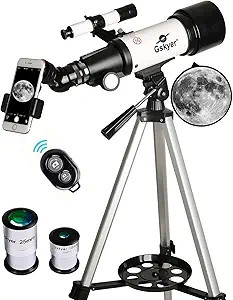
Gskyer 70mm Aperture Refracting Telescope with Carry Bag, Phone Adapter, and Wireless Remote
The short 400mm tube is what defines this Gskyer — it is the most packable 70mm option in the batch, sliding into its carry bag with the tripod for genuine dark-sky road trips. Compared with the Koolpte 70mm, the f/5.7 focal ratio trades away some high-power stability in exchange for wider fields of view, which actually suits scanning the Milky Way and framing the Moon with a phone.
The coated optics and full accessory set — Barlow, finder, smartphone adapter, remote — make it a self-sufficient travel kit. The catch is that short focal length cuts both ways: pushing magnification toward planetary detail gets noticeably softer than on longer-tube models, and eyepiece focal lengths are not specified, so buyers cannot pre-calculate magnification. For travel-first buyers, that compromise is reasonable; for planetary enthusiasts, the MEEZAA 80mm is the better spend.
Pros:- Compact 400mm tube with carry bag makes it the most travel-friendly 70mm here
- Coated optics improve contrast on the Moon and bright stars
- Smartphone adapter and wireless remote support simple astro-imaging out of the box
- Wide field of view suits sweeping star fields and Milky Way scanning
Cons:- Short f/5.7 focal ratio produces softer images at high magnification than longer-tube models
- Eyepiece focal lengths are not specified, making magnification hard to compare before buying
- 70mm aperture limits faint deep-sky targets
Best for: Travelers and campers who prioritize a packable kit for wide-field Moon and star viewing away from city lights
Not ideal for: Buyers focused on planetary detail — the short focal length softens high-magnification views
- Optical design:Refracting
- Aperture:70 mm
- Focal length:400 mm (f/5.7)
- Eyepieces:2 replaceable eyepieces
- Barlow lens:3x
- Finder scope:5×24
- Tripod:Adjustable aluminum alloy
- Included accessories:Carry bag, smartphone adapter, wireless camera remote
Our verdict“Choose this when portability matters more than planetary magnification — it is the kit that actually goes on the trip.”
MEEZAA 80mm Aperture 500mm Refractor Telescope
This MEEZAA is where the lineup graduates from toy-adjacent to genuinely capable. The 80mm aperture with fully multi-coated optics pulls in roughly 30% more light than the Koolpte 70mm or Gskyer 70mm, which translates directly into brighter lunar detail and steadier views of Jupiter’s cloud bands. Its 20x–150x magnification range also out-reaches the Celticbird 80mm, whose 66x ceiling is noticeably more restrictive on planets.
The 45° zenith mirror and waterproof backpack add everyday comfort and travel practicality that cheaper kits skip — the angled view alone makes long observing sessions far easier on the neck. The honest ceiling: the manual altazimuth mount means tracking objects at 150x requires constant nudging, and there is no go-to or motorized tracking. For a beginner growing into the hobby, those limits are acceptable; for an adult eyeing astrophotography, they will bite quickly.
Pros:- 80mm aperture with fully multi-coated optics delivers visibly brighter, sharper views than any 70mm here
- 20x–150x magnification range offers genuine planetary reach for the price
- 45° zenith mirror makes comfortable extended viewing, including for taller adults
- Waterproof backpack and complete accessory kit make it genuinely travel-ready
Cons:- Manual altazimuth mount requires constant re-aiming at high magnification
- No motorized tracking or automated object location
- 150x ceiling is modest for detailed deep-sky work
Best for: Teens and adults who have outgrown a 70mm kit and want brighter views without a big budget jump
Not ideal for: Aspiring astrophotographers — the manual AZ mount cannot track objects for longer exposures
- Aperture:80 mm
- Focal length:500 mm
- Magnification range:20x–150x
- Eyepieces:25 mm and 10 mm
- Barlow lens:3X
- Optical coating:Fully multi-coated
- Mount type:Altazimuth
- Tripod height range:16.92–44.48 inches
- Included accessories:Phone adapter, waterproof backpack, 3X Barlow lens, finder scope
Our verdict“The strongest value in this batch: enough aperture and magnification to keep a growing beginner engaged for years.”
Celticbird 80mm Aperture 600mm Refractor Telescope with AZ Mount
The 600mm focal length at f/6.7 gives this Celticbird the longest tube among the 80mm picks, and that optical patience pays off: compared with the MEEZAA 80mm/500mm, the extra focal length delivers cleaner, higher-contrast views at the eyepiece, and the Kellner eyepieces are a genuine step above the generic optics in cheaper kits. Add the included moon filter and three-year warranty, and the build confidence here is unusual at this tier.
The tradeoff is deliberate restraint. With only 30x–66x native magnification, Saturn stays small — the MEEZAA’s 150x range shows more planetary detail, and buyers can add a Barlow later to close the gap. Tool-free assembly and a 5.8-pound packed weight make it friendly for kids around 8–12 and adults alike. This is the choice when image crispness matters more than headline magnification numbers.
Pros:- Longest focal length in this batch yields sharper, higher-contrast images than shorter 80mm rivals
- Kellner eyepieces outclass the generic optics bundled with cheaper kits
- Moon filter, phone adapter, and backpack round out a genuinely usable kit
- Tool-free assembly and 5.8-pound weight suit kids and travel
Cons:- Native 30x–66x magnification is limited for planetary detail without added accessories
- Manual altazimuth mount demands constant tracking by hand
- Longer 600mm tube is less compact to pack than the Gskyer or MEEZAA
Best for: Buyers who prioritize crisp, high-contrast lunar and planetary views and solid warranty backing over maximum magnification
Not ideal for: Anyone wanting big planetary views straight from the box — 66x keeps planets small without buying extra eyepieces
- Aperture:80 mm
- Focal length:600 mm (f/6.7)
- Magnification:30x–66x
- Eyepieces:20 mm and 9 mm Kellner
- Mount:Altazimuth (AZ)
- Optical coating:Fully multi-coated
- Field of view:3.4 degrees
- Weight:5.8 pounds
- Warranty:3 years
Our verdict“The best image quality of the group for buyers who value crispness over headline magnification — just budget for an extra eyepiece later.”
NASA Lunar Telescope for Kids with Tripod and Finder Scope
This model stands out as the gentlest entry point in the entire lineup — less a serious instrument, more a guided first encounter with the Moon. Where the 50mm Beginner Telescope with Tripod markets itself as a general STEM toy, this one narrows the mission: two purpose-built eyepieces, a finder scope, and a NASA learning guide that frames each session as a small lesson. That focus is its strength and its ceiling. The 25mm objective gathers far less light than the 70mm refractors from Koolpte or Gskyer, so planets and star clusters stay out of reach. But for a five-to-nine-year-old who wants to see craters tonight without help assembling anything complicated, this pick makes more sense than a heavier, pricier kit they will outgrow or abandon.
Pros:- Two matched eyepieces and a finder scope make locating the Moon genuinely achievable for kids
- Tabletop tripod and smooth mount keep the view steady without adult strength
- Educational learning guide turns viewing sessions into structured discovery
- Fast, simple assembly with no tools or prior knowledge
Cons:- 25mm objective limits almost everything except lunar viewing
- 0.85-degree field of view makes finding and tracking targets frustrating
Best for: Parents of young children (roughly 5-9) who want a simple, Moon-focused first telescope with educational framing
Not ideal for: Families hoping to view planets or deep-sky objects — the 25mm aperture is simply too small for anything beyond lunar and basic terrestrial viewing
- Magnification:90x
- Objective Lens Diameter:25 mm
- Eyepieces:Two (low-power and high-power)
- Finder Scope:Straight-through
- Field of View:0.85 degrees
- Optical Coating:Fully coated
- Dimensions:7.09 × 4.13 × 17.05 in
Our verdict“A deliberate, Moon-only starter scope that trades versatility for simplicity — buy it for a young child’s first look at craters, not for a household’s long-term astronomy hobby.”
Telescope for Kids, 50mm 100x Beginner Telescope with Tripod
Positioned as a screen-free STEM toy rather than an instrument, this kit competes on play value and price of admission, not optics. Compared with the NASA Lunar Telescope, it offers a slightly larger 50mm objective and more accessories — a Barlow lens, a reflex finderscope, two eyepieces — which stretches its reach to bright planets on a good night. But it can’t match the 70mm Travel Telescope with AZ Mount, whose larger aperture and coated glass deliver noticeably sharper images. The fixed mount is the real compromise here: there’s no slow-motion control, so kids nudge the tube by hand and lose the target. For a six-to-twelve-year-old who wants a backyard adventure kit that doubles as a telescope — and who may or may not stick with the hobby — this is the low-risk choice.
Pros:- Complete starter bundle with tripod, finderscope, two eyepieces, and Barlow lens
- Very light (600 g) and portable for camping and travel
- Genuinely kid-friendly assembly that encourages independent exploration
- Multi-coated optics are respectable for this price class
Cons:- Fixed mount offers no tracking or fine adjustment, making high magnification impractical
- 50mm aperture is too small for satisfying planetary or deep-sky detail
- Younger children will still need adult help with setup and focusing
Best for: Gift-givers buying for curious kids aged 6-12 who want an affordable, portable STEM toy for camping trips and backyard play
Not ideal for: Anyone who already knows they want sustained astronomy — the fixed mount and 50mm aperture will frustrate a budding hobbyist within months
- Objective Lens Diameter:50 mm
- Magnification:100x
- Focal Length:400 mm to 600 mm
- Eyepieces:6 mm and 20 mm
- Barlow Lens:Included
- Mount:Fixed
- Item Weight:600 g
- Recommended Age:6-12
Our verdict“A cheap, cheerful gateway toy that wins on bundled accessories and portability — a smart gift gamble, not a long-term observing tool.”
70mm Aperture 400mm Refractor Travel Telescope for Kids and Adult Beginners with AZ Mount
This is where the lineup shifts from toy to instrument. The 70mm aperture with fully coated glass produces views that neither the 50mm STEM kit nor the NASA Lunar Telescope can approach, and the altazimuth mount with slow, controlled movement fixes the ‘nudge and lose it’ problem of fixed-mount models. The generous 2.4-degree field of view is a quiet advantage: beginners spend less time hunting and more time looking, which is the single biggest factor in whether someone sticks with the hobby. The tradeoff is honest — 32x maximum magnification keeps Saturn’s rings small, and the short adjustable tripod (12-38 inches) forces seated or crouched viewing for adults. Compared with the 15X-150X 70mm refractor, this model trades reach for stability and image sharpness, a sensible exchange at this level.
Pros:- Fully coated 70mm optics deliver genuinely sharp lunar and planetary views
- Wide 2.4-degree field of view makes locating targets much easier for novices
- Phone adapter opens the door to simple astrophotography
- Tool-free assembly and an adjustable tripod that works for kids
Cons:- Maximum magnification of 32x is low compared with Barlow-equipped rivals
- Tripod extends only to 38 inches, uncomfortable for standing adults
- Manual focus demands patience from younger children
Best for: Families and adult beginners who want sharp, stable, low-hassle first views of the Moon and planets without overspending
Not ideal for: Buyers chasing high-magnification planetary detail — the 32x ceiling and modest tripod height will feel limiting quickly
- Aperture:70 mm
- Focal Length:400 mm
- Magnification:20x-32x
- Eyepieces:12.5 mm and 20 mm Plössl
- Mount:Altazimuth (AZ)
- Field of View:2.4 degrees
- Tripod:Adjustable aluminum, 12-38 inches
- Weight:1.9 kg
Our verdict“The most balanced step up from toy telescopes — accept the modest magnification ceiling and you get the sharpest, most frustration-free first-year experience in this group.”
70mm Aperture Refractor Telescope for Kids and Adults, 15X-150X, 300mm Focal Length, FMC Optics, Phone Adapter
Where the 70mm Travel Telescope keeps magnification conservative for stability, this kit swings the other way: a 3X Barlow, 1.5X erecting eyepiece, and two eyepieces unlock a 15X-150X range, plus a wireless remote for hands-free phone photography. Nobody at this price tier will get clean views at 150X — the 300mm focal length and 70mm aperture can’t support it — but the flexibility to swap between low scanning power and lunar detail is real, and the erecting eyepiece makes daytime wildlife and scenery viewing practical, something lunar-focused options can’t do. Compared with the Koolpte 80mm, the shorter focal length makes it more forgiving and compact but caps its planetary potential. The inverted finder-scope image is an avoidable annoyance that beginners should practice with before a real session.
Pros:- Richest accessory loadout in this group: two eyepieces, 3X Barlow, erecting eyepiece, phone adapter, and wireless remote
- Fully multi-coated 70mm glass produces bright, clear beginner-grade images
- 1.5X erecting eyepiece enables correct-image terrestrial viewing
- Tool-free setup on a stable tripod suits shared family use
Cons:- Advertised 150X magnification exceeds what a 70mm/300mm scope can resolve cleanly
- Finder scope shows an inverted image, confusing for first-time users
- Short focal length limits high-detail planetary observing
Best for: Buyers who want one kit that handles the Moon, planets, and daytime scenery with maximum accessory flexibility
Not ideal for: Detail-obsessed planetary observers — the short 300mm focal length and exaggerated top magnification promise more than the optics deliver
- Aperture:70 mm
- Focal Length:300 mm
- Magnification:15X-150X
- Optics:Fully multi-coated optical glass
- Eyepieces:20 mm and 6 mm
- Barlow Lens:3X
- Erecting Eyepiece:1.5X
- Setup:Tool-free
Our verdict“The most versatile all-in-one bundle here — pick it for daytime-and-night dual use, but treat the top magnification claim as marketing rather than a real capability.”
Koolpte 80mm Telescope for Adults and Beginners
Of the five picks here, the Koolpte 80mm is the only one built to stay relevant past the first year. Its 80mm aperture and 600mm focal length at f/6.7 gather roughly 30% more light than any 70mm option, which translates directly into brighter lunar detail, steadier views of Jupiter’s bands, and a realistic ceiling for the included 3X Barlow. Where the 15X-150X bundle feels like a starter kit to outgrow, this one reads as a small investment: Plössl-style eyepieces, a carrying bag, phone adapter, and wireless remote cover the accessories a beginner actually uses. The honest caveat is documentation — no tripod height or weight is published, and the f/6.7 fast optics demand more precise focusing, which can test impatient newcomers. Adults and patient teens will thrive; restless younger kids belong with the NASA or 50mm models.
Pros:- 80mm aperture delivers noticeably brighter, more detailed views than any 70mm rival here
- 600mm focal length gives the 3X Barlow a realistic high-power ceiling rather than an inflated number
- Carrying bag and adjustable tripod make it genuinely portable for travel
- Complete accessory set: two eyepieces, Barlow, finder, phone adapter, and wireless remote
Cons:- Tripod height and total weight are unspecified, making portability claims hard to verify
- Fast f/6.7 optics require more careful focusing, which can frustrate first-timers
- Larger and less toy-like than kid-focused options in this lineup
Best for: Teens and adults committing to astronomy as a lasting hobby who want headroom to grow beyond beginner views
Not ideal for: Young children or casual gift buyers — the larger size, finer focusing, and higher expectations make it overkill for a first toy telescope
- Aperture:80 mm
- Focal Length:600 mm
- Focal Ratio:f/6.7
- Eyepieces:25 mm and 10 mm
- Magnification:24x-60x; up to 180x with 3X Barlow
- Optics:Fully multi-coated
- Tripod:Adjustable aluminum
- Setup:Tool-free
Our verdict“The most capable scope of this batch — buy it if astronomy is a hobby you intend to keep, and skip it if you just want a child’s first look at the Moon.”
How We Picked
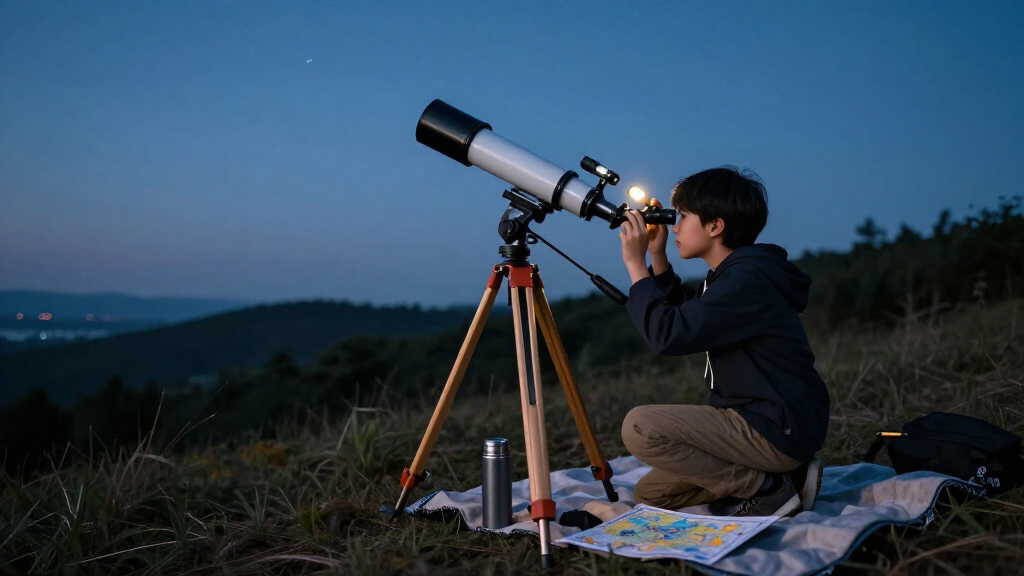
I evaluated each telescope through the eyes of a first-time buyer: how easy is it to set up on night one, how stable is the mount when you touch the focuser, and how long will the optics stay satisfying as skills grow. Aperture came first, since light-gathering power determines what you can actually see — a telescope that only shows the Moon will not sustain a beginner’s interest. Mount stability and ease of aiming came second, because a wobbly tripod or a confusing equatorial mount ruins good optics. Third, I weighed accessory quality: bundled eyepieces, finderscopes, phone adapters, and star maps all affect the out-of-box experience.
The ranking favors telescopes that support a beginner’s progression rather than just their first night. Models with guided navigation or upgrade paths rank higher than similarly priced scopes with dead-end accessories. Budget models were not penalized for being basic — they were judged on whether they deliver honest performance for the money. Conversely, kids’ toy telescopes rank lower for general beginners because their 50mm objectives and plastic mounts cap out quickly, even when they work well for their intended age group.
Factors to Consider When Choosing Telescopes For Beginners
Before picking a specific model, it helps to understand what actually determines whether a first telescope gets used or collects dust in a closet. These are the factors that shaped my ranking — and the mistakes I see first-time buyers make most often.Aperture: The Number That Actually Matters
Aperture (the diameter of the main lens or mirror) determines everything — how much light your telescope collects, how sharp planets appear, and how faint an object you can see. A 50mm telescope shows the Moon and little else; 70mm adds Saturn’s rings and Jupiter’s moons on a steady night; 80mm begins to reveal cloud bands and brighter deep-sky objects like the Orion Nebula. This is why the 80mm models cluster at the top of my value rankings despite costing more. A common mistake is shopping by magnification instead: a scope advertised at 150x with a small aperture produces dim, mushy images, because you’re magnifying light the lens never gathered. A useful rule of thumb is that maximum useful magnification is roughly 50x per inch of aperture — so a 70mm scope tops out near 140x no matter what the box claims. When in doubt, always buy more aperture rather than more advertised zoom.
Mount Stability: The Hidden Dealbreaker
More beginners abandon the hobby because of shaky mounts than poor optics. Every time you touch the focuser, an unstable tripod sends the image bouncing — and at 100x magnification, a tiny vibration looks like an earthquake. The altazimuth (up-down, left-right) mounts on the refractors in this lineup are the right choice for beginners; avoid equatorial mounts on entry-level scopes because their polar-alignment setup confuses newcomers before they see a single star. That said, alt-az mounts vary widely in build quality. Check whether the tripod is aluminum or plastic, whether the slow-motion controls are metal, and whether the mount head has any play in it. A heavier tripod is annoying to carry but transforms the viewing experience. If you must choose between a better telescope on a cheap tripod and a slightly lesser telescope on a solid one, take the solid mount — accessories can be upgraded later, but a bad mount is rarely fixable.
Refractor vs. Reflector for First-Time Buyers
Fourteen of the fifteen models here are refractors (lens-based) and one — the StarSense LT 114AZ — is a Newtonian reflector (mirror-based). Each design suits a different beginner. Refractors are sealed, rugged, and need zero maintenance — you set them up and look through them, which is why they dominate the entry market and why families with kids should stick to them. Reflectors offer more aperture per dollar, which is why the 114mm StarSense outperforms every 70mm refractor on faint objects, but their mirrors occasionally need collimation (alignment), which intimidates some newcomers. Reflectors also produce upside-down images unless corrected, which matters if you plan to use the scope for daytime birding too. My honest take: if your interest is purely the night sky and you want maximum view for the money, a small reflector is worth the small learning curve. If you want a grab-and-go scope the whole family can share carelessly, a refractor wins.
Smartphone Guidance: Genuinely Useful or a Gimmick?
The Celestron StarSense Explorer system — a phone dock plus an app that guides you to objects by arrows — is the most meaningful innovation in beginner telescopes in a decade, and it is why that model ranks first. Traditional finderscopes force beginners to learn star-hopping before they’ve seen anything rewarding, and frustration at this stage is what kills the hobby. Guided navigation lets a first-timer find Saturn in ten minutes, which builds the motivation to eventually learn the sky manually. That said, guided systems depend on your phone’s camera and a clear view for the app’s plate-solving, so they work less well in heavy light pollution or with older phones. Phone adapters for photography, common on the budget models here, are a different story: they let you snap lunar photos through the eyepiece, but do not expect planetary photography — that requires tracking mounts far beyond beginner budgets. Treat phone mounts as a fun extra, not a reason to choose one scope over another.
Realistic Expectations: What You Will Actually See
The biggest source of buyer disappointment is expecting Hubble-style images from a beginner telescope. Through any scope in this lineup, planets appear as small but sharp discs — Saturn’s rings clearly visible, Jupiter showing its cloud bands and four Galilean moons. Deep-say objects like galaxies and nebulae appear as faint gray smudges that reward patience and dark skies. The Moon, ironically, is the most spectacular target of all and looks stunning through even a 70mm scope — which is why lunar-focused kids’ telescopes exist at all. If you live under bright city lights, plan on planets, the Moon, and bright star clusters; faint nebulae require driving to darker locations. Knowing this before buying prevents the classic mistake of blaming the telescope for what is actually a light-pollution problem. A free light-pollution map app will tell you more about what you can see than any spec sheet.
When to Spend More — and When Not To
The jump from 50mm to 70mm buys a real upgrade in what you can see. The jump from 70mm to 80mm buys a meaningful but subtler improvement. Beyond 80mm in refractors, prices climb steeply because large lenses are expensive to make — which is why serious budget astronomers eventually move to reflectors or Dobsonians. My advice: if you’re unsure whether astronomy will stick, buy a solid 70mm like the Gskyer and spend the savings on a better eyepiece or a star atlas. If you already know you’re hooked — maybe you’ve borrowed a scope or attended a star party — go straight to an 80mm refractor or the 114mm StarSense, because the cheaper scope will only last you six months before you want more. Never buy a telescope as a gift for an adult based purely on price; a disappointing telescope costs more in abandoned interest than a good one costs in dollars.
Frequently Asked Questions
Is a 70mm telescope good enough for a beginner, or should I pay more for 80mm?
For most first-time buyers, 70mm is a genuinely good starting point — it shows the Moon in crisp detail, Saturn’s rings, Jupiter’s moons, and bright star clusters. The 80mm models gather about 30% more light, which makes fainter objects easier and planets slightly brighter and sharper, but the difference is a refinement rather than a night-and-day change. Where 80mm pulls ahead is longevity: a beginner who stargazes monthly will outgrow a 70mm’s limits within a year, while an 80mm stays satisfying longer. If the price gap between a well-built 70mm and a comparable 80mm is small, take the 80mm. If the gap is large, put the difference toward a quality eyepiece or a Moon filter for the 70mm instead — that often improves the view more than extra aperture at this level.
Why is the Celestron StarSense Explorer LT 114AZ ranked highest if other telescopes are easier to carry?
Portability matters, but finding objects is where beginners actually fail, and the StarSense system directly solves that. Without guidance, a new astronomer can spend an entire evening failing to locate Saturn and conclude the telescope — or the hobby — doesn’t work. The StarSense app uses your phone’s camera to identify where the scope is pointing and walks you to the target with simple arrows, which turns a frustrating first night into a rewarding one. The 114mm mirror also gathers roughly twice the light of the 70mm refractors in this lineup, so objects look brighter once found. The tradeoffs are real: it’s bulkier than a 70mm refractor, the mirrors may eventually need alignment, and it’s useless for daytime terrestrial viewing since the image is inverted. For a beginner whose goal is the night sky, those tradeoffs are worth it; for a traveler or bird-watcher, a compact refractor is the smarter pick.
Can I take photos through these beginner telescopes with my phone?
Yes, and most models in this roundup include a phone adapter that clamps your phone over the eyepiece — but set expectations correctly. Moon photography works well through even a 70mm scope, and you can capture Jupiter and Saturn as small but recognizable discs with patience and a steady hand. What you cannot do with any manual, non-tracking telescope is long-exposure photography of nebulae and galaxies, because the sky’s rotation smears the image within a second or two. Planetary imaging with stacked video frames is possible on manual mounts but tedious. If astrophotography is your main goal, no telescope in this beginner range is the right purchase — you’d be better served saving for a tracking equatorial mount first. If photography is a fun side activity alongside visual observing, the included phone adapters are perfectly adequate.
Are the cheap 50mm kids’ telescopes a waste of money?
Not necessarily — it depends entirely on who’s using them. For a child under about ten, a 50mm scope like the NASA Lunar Telescope delivers exactly what it promises: a good view of the Moon and the occasional planet, in a package light enough for small hands and cheap enough that breakage isn’t a tragedy. As a tool for learning focus, patience, and basic sky navigation, it’s a legitimate starter. The problem arises when adults or older kids buy them expecting more — a 50mm objective genuinely cannot show nebulae, galaxy detail, or planetary surface features, and the plastic mounts on most of these models make fine focusing difficult. My rule: a 50mm scope is a toy with educational value, a 70mm is a real telescope at entry level. If the recipient is over ten or the buyer is the user, skip 50mm entirely — the disappointment risk outweighs the savings.
Do I need a dark sky location for a beginner telescope to be worth it?
No — and this is one of the most common misconceptions stopping people from buying. The best beginner targets are almost unaffected by light pollution: the Moon, Saturn, Jupiter, Venus, and Mars are all bright enough to observe brilliantly from the middle of a city. Double stars and bright clusters like the Pleiades also cut through urban skies well. What light pollution destroys is faint deep-sky viewing — galaxies and most nebulae — which will look like barely-there smudges or be invisible from downtown, no matter which telescope in this lineup you own. The practical approach is to learn the Moon and planets from home, then take advantage of the portability of these small refractors for occasional trips to darker locations a short drive away. A scope that lives on your balcony and gets used weekly beats a bigger one that requires an expedition you never take.
Conclusion
After comparing all fifteen models, the right choice depends less on specs and more on who is holding the eyepiece. For the best overall beginner telescope, the Celestron StarSense Explorer LT 114AZ earns the top spot: its smartphone guidance and larger 114mm mirror solve the two problems — finding objects and seeing them clearly — that end most beginners’ interest early. For best value, the Gskyer 70mm delivers honest optics, a usable mount, and sensible accessories without paying for the 80mm class. The MEEZAA 80mm and Celticbird 80mm represent the premium step-up for buyers who already know they’re committed and want a scope that won’t be outgrown in six months. For young beginners, the NASA Lunar Telescope is the strongest of the kids’ models because it sets honest expectations, while the Celestron Travel Scope 70mm is the clear pick for travel and grab-and-go use thanks to its backpack design. Skip the generic 50mm and no-name 70mm boxes unless budget leaves no alternative — the difference between a telescope that gets used and one that gets abandoned is usually twenty dollars and a stable tripod. Whichever you choose, get outside on the next clear night: the Moon alone will reward you immediately.
Fall Picks
fall essentials
As an affiliate, we earn on qualifying purchases.