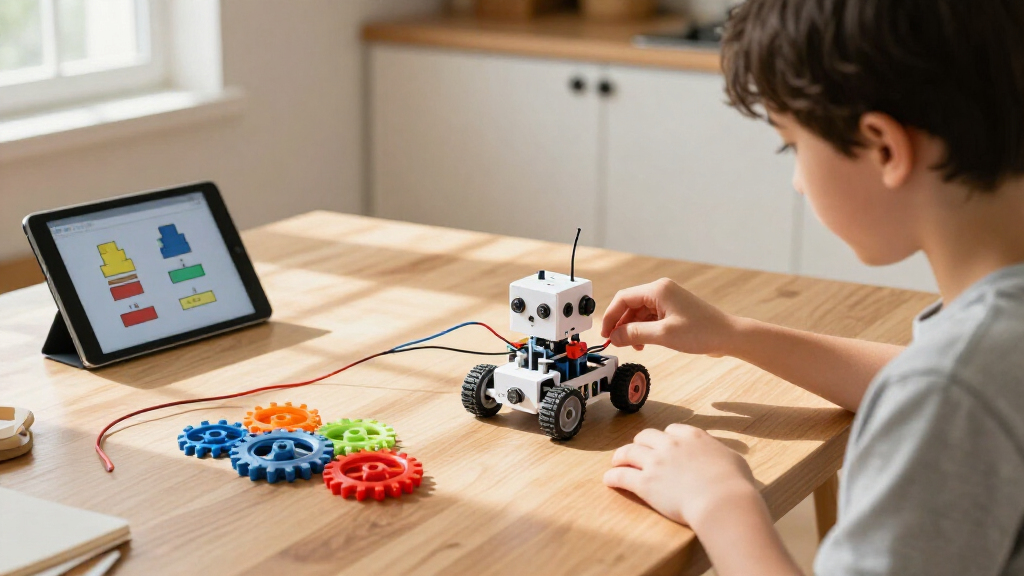
The best kids’ coding robot kits pair a build children can enjoy with programming they can grow into. My best overall pick is the Makeblock mBot STEM Coding Robot Kit, a strong middle ground for school-age learners who want guided coding and room to build skills. For younger beginners, the Thames & Kosmos Kids First Coding & Robotics Kit keeps the entry point approachable, while the mBot Ranger 3-in-1 suits older kids who want more build variety. The main tradeoff is between simple, screen-light play and kits with deeper coding tools that take more setup. Read on for the full breakdown and help matching a kit to your child’s age, patience, and interests.

Prime made for students and young adults
- Fast, free delivery for dorm and study essentials
- Prime Video and Amazon Music included
- Member-only deals
Key Takeaways
- The standard Makeblock mBot is the strongest all-around balance: it combines an accessible starting point with a clearer path into coding than remote-control-first toys.
- Age and patience matter as much as coding level: Thames & Kosmos Kids First is aimed at younger starters, while the Ranger and Mech-5 are better fits for older builders comfortable with more involved assembly.
- Build variety is not the same as coding depth: multi-configuration kits such as the Ranger and Sillbird 5-in-1 offer different robot forms, while Arduino- and Scratch-compatible options emphasize programming exploration.
- Some kits lean more toward construction or remote control: the KiwiCo Snake Robot and Sillbird remote-control model can appeal to hands-on builders, but buyers should check whether their child wants coding activities first.
- The most expandable options ask more from the buyer: the ELEGOO UNO R3 and ACEBOTT Arduino-compatible kits suit families ready for setup and troubleshooting, not those seeking the quickest first session.
| Thames & Kosmos My Robotic Pet: Coding Chameleon Robotics Kit |  | Best Screen-Free Robot Build for Older Kids | Brand: Thames & Kosmos | Model number: 620507 | Age range: 8+ years | VIEW LATEST PRICE | See Our Full Breakdown |
| Makeblock mBot Ranger 3-in-1 Coding Robot Building Kit for Kids Ages 10+ |  | Best for Advanced, Reconfigurable Projects | Brand: Makeblock | Model number: MBR-K01-01 | Age range: 10+ years | VIEW LATEST PRICE | See Our Full Breakdown |
| Teach Tech Mech-5 STEM Coding Robot Building Kit for Ages 10+ |  | Best for Mechanical, Screen-Free Coding | Brand: Teach Tech | Model: TTC-895 | Recommended age: 10 years and up | VIEW LATEST PRICE | See Our Full Breakdown |
| Makeblock mBot Arduino Robot Kit with Scratch Coding Box for Kids Ages 8-12 |  | Best First App-Based Coding Robot | Brand: Makeblock | Model number: mBot-K08-01 | Recommended age: 8–12 years | VIEW LATEST PRICE | See Our Full Breakdown |
| Thames & Kosmos Kids First Coding & Robotics Kit |  | Best for Early Elementary Beginners | Brand: Thames & Kosmos | Model number: 567012 | Age range: 4–8 years | VIEW LATEST PRICE | See Our Full Breakdown |
| Makeblock mBot STEM Coding Robot Kit for Kids Ages 8–12 | 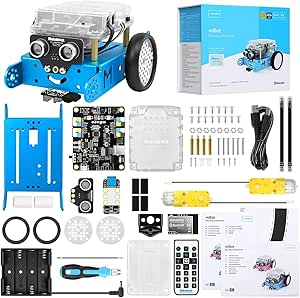 | Best for a First Step into Coding | Recommended age: 8 years and up | Model: 90053 | Programming platforms: Scratch, Arduino, and mBlock | VIEW LATEST PRICE | See Our Full Breakdown |
| KiwiCo Remote Control Snake Robot – DIY Robotics Building Kit for Ages 9+ |  | Best for Hands-On Mechanical Learning | Recommended age: 9+ | Material: Wood | Robot type: Remote-controlled snake robot | VIEW LATEST PRICE | See Our Full Breakdown |
| Sillbird 5-in-1 Programmable STEM Robot Building Kit with App and Remote Control |  | Best for Multiple Builds | Recommended age: 8–16 years | Number of pieces: 488 | Build options: Robot, dinosaur, car, tank, and more | VIEW LATEST PRICE | See Our Full Breakdown |
| ACEBOTT 4-in-1 Programmable Robot Arm and Tank Car Kit |  | Best for Advanced Builders | Recommended age: 12 years and up | Controller: ESP32 | Robotic arm: 5DOF | VIEW LATEST PRICE | See Our Full Breakdown |
| Sillbird Building Robot Kit with Remote Control – STEM Gift for Boys Ages 8‑12 |  | Best for App-and-Remote Play | Recommended age: 8 years and up | Number of pieces: 488 | Build options: Five models, including robot, car, tank, and dinosaur | VIEW LATEST PRICE | See Our Full Breakdown |
| ELEGOO UNO R3 Smart Robot Car Kit V4 with Camera |  | Best for Camera-Based Arduino Projects | Controller: UNO R3 | Camera and Wi-Fi module: ESP32-WROVER-based | Sensors: Line-tracking and ultrasonic | VIEW LATEST PRICE | See Our Full Breakdown |
| ACEBOTT Robotics Kit for Kids Ages 8‑16 – Smart Robot Car Compatible with Arduino & Scratch |  | Best for Multi-Language Learning | Model: QD106 | Programming: Scratch, Arduino and Python | Compatible devices: Computers, tablets and smartphones | VIEW LATEST PRICE | See Our Full Breakdown |
| kids coding robot kit | Recommended age | Model |
|---|---|---|
| Thames & Kosmos My Robotic Pet | — | — |
| Makeblock mBot Ranger 3-in-1 C | — | — |
| Teach Tech Mech-5 STEM Coding | 10 years and up | TTC-895 |
| Makeblock mBot Arduino Robot K | 8–12 years | — |
| Thames & Kosmos Kids First Cod | — | — |
| Makeblock mBot STEM Coding Rob | 8 years and up | 90053 |
| KiwiCo Remote Control Snake Ro | 9+ | SNAK-F2009 |
| Sillbird 5-in-1 Programmable S | 8–16 years | — |
| ACEBOTT 4-in-1 Programmable Ro | 12 years and up | QD043 |
| Sillbird Building Robot Kit wi | 8 years and up | US-B897R1 |
| ELEGOO UNO R3 Smart Robot Car | 12 years and up | — |
| ACEBOTT Robotics Kit for Kids | — | QD106 |
More Details on Our Top Picks
Thames & Kosmos My Robotic Pet: Coding Chameleon Robotics Kit
The Coding Chameleon pairs a substantial build with physical action-card programming, so kids can explore coding without moving straight to an app. Its color and infrared sensors support interactive responses, while the three play modes add variety beyond the build itself: coding challenges sit alongside more open-ended pet-style interaction. Compared with the younger-focused Kids First Coding & Robotics Kit, this chameleon is a more involved project for children ready to assemble and explore a more lifelike robot. The tradeoff is that its 15-inch body and articulated features need room and gentler handling, and battery power adds ongoing upkeep. Children under 12 may also need adult help during assembly, so this is less suited to families seeking a quick, independent first activity.
Pros:- Physical action cards offer screen-free coding practice.
- Coding, Wild, and Pet modes give children different ways to interact.
- Color and infrared sensors support responsive robot behavior.
- The manual provides structured STEM activities and biomimicry context.
Cons:- Assembly may require adult help for children under 12.
- Battery-powered operation requires batteries to be on hand.
- Plastic construction may not suit rough play.
Best for: Families with children 8 and older who want screen-free programming paired with a detailed animal-themed build.
Not ideal for: Young children who need to complete assembly independently, or families looking for a compact robot that can stand up to rough handling.
- Brand:Thames & Kosmos
- Model number:620507
- Age range:8+ years
- Dimensions:15 inches long
- Sensors and lights:Color sensor, infrared sensor, RGB LEDs
- Play modes:Coding Mode, Wild Mode, Pet Mode
- Programming method:Physical action cards
- Power source:Batteries
Our verdict“Choose the Coding Chameleon for an older child who wants a screen-free, animal-inspired robot build and can handle a more involved assembly.”
Makeblock mBot Ranger 3-in-1 Coding Robot Building Kit for Kids Ages 10+
For a child ready to move beyond a single robot design, the mBot Ranger offers three configurations: tank, self-balancing bird, and three-wheel racing car. Its sensor selection and support for both Scratch and Arduino give the kit a longer learning runway than the simpler Makeblock mBot kit, which centers on guided introductory projects. That flexibility can keep older learners experimenting with movement, sensing, and code as their skills grow. It also makes this the more demanding choice: the 10+ age recommendation reflects a parts-heavy build that may call for adult support, and the battery requirement is not covered by the kit. I would pick the Ranger for families who value expandability over a quick first build; younger beginners may find the standard mBot easier to start with.
Pros:- Three configurations offer distinct ways to build and experiment.
- Supports Scratch and Arduino programming.
- Includes ultrasonic, line-tracking, light, gyroscope, and temperature sensors.
- Metal parts and motors support projects across varied surfaces.
Cons:- Requires six AA or lithium batteries, which are not included.
- The extensive parts list can make assembly challenging for younger children.
- Its broader feature set may be more than a beginner needs.
Best for: Families with children 10 and older who want multiple robot builds, sensor-based projects, and a path from block coding to Arduino.
Not ideal for: Younger beginners or buyers who want a quick assembly with minimal setup and no separate battery purchase.
- Brand:Makeblock
- Model number:MBR-K01-01
- Age range:10+ years
- Robot configurations:Tank, self-balancing bird, three-wheel racing car
- Programming languages:Scratch, Arduino
- Sensors:Ultrasonic, line-tracking, two light sensors, gyroscope, temperature sensor
- Connectivity:Bluetooth module
- Battery requirement:Six AA or lithium batteries; not included
Our verdict“Pick the mBot Ranger for an older learner who wants varied builds and room to grow into Arduino, rather than the faster-starting standard mBot.”
Teach Tech Mech-5 STEM Coding Robot Building Kit for Ages 10+
The Mech-5 makes the physical sequence visible: children place coding buttons on a mechanical wheel, then watch the robot carry out movements and actions such as lifting, kicking, or drawing. That tactile approach sets it apart from the app-based Makeblock mBot, which teaches through Scratch and Arduino projects rather than a mechanical coding wheel. It also avoids batteries, making it a straightforward option for screen-free tinkering once assembly is complete. The main cost is time and care: the build takes multiple hours, and incorrect construction can affect the result. Its button-based programming is more concrete but less flexible than software coding, so I would favor it for an older child interested in mechanisms over a learner seeking app-based coding progression.
Pros:- Mechanical coding wheel makes command sequences physically visible.
- Robot actions include throwing, lifting, kicking, and drawing.
- Build supports mechanical engineering and problem-solving practice.
- Does not require batteries.
Cons:- Assembly takes multiple hours.
- Careful construction is needed for the robot to work as intended.
- Button-based programming offers less flexibility than Scratch or Arduino.
Best for: Children around 10 and older who enjoy careful building and want a tangible introduction to programming movement without an app.
Not ideal for: Families seeking a quick activity, app-based coding, or a robot that can be used immediately after unboxing.
- Brand:Teach Tech
- Model:TTC-895
- Recommended age:10 years and up
- Programming method:Coding buttons on a mechanical coding wheel
- Movement:Forward, backward, and 360-degree rotation
- Actions:Throwing, lifting, kicking, and drawing
- Assembly time:Multiple hours
- Battery requirement:None
Our verdict“Choose the Mech-5 for a patient young builder who values hands-on mechanisms over app-based coding and can spend time on assembly.”
Makeblock mBot Arduino Robot Kit with Scratch Coding Box for Kids Ages 8-12
The standard Makeblock mBot is the more approachable entry point for children who want a programmable robot without a long construction session. The kit is designed to assemble in about 15 minutes and includes guided projects such as line following and obstacle avoidance, giving beginners a clear first step before they explore Scratch and Arduino. Compared with the 3-in-1 mBot Ranger, this version is narrower in scope: it does not offer three configurations or the Ranger’s listed array of sensors, but its shorter setup and project guidance make it easier to get started. The four included projects may feel limiting once a child has completed them, and AA batteries are not included. This is a practical first coding robot, not the choice for someone seeking a large, open-ended parts platform.
Pros:- Designed for a roughly 15-minute build.
- Includes guided projects for line following and obstacle avoidance.
- Supports Scratch and Arduino programming.
- Includes tools, cables, sensors, and an infrared remote controller.
Cons:- The four pre-designed projects may not sustain interest for long.
- AA batteries are not included.
- Offers less reconfiguration than the mBot Ranger.
Best for: Families with children ages 8–12 who want a fast assembly, guided starter projects, and a first step from block coding toward Arduino.
Not ideal for: Older or experienced builders who want multiple robot forms, a broad sensor set, or an extensive project library in the box.
- Brand:Makeblock
- Model number:mBot-K08-01
- Recommended age:8–12 years
- Programming languages:Scratch, Arduino
- Guided projects:Four, including line following and obstacle avoidance
- Sensors:Line-follower sensor
- Included control:Infrared remote controller
- Battery holder:AA battery holder included; batteries not included
Our verdict“Choose this mBot for an 8–12-year-old who needs a quick, guided first robot, and choose the Ranger if multiple builds matter more than an easy start.”
Thames & Kosmos Kids First Coding & Robotics Kit
The Kids First Coding & Robotics Kit is the clearest fit here for young learners who are not ready for app-based coding or complex robot assembly. Children use physical code cards and map grids to guide Sammy through story challenges, meeting concepts such as sequencing, loops, and variables in a concrete format. Compared with the Coding Chameleon, it targets a younger age range and prioritizes foundational logic over a lifelike robot with multiple play modes. The six story scenarios and 64-page manual give adults a guided way to support lessons, though children at the younger end of the 4–8 range may need help. Its age focus is also a limit: older kids looking for Scratch, Arduino, or more open-ended robot projects are likely to outgrow it quickly.
Pros:- Uses physical code cards without apps or smart devices.
- Story challenges introduce sequencing, loops, functions, conditions, events, and variables.
- Map grids make programmed routes tangible for early learners.
- Includes a 64-page manual and six story scenarios.
Cons:- Children around age 4 may need adult support to complete lessons.
- The introductory concepts may not hold older children’s interest.
- It does not offer Scratch or Arduino programming.
Best for: Caregivers and educators introducing children in kindergarten through grade 2 to coding logic without screens.
Not ideal for: Older children who want app-based programming, complex robot builds, or projects that extend beyond introductory coding concepts.
- Brand:Thames & Kosmos
- Model number:567012
- Age range:4–8 years
- Grade level:K–2
- Robot feature:Sammy robot with OID scanner
- Included learning materials:Code cards, story cards, map grids, building pieces, 64-page manual
- Coding concepts:Sequencing, loops, functions, conditions, events, variables
- Warranty:1 year against manufacturer defects
Our verdict“Choose this kit for a young beginner who needs story-led, screen-free coding foundations, rather than an older child ready for Scratch or a more complex build.”
Makeblock mBot STEM Coding Robot Kit for Kids Ages 8–12
The Makeblock mBot is a strong fit for children ready to move from simple robot play toward coding and electronics. Guided lessons, coding cards, and Makeblock apps introduce Scratch and Arduino, while line-following and obstacle-avoidance modes give kids visible results to explore between coding sessions. Its roughly 15-minute assembly is more approachable than the advanced ACEBOTT 4-in-1 Programmable Robot Arm and Tank Car Kit, which is aimed at older learners and adds a 5DOF arm. The mBot also has room to grow through compatible add-on packs and modules. That flexibility comes with a battery caveat: the four AA batteries and remote’s CR2025 are not included. I’d choose it over the multi-model Sillbird 5-in-1 when coding lessons matter more than building several different shapes.
Pros:- Introduces Scratch, Arduino, electronics, and robotics through guided materials
- Line-following and obstacle-avoidance functions make coding concepts tangible
- Metal construction and compatibility with add-on packs support future projects
- Assembly takes approximately 15 minutes
Cons:- Four AA batteries and one CR2025 battery are not included
- Offers fewer alternate build forms than the Sillbird 5-in-1 kits
Best for: Children around age eight and up who want guided Scratch lessons and a robot they can expand into Arduino projects
Not ideal for: Families who want a rechargeable kit ready to run out of the box, since the robot and remote batteries must be purchased separately
- Recommended age:8 years and up
- Model:90053
- Programming platforms:Scratch, Arduino, and mBlock
- Functions:Remote control, line-following, and obstacle avoidance
- Assembly time:Approximately 15 minutes
- Robot power:4 AA batteries, not included
- Remote battery:1 CR2025 battery, not included
- Expansion compatibility:Makeblock add-on packs, over 100 electronic modules, and 500+ parts
Our verdict“Choose the mBot for guided coding lessons and room to expand, provided you’re prepared to supply its batteries.”
KiwiCo Remote Control Snake Robot – DIY Robotics Building Kit for Ages 9+
The KiwiCo Remote Control Snake Robot takes a more focused route than the programmable cars in this roundup: kids build a moving snake and explore how electricity, switches, and robotics work. Its maze pieces and customizable skins add an open-ended play element, so the finished build can be more than a one-time assembly project. Compared with the Makeblock mBot, this kit is centered on hands-on mechanical discovery rather than Scratch or Arduino coding; buyers seeking software lessons should choose the mBot instead. The tradeoff is that the wooden parts may not stand up to rough handling, and assembly can call for adult help, especially for younger builders. I’d pick it for a child who enjoys making and customizing a physical mechanism, not for one expecting a coding platform or multiple robot configurations.
Pros:- Introduces electricity, switches, engineering, and robotics through assembly
- Remote control provides interactive movement after the build
- Customizable skins and maze pieces support creative play
- Includes the components needed for assembly
Cons:- Wooden components can be fragile if handled roughly
- Assembly may require adult assistance
- Does not offer the Scratch or Arduino programming platforms found on the Makeblock mBot
Best for: Builders age nine and up who enjoy assembling a moving mechanism, customizing its appearance, and exploring mazes
Not ideal for: Children specifically seeking Scratch or Arduino programming lessons, or families who need a kit built to withstand rough handling
- Recommended age:9+
- Material:Wood
- Robot type:Remote-controlled snake robot
- Learning focus:STEM, robotics, and engineering
- Included play accessories:Customizable skins and maze pieces
- Dimensions:11 x 7.5 x 3.38 inches
- Model:SNAK-F2009
Our verdict“Pick this kit for a child who prefers building and customizing a mechanical robot over coding through an app.”
Sillbird 5-in-1 Programmable STEM Robot Building Kit with App and Remote Control
The Sillbird 5-in-1 makes variety its main draw: its 488 pieces can form a robot, dinosaur, car, tank, and other models, with build difficulty that progresses. That means it offers more reasons to rebuild than the single-purpose KiwiCo Snake Robot, while app and remote controls let kids interact with their creations in different ways. Basic programming is included, but the listing gives less emphasis to structured coding instruction than the Makeblock mBot, which has guided lessons and Scratch and Arduino support. I’d favor this Sillbird for a child who likes construction challenges and changing forms, not for a family seeking a deeper coding curriculum. The large piece count also means assembly takes patience, and play lasts up to 40 minutes per charge before recharging is needed.
Pros:- Five build options include a robot, dinosaur, car, and tank
- Progressive build difficulty gives children new construction challenges
- Supports app control, remote control, and basic programming
- Rechargeable battery provides up to 40 minutes of play per charge
Cons:- The 488-piece build can take patience and sustained attention
- Play time is limited to up to 40 minutes per charge
- Coding instruction is less developed than the guided lessons on the Makeblock mBot
Best for: Children ages 8–16 who enjoy rebuilding models and want both app and remote control in one kit
Not ideal for: Buyers prioritizing guided Scratch or Arduino instruction, or children who lose interest in longer, piece-heavy builds
- Recommended age:8–16 years
- Number of pieces:488
- Build options:Robot, dinosaur, car, tank, and more
- Control methods:Bluetooth app and remote control
- Programming:Basic programming
- Play time:Up to 40 minutes per charge
- Dimensions:6 x 7 x 8 inches
- Weight:1.8 pounds
Our verdict“Choose this Sillbird for a child who values rebuilding different models more than following a detailed coding curriculum.”
ACEBOTT 4-in-1 Programmable Robot Arm and Tank Car Kit
The ACEBOTT 4-in-1 is the most technically ambitious option in this group. Its ESP32 controller supports Arduino and Scratch, and the 5DOF arm adds a hands-on task—grabbing, lifting, and placing objects—that a general-purpose kit like the Sillbird 5-in-1 does not emphasize. Four configurations, from a robot car to a robotic arm tank, let older learners explore how the same hardware changes with a build. The 16 guided tutorials give projects some structure, while app and IR remote controls offer different ways to drive it. The tradeoff is a higher learning and assembly burden: it’s recommended for ages 12 and up, so it is a poor match for a younger child’s first coding robot. I’d choose it over the Makeblock mBot for a teen ready for more involved mechanisms.
Pros:- Four configurations include car, tank, robotic arm car, and robotic arm tank
- 5DOF arm can grab, lift, and place objects
- Supports Arduino and Scratch with 16 guided tutorials
- Rubber tank treads are designed for grass, gravel, slopes, and carpet
Cons:- Assembly and coding can be challenging for beginners
- Recommended age of 12 and up makes it less suitable for younger children
- The specialized arm and tracked configurations are more involved than the Makeblock mBot’s introductory setup
Best for: Learners age 12 and up who already have interest in coding and want to build and program a robot arm or tracked vehicle
Not ideal for: Younger beginners or children who need a simple, quick-start robot with minimal assembly and coding demands
- Recommended age:12 years and up
- Controller:ESP32
- Robotic arm:5DOF
- Configurations:Robot car, tank robot, robotic arm car, and robotic arm tank
- Programming compatibility:Arduino and Scratch
- Control methods:IR remote and iOS or Android app
- Guided tutorials:16
- Model:QD043
Our verdict“Choose the ACEBOTT for an older learner ready for a more demanding Arduino or Scratch build with a functional robotic arm.”
Sillbird Building Robot Kit with Remote Control – STEM Gift for Boys Ages 8‑12
This Sillbird Building Robot Kit is a flexible pick for children who want to assemble different shapes and then control them by either Bluetooth app or handheld remote. Its 488 pieces and five model options overlap with the Sillbird 5-in-1 Programmable STEM Robot Building Kit; here, the blue model is listed for ages eight and up, with colorful step-by-step instructions aimed at making assembly manageable. The rechargeable battery avoids the separate battery purchases required by the Makeblock mBot, though play is capped at up to 40 minutes per charge. The other tradeoff is that app-based control needs a smartphone or tablet, even though the handheld remote offers an alternative. I’d choose this over the mBot when multi-model construction and two control methods matter more than guided Scratch or Arduino learning.
Pros:- 488 pieces support five different model builds
- Bluetooth app and handheld remote provide two control options
- Rechargeable battery avoids replacing disposable robot batteries
- Colorful step-by-step instructions guide assembly
Cons:- Play time is limited to up to 40 minutes per charge
- App-based control requires a smartphone or tablet
- Offers less clearly specified coding instruction than the Makeblock mBot
Best for: Children age eight and up who want several build options, clear assembly instructions, and a choice of app or handheld control
Not ideal for: Families without a compatible smartphone or tablet who expect to use app controls, or buyers looking for a structured Scratch or Arduino coding course
- Recommended age:8 years and up
- Number of pieces:488
- Build options:Five models, including robot, car, tank, and dinosaur
- Control methods:Bluetooth app and handheld remote
- Battery type:Rechargeable
- Play time per charge:Up to 40 minutes
- Dimensions:10 x 8 x 2 inches
- Model:US-B897R1
Our verdict“Choose this Sillbird for accessible multi-model building and dual controls, but look elsewhere for a more lesson-driven coding kit.”
ELEGOO UNO R3 Smart Robot Car Kit V4 with Camera
The ELEGOO UNO R3 suits older beginners who want a buildable car that connects coding to visible movement and camera feedback. Its FPV camera, line-tracking and ultrasonic obstacle sensors offer more ways to experiment than a basic remote-control robot, while Arduino IDE programming gives learners room to work beyond preset commands. Compared with the ACEBOTT Robotics Kit, this model emphasizes camera features and Arduino rather than a choice of Scratch, Arduino and Python. App and IR controls also let a child drive it before writing code. The tradeoff is a steeper start: assembly and programming may call for adult help, and its stated recommended age is 12 and up. I’d choose it for a focused Arduino-and-sensors project, not for a younger child seeking the gentlest first coding experience.
Pros:- FPV camera adds visual feedback to robot-car experiments.
- Line-tracking and ultrasonic sensors support varied behavior projects.
- App and IR remote offer both phone-based and direct control.
- Guided instructions, sample programs and keyed connectors support assembly and learning.
Cons:- Assembly and Arduino programming can require adult guidance for beginners.
- Its recommended age of 12 and up makes it a less natural fit for younger children.
- The camera-and-sensor feature set may be more involved than a child wants for casual play.
Best for: Learners aged 12 and up who want to explore Arduino, sensor-driven movement and FPV camera feedback in one robot car.
Not ideal for: Younger first-time builders who need a simple, low-setup activity or families unwilling to help with assembly and coding.
- Controller:UNO R3
- Camera and Wi-Fi module:ESP32-WROVER-based
- Sensors:Line-tracking and ultrasonic
- Programming:Arduino IDE
- Control:ELEGOO app and IR remote
- Battery:2000 mAh rechargeable lithium-ion, included
- Recommended age:12 years and up
- Dimensions:8 x 7 x 6 inches
Our verdict“Pick this kit for an older learner ready to build and code an Arduino car with camera and sensor features.”
ACEBOTT Robotics Kit for Kids Ages 8‑16 – Smart Robot Car Compatible with Arduino & Scratch
The ACEBOTT QD106 is the more flexible learning path for families who want a child to start with visual coding and later move to text-based languages. Its support for Scratch, Arduino and Python gives the same car a wider teaching range than the ELEGOO UNO R3, which centers on Arduino IDE and adds FPV camera features instead. Story-based tutorials and video guidance can help make assembly and early coding feel more directed, while app and IR control provide a way to see commands take effect. It also avoids soldering, which lowers one barrier for home projects. The compromises are practical: batteries are not included, and younger builders may still need adult help with assembly. I’d favor ACEBOTT for programming progression, but choose ELEGOO if camera-based experiments matter more.
Pros:- Scratch, Arduino and Python offer multiple entry points and room to progress.
- Works with computers, tablets and smartphones.
- No soldering is required.
- Video and story-based tutorials plus app and IR control support guided experimentation.
Cons:- Batteries are not included.
- Assembly may be challenging for younger children without adult assistance.
- The listed age information is mixed, so buyers should check suitability for the child’s experience level.
Best for: Families seeking one robot car that can introduce Scratch and support later exploration of Arduino or Python, with adult help available for assembly.
Not ideal for: Buyers who want batteries included, or children who need a very simple, independently assembled first robot.
- Model:QD106
- Programming:Scratch, Arduino and Python
- Compatible devices:Computers, tablets and smartphones
- Control:App and IR remote
- Assembly:No soldering required
- Age description:Kids ages 12+; also described as suitable for ages 8–16
- Included components:Smart car kit
Our verdict“Choose ACEBOTT for a guided robot-car kit that can grow from Scratch into Arduino or Python, provided you can supply batteries and assembly help.”
How We Picked
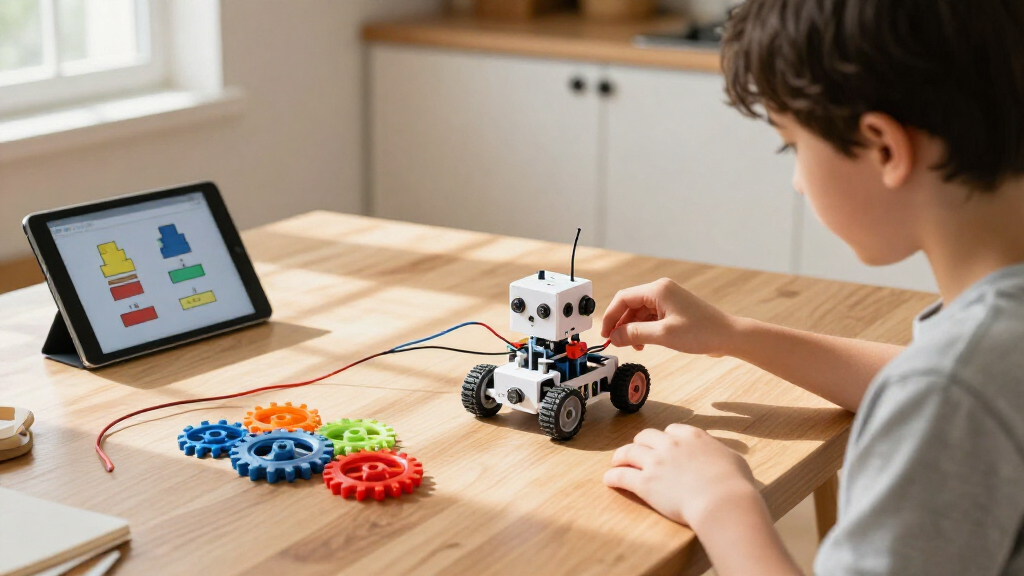
I compared these kits by how well they connect building, coding, and visible robot behavior, rather than treating every STEM label as proof of a similar learning experience. I weighed the stated age range, assembly demands, coding approach, activity variety, and the likely support needed from an adult. I also looked at whether a kit offers a useful next step after the first build, such as alternate configurations or programming tools.
The ranking favors kits that balance an approachable start with meaningful coding practice, which puts the standard Makeblock mBot ahead of more specialized picks. Beginner-friendly sets rank well for younger learners but may offer less room to advance; advanced Arduino-style kits rank lower for general use because setup and debugging can create friction. Kits centered on remote control or a single creature build can still be good matches, but their appeal depends more on a child’s particular interests.
Factors to Consider When Choosing Kids Coding Robot Kits
Before choosing among kids’ coding robot kits, match the kit to the kind of learning your child actually enjoys. These broader checks can help prevent a mismatch between a promising feature list and the experience at home.
Match the Coding Style to the Child
“Coding” can mean anything from arranging simple commands to writing or modifying programs. A child who is new to programming may benefit from guided visual blocks and quick feedback, while an experienced learner may want access to Arduino-compatible tools or more open-ended code. Don’t choose solely by the oldest age listed on a box: comfort with reading instructions and debugging can matter more than age. Ask whether your child wants to make a robot move right away or is happy to spend time figuring out why a program behaves differently than expected. A kit that feels easy at first but offers no next step can lose appeal; a highly flexible kit can frustrate a beginner if the first successful run takes too long.
Separate Building Time From Coding Time
Some kits devote much of the activity to assembling a robot, while others put more emphasis on programming what it does. That distinction affects how often a child can repeat a coding experiment: a long first build may be satisfying, but it leaves less time for changing commands in a short session. For children who enjoy construction, assembly is part of the fun rather than a hurdle. For a child mainly interested in code, check whether the robot can be reused for several programming challenges without rebuilding it each time. A common mistake is to assume that more pieces or more robot forms automatically mean more coding practice. Look for a balance that matches your child’s preferred way to play.
Check the Adult Support and Setup Burden
App-based and programmable kits may involve pairing, software installation, device compatibility, or firmware and connection setup. Those steps can shape the first session as much as the robot itself, so check the manufacturer’s requirements before buying. A parent who enjoys troubleshooting may welcome an Arduino-compatible platform; a family seeking independent play may prefer a more guided experience. Also consider whether instructions are clear enough for the intended age and whether younger children will need help with small parts or delicate connections. Don’t assume that a robot is ready to use straight from the box just because it includes a remote or app. A little preparation can help the child spend more time building and experimenting.
Prioritize a Useful Learning Path Over a Long Feature List
Alternate builds, sensors, and programming modes are valuable only when they give the child a reason to keep experimenting. Think about what a child could try after the first successful movement: changing a sequence, responding to an obstacle, or adapting a build for a new task. A kit with fewer configurations may still teach more if its activities progress clearly. Conversely, multiple robot forms can keep a builder interested even when the coding tasks are modest. Ask whether your child is more motivated by mastering one robot or rebuilding different designs. That preference can matter more than the total number of advertised functions.
Plan for Small Parts, Storage, and Repeated Use
Robot kits can involve loose pieces, wires, fasteners, and components that need to be stored between sessions. A build that gets taken apart may be harder to return to if parts are not organized, so think about where the kit will live and who will manage cleanup. Younger children may need an adult to track small components, while older builders may enjoy sorting and rebuilding independently. Check whether the robot is meant to remain assembled or whether changing forms is central to its appeal. Consider the play space too: moving robots need a clear surface, and some builds are better suited to tabletop exploration than racing across a room. These practical details affect how often a kit gets used.
Know When Extra Flexibility Is Worth the Effort
More open-ended kits can support longer-term projects, but flexibility often brings more setup, less hand-holding, and a steeper debugging curve. That extra complexity makes sense when a child already enjoys coding or has an adult available to help with early problems. For a first robot, a clearly guided kit may produce more satisfying learning than a platform with many possible extensions. Avoid paying for advanced features your child is unlikely to use soon; instead, choose a kit that matches current skills and has a realistic next step. If the child quickly outgrows structured activities, a programmable platform can be a better long-term fit. The right tradeoff is the one that keeps experimentation enjoyable rather than turning every session into setup work.
Frequently Asked Questions
Which type of coding robot kit is best for a child who has never coded?
Start with a kit that offers clear, guided activities and an easy way to see what a command changes. For younger children, the Thames & Kosmos Kids First Coding & Robotics Kit is the beginner-oriented pick in this group. A school-age child ready for visual coding may get more room to progress from the standard Makeblock mBot. Check the age guidance and the expected building effort as well as the coding interface. If an adult cannot help with setup, avoid making an advanced, Arduino-style kit the child’s first experience.
Should I choose a robot kit with an app or one with a remote control?
Choose based on whether the child wants to program behavior or simply control movement. An app or coding interface can support experiments with commands and logic, though it may require a compatible device and setup time. A remote control makes immediate play straightforward but does not necessarily teach programming. Some kits combine both approaches, but the presence of an app alone does not guarantee substantial coding activities. Before choosing, check what the child can do after the first few minutes of driving the robot.
Are Arduino-compatible robot kits a good first purchase?
They can be a good first purchase for an older or especially patient learner who likes technical projects and has help available. Arduino-compatible options such as the ELEGOO UNO R3 Smart Robot Car and the ACEBOTT Smart Robot Car offer more room for experimentation than a tightly guided starter activity. That flexibility can also mean more setup and debugging before a child sees results. For a younger beginner seeking quick wins, a more structured kit is usually a gentler start. Check the learning materials and required devices before deciding.
Is a multi-build kit better than a single-robot kit?
Not automatically: several build forms can sustain interest, but they do not prove that the kit teaches more coding. A multi-build option makes sense for a child who enjoys taking designs apart and rebuilding them. A single-robot kit may be a better fit if the child wants to spend time changing programs rather than repeating assembly. Consider how long each build takes and whether activities reuse the same robot or require frequent reconstruction. The best choice depends on whether your child is more motivated by new shapes or new behaviors.
What should I check before buying a robot kit as a gift?
Confirm the child’s age and building experience, then check device compatibility, setup needs, and whether the kit’s coding style matches what they already know. Think about who can help with assembly or troubleshooting, especially for programmable kits with more open-ended tools. Also consider whether the child wants a creature, vehicle, robot arm, or general-purpose robot; a specific design can be a strong draw or a mismatch. Check the parts and storage demands so the gift has a practical place to be built and kept. If you are unsure about their coding experience, a guided starter kit is a safer choice than an advanced platform.
Conclusion
For most school-age children, I’d start with the Makeblock mBot STEM Coding Robot Kit as the best overall balance of accessible coding and room to progress. For best value in learning scope, the Makeblock mBot Arduino Robot Kit with Scratch Coding Box is a sensible option for families who want a guided route toward more coding; check that its setup suits your household. The Makeblock mBot Ranger 3-in-1 is my best premium-style pick for older builders who care about multiple configurations, while Thames & Kosmos Kids First Coding & Robotics Kit is the best fit for younger beginners. Choose the ELEGOO UNO R3 Smart Robot Car or ACEBOTT Smart Robot Car for a child ready to explore more technical, Arduino-compatible projects. If your child is drawn to a snake build, a robot arm, or remote-control play, pick the specialized kit that matches that interest—but favor a more coding-focused option when programming practice is the main goal.
Evergreen bestsellers Picks

Dyson Airwrap i.d. Multi-Styler for Straight and Wavy Hair

KitchenAid Artisan 5-Qt Tilt Head Stand Mixer, Milkshake

LG 77-Inch OLED evo C6 4K Smart TV
As an affiliate, we earn on qualifying purchases.