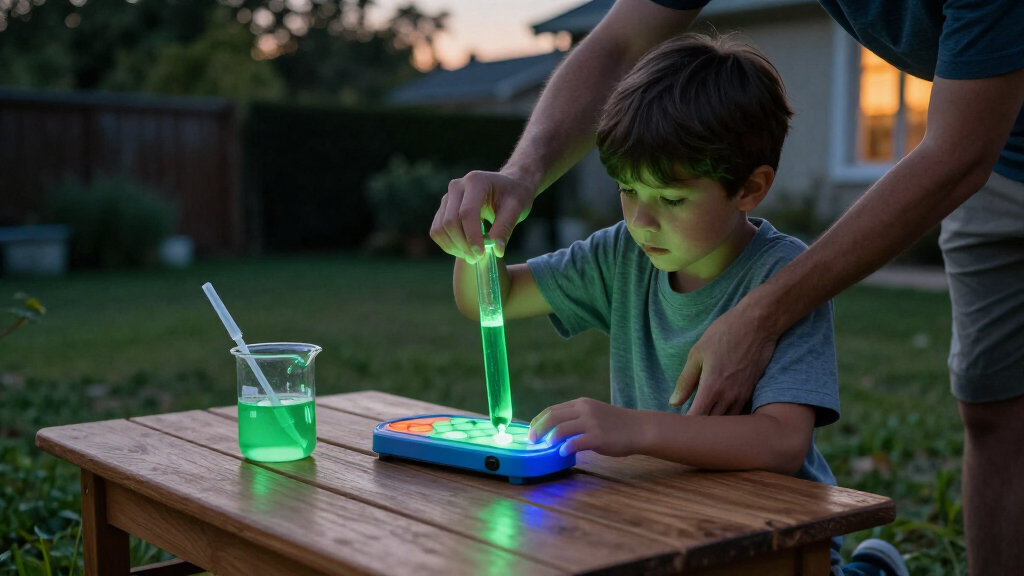
For a strong all-around choice, I’d start with the National Geographic Glow-in-the-Dark Mega Science Experiment Kit, which brings multiple hands-on activities together in one kit. The Thames & Kosmos Glow-in-the-Dark Science Lab is a standout for kids who want a more focused experiment-led experience, while the Creativity for Kids Grow ‘N Glow Terrarium pairs a glowing display with plant care. The main tradeoff is breadth versus depth: a multi-activity kit offers more variety, while a focused project can hold a child’s attention longer but may be a one-time activity. Age fit, adult help, cleanup, and whether the glow is central to the activity also separate these options. Read on for my full breakdown of all nine kits and help matching one to your child.

Prime made for students and young adults
- Fast, free delivery for dorm and study essentials
- Prime Video and Amazon Music included
- Member-only deals
Key Takeaways
- The Mega Science Experiment Kit is my best overall pick because its broad activity mix gives kids more ways to explore than a single-project kit.
- Focused projects serve different interests: the crystal kit centers on patient growth, the solar system kit on display and space, and the bouncy-ball kit on a quick, tangible result.
- The terrarium is the clearest bridge between science and ongoing care, but it asks for more follow-through than an experiment that ends when the activity is done.
- Glow is not the same as scientific depth: compare what children actually make or investigate, not just the darkness-ready theme.
- Adult involvement and cleanup vary by activity. Check age guidance and setup needs before choosing a kit for independent play or a group session.
| National Geographic Jumbo Glow-in-the-Dark Crystal Growing Kit for Kids |  | Best for a Showpiece Science Project | Brand: National Geographic | Age range: 8 years and up | Theme: Earth science | VIEW LATEST PRICE | See Our Full Breakdown |
| Smartivity Glow Magic Science Kit for Kids |  | Best for Experiment Variety | Brand: Smartivity | Age range: 6–14 years | Experiments: 20 glow-in-the-dark science experiments | VIEW LATEST PRICE | See Our Full Breakdown |
| Thames & Kosmos Glow-in-the-Dark Science Lab STEM Experiment Kit |  | Best for Focused Chemistry Learning | Brand: Thames & Kosmos | Recommended age: 8 years and up | Activities: 5 | VIEW LATEST PRICE | See Our Full Breakdown |
| Glow-in-the-Dark Science Experiments Kit for Kids Ages 8–12 |  | Best for Older Kids Who Want More Activities | Brand: PW | Age range: 8–12 years | Activities: 15+ | VIEW LATEST PRICE | See Our Full Breakdown |
| Creativity for Kids Grow ‘N Glow Terrarium Kit |  | Best for Gardening and Craft Fans | Recommended age: 6+ | Planting cycles: 2 | Seeds: Chia and wheatgrass | VIEW LATEST PRICE | See Our Full Breakdown |
| National Geographic Glow-in-the-Dark Solar System Model Kit |  | Best for Space-Loving Builders | Brand: Blue Marble | Age range: 8 years and up | Planets included: 8 planets and the Sun | VIEW LATEST PRICE | See Our Full Breakdown |
| Tasty Labs Groovy Glowing Candy Lab Experiment Set |  | Best for Edible Glow Experiments | Brand: Thames & Kosmos | Age range: 6–14 years | Included components: Fruit punch mix (76 g), tropical pineapple mix (76 g), gelatin packet (24 g), sour sugar mix (30 g), molding tray, UV flashlight, 4 plastic bags, sticker sheet, manual | VIEW LATEST PRICE | See Our Full Breakdown |
| National Geographic Glow-in-the-Dark Mega Science Experiment Kit for Kids |  | Best Variety of Glow Experiments | Brand: Blue Marble | Age range: 8 years and up | Educational objective: STEM | VIEW LATEST PRICE | See Our Full Breakdown |
| Blue Marble Glow-in-the-Dark Bouncy Ball Science Activity Kit |  | Best for Groups and Repeat Making | Brand: Blue Marble | Age range: 6 years and up | Ball capacity: Up to 45 | VIEW LATEST PRICE | See Our Full Breakdown |
| glow in the dark science kits for kid | Brand | Included components | Dimensions | Age range |
|---|---|---|---|---|
| National Geographic Jumbo Glow | National Geographic | Crystal growing kit, detailed learning guide, fluorite specimen | 7.24 x 2.37 x 10 inches | 8 years and up |
| Smartivity Glow Magic Science | Smartivity | Box | 9.84 x 9.84 x 2.36 inches | 6–14 years |
| Thames & Kosmos Glow-in-the-Da | Thames & Kosmos | Plaster powder, plastic mold, glow-in-the-dark stickers, UV flashlight, cardboard test tube stand, small parts, yellow and pink UV pigments, beakers, test tube with cap, brush, spatula, and manual | 8.8 x 2.5 x 11 inches | — |
| Glow-in-the-Dark Science Exper | PW | Instruction manual | 9.65 x 7.68 x 1.97 inches | 8–12 years |
| Creativity for Kids Grow ‘N Gl | — | — | — | — |
| National Geographic Glow-in-th | Blue Marble | 6 paint colors, glow-in-the-dark accent paint, brush, palette, decals, fact poster, instructions | 7.09 x 2.36 x 12.01 inches | 8 years and up |
| Tasty Labs Groovy Glowing Cand | Thames & Kosmos | Fruit punch mix (76 g), tropical pineapple mix (76 g), gelatin packet (24 g), sour sugar mix (30 g), molding tray, UV flashlight, 4 plastic bags, sticker sheet, manual | 8.8 x 2.5 x 11 inches | 6–14 years |
| National Geographic Glow-in-th | Blue Marble | Glowing crystal seed, glowing putty with storage tin, wernerite rock, two slime powders, two slime containers | 10 x 2.17 x 7.28 inches | 8 years and up |
| Blue Marble Glow-in-the-Dark B | Blue Marble | 2 packets of glow-in-the-dark polymer powder, 5 molds, instructions | 6.06 x 2.36 x 6.18 inches | 6 years and up |
More Details on Our Top Picks
National Geographic Jumbo Glow-in-the-Dark Crystal Growing Kit for Kids
The standout here is the jumbo glow-in-the-dark crystal: unlike the Smartivity Glow Magic Science Kit, which spreads attention across 20 short experiments, this kit centers on one slow-growing result kids can watch develop over several days. That makes crystal formation easier to follow and gives the project a satisfying display payoff. The learning guide introduces the science, while the included fluorite specimen offers a real mineral to compare with the grown crystal. It is a better fit for children who enjoy geology and patient observation than for kids seeking a new activity every afternoon. The tradeoff is its narrow scope: the supplied details describe one main crystal-growing project, not a broad experiment collection, and adult help may be useful during setup.
Pros:- Grows a large crystal that glows in the dark
- Includes a fluorite specimen for a real-world mineral comparison
- Learning guide introduces crystal science
- Multi-day growth gives kids a project to observe over time
Cons:- Focuses on a single main crystal-growing project rather than a range of experiments
- The crystal takes several days to grow, so it does not provide an immediate finished result
Best for: Children ages 8 and up who enjoy rocks, geology, and watching one hands-on project develop over several days.
Not ideal for: Families looking for many quick experiments or a kit with a clearly stated sequence of varied activities.
- Brand:National Geographic
- Age range:8 years and up
- Theme:Earth science
- Included components:Crystal growing kit, detailed learning guide, fluorite specimen
- Growth time:A few days
- Dimensions:7.24 x 2.37 x 10 inches
- Weight:380 g
- Model number:NGJUMCRYSTAL2
Our verdict“Choose this kit for an age-8-and-up child who would rather grow and study one glowing crystal than cycle through a large set of experiments.”
Smartivity Glow Magic Science Kit for Kids
For kids who want to keep trying new activities, the 20 glow-in-the-dark experiments give this kit a broader playbook than the Thames & Kosmos Glow-in-the-Dark Science Lab, which lists five activities. Projects such as a glowing lava lamp, soap, and spinner bring variety to at-home STEM sessions, while step-by-step instructions and videos offer more guidance than a kit relying on a manual alone. A mess mat is a useful inclusion for hands-on work, though it does not remove the need to manage materials or supervise younger children. Compared with the National Geographic Jumbo Glow-in-the-Dark Crystal Growing Kit, Smartivity favors a succession of experiments over a single project that develops over days. The tradeoff is that some activities can get messy and children may still need adult help.
Pros:- Includes 20 glow-in-the-dark experiments
- Offers illustrated instructions and instructional videos
- Mess mat supports more contained hands-on work
- Activities include varied projects such as a lava lamp, soap, and spinner
Cons:- Some experiments may involve messy materials
- Adult involvement may be needed for some children
- The listed included components specify only the box, so the supplied experiment materials are not detailed in the product data
Best for: Families with children ages 6–14 who want a varied set of guided glow experiments for repeated at-home activity sessions.
Not ideal for: Caregivers seeking a low-mess, mostly independent activity, especially for younger children who need help with experiment steps.
- Brand:Smartivity
- Age range:6–14 years
- Experiments:20 glow-in-the-dark science experiments
- Educational focus:STEM
- Included components:Box
- Dimensions:9.84 x 9.84 x 2.36 inches
- Weight:828 g
- Model number:SMRT 1214
Our verdict“Pick Smartivity for a family seeking the broadest stated range of guided glow experiments, provided they are prepared for cleanup and occasional adult assistance.”
Thames & Kosmos Glow-in-the-Dark Science Lab STEM Experiment Kit
This kit is the more focused chemistry choice: its five activities cover glowing materials, neon pigments, light, and phosphorescence rather than trying to match the 20-project range of the Smartivity Glow Magic Science Kit. Making neon chalk and glow sticks gives kids tangible results, and the included UV flashlight helps them examine the pigments and see how the light changes their appearance. The box also serves as a blacklight showcase, adding a simple way to display the work. Compared with the National Geographic Jumbo Glow-in-the-Dark Crystal Growing Kit, this is less about waiting for a specimen to grow and more about carrying out several chemistry activities. Its narrower activity count is a real limitation, and the flashlight needs one AAA battery.
Pros:- Five hands-on activities explore glowing materials and light
- Includes yellow and pink UV pigments
- UV flashlight supports direct observation of the materials
- Kit box doubles as a blacklight showcase
Cons:- Includes five activities, fewer than the Smartivity kit’s stated 20
- Requires one AAA battery for the UV flashlight
- A focused chemistry set may be less appealing to children who prefer a growing project or craft
Best for: Children ages 8 and up who want guided chemistry activities about fluorescent pigments, phosphorescence, and light.
Not ideal for: Families seeking a long sequence of varied experiments or a kit that can be used without supplying a AAA battery.
- Brand:Thames & Kosmos
- Recommended age:8 years and up
- Activities:5
- Included components:Plaster powder, plastic mold, glow-in-the-dark stickers, UV flashlight, cardboard test tube stand, small parts, yellow and pink UV pigments, beakers, test tube with cap, brush, spatula, and manual
- Battery:1 AAA battery
- Dimensions:8.8 x 2.5 x 11 inches
- Weight:12.8 ounces
- Warranty:1 year against manufacturer defects
Our verdict“Choose this for a child who wants a compact, guided introduction to glow chemistry and has a AAA battery available.”
Glow-in-the-Dark Science Experiments Kit for Kids Ages 8–12
With more than 15 activities, this kit offers a wider stated menu than the Thames & Kosmos Glow-in-the-Dark Science Lab, while keeping its age guidance aimed at children 8–12. Chemistry and physics activities, including glowing slime and luminous reactions, give kids different kinds of results to observe. The illustrated instruction manual supports independent reading and step-following, though some experiments may still call for adult guidance. Compared with the Smartivity Glow Magic Science Kit, it has fewer listed activities than Smartivity’s 20, but its age band is more tightly focused on school-age kids. The product details list an instruction manual as the included component, so families should check the kit’s contents before expecting specific tools or materials. It is less suited to buyers who want a named, fully itemized component list.
Pros:- Offers more than 15 hands-on activities
- Combines chemistry and physics themes
- Illustrated manual guides children through experiment steps
- Activities encourage observation, logical thinking, and problem-solving
Cons:- Some experiments may require adult guidance
- Product data lists only the instruction manual as an included component, leaving other kit contents unclear
- The 8–12 age range is less suitable for younger children than the Smartivity kit’s stated age range
Best for: Families with children ages 8–12 who want a broad set of glow-themed chemistry and physics activities supported by illustrated directions.
Not ideal for: Buyers who need a clearly itemized list of included experiment materials or children who will need substantial hands-on adult support.
- Brand:PW
- Age range:8–12 years
- Activities:15+
- Theme:Chemistry
- Material:Polyvinyl Alcohol (PVA)
- Included components:Instruction manual
- Dimensions:9.65 x 7.68 x 1.97 inches
- Model number:PW-STEM-LSK-100
Our verdict“Consider this for an 8–12-year-old seeking many glow-themed activities, but verify the supplied materials if a detailed component list matters to you.”
Creativity for Kids Grow ‘N Glow Terrarium Kit
This is the gentlest, most nature-centered option in the group: instead of chemistry experiments like those in the Thames & Kosmos Glow-in-the-Dark Science Lab, children plant chia and wheatgrass seeds and watch the greenery grow. The kit pairs that living project with a decorated mini terrarium and glow-in-the-dark decorations, so the science activity also becomes a craft. Materials for two planting cycles give kids a chance to repeat the process, while the stated growth time of as little as 3–4 days can make the wait feel manageable. Compared with the National Geographic Jumbo Glow-in-the-Dark Crystal Growing Kit, this pick involves ongoing care: plants need water and light, not just observation. It is not the choice for kids who want immediate experiments or do not want to tend living things.
Pros:- Combines planting, simple science, and terrarium decorating
- Includes chia and wheatgrass seeds
- Supplies support two planting cycles
- Glow-in-the-dark decorations add a nighttime display element
Cons:- Plants need ongoing water and light
- Growth depends on care, so results are not a one-session activity
- Offers a gardening-and-craft project rather than a broad set of science experiments
Best for: Children ages 6 and up who enjoy crafts and want a simple introduction to planting, seed growth, and ongoing plant care.
Not ideal for: Families seeking chemistry experiments, a no-maintenance activity, or a project that does not require regular water and light.
- Recommended age:6+
- Planting cycles:2
- Seeds:Chia and wheatgrass
- Growth time:As little as 3–4 days
- Terrarium material:Plastic
- Project type:Terrarium planting and decorating
- Glow feature:Glow-in-the-dark decorations
Our verdict“Choose Grow ‘N Glow for a child who likes crafts and is ready to care for a small planting project beyond the initial setup.”
National Geographic Glow-in-the-Dark Solar System Model Kit
The movable solar system model gives kids a lasting display as well as a build-and-paint activity. It includes the Sun and all eight planets, with glow-in-the-dark accent paint to highlight the finished model; the movable arms let kids change the planets’ positions while exploring the display. Compared with the National Geographic Glow-in-the-Dark Mega Science Experiment Kit, this pick focuses on a single themed project rather than several different glowing materials. Paints, decals, a fact poster, and instructions add learning and customization, but the activity takes more hands-on time than a ready-to-use experiment. Assembly and painting are required, so it suits children who enjoy making a model, not those looking for immediate glow effects or a series of short experiments.
Pros:- Includes the Sun and all eight planets for a complete solar system model
- Movable arms let kids reposition the planets
- Paints, brush, palette, decals, and instructions are included
- Fact poster connects the craft activity with space learning
Cons:- Requires assembly and painting rather than offering a ready-made display
- The glow effect comes from accent paint, not a range of separate glowing experiments
Best for: Space-curious children ages 8 and up who enjoy building, painting, and keeping a science project on display.
Not ideal for: Kids who want several quick experiments or a glow effect with minimal setup; assembly and painting are part of the activity.
- Brand:Blue Marble
- Age range:8 years and up
- Planets included:8 planets and the Sun
- Features:Glow-in-the-dark details; movable arms
- Included components:6 paint colors, glow-in-the-dark accent paint, brush, palette, decals, fact poster, instructions
- Material:Plastic
- Dimensions:7.09 x 2.36 x 12.01 inches
- Model number:NGSOLARSYS
Our verdict“Choose this kit for a space fan who wants to build and customize a glowing model, rather than sample several types of experiments.”
Tasty Labs Groovy Glowing Candy Lab Experiment Set
For kids who want their science activity to end in a treat, the glowing candy experiments make this set distinct from the other kits here. Flavor mixes, gelatin, a molding tray, and a UV flashlight support activities involving gummies, hard candy, ice cubes, and rock candy, while the manual introduces luminescence and light science. Unlike the National Geographic Glow-in-the-Dark Solar System Model Kit, this is a kitchen activity rather than a build-and-display project; compared with the Blue Marble Glow-in-the-Dark Bouncy Ball Science Activity Kit, the results are edible but involve food preparation. The key tradeoff is that the candies need a blacklight to glow, and cooking or preparing food may call for adult help. Choose it for supervised kitchen science, not a no-mess tabletop experiment.
Pros:- Includes mixes and tools for making several types of candy and ice
- UV flashlight helps reveal the candy’s glow
- Combines cooking with hands-on science topics
- Molding tray supports making candy in fun shapes
Cons:- A blacklight is needed to see the candy glow
- Food preparation can require adult supervision
- The activity is less suited to children looking for a non-food experiment
Best for: Families with children ages 6–14 who want a supervised kitchen activity combining candy-making with glow and light science.
Not ideal for: Buyers seeking a low-prep activity or glow effects visible without a UV flashlight; food preparation may need adult supervision.
- Brand:Thames & Kosmos
- Age range:6–14 years
- Included components:Fruit punch mix (76 g), tropical pineapple mix (76 g), gelatin packet (24 g), sour sugar mix (30 g), molding tray, UV flashlight, 4 plastic bags, sticker sheet, manual
- Activities:Glow-in-the-dark gummies, hard candy, ice cubes, and rock candy
- Glow method:Riboflavin; UV flashlight
- Material:Plastic
- Dimensions:8.8 x 2.5 x 11 inches
- Language:English
Our verdict“Pick this set for supervised edible experiments; skip it if you want a simpler, non-kitchen glow activity.”
National Geographic Glow-in-the-Dark Mega Science Experiment Kit for Kids
The variety of glowing materials is the main reason this kit earns its place: kids can grow a glowing crystal, make slime, and explore putty and wernerite. A full-color guide explains the science, making this a stronger choice for families or classrooms that want several different activities in one kit. Compared with the National Geographic Glow-in-the-Dark Solar System Model Kit, it favors experimenting over building a display; unlike the Blue Marble Glow-in-the-Dark Bouncy Ball Science Activity Kit, it offers several kinds of results rather than concentrating on one repeatable craft. Its tradeoff is that the listed components are a collection of smaller activities, not a single large project, and the recommended age starts at 8. Geology-themed glow play suits curious kids, but younger children will need another pick.
Pros:- Includes a glowing crystal, slime, putty, and wernerite
- Full-color guide explains the science behind the activities
- Offers several types of hands-on glow exploration
- Suitable for home, homeschool, or classroom use
Cons:- Recommended for ages 8 and up, limiting use with younger children
- Focuses on several smaller activities rather than one lasting display project
Best for: Families, homeschoolers, and classroom leaders looking for several glow-focused science activities for children ages 8 and up.
Not ideal for: Children younger than 8 or buyers who want one substantial build-and-display project rather than several smaller experiments.
- Brand:Blue Marble
- Age range:8 years and up
- Educational objective:STEM
- Theme:Geology
- Included components:Glowing crystal seed, glowing putty with storage tin, wernerite rock, two slime powders, two slime containers
- Materials:Crystals, slime, putty, mineral
- Dimensions:10 x 2.17 x 7.28 inches
- Model number:NGMEGAGID
Our verdict“Choose this kit when variety matters more than a single finished project and the child is at least 8.”
Blue Marble Glow-in-the-Dark Bouncy Ball Science Activity Kit
With materials for up to 45 bouncy balls, this kit is the lineup’s clearest choice for parties, siblings, or groups who want to make and share something. Six powder colors and five molds give kids options for different looks and shapes, while the instructions and learning guide introduce the science behind the activity. Compared with the National Geographic Glow-in-the-Dark Solar System Model Kit, it makes portable playthings instead of a display; unlike the National Geographic Glow-in-the-Dark Mega Science Experiment Kit, it centers on one repeatable activity rather than several kinds of glowing materials. That focus can be a plus for group participation, but the balls require a 10-minute water soak and drying time, so the activity is not instant. Choose it for hands-on making and play, not for a varied experiment set.
Pros:- Makes up to 45 glow-in-the-dark bouncy balls
- Six polymer powder colors support color variety
- Five molds offer different shapes
- Learning guide connects ball-making with STEM concepts
Cons:- Balls need a 10-minute water soak and drying time
- The activity focuses on making bouncy balls rather than exploring several science topics
Best for: Parents or group leaders seeking a color-rich, repeatable activity for children ages 6 and up to make and share.
Not ideal for: Kids who want an immediate result or a range of different experiments; each ball requires soaking and drying.
- Brand:Blue Marble
- Age range:6 years and up
- Ball capacity:Up to 45
- Colors:6 polymer powder colors
- Molds:5 unique shapes
- Included components:2 packets of glow-in-the-dark polymer powder, 5 molds, instructions
- Dimensions:6.06 x 2.36 x 6.18 inches
- Weight:10.08 ounces
- Model number:ABBALLKIT45
Our verdict“Pick this kit for group-friendly making and play, provided the child is happy to wait for the balls to soak and dry.”
How We Picked
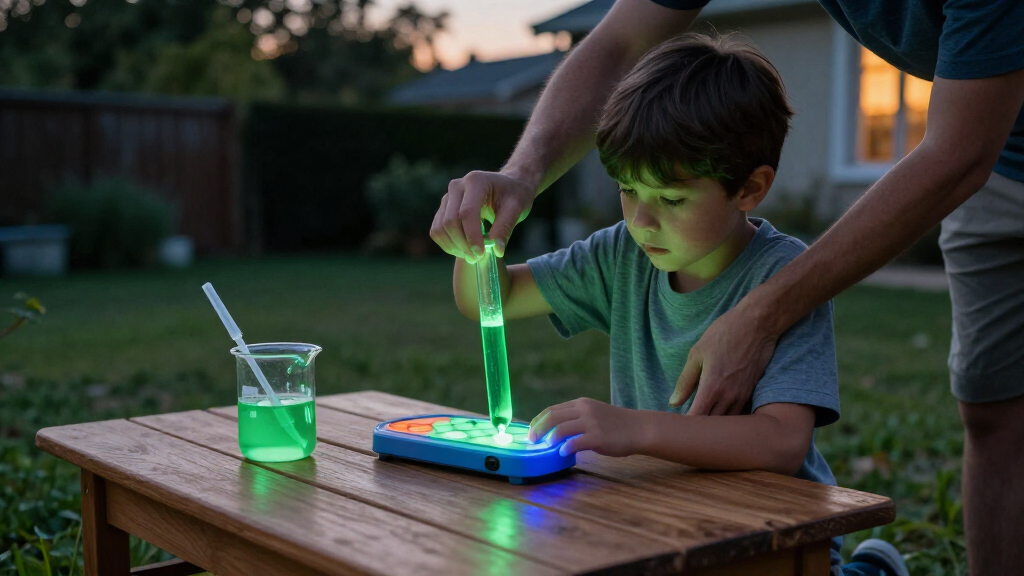
I compared the nine kits on how well their activities connect a visible glow effect to a hands-on science idea, how much variety they offer, and whether the finished activity gives a child a satisfying result. I also weighed age fit, setup and adult involvement, repeat-play potential, and the practical difference between a temporary experiment and a display or growing project. These factors matter because a dramatic glow alone may not keep a child engaged once the novelty fades.
The ranking favors kits that combine meaningful activity, accessible use, and more than one reason to return to the project. That puts the National Geographic Mega Science Experiment Kit first for its range, while more specialized kits rank higher for particular interests rather than broad appeal. Single-project options are not lesser choices: they can be a better match when a child wants crystals, space, candy experiments, or a quick build, but their narrower scope affects their place in an all-purpose roundup.
| glow in the dark science kits for kid | Brand | Model number |
|---|---|---|
| National Geographic Jumbo Glow | National Geographic | NGJUMCRYSTAL2 |
| Smartivity Glow Magic Science | Smartivity | SMRT 1214 |
| Thames & Kosmos Glow-in-the-Da | Thames & Kosmos | — |
| Glow-in-the-Dark Science Exper | PW | PW-STEM-LSK-100 |
| Creativity for Kids Grow ‘N Gl | — | — |
| National Geographic Glow-in-th | Blue Marble | NGSOLARSYS |
| Tasty Labs Groovy Glowing Cand | Thames & Kosmos | — |
| National Geographic Glow-in-th | Blue Marble | NGMEGAGID |
| Blue Marble Glow-in-the-Dark B | Blue Marble | ABBALLKIT45 |
Factors to Consider When Choosing Glow In The Dark Science Kits For Kids
Before choosing among glow-in-the-dark science kits for kids, I’d look past the package theme and match the activity to the child’s interests, patience, and available adult help. These differences often matter more than the number of experiments listed.
Choose the kind of science activity first
Start with what your child likes doing, not simply the promise of a glowing result. Growing crystals and tending a terrarium involve waiting or follow-up, while a model or bouncy-ball activity offers a more immediate object to handle or display. Experiment labs may suit children who enjoy trying several steps and comparing outcomes. A common mismatch is buying a visually appealing kit for a child who would rather build, mix, or care for something. If you are unsure, a kit with varied activities can reduce the risk of choosing a single project that does not hold their interest.
Check age guidance against the child’s working style
Age labels provide a starting point, but they do not tell you whether a child will manage measuring, reading instructions, or waiting for a result. Consider whether your child prefers to work alone or benefits from an adult reading directions and helping with setup. Younger children may enjoy the visible steps but still need hands-on supervision, while older children may want a project with more room to follow directions independently. Avoid treating an age range as a promise of solo use. If the kit is a gift, check the listed guidance and project steps before the activity day.
Think about when and where the glow will be seen
A glow effect is most satisfying when the project can be viewed in a suitably dark space, so think about where your child will use or display it. A wearable or portable result has different practical value from a larger model that needs a shelf. Some projects may need to be charged by exposure to light before they glow, so check the product instructions rather than assuming the effect is immediate or constant. For a shared bedroom, consider whether the finished object will be welcome as ongoing decor. Choosing for display can stretch the value of a project beyond the activity session, but it may also take up space.
Compare one-time fun with repeat engagement
A kit with many experiments may offer variety, but the number of listed activities does not guarantee that each one will be equally engaging. A focused project can feel more rewarding if it produces something the child wants to keep, while a growing or care-based kit can invite attention after the initial setup. Ask whether your child enjoys repeating experiments, following a project over time, or completing a task in one sitting. A one-session activity can work well for a rainy afternoon or party, but it may offer less to return to afterward. For a longer-lasting gift, look for a finished result or ongoing responsibility that suits the child.
Plan for supervision, setup, and cleanup
Science activities can involve small components, mixing, growing materials, or steps that call for adult guidance. Check the kit instructions for what is included and what you may need to supply at home; the package name alone may not answer that. For group use, favor a project whose setup and cleanup fit the time and space available. A more involved activity can be rewarding, but it may frustrate a child if the adult support it needs is not available. Set up a work area in advance and read the instructions before handing over the kit, especially when the project involves food or materials that need careful handling.
Pay for fit and substance, not just a dramatic theme
A glowing label can make very different activities look interchangeable, even when one focuses on experiments and another mainly produces a decorative object. Decide which matters most: variety, a lasting display, a specific science topic, or a quick activity with a clear result. A broader kit can make sense for a child who likes sampling different experiments, while a specialized option may be a closer match for a known interest. Do not equate more components with better learning or more repeat use. The best fit is the kit your child is likely to complete and enjoy, with a level of adult help your household can provide.
Frequently Asked Questions
Which kit makes the most sense if I do not know what kind of science activity the child likes?
I’d lean toward the National Geographic Glow-in-the-Dark Mega Science Experiment Kit because its wider activity mix is less dependent on one specific interest. It is a better starting point than choosing crystals, space, or candy experiments when you do not know the child’s preferences. Still, check the age guidance and instructions to see whether the activities suit the child’s independence level. If you do know they love one topic, a focused kit may feel more personal. Variety is a useful hedge, not a guarantee that every activity will appeal.
Are glow-in-the-dark kits suitable for a child who wants to do science without much adult help?
Some steps may be manageable for children on their own, but adult help depends on the specific kit and the child’s reading and coordination skills. Before buying, look at the instructions and age guidance for setup, measuring, mixing, or ongoing care. A project that requires preparation or supervision may be less suitable for independent play than its packaging suggests. If solo use is a priority, choose a straightforward activity and have an adult review the directions first. Plan for supervision rather than assuming every glow-themed kit is self-guided.
Should I choose a kit with many experiments or one larger project?
Choose a multi-activity kit if the child enjoys sampling different experiments or you want options for more than one session. A single-project kit may be more satisfying when the child has a clear interest, such as growing crystals or building a space-themed display. The tradeoff is variety versus focus: a broad kit can offer more different experiences, while one project may give a stronger sense of completion. Think about the child’s attention span and whether they like returning to an activity over time. The roundup’s Mega Science Experiment Kit is the broadest match, while the specialized picks suit narrower interests.
Can I give a glow-in-the-dark science kit as a group activity or party gift?
It can work, but the best choice depends on how many children will participate and how much setup the activity needs. A project with several steps or materials may call for adult help and enough room for each child to work. A quicker, more self-contained activity may be easier to manage in a group, while a growing or display project can be better suited to an individual gift. Check whether one kit is designed for one child or can be shared before planning a party around it. Prepare the work area and instructions ahead of time to keep the activity moving.
What should I check if the glow effect is the main reason I am buying the kit?
Read the product details to see which parts glow and whether the effect belongs to the experiment, the finished object, or both. Also check whether the result needs exposure to light before it can glow, and whether it is meant to be viewed as a lasting display. A kit can have a strong glow theme without making the light effect central to every activity. If the child wants something to keep, consider the finished project’s size and whether there is a suitable place to show it. Choosing based on the actual glowing result helps avoid disappointment when the packaging’s theme sets bigger expectations than the activity delivers.
Conclusion
For the broadest match, I recommend the National Geographic Glow-in-the-Dark Mega Science Experiment Kit as best overall, especially for a child who likes variety. The National Geographic Jumbo Glow-in-the-Dark Crystal Growing Kit is my best value-style choice for a child drawn to a focused, visible growing project; it is less suited to anyone who wants several kinds of activities. For a premium-feeling, experiment-led experience, choose the Thames & Kosmos Glow-in-the-Dark Science Lab, while the Smartivity Glow Magic Science Kit is my best beginner pick for a child who wants an approachable introduction. Match specific interests with the Creativity for Kids Grow ‘N Glow Terrarium for plant care, the National Geographic Solar System Model for space, the Tasty Labs Groovy Glowing Candy Lab for food-centered experiments, or the Blue Marble Bouncy Ball Kit for a quick physical project. The separate Glow-in-the-Dark Science Experiments Kit for Kids Ages 8–12 can suit shoppers seeking an age-targeted general experiment option; compare its activity details with the broader Mega kit before choosing. My final advice is to pick for the activity the child will want to complete, not glow alone.
Columbus Day / Indigenous Peoples' Day Picks
long weekend sales
As an affiliate, we earn on qualifying purchases.