The Voynich Manuscript has sparked theories suggesting it encodes botanical knowledge, mystical astrology, or is simply a clever hoax. Given its complex script and mysterious symbols, some believe it reflects genuine Renaissance science, while others think it’s a concealed mystical or alchemical text. Still, many suspect the whole thing might be a fake with no real meaning. If you keep exploring, you’ll uncover what makes this ancient puzzle so endlessly fascinating.
Key Takeaways
- The manuscript’s botanical illustrations suggest a focus on plants, supporting theories of herbal or medicinal knowledge.
- Its complex, star-like diagrams and symbols point to possible links with astrology or mystical practices of the Renaissance.
- The undeciphered cipher and coded language fuel debates about whether it encodes scientific, mystical, or hidden knowledge.
- Some scholars believe the manuscript is a sophisticated hoax, with no meaningful content or purpose.
- Its origin in early 15th-century Europe aligns with theories of alchemy, astrology, or secret scientific texts from the period.
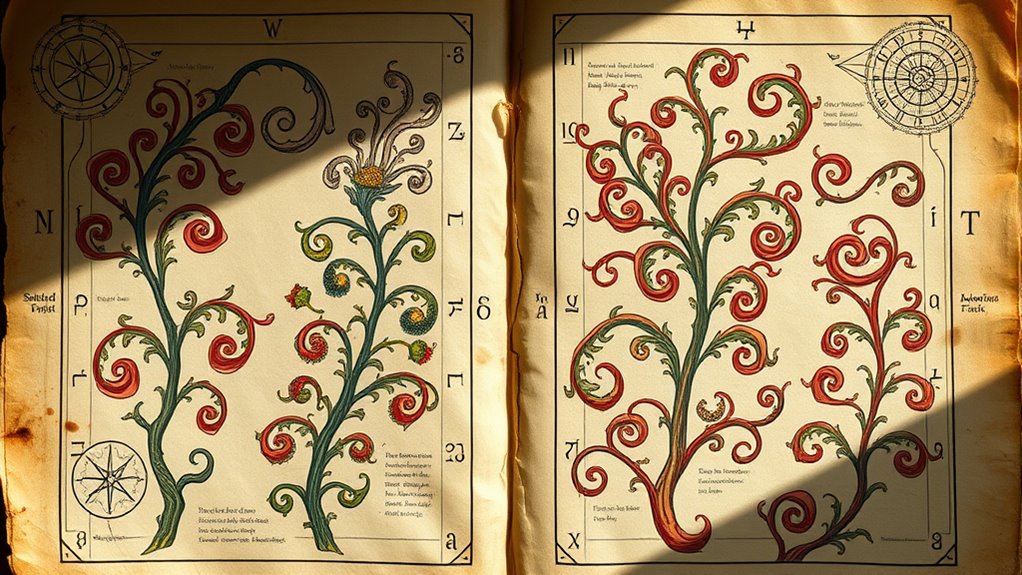
The Voynich Manuscript has long puzzled historians, cryptographers, and linguists alike, prompting numerous theories about its origins and meaning. To understand its mysteries, you need to consider its historical context. The manuscript dates back to the early 15th century, possibly created in Europe during the late Middle Ages or the Renaissance. This was a time of significant cultural and scientific upheaval, with new ideas in astronomy, herbal medicine, and alchemy emerging. Many believe the manuscript reflects this vibrant period, containing coded knowledge that was either intentionally hidden or misunderstood over centuries. The cultural environment of its creation influences how you interpret its content, whether as a scientific treatise, a mystical text, or something entirely different. historical context plays a crucial role in shaping theories about its purpose and meaning. Cryptography techniques are central to deciphering the manuscript’s complex script. When you examine the text, it appears to be written in an unknown language or a cipher, sparking debates among cryptographers. Some argue the script is a form of cipher, employing techniques that obscure meaning—possibly a substitution cipher, a polyalphabetic cipher, or a more complex encryption system. Over the years, numerous cryptographers have attempted to crack its code, using both classical techniques and modern computational methods. Despite these efforts, the true nature of its encryption remains elusive, fueling speculation that it might be a hoax or a sophisticated cipher that has yet to be deciphered. The manuscript’s unique alphabet and recurring patterns suggest a structured cryptographic system, but no consensus exists on its true method, leaving the mystery intact.
Frequently Asked Questions
Who Was the Original Author of the Voynich Manuscript?
You might wonder who the original author of the Voynich Manuscript was, but the true authorship remains a puzzle mystery. Researchers have debated for years over the authorship, yet no definitive evidence identifies who created it. Some believe it was crafted by a single individual, while others suggest multiple contributors. The ongoing authorship debate keeps this enigmatic manuscript shrouded in secrecy, fueling intrigue and speculation without a conclusive answer.
Has Anyone Conclusively Deciphered the Manuscript’s Language?
No, nobody has conclusively deciphered the Voynich Manuscript’s language yet. Despite numerous cryptographic breakthroughs and ongoing research, the linguistic mysteries remain unsolved. You’ll find that experts continue to analyze its strange script and symbols, but no definitive translation exists. The manuscript’s unique language challenges even the most skilled cryptographers and linguists, keeping its secrets hidden and fueling speculation about its true meaning.
What Modern Technology Has Been Used to Analyze the Manuscript?
You use modern technology like spectral imaging to reveal hidden details and improve readability of the Voynich Manuscript. Radiocarbon dating helps determine its age, confirming its historical origins. These techniques enable researchers to analyze the manuscript non-invasively, uncover previously invisible features, and gather clues about its provenance. Spectral imaging and radiocarbon dating are essential tools that bring us closer to understanding this mysterious document.
Could the Manuscript Be a Coded Message From a Secret Society?
It’s quite plausible that the manuscript contains cryptic symbols, hinting at secret messages from a clandestine group. You might see it as a coded communication, designed to hide information from outsiders. While some believe it’s merely an elaborate hoax, others suspect it was created by a secret society to pass clandestine knowledge. The mysterious symbols invite curiosity, prompting you to wonder whether you’re uncovering hidden truths or simply chasing shadows.
Are There Any Known Copies or Similar Manuscripts Elsewhere?
You’ll find that there are no exact copies of the Voynich Manuscript, but some historical parallels exist in other mysterious manuscripts. Reproductions and facsimiles have been made for scholarly study, which helps researchers compare styles and texts. While no known manuscript closely resembles it, these parallels and reproductions provide insight into similar secretive or enigmatic documents from history, fueling ongoing curiosity and investigation.
Conclusion
As you close the book on the Voynich Manuscript, imagine yourself standing in a shadowy garden, where strange plants twist and shimmer under a ghostly moon. Whether it’s a secret code, ancient astrology, or an elaborate hoax, the mystery remains alive, whispering through the pages like a hidden melody. The truth is still out there, waiting to be uncovered. Until then, you’re left gazing at this enigmatic relic, caught between wonder and doubt.