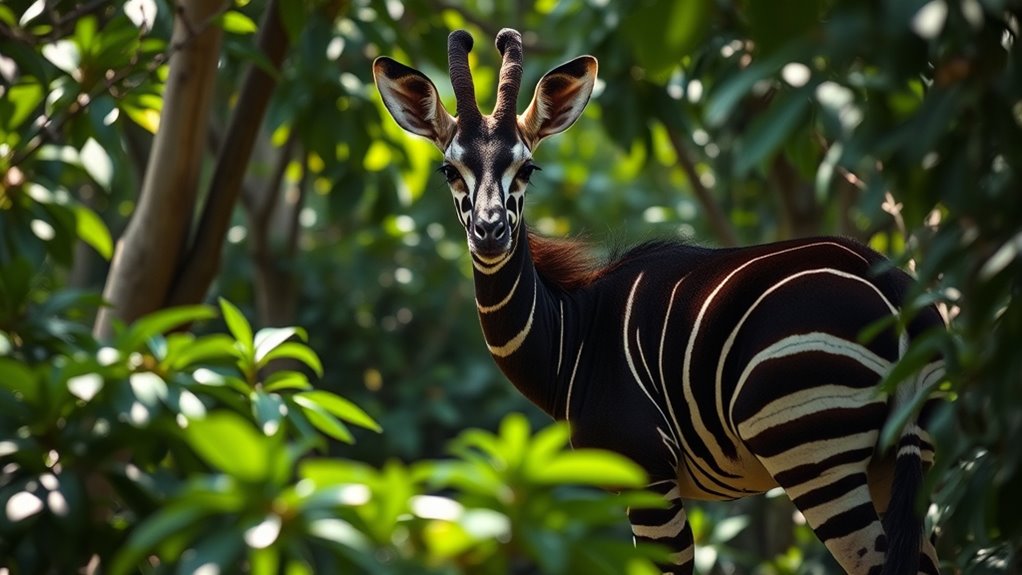

The okapi was once thought to be a mysterious cryptid, believed to belong to legend or myth. However, scientists confirmed it as a real animal native to the Congo’s rainforests, resembling a mix between a zebra and a giraffe. Its elusive nature made it hard to find, but today, conservation efforts help protect its fragile habitat. Keep exploring to learn more about how this extraordinary creature evolved from myth to reality.

Prime made for students and young adults
- Fast, free delivery for dorm and study essentials
- Prime Video and Amazon Music included
- Member-only deals
Key Takeaways
- The okapi was once considered a cryptid, believed to be myth until scientific discovery confirmed its existence in the early 20th century.
- Native to Congo rainforests, the okapi’s elusive nature contributed to its status as a mystery before formal recognition.
- Its distinctive zebra-like leg stripes and secretive habits helped it blend into dense foliage, fueling myths and legends.
- Conservation efforts have shifted the okapi from a legendary creature to an endangered, protected species with ongoing ecological importance.
- The transformation from cryptid to real animal highlights the importance of exploration and scientific research in uncovering Earth’s hidden species.
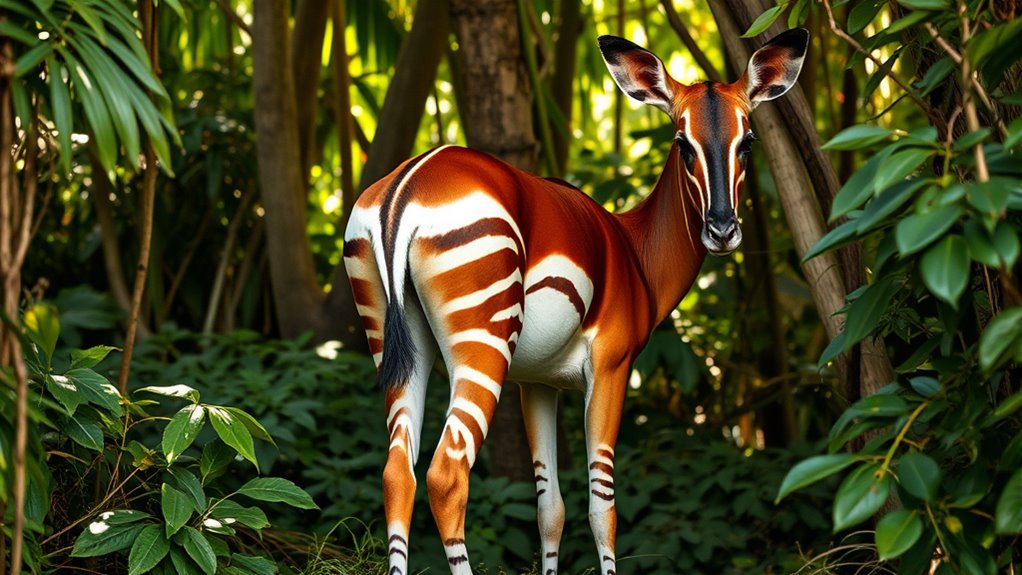
The okapi is a remarkable mammal native to the dense rainforests of the Democratic Republic of Congo. Unlike its distant relative, the giraffe, the okapi’s appearance is more elusive, with striking zebra-like stripes on its legs and a body that blends seamlessly into the thick foliage. This animal’s habitat range is confined primarily to the remote forests of the Congo basin, where it thrives in the humid, densely vegetated environment. Because of its secluded habitat, many people once considered the okapi a mythical creature, but now you can observe its presence in conservation centers and through scientific studies. Its limited distribution makes understanding and protecting its habitat essential for survival. The animal’s secretive nature has contributed to its mystique, making it a fascinating subject for both scientists and enthusiasts alike.
In its natural habitat, the okapi stays hidden, moving quietly through the undergrowth. Its habitat range is quite restricted, which makes it especially vulnerable to habitat destruction caused by logging, agricultural expansion, and mining activities. Recognizing these threats, conservation efforts have intensified to safeguard the okapi’s environment. Numerous initiatives focus on protecting the Congo rainforest, establishing national parks such as the Okapi Wildlife Reserve, which covers thousands of square kilometers. This reserve is fundamental because it not only provides a sanctuary for the okapi but also supports countless other species that share its habitat. Efforts include anti-poaching patrols, habitat restoration, and working with local communities to promote sustainable land-use practices. These steps are indispensable because, despite ongoing conservation, the okapi remains classified as endangered due to habitat fragmentation and poaching.
Conservation organizations, both local and international, actively monitor okapi populations, employing camera traps and field surveys to gather data. They also work to educate local communities about the importance of preserving this unique species, emphasizing how the okapi is an integral part of the rainforest ecosystem. You can support these efforts by spreading awareness or contributing to organizations dedicated to protecting the Congo’s biodiversity. Protecting the okapi’s habitat range isn’t just about saving a single species; it’s about maintaining the health of the entire rainforest ecosystem, which sustains countless other plants and animals. Recognizing the endangered status of the okapi underscores the urgency of these conservation initiatives. The ongoing conservation efforts are indispensable, especially as human activities continue to encroach on the forest. If these initiatives succeed, the okapi’s future will be brighter, and you’ll be helping guarantee that this extraordinary animal remains a fundamental part of Africa’s natural heritage for generations to come.
Frequently Asked Questions
How Was the Okapi First Discovered by Scientists?
You learn that the okapi was first discovered by scientists in 1901, following early sightings by local villagers in the Congo. These reports intrigued explorers, leading to a scientific discovery when zoologists finally captured and examined a live specimen. The okapi’s unique appearance, with zebra-like stripes and a giraffe’s body, amazed the scientific community and confirmed it as a real animal, previously thought to be a cryptid.
Are There Any Ongoing Threats to the Okapi’s Survival?
You should know that ongoing threats like habitat destruction and poaching still threaten the okapi’s survival. As human activities expand, forests where they live get cleared, reducing their shelter and food sources. Poaching for their meat and hide also puts pressure on their populations. Conservation efforts are vital to protect their habitat and prevent illegal hunting, ensuring these unique animals continue to thrive in the wild.
What Is the Genetic Relationship Between Okapis and Giraffes?
You know what they say, “Birds of a feather flock together,” and it holds true for okapis and giraffes. Genetically, okapis are close relatives to giraffes, sharing an evolutionary link that dates back millions of years. Their genetic divergence is relatively small, highlighting their common ancestry. Despite differences, their similarities reveal how evolution shapes species over time, making the okapi a fascinating example of nature’s intricate family tree.
How Do Local Communities in Congo Perceive the Okapi?
You’ll find that local communities in Congo often see the okapi through local folklore, viewing it as a mystical creature with spiritual significance. These beliefs help foster community conservation efforts, as people feel a cultural responsibility to safeguard the okapi. Many locals view it as a symbol of their natural heritage, inspiring pride and encouraging sustainable practices to ensure its survival for future generations.
Can the Okapi Be Kept in Captivity Successfully?
You can keep the okapi in captivity successfully, but it’s no easy feat. Like caring for a delicate songbird, you need dedicated efforts in captive breeding to guarantee their numbers grow. Habitat preservation is essential, too, because their natural forest home nurtures their spirit. When these elements align, the okapi can thrive, reminding us that with love and care, even elusive creatures can find a safe haven under human stewardship.
Conclusion
Just like the okapi’s journey from myth to reality, sometimes what we believe in quietly exists beyond our sight. It reminds you that wonder and discovery often hide just beneath the surface, waiting for you to look closer. Keep an open mind, for the world is full of surprises that challenge what you think is possible. Like the okapi’s story, your own adventures may lead you to truths you never imagined, if you’re willing to seek them out.
Evergreen bestsellers Picks
bestsellers
As an affiliate, we earn on qualifying purchases.