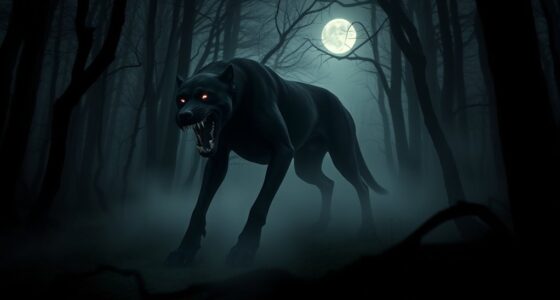
The Black Shuck is a legendary spectral dog from East Anglia, known for its terrifying sightings and dark origins. You might hear stories of a massive, jet-black hound with glowing eyes appearing during stormy nights near churches or crossroads. Some say it’s a harbinger of doom, while others believe it’s a guardian spirit. Curious about the legends and mysteries surrounding this eerie creature? Keep exploring to uncover more about its haunting history.
Key Takeaways
- Black Shuck is a legendary spectral dog from East Anglia, with origins rooted in pagan beliefs and regional folklore.
- Sightings describe a massive, black dog with glowing eyes often seen near churches, graveyards, or crossroads during storms.
- The creature is considered a supernatural messenger, symbolizing death, warning, or sometimes acting as a guardian spirit.
- Legend blends myth, superstition, and regional stories, making Black Shuck a lasting symbol of mystery and the macabre.
- The legend continues to fascinate locals and visitors, cementing Black Shuck’s place in East Anglia’s cultural and supernatural history.

Have you ever wondered about the eerie legends lurking in English folklore? One of the most infamous tales is that of the Black Shuck, a spectral hound said to haunt the coastlines and countryside of East Anglia. Its mythical origins are shrouded in mystery, with stories dating back centuries that blend myth, superstition, and regional sightings. Many believe that the Black Shuck is a supernatural messenger, a harbinger of doom, or perhaps a guardian spirit, depending on the tale. Its origins are often traced to ancient pagan beliefs, where such spectral dogs represented death or the presence of spirits. Over time, these stories evolved, and the Black Shuck became a fixture of local legend, appearing in folklore across Norfolk, Suffolk, and Essex.
In these regions, sightings of the Black Shuck are remarkably consistent. Travelers and villagers alike have reported encounters with a massive, jet-black dog with glowing eyes that seem to pierce through the darkness. These regional sightings typically occur during stormy nights, especially near old churches, graveyards, or lonely crossroads. Some accounts describe the beast as having a spectral glow, while others mention it being as solid as any living creature, yet undeniably supernatural. Many who claim to have seen the Black Shuck say they felt an overwhelming sense of fear or awe, as if the creature carried an ominous message or was a warning of impending tragedy. These stories have persisted for generations, cementing the Black Shuck’s status as a symbol of the mysterious and the macabre in East Anglia.
The legends also tell of the Black Shuck’s ferocity; it’s often said to attack or chase those who cross its path, especially on stormy nights. Yet, despite its aggressive reputation, some tales suggest it’s a protector of sorts, guiding lost souls or warning of danger. The creature’s mythical origins are sometimes linked to stories of demonic entities or ancient spirits, which adds a layer of supernatural intrigue to these regional sightings. What makes the Black Shuck particularly enthralling is how these stories have persisted, passed down through generations, blending fact and myth seamlessly. Interestingly, some theories propose that such spectral dogs could be connected to antique beliefs, where spirits or guardian entities were thought to manifest in animal forms. Whether as a creature of folklore, a supernatural omen, or a symbol of the eerie, the Black Shuck remains one of East Anglia’s most enduring legends, inviting curiosity and fear in equal measure.
Frequently Asked Questions
Has Anyone Ever Captured Photographic Evidence of the Black Shuck?
You won’t find any definitive photographic evidence of the Black Shuck, despite numerous eyewitness accounts describing encounters. Many claim to have seen the spectral hound, but photos taken at the time are either unclear or inconclusive. The creature’s ghostly nature makes capturing it on camera difficult, and skeptics argue that eyewitness reports could be misidentifications or illusions. So, the Black Shuck remains an elusive legend with no verified photographic proof.
Are There Specific Locations in East Anglia Known for More Sightings?
You should know that haunted forests like Dunwich Heath and coastal hotspots such as the Norfolk coast are prime locations for sightings of the Black Shuck. These eerie spots seem to draw the spectral hound closer, especially at night. If you’re daring enough, visiting these areas might reveal shadowy figures lurking just beyond your sight, fueling your curiosity and adding an edge of suspense to your adventure.
What Are the Historical Origins of the Black Shuck Legend?
You’re curious about the origins of the Black Shuck legend. It dates back to medieval folklore, where it served as a supernatural symbol of warning or doom. People believed the spectral hound represented divine punishment or a harbinger of death, often seen as a supernatural sign. Over centuries, stories evolved, blending local legends with broader supernatural symbolism, creating the eerie reputation that persists in East Anglia today.
Do Similar Spectral Hounds Exist in Other Cultures Worldwide?
Yes, similar spectral hounds appear in cultures worldwide. Mythical creatures like the Germanic Black Dog, the Welsh Cŵn Annwn, and the Irish Cu Sith all share folklore comparisons with the Black Shuck. These spectral dogs often symbolize death, warning, or supernatural forces. You might find them across different traditions, each with unique stories, but they all evoke the same eerie sense of a ghostly, otherworldly canine presence.
How Has the Black Shuck Influenced Local Folklore and Traditions?
You might notice how the Black Shuck haunts East Anglia’s local superstitions, shaping folklore festivals and stories. For example, villagers once believed sighting the hound warned of impending doom, blending fear with tradition. This spectral presence influences local customs, inspiring tales told at festivals and reinforcing community bonds. Its legend reminds you that folklore often acts as a powerful guardian, shaping cultural identity through shared ghost stories and superstitions.
Conclusion
As you walk through East Anglia’s misty fields, imagine the Black Shuck lurking in the shadows, a ghostly guardian or ominous omen. Like the thunderous bark that once startled a family on a stormy night, this spectral hound leaves a lasting impression—reminding you that some legends are etched into the land itself. Whether a protector or a warning, the Black Shuck continues to haunt the imagination, a shadow that refuses to fade.