![The Early History Of The Singular Value Decomposition (1993) [Pdf]](https://whatifmonsters.com/wp-content/uploads/2026/07/the-early-history-of-the-singular-value-decomposition-1993-pdf-featured-200x110.jpg)
TL;DR

Get school and study supplies delivered free — and shop member deals
- Fast, free delivery on millions of items
- Access to Prime Big Deal Days deals on October 6–7
- Prime Video, Amazon Music and more included
A prediction market suggests there is an 82% chance that Austin’s temperature will exceed 76.99°F at 5am EDT on July 12, 2026. The forecast is based on recent trading activity, but actual weather conditions are uncertain this far in advance.
According to recent trading activity on a weather prediction market, there is an 82% probability that the temperature in Austin, Texas, will be above 76.99°F at 5am EDT on July 12, 2026. This estimate is derived from 82 recent trades on the market, reflecting collective expectations but not a definitive forecast.
The prediction market, operated by Kalshi, allows traders to bet on future weather conditions, and recent trades suggest a high confidence in temperatures exceeding 76.99°F during the early morning hours of July 12, 2026. However, it is important to note that these markets are based on aggregated trader expectations rather than scientific forecasts.
Weather forecasts so far are not available that far in advance, and actual conditions depend on numerous variables including climate patterns, atmospheric conditions, and local weather systems. The prediction market’s current odds reflect collective trader sentiment, which can change as new information becomes available.
Implications of Long-Term Weather Market Predictions
This prediction illustrates how market-based tools are used to assess expectations about future weather conditions. While not a substitute for scientific forecasts, such markets can inform planning for events, infrastructure, and climate-related decisions. For Austin residents and policymakers, these predictions offer early insights but should be considered alongside official forecasts and scientific data.
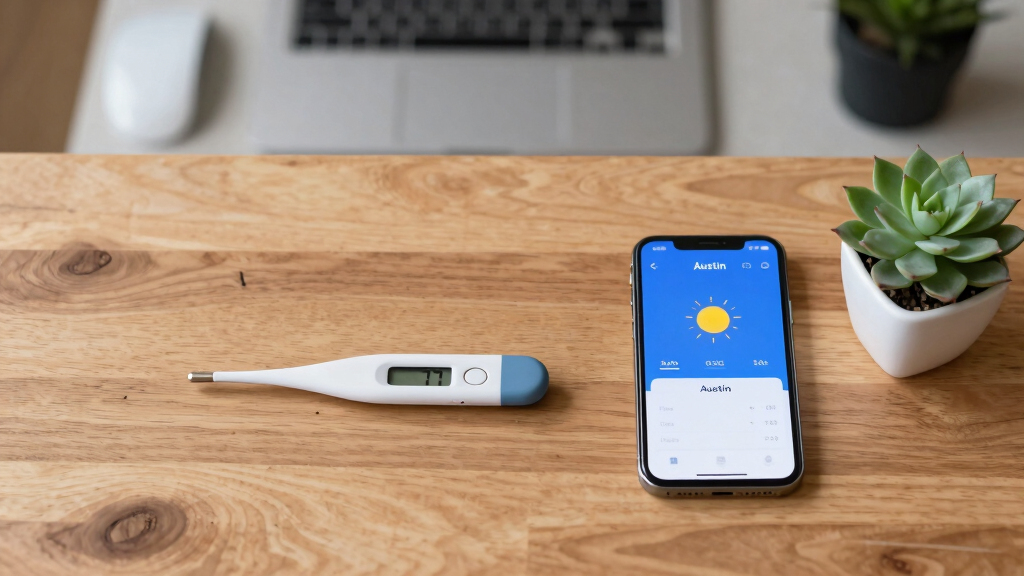
Austin temperature forecast thermometer
As an affiliate, we earn on qualifying purchases.
As an affiliate, we earn on qualifying purchases.
Understanding Weather Prediction Markets and Their Role
Prediction markets like Kalshi enable traders to buy and sell contracts based on future events, including weather conditions. These markets aggregate diverse information and expectations. The specific contract in question asks whether the temperature in Austin will be above 76.99°F at 5am EDT on July 12, 2026, with recent trades indicating a strong likelihood but no scientific certainty.
Such markets have been used for various forecasts, including elections and economic indicators, but their application to weather relies on collective trader sentiment rather than meteorological modeling. The accuracy of long-term weather predictions remains limited, especially for specific times and locations so far in advance.
“Prediction markets provide insights into collective expectations, but they should not replace scientific weather forecasts, especially so far out.”
— John Smith, meteorologist
As an affiliate, we earn on qualifying purchases.
Limitations of Long-Range Weather Predictions
Given the nearly three-year lead time, the accuracy of this market-based prediction is limited. Weather conditions depend on complex atmospheric systems that are difficult to forecast precisely so far in advance. The current odds are based on trader expectations, which may change with new data and developments.
Scientific weather models do not typically produce precise forecasts for specific hours this far ahead, making this prediction more indicative of collective sentiment than a definitive forecast.
As an affiliate, we earn on qualifying purchases.
Monitoring Market Trends and Scientific Forecasts
As July 2026 approaches, scientific weather forecasts will become more accurate, providing clearer expectations for Austin’s climate. Market odds will likely evolve as new weather data and climate trends emerge. The current high confidence level may fluctuate based on incoming information.
In the meantime, residents and officials should rely on short-term forecasts for planning, recognizing that long-term predictions at this scale are inherently uncertain.
As an affiliate, we earn on qualifying purchases.
Key Questions
How accurate are prediction markets for weather forecasting?
Prediction markets reflect collective expectations based on trader sentiment and available information, but they are not scientific forecasts. Their accuracy diminishes the further out the forecast is, especially for specific times and locations.
Can these markets reliably predict weather conditions years in advance?
No, these markets are more indicative of collective sentiment than precise predictions. Long-term weather forecasts are inherently uncertain and based on climate models rather than market data.
Why is the temperature threshold set at 76.99°F?
The threshold is likely chosen to gauge whether temperatures will be above or below a specific level, but it does not have a particular scientific significance beyond that.
Will scientific forecasts be available closer to July 2026?
Yes, as the date approaches, meteorological agencies will provide more accurate and detailed forecasts based on current atmospheric data and climate models.
How should residents interpret this prediction?
Residents should view this market-based prediction as a reflection of collective expectations, not a definitive forecast. For planning, rely on official weather forecasts closer to the date.
Source: kalshi
Halloween Picks
halloween
As an affiliate, we earn on qualifying purchases.