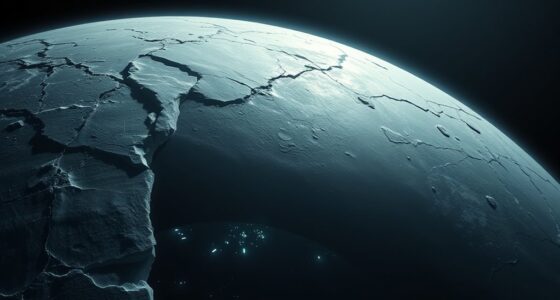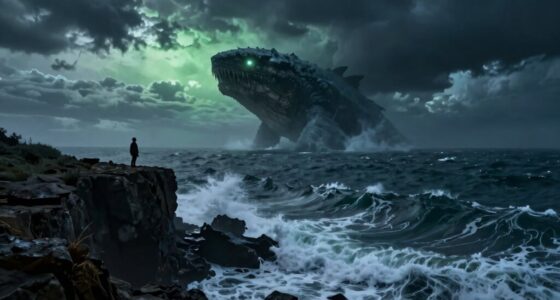
The Hollow Earth Theory claims there’s a hidden world inside our planet, home to monsters, civilizations, and strange creatures. While these ideas have captured imaginations for centuries, scientific evidence shows Earth’s interior is solid, with a dense core and layered mantle. Despite this, many myths, conspiracy theories, and stories suggest otherwise, fueling ongoing fascination. If you keep exploring, you’ll discover how these ancient legends and modern beliefs continue to influence ideas about what’s beneath our feet.

Prime made for students and young adults
- Fast, free delivery for dorm and study essentials
- Prime Video and Amazon Music included
- Member-only deals
Key Takeaways
- The Hollow Earth Theory suggests monsters or strange creatures could exist within Earth’s hidden interior, but lacks scientific evidence.
- Ancient myths and legends describe monsters and spirits dwelling inside Earth, inspiring modern speculative ideas.
- Modern science confirms Earth’s interior is solid with a metallic core, contradicting the existence of monsters in the core.
- Conspiracy theories claim governments hide the truth about creatures or civilizations inside a hollow Earth.
- The myth persists due to human curiosity, symbolism, and fascination with the unknown beneath the Earth’s surface.

Have you ever wondered what lies beneath the Earth’s surface? The idea of a hollow Earth has fascinated humanity for centuries, rooted in ancient inner Earth myths that speak of hidden worlds and mysterious civilizations living beneath our feet. These myths often describe vast underground realms inhabited by strange creatures or ancient beings, fueling imaginations for generations. Today, the Hollow Earth Theory persists as a fringe idea, but it also sparks modern scientific debates. Most scientists dismiss it outright, citing geological evidence that confirms the Earth’s solid core, but enthusiasts cling to the idea that there might be more than meets the eye beneath the crust.
Ancient myths and modern curiosity fuel the enduring fascination with a hollow Earth beneath our feet.
You might find it intriguing that the hollow Earth concept isn’t just a modern conspiracy; it has deep roots in various cultures. Many ancient civilizations, from the Greeks to the Norse, envisioned worlds inside the Earth, filled with monsters or spirits. These stories often served symbolic or spiritual purposes but laid the groundwork for modern myths. Fast forward to the 17th and 18th centuries, and explorers and scientists like Edmond Halley suggested the Earth might contain concentric shells or even large empty spaces. These hypotheses, while speculative, kept the conversation alive and added layers to the inner Earth myths.
Today, the scientific community bases its understanding on seismic data, gravity measurements, and volcanic activity, all pointing to a layered but solid interior. Modern scientific debates revolve around the Earth’s composition, but they consistently reinforce the idea of a dense, metallic core surrounded by a semi-fluid mantle. This understanding leaves little room for the hollow Earth theories, which often suggest vast, empty cavities or even civilizations living inside the planet. Nonetheless, some conspiracy theories propose that the government or secret societies are hiding the truth about a hollow Earth, fueling speculation and popular culture references. Interestingly, ongoing seismic research provides insights into Earth’s structure, which further supports the scientific consensus of a solid interior.
You might wonder why, despite all scientific evidence, the hollow Earth theory still endures. Part of the reason is the allure of the unknown and the human desire for adventure and mystery. Stories of monsters or hidden civilizations inside the Earth tap into primal fears and curiosities, making them compelling even in the face of scientific refutation. While modern debates support a solid Earth based on extensive research, the myth persists because it satisfies a need for wonder and the possibility of discovering something extraordinary beneath the surface. Whether as a scientific theory or a captivating myth, the idea of monsters in the core continues to fascinate your imagination and challenge your understanding of what’s possible beneath our feet.
As an affiliate, we earn on qualifying purchases.
Frequently Asked Questions
What Evidence Supports the Existence of Monsters Inside the Earth?
You won’t find concrete scientific evidence supporting monsters inside the Earth. Instead, proponents cite mythical beings from ancient texts, claiming these stories suggest hidden creatures dwelling deep below. Some believe unusual seismic activity or unexplained phenomena hint at these mythical beings’ existence. However, mainstream science dismisses these ideas, viewing them as legends rather than factual proof, so no solid evidence currently backs the idea of monsters lurking in the Earth’s core.
Are There Any Scientific Experiments Detecting Creatures Within the Earth’s Core?
You might be surprised to learn that no scientific experiments have definitively detected subterranean creatures within the Earth’s core. Researchers use underground sonar to explore deep underground environments, but this technology mainly maps geology and detects underground movements, not creatures. Despite fascination with monsters in the core, current science hasn’t found evidence of such beings. Still, the idea intrigues many, inspiring ongoing exploration and technological advancements.
How Do Legends of Hollow Earth Vary Across Different Cultures?
You’ll notice that cultural legends vary widely about the hollow earth, often featuring mythical creatures like dragons, giants, or subterranean beings. In some traditions, such as Tibetan or Native American myths, the earth’s interior is inhabited by spirits or ancient monsters. These stories reflect local beliefs and serve as metaphors or warnings, showing how different cultures interpret the idea of a hidden world beneath our feet and the mythical creatures that might dwell there.
Could the Hollow Earth Theory Explain Mysterious Underground Phenomena?
You might find the hollow earth theory intriguing, as about 20% of the population believes in hidden worlds beneath our feet. This modern conspiracy could explain mysterious underground phenomena like strange noises and unexplained structures. Ancient myths often describe vast underground domains, giving some credibility to the idea. While scientific evidence is lacking, these stories fuel curiosity and keep the possibility alive that there’s more beneath the surface than we realize.
What Are the Latest Discoveries Related to Underground Ecosystems?
Recent discoveries reveal vibrant underground microbial life thriving in extreme conditions. You’ll find subterranean bioluminescence lighting up deep caves and aquifers, showcasing nature’s adaptability. These ecosystems are teeming with unique organisms that produce their own light, indicating complex microbial relationships. This growing knowledge helps scientists understand underground ecosystems better, emphasizing that even beneath the Earth’s surface, life persists in astonishing forms, defying previous assumptions about the limits of habitability.
underground world exploration kit
As an affiliate, we earn on qualifying purchases.
As an affiliate, we earn on qualifying purchases.
Conclusion
So, stay skeptical but curious about the strange secrets hiding beneath the surface. The Hollow Earth holds haunting horrors and mysterious monsters lurking in the dark, deep depths. As you ponder this peculiar puzzle, picture a pulsating, parasitic planet, pulsing with peril and possibility. Keep your curiosity kindled and your questions quivering, for the core conceals countless curiosities. Remember, the mysteries beneath might just mesmerize your mind or make you marvel at the unknown.
mythology and legends about Earth's interior
As an affiliate, we earn on qualifying purchases.
As an affiliate, we earn on qualifying purchases.
As an affiliate, we earn on qualifying purchases.
Evergreen bestsellers Picks
bestsellers
As an affiliate, we earn on qualifying purchases.