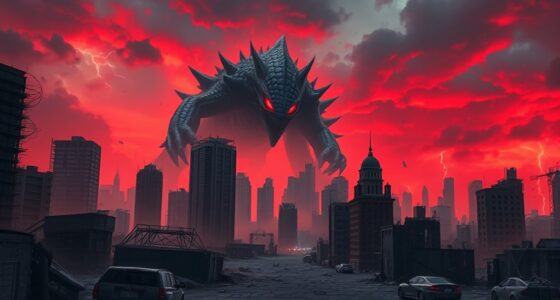
Nostradamus’s cryptic quatrains often mention monsters or apocalyptic beings, but his descriptions are poetic symbols rather than literal creatures. His verses use allegory and metaphor, leaving interpretations open to bias and fear. Many believe he foresaw societal upheavals or natural disasters, not beastly monsters. If you want to understand why these visions are so debated and how symbolism shapes them, there’s more to uncover behind the centuries of interpretations.
Key Takeaways
- Nostradamus’s quatrains contain cryptic, symbolic imagery often interpreted as descriptions of monsters or apocalyptic beasts.
- Many alleged monster references are poetic allegories for societal upheavals, disasters, or political conflicts.
- Critical analysis suggests these interpretations are subjective, with language open to multiple, often metaphorical, meanings.
- Modern skeptics argue that claims of literal monsters in his prophecies are speculative and lack concrete evidence.
- Nostradamus’s visions continue to inspire popular culture, often fueled by fears and interpretations of apocalyptic creatures.

Nostradamus’s cryptic prophecies have long fascinated those who seek to understand the future, often describing terrifying monsters and apocalyptic creatures. These mysterious predictions, written in obscure quatrains, have inspired countless interpretations over the centuries. Many believe Nostradamus foresaw monstrous beings or destructive forces, fueling speculation that his visions point to real entities or events. However, when you examine these prophecies through the lens of historical interpretations, you’ll find that their meanings are often vague and open to multiple readings. Over time, people have spun stories about terrifying beasts emerging from his verses, imagining scenarios where ancient monsters rise again or new, monstrous threats threaten humanity. These interpretations tend to reflect the fears and anxieties of their respective eras, whether it’s medieval fears of demons or modern concerns about apocalyptic disasters. Still, skeptics argue that such interpretations are largely subjective, highlighting the importance of scrutinizing these claims critically. Additionally, the language used by Nostradamus often contains symbolic imagery that can be interpreted in numerous ways, further complicating efforts to identify literal monsters. Modern skepticism challenges the idea that Nostradamus’s writings predict literal monsters or creatures. Critics point out that his quatrains are written in cryptic language, filled with symbolic imagery that can be shaped to fit almost any event. They argue that the tendency to interpret his prophecies as references to monsters or monsters-like phenomena is often a product of confirmation bias. If you look closely, you’ll see that many alleged descriptions of monsters are actually metaphorical or poetic, describing political upheaval, natural disasters, or societal collapse. These skeptics emphasize that Nostradamus was a product of his time, influenced by the superstitions and fears of 16th-century Europe, rather than a genuine seer of monstrous creatures. They caution against taking these predictions at face value and urge a rational approach that considers historical context and the ambiguity embedded in his words. While the allure of uncovering monsters from the past remains compelling, modern interpretations often highlight how these supposed visions can be explained away as poetic allegories rather than actual premonitions of monstrous beings. Ultimately, whether you see Nostradamus as a prophet or a poetic mystic, it’s clear that his prophecies continue to inspire debate, especially when it comes to the idea of monstrous, apocalyptic entities.
Frequently Asked Questions
Did Nostradamus Ever Predict Specific Monster Appearances?
Nostradamus never explicitly predicted specific monster appearances, but his writings often include vague references that some interpret as ancient creature theories or cryptid symbolism. You might see his quatrains as allusions to mythical beasts or hidden monsters, sparking curiosity about cryptid sightings. While he didn’t directly forecast monsters, his cryptic language invites speculation, making it fun for you to connect his prophecies with legendary creatures and ancient creature theories.
Are There Modern Sightings Linked to Nostradamus’ Prophecies?
There aren’t any verified modern cryptid sightings directly linked to Nostradamus’ prophecies. You might notice stories that feed into modern folklore about mysterious creatures, but these are typically inspired by local legends or media rather than Nostradamus’ predictions. While some enthusiasts draw loose connections, there’s no concrete evidence that his writings predict specific cryptid sightings today. Instead, these stories often thrive in the domain of speculation and myth.
What Monsters Are Most Commonly Associated With Nostradamus?
You might notice that creatures like dragons, sea monsters, and giant beasts are most commonly linked to Nostradamus. These monsters often draw from ancient mythologies and cryptid sightings, fueling speculation about his prophecies. You can see how people connect these legendary beings to his visions, imagining that his predictions hint at future encounters with mythical creatures rooted in ancient stories and mysterious sightings.
How Accurate Are Nostradamus’ Monster-Related Predictions?
Nostradamus’ monster-related predictions are often vague and open to interpretation, making their prophecy accuracy questionable. You might see references to mythical creatures like dragons or beasts, but these are usually symbolic rather than literal. While some believe his prophecies are eerily accurate, most skeptics argue that the connections to mythical creatures are coincidental or exaggerated. So, don’t rely on his predictions for precise details about monsters.
Are There Secret Codes About Monsters in Nostradamus’ Writings?
You probably think Nostradamus hid secret codes about monsters, right? Well, surprise! His writings are filled with cryptic symbols and hidden messages, but not necessarily clues to mythical beasts. Instead, he used obscure language and vague predictions to keep us guessing. So, while it’s fun to imagine secret codes, most scholars agree there’s just clever wordplay, not secret monster messages lurking in his texts.
Conclusion
As you uncover Nostradamus’s visions, you realize they’re like shadows dancing on the edge of understanding—elusive yet enthralling. His prophetic monsters serve as mirrors, reflecting fears and hopes tangled in human imagination. Though history may never fully reveal their truth, they remind you that the past’s mysteries are the monsters lurking just beyond the light of certainty, whispering secrets only the brave dare to chase.