
Roman bestiaries describe mythical creatures like giant spiders, symbolizing chaos and divine punishment, which influence local reports and folklore in Britannia. These stories merge fact and fiction, reflecting cultural fears and symbols of danger. Most sightings of giant spiders are likely misinterpretations or folklore rather than real beasts, but the myth’s legacy persists in modern stories and artwork. If you look further, you’ll uncover how ancient symbolism shaped these intriguing legends.
Key Takeaways
- Roman bestiaries depicted giant spiders as symbols of chaos, danger, and divine punishment, blending myth with natural history.
- Archaeological finds in Britannia include fossilized arachnids linking ancient species to mythic symbolism.
- Reports of giant spiders in Britannia are largely attributed to misidentifications, hallucinations, or folklore rather than verified creatures.
- Roman and British folklore both portray monstrous spiders as symbols of chaos, fear, and societal caution, possibly influencing each other.
- Modern interpretations draw on Roman mythic imagery, but credible evidence for actual giant spiders in Britannia remains weak.
Ancient Roman Texts and Descriptions of Unusual Creatures
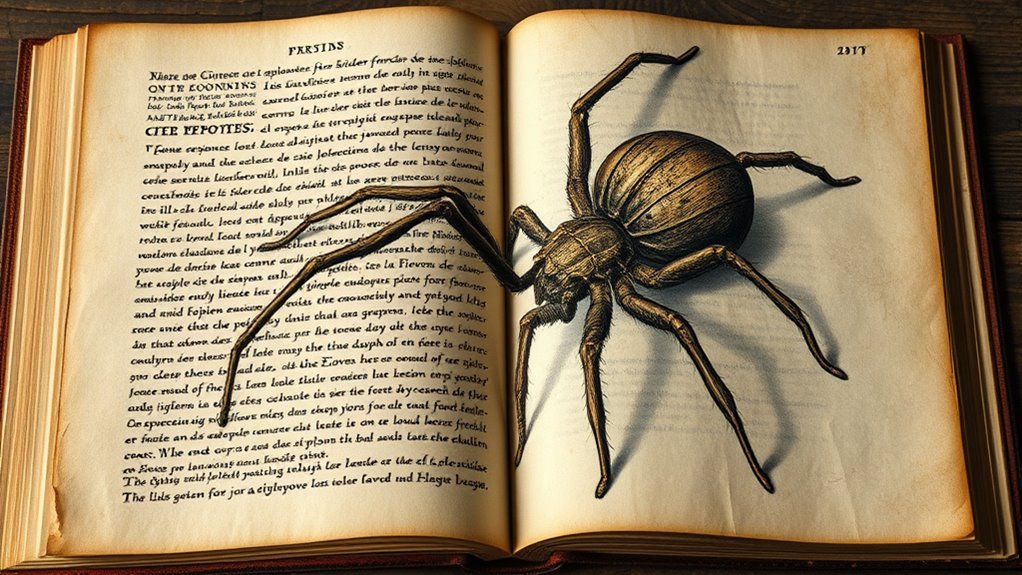
Ancient Roman texts often mention unusual creatures that sparked curiosity and fear, blending observation with myth. These accounts describe mythical creatures that seemed to embody Roman symbolism, representing virtues or warnings. Roman authors documented strange beasts, some resembling giant spiders or other arachnids, often as symbols of chaos or danger. Such creatures appeared in stories meant to convey moral lessons or reflect the fears of Roman society. While these descriptions blend fact with fiction, they reveal how Romans interpreted the natural world through the lens of myth and symbolism. Their writings suggest that these unusual creatures left a lasting impression, inspiring stories that intertwined reality with myth, emphasizing the significance of symbolism in understanding their worldview.
The Mythology Behind Giant Spiders in Roman Lore
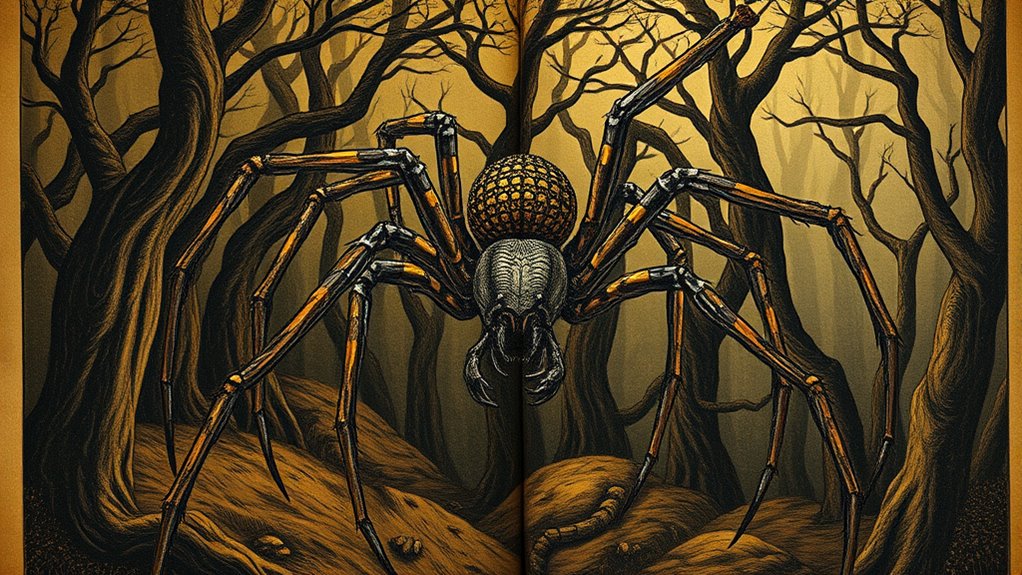
Giant spiders in Roman lore are more than just monstrous creatures; they embody complex symbolism rooted in myth and cultural fears. These mythical arachnids often represent chaos, danger, or divine punishment, reflecting humanity’s struggle with the unknown. Some stories depict divine spiders as divine spiders, messengers or symbols of divine wrath, emphasizing their supernatural significance. These divine spiders symbolize the thin line between the mortal and divine worlds, serving as reminders of nature’s power and unpredictability. Their presence in Roman myth highlights fears of uncontrollable forces lurking in the shadows. Whether as warnings or divine agents, these mythical arachnids reveal the Romans’ view of giant spiders as creatures intertwined with divine will and cosmic balance.
Archaeological Evidence and Discoveries in Britannia

You can examine ancient spider fossils that hint at the presence of giant arachnids in Britannia’s past. Archaeological site discoveries reveal strange remains and artifacts linked to these creatures. These findings challenge what you thought you knew about the region’s prehistoric life.
Ancient Spider Fossils
Archaeologists in Britannia have uncovered a surprising number of spider fossils that date back millions of years, providing crucial evidence of the region’s prehistoric biodiversity. These fossils help connect ancient arachnids to the symbolism seen in medieval bestiaries, where spiders often represented patience or danger. The fossils reveal diverse species, some resembling giant spiders described in Roman texts and later reports. These discoveries support the idea that large arachnids played a significant role in Britain’s ancient ecosystems. Such findings deepen our understanding of how spider symbolism evolved over time, from prehistoric creatures to medieval allegories. The table below summarizes key fossils and their significance:
| Fossil Species | Approximate Age | Significance | Related Symbolism | Location Found |
|---|---|---|---|---|
| Megarachne | 300 million years | Largest known fossil | Power, dominance | Northern Britannia |
| Araneus | 50 million years | Modern ancestor | Patience, fate | Southern Britannia |
| Fossil A | 200 million years | Prehistoric predator | Danger | Western Britannia |
| Fossil B | 150 million years | Evolutionary link | Wisdom | Eastern Britannia |
| Fossil C | 100 million years | Extinct species | Mystery | Central Britannia |
Archaeological Site Discoveries
Recent excavations across Britannia have revealed an array of well-preserved spider fossils and related artifacts, shedding light on the region’s ancient arachnid-rich ecosystems. Archaeologists have uncovered fragments of medieval bestiary illustrations depicting giant spiders, emphasizing their symbolic significance. These discoveries support the idea that spiders held a prominent place in local folklore, often representing danger or mystery. Some site finds include carved stone depictions and embedded mosaics that align with historical reports of giant spiders. These artifacts deepen your understanding of how ancient societies perceived spiders, blending real creatures with mythic symbolism. The archaeological evidence suggests that, for centuries, spiders played a vital role in shaping cultural stories and beliefs across Britannia, bridging the gap between natural history and medieval symbolism.
Comparing Roman Accounts With Local British Folklore

Roman accounts of giant spiders in Britannia often describe monstrous creatures terrorizing villages and forests, emphasizing their size and ferocity. These descriptions resemble medieval spider legends, which mythologized such beasts as symbols of chaos and danger. When comparing these accounts with local British folklore, you notice shared themes of monstrous arachnids lurking in dark places. Roman insect symbolism often linked spiders to cunning and death, while British legends sometimes portray giant spiders as guardians or curses. Both traditions reflect fears of the unknown and the wild. The similarities suggest that Roman narratives may have influenced or been shaped by native stories, or vice versa. This blending of folklore demonstrates how giant spiders became enduring symbols of terror across different cultures in Britannia.
Possible Explanations for the Reports of Giant Spiders

One plausible explanation for reports of giant spiders in Britannia is that they stem from misidentifications of known creatures or natural phenomena. Medieval bestiary illustrations often exaggerated or stylized animals, influencing how people visualized strange creatures. When encountering unfamiliar insects or arachnids, individuals might have mistaken them for enormous spiders, especially in low-light conditions or during foggy days. These reports could also be fueled by fantasy illustrations found in manuscripts, which depict fantastical or oversized beings to evoke awe. Over time, such images and sightings blended into local folklore and Roman accounts, creating a narrative of giant spiders. Ultimately, these stories likely reflect a combination of misinterpretation, imaginative art, and cultural storytelling rather than actual giant arachnids.
Symbolism and Cultural Significance of Arachnids in Roman Society

In Roman society, arachnids often symbolize power and control, reflecting their role in myths and stories. Many believe that giant spiders represent fears and cultural anxieties, shaping how people viewed these creatures. Exploring these symbols reveals how Romans used arachnids to express deeper societal themes.
Arachnids as Symbols of Power
Arachnids, particularly spiders, have long served as potent symbols of power and control in Roman society. Through arachnid symbolism, they represent cunning, dominance, and the ability to manipulate unseen forces. Roman leaders and elites often associated spiders with the idea of strategic influence, viewing their intricate webs as metaphors for political and military control. Power representations in Roman art and literature frequently depict arachnids as symbols of sovereignty, emphasizing their role in asserting authority and mastery over chaos. This imagery reinforced the belief that strength lies not only in physical might but also in the subtle, calculated use of influence. By embodying these qualities, arachnids became enduring emblems of power, reminding Romans of the importance of strategy and control in societal hierarchy.
Cultural Myths and Fears
Despite their often benign appearance, spiders and other arachnids in Roman society carried deep-seated fears and complex symbolism. They represented danger, cunning, and chaos, fueling cultural myths that persisted into medieval art. These fears extended beyond daily life, inspiring cryptozoology theories about monstrous spiders lurking in shadows. In Roman minds, spiders symbolized the weaving of fate, sometimes seen as ominous omens. This symbolism persisted in later European culture, where spider motifs appeared in tapestries and frescoes, reinforcing fears. The table below captures the emotional power of arachnids across different contexts:
| Context | Symbolic Meaning | Emotional Impact |
|---|---|---|
| Roman Society | Deception, danger | Fear, suspicion |
| Medieval Art | Fate, chaos | Anxiety, foreboding |
| Cryptozoology | Hidden monsters | Fascination, dread |
| Folklore | Cunning predators | Unease, mistrust |
| Cultural Myths | Omens of misfortune | Anxiety, superstition |
Modern Interpretations and Scientific Perspectives

Modern scientists often approach reports of giant spiders in Britannia with skepticism, seeking natural explanations for these sightings. They consider possibilities like genetic anomalies in modern arachnids, which could cause unusual growth or behavior. Such anomalies might result from environmental factors or mutations, leading to larger-than-normal spiders that could be mistaken for giants. Researchers also analyze historical data and recent sightings, applying scientific methods to determine if these creatures are exaggerations or misunderstandings. Most experts agree that the evidence for genuinely enormous spiders is weak, attributing many reports to misidentifications, hallucinations, or folklore. While these explanations don’t fully dismiss the stories, they suggest that natural, biological factors are more likely than mythical beasts or ancient creatures still lurking in the shadows of Britannia.
The Legacy of Roman Bestiaries in Contemporary Mythology

Roman bestiaries played a significant role in shaping the way people imagined and understood strange creatures, including giant spiders, in ancient and medieval times. Their influence persists today, especially in medieval bestiaries and modern cryptids. You might picture:
- Gigantic, hairy spiders lurking in dark forests, inspired by ancient descriptions.
- Mythical beasts that combine features of real animals with fantastical traits.
- Dark, shadowy figures that evoke fear and curiosity, shaping tales passed down through generations.
- Modern cryptids like the giant spider or other mysterious creatures that echo ancient fears and stories.
These stories and images continue to influence contemporary mythology, inspiring movies, books, and folklore. Your understanding of these creatures is rooted in a long history of myth-making, where medieval bestiaries serve as a bridge between past fears and present fascination.
Frequently Asked Questions
Were Any Giant Spiders Ever Found Alive in Britannia?
You might wonder if any giant spiders have ever been found alive in Britannia. While some believe in mythical creatures and ancient sightings, there’s no solid evidence to confirm these giant spiders ever existed or were discovered alive. Most reports are considered folklore or misidentifications of other creatures. So, based on current knowledge, it’s safe to say no confirmed live giant spiders have been found in Britannia.
How Did Roman Bestiaries Influence Later European Monster Legends?
Medieval bestiary influences shaped how later European monster legends evolved, blending real animals with mythological traits. You see, these bestiaries served as a foundation for storytelling, inspiring artists and writers to imagine fantastical creatures. This mythological creature evolution made monsters more vivid and symbolic, influencing tales for centuries. So, the way legends developed was directly impacted by how these early bestiaries depicted and categorized strange, wondrous beings.
Did Roman Reports of Giant Spiders Impact Local British Culture?
Imagine you’re walking through ancient Britain, where whispers of giant spiders become part of your cultural folklore. These reports, as mythical creature symbolism, shape local stories and fears, fueling the evolution of cultural folklore. You see how such tales transform over generations, blending reality and myth, and influence community identity. The impact is a proof to how extraordinary creatures, real or imagined, can weave into the fabric of local culture.
Are There Any Artistic Depictions of Giant Spiders From Roman Times?
You might wonder if there are any artistic representations of giant spiders from Roman times. While direct mythical illustrations are rare, some ancient Roman artworks and mosaics depict fantastical creatures that could include giant spiders. These artistic representations often blend myth and reality, showcasing the Romans’ fascination with strange beasts. So, although scarce, some evidence hints at their interest in illustrating mythical creatures like giant spiders.
What Modern Technologies Could Verify the Existence of These Spiders?
Imagine using cutting-edge tech like remote sensing and genetic analysis to uncover hidden mysteries. You could deploy drones equipped with thermal imaging to scan dense forests for giant spider activity. Genetic analysis of soil samples might reveal ancient DNA traces, confirming their existence. These technologies act like modern detectives, helping you verify whether legends are rooted in reality or just myth, opening a new chapter in understanding ancient creatures.
Conclusion
So, next time you hear about giant spiders lurking in Britain’s shadows, remember—Roman bestiaries might’ve just been the ancient world’s biggest prank. They described monsters that never quite made it into modern biology, yet here we are, still fascinated. Maybe those tales were just Roman flair, or maybe Britain’s spiders are just the giants we never knew. Either way, history’s best stories often hide the truth beneath a web of irony.