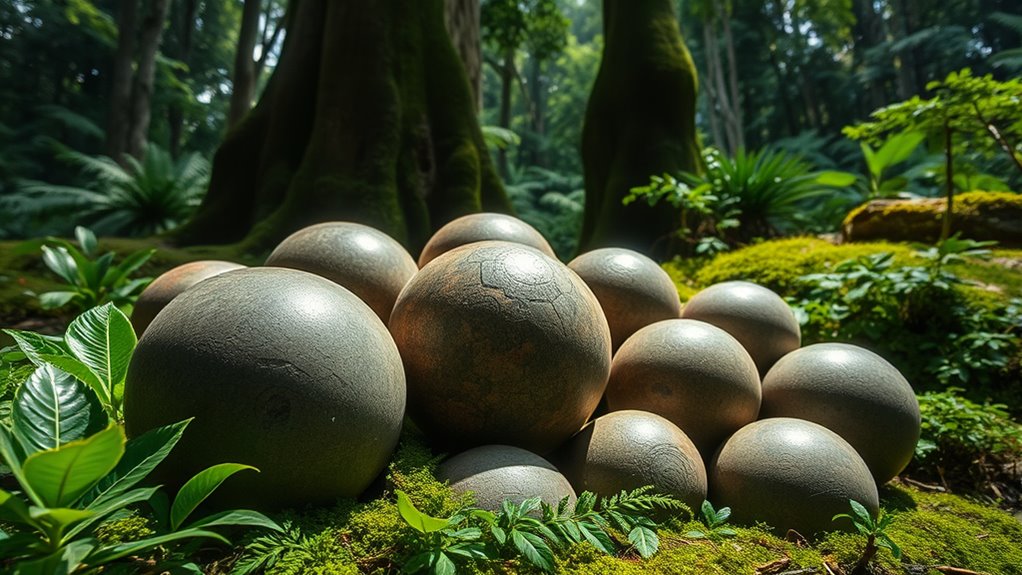
The mysterious stone spheres of Costa Rica spark debate over whether they are ancient art crafted by indigenous peoples or evidence of extraterrestrial help. These perfectly round, polished stones demonstrate impressive craftsmanship and precise geometry that challenge our understanding of early human skills. While many believe they held cultural, ritual, or social significance, some speculate about alien involvement. If you want to uncover the intriguing facts behind these enigmatic artifacts, there’s more to discover that might change your perspective.
Key Takeaways
- The stone spheres are crafted by ancient Costa Rican peoples, showcasing advanced skill but with no confirmed extraterrestrial involvement.
- Their precise shapes and large sizes have sparked speculation about alien technology, though they are generally considered human-made.
- Archaeological evidence supports their cultural and ritual significance, indicating they are artifacts of early human societies.
- No definitive proof links the spheres to extraterrestrial origins; their creation aligns with known ancient craftsmanship.
- The ongoing mystery and craftsmanship continue to fuel debates about whether they are art, cultural symbols, or alien artifacts.

The Stone Spheres of Costa Rica are among the most intriguing archaeological mysteries in Central America. When you stand before these perfectly round, polished stones, you might wonder about their mystery origins and what purpose they served. These enigmatic artifacts, scattered across the Diquis Delta and nearby regions, have puzzled archaeologists and visitors alike for centuries. Their precise craftsmanship suggests they weren’t just random rocks but held some form of cultural significance, perhaps symbolizing power, spirituality, or social status. The mystery origins of these spheres remain unresolved, with theories ranging from ancient advanced civilizations to extraterrestrial involvement, but no definitive answer has emerged. What’s clear is that they represent a sophisticated level of craftsmanship that defies easy explanation, especially considering their massive size and the effort it took to shape and transport them.
You might find yourself speculating about how these spheres came to be, especially since their creation predate written history in the region. Some believe that the indigenous peoples of Costa Rica crafted them, but the methods they used are still debated. The fact that many of these stones are perfectly spherical, with some measuring over 2 meters in diameter and weighing several tons, adds to their allure. Their smooth surfaces and uniform shapes suggest that their creators possessed advanced knowledge of geometry and tool use, making the mystery origins even more compelling. It’s tempting to think of the spheres as artifacts of a lost civilization, whose knowledge and skills have been long forgotten. Additionally, the strict regulations that govern these archaeological sites highlight the importance of preserving their integrity for future research.
As you explore their cultural significance, it becomes evident that these spheres weren’t merely decorative objects. They may have played a role in rituals or served as territorial markers, emphasizing social hierarchy or spiritual beliefs. Some scholars believe they were connected to astronomical events or calendar systems, highlighting their importance in the cultural practices of ancient Costa Rican societies. The fact that they are often found in ceremonial sites supports this idea. Whether they symbolized deities, served as celestial markers, or commemorated ancestors, their cultural importance is undeniable.
While the true origin of the stone spheres remains a mystery, what’s certain is that they continue to fascinate and inspire curiosity. They offer a glimpse into a sophisticated past, urging you to ponder the ingenuity of ancient peoples. Ultimately, these spheres challenge your understanding of early human achievement and remind you that some mysteries might never be fully unraveled, keeping their secrets safe in the heart of Costa Rica’s lush landscape.
Frequently Asked Questions
Who Discovered the Stone Spheres First?
You discover that the first person to find the stone spheres was an American traveler named William von Dürckheim in the 1930s. His exploration revealed these ancient crafts with remarkable archaeological significance, highlighting their sophisticated craftsmanship. As you learn more, you see how these mysterious spheres continue to fascinate archaeologists and visitors, emphasizing their importance in understanding Costa Rica’s cultural history and the ancient civilizations that created them.
Are There Any Known Legends Associated With the Spheres?
Like whispers from myth, legends surround these spheres, hinting at mythical origins and cultural significance. Locals believe they were created by ancient spirits or divine beings, serving as guardians or markers for sacred sites. Some stories speak of their mystical powers or connections to ancestral knowledge, emphasizing their importance in Costa Rican heritage. These legends deepen the mystery, inviting you to explore their cultural roots and the stories woven into their enduring presence.
What Materials Were Used to Craft the Spheres?
You find that the spheres were crafted from natural stone, primarily granodiorite, which is durable and hard. To shape these spheres, ancient artisans used traditional crafting techniques involving percussion and abrasion, carefully chiseling and smoothing the surfaces. Their skillful methods allowed them to create perfectly round forms despite the stones’ toughness, showcasing impressive craftsmanship and knowledge of natural materials.
Have Any Spheres Been Intentionally Moved or Repositioned?
You’ll find that some stone spheres have been intentionally moved or repositioned, especially during archaeological excavations or site preservation efforts. Approximately 300 spheres are known, and their placement influences perceptions of artifact authenticity and archaeological significance. Moving these artifacts helps researchers study their origins and cultural context, but it raises questions about their authenticity. Such interventions are carefully documented to preserve their archaeological value and better understand their historical significance.
Are Similar Artifacts Found Elsewhere in the World?
You’ll find similar artifacts in other parts of the world, often as geological formations or modern carvings. For example, some stone spheres in Africa and Asia resemble Costa Rican ones, but many are natural concretions shaped by geological processes. While some are man-made, others are simply fascinating natural formations. This variety shows that similar artifacts can emerge through different methods, blending art, geology, and history across cultures.
Conclusion
So, you see, the stone spheres of Costa Rica are truly a marvel that defies explanation, like a secret whispered by ancient gods. Whether they’re alien artifacts or masterful art, they challenge your imagination and leave you in awe. These perfect orbs, glowing with mystery, are arguably the most intriguing relics on Earth. You won’t find anything more mesmerizing—these stones are a proof of human ingenuity and the universe’s endless wonders.