

The Tunguska explosion of 1908 was caused by a massive meteoroid that disintegrated high in Siberia’s atmosphere, releasing energy equivalent to 10-15 megatons of TNT. As you explore, you’ll find that it leveled over 2,150 square kilometers of forests without creating a crater, because it exploded high above the ground. This event highlights the power of space objects and the importance of tracking near-Earth objects, revealing more surprises from our universe.

Get school and study supplies delivered free — and shop member deals
- Fast, free delivery on millions of items
- Access to Prime Big Deal Days deals on October 6–7
- Prime Video, Amazon Music and more included
Key Takeaways
- The Tunguska event was a high-altitude atmospheric explosion caused by a meteoroid approximately 50-60 meters in diameter.
- It released energy equivalent to 10-15 megatons of TNT, flattening over 2,150 sq km of Siberian forest.
- The explosion occurred around 5-10 km above ground, explaining the absence of a crater.
- Evidence includes widespread tree damage, shockwaves, and atmospheric disturbances, with no impactor found nearby.
- The event underscores the universe’s dynamic nature and the importance of monitoring near-Earth objects.
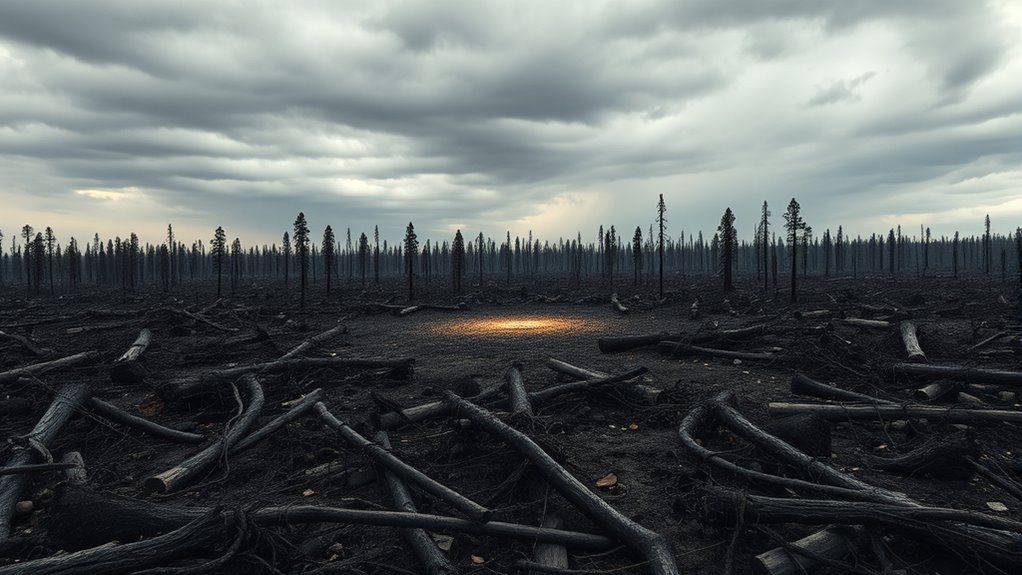
On June 30, 1908, a powerful explosion rocked the remote Tunguska region of Siberia, leveling thousands of square kilometers of forest in an instant. You might wonder what caused such devastation in a place so far from human civilization. The prevailing theory points to a meteoritic impact—a massive space rock hurtling through Earth’s atmosphere. As it entered the atmosphere at high speed, it didn’t survive the fiery descent intact. Instead, it exploded in an atmospheric explosion, releasing an immense amount of energy comparable to a nuclear bomb. This explosion shattered the meteoroid into fragments, creating a shockwave that spread out in all directions, flattening trees and causing widespread destruction over an area of approximately 2,150 square kilometers.
You should understand that this atmospheric explosion is the key to comprehending the event’s scale. Unlike a typical meteorite impact that leaves a crater, the Tunguska event’s explosion happened high above the ground, releasing energy that devastated the forest below without creating a crater. The explosion’s force was so powerful that it caused a sonic boom heard hundreds of miles away and sent shockwaves around the globe. The event’s intensity is evident in the twisted, fallen trees, all pointing away from the epicenter, indicating a sudden, violent energy release. You can imagine the pressure wave rippling through the air, shattering windows, and causing a bright flash visible even in parts of Europe and Asia.
Scientists have studied the remnants and eyewitness reports to piece together what happened. They believe that a meteoroid roughly 50-60 meters in diameter entered Earth’s atmosphere at speeds exceeding 15 kilometers per second. The atmospheric explosion happened at an altitude of about 5 to 10 kilometers, dispersing the energy over a vast area. You might find it fascinating that the explosion released energy equivalent to between 10-15 megatons of TNT, making it one of the most powerful natural explosions in recorded history. The lack of a crater puzzles many, but the high-altitude explosion explains why no impactor was found nearby. Instead, the event left behind the haunting scars of flattened forests and a scientific mystery that continues to intrigue researchers today. Additionally, recent studies have suggested that the event could have caused minor atmospheric disturbances detectable by modern sensors, highlighting its significance in understanding atmospheric impacts.
This incident remains a striking example of how a meteoritic impact can unleash destructive power without direct contact with Earth’s surface. You see, it underscores the importance of monitoring near-Earth objects, as even small space rocks can cause significant damage when they explode in the atmosphere. The Tunguska event isn’t just a story of destruction; it’s a reminder of the dynamic and sometimes dangerous universe we inhabit.
As an affiliate, we earn on qualifying purchases.
Frequently Asked Questions
What Was the Exact Size of the Object That Caused the Explosion?
You learn that the meteoritic fragment responsible for the explosion was roughly 50 to 60 meters in diameter. This size contributed to an explosion magnitude estimated at 10 to 15 megatons of TNT, enough to flatten trees over 830 square miles. Although no impact crater was found, the fragment’s size and the explosion’s power reveal how a relatively small celestial object can cause massive destruction on Earth.
Were There Any Long-Term Environmental Effects Observed After the Event?
You’ll find that long-term ecological impact was surprisingly limited, but the event did cause noticeable atmospheric changes. The explosion cleared vast forested areas, disrupting local ecosystems temporarily. In the years after, scientists observed altered weather patterns and increased atmospheric dust, which could have affected climate conditions locally. While the immediate devastation was clear, the environment gradually recovered, showing nature’s resilience despite the atmospheric upheaval caused by the blast.
Has Any Credible Evidence Linked the Explosion to Extraterrestrial Life?
You won’t find credible evidence linking the Tunguska explosion to extraterrestrial hypotheses or alien encounters. Most scientists agree it was caused by a meteoroid or comet airburst. While some speculate about alien involvement, these claims lack scientific backing and rely on speculation rather than solid proof. If you’re interested in extraterrestrial hypotheses, keep an eye on ongoing research, but current evidence doesn’t support any connection to alien encounters.
Could Similar Events Happen Again in the Same Region?
Yes, similar meteor impacts could happen again in the Tunguska region. A future impact might cause another massive explosion, damaging forests and ecosystems. Over time, forest regrowth would occur, but the area could experience repeated disturbances. Monitoring space for near-Earth objects and understanding impact risks helps prepare for such events, ensuring that the region isn’t left vulnerable to another devastating meteor impact that could alter its landscape again.
What Conspiracy Theories Surround the Tunguska Incident?
You might come across conspiracy theories suggesting government cover-ups or secret military experiments behind the Tunguska incident. Some believe the explosion was caused by a top-secret weapon test or alien activity, with authorities hiding the truth to avoid panic. These theories thrive on the mysterious nature of the event and limited official information, fueling speculation that powerful entities are concealing the real cause for their own purposes.
near-Earth object tracking telescope
As an affiliate, we earn on qualifying purchases.
As an affiliate, we earn on qualifying purchases.
Conclusion
You can’t help but wonder what really caused the Tunguska explosion, which flattened 800 square miles of Siberian forest. Imagine the force of a 10-megaton explosion—about 1,000 times more powerful than the atomic bomb dropped on Hiroshima—yet no impact crater remains. This mysterious event leaves you pondering the power of nature and the unknown, reminding you that some secrets in our universe still remain hidden, waiting to be uncovered.
As an affiliate, we earn on qualifying purchases.
atmospheric explosion experiment kit
As an affiliate, we earn on qualifying purchases.
As an affiliate, we earn on qualifying purchases.
Halloween Picks
halloween
As an affiliate, we earn on qualifying purchases.