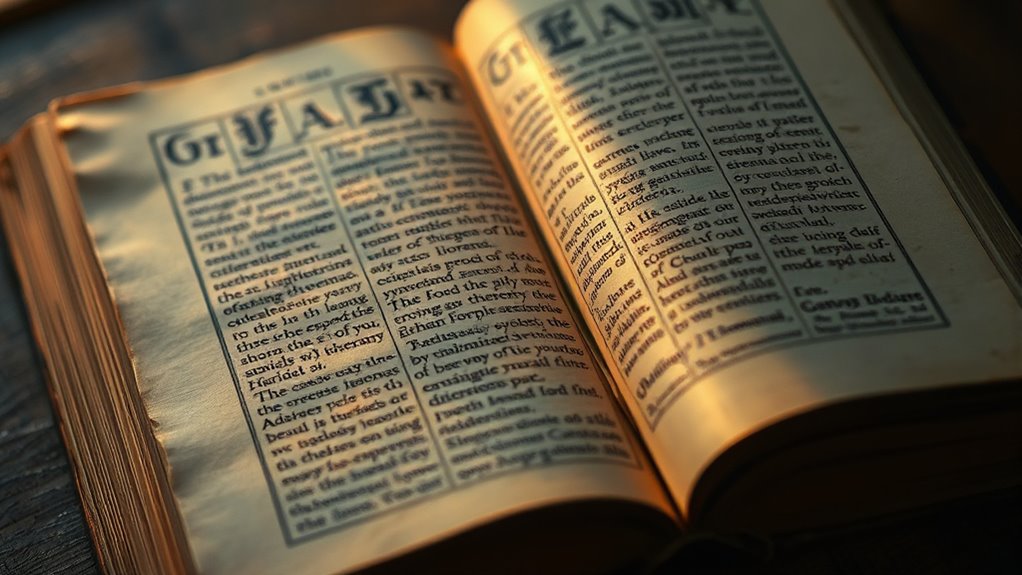

The Voynich Manuscript remains one of history’s greatest mysteries, filled with strange symbols, peculiar images, and an unknown language that resist all decoding attempts. Despite many efforts, scholars haven’t cracked its cipher or understood its purpose, leading to theories of it being a hoax or a sophisticated secret code. Its age and mysterious design keep fueling curiosity. If you keep exploring, you’ll uncover even more about this fascinating enigma and its ongoing quest for understanding.
Key Takeaways
- The Voynich Manuscript remains undeciphered despite numerous cryptographic attempts, highlighting its mysterious and complex coding system.
- Its strange symbols, illustrations, and unknown language suggest it may use an unrecognized cipher or constructed language.
- Historical clues like parchment, ink, and handwriting date it to the early 15th century, fueling speculation about its origin and purpose.
- The manuscript’s resistance to all decipherment efforts makes it a symbol of human curiosity and the limits of current cryptography.
- Ongoing research continues to explore theories of hoaxes, secret communication, or lost knowledge, keeping its enigma alive.
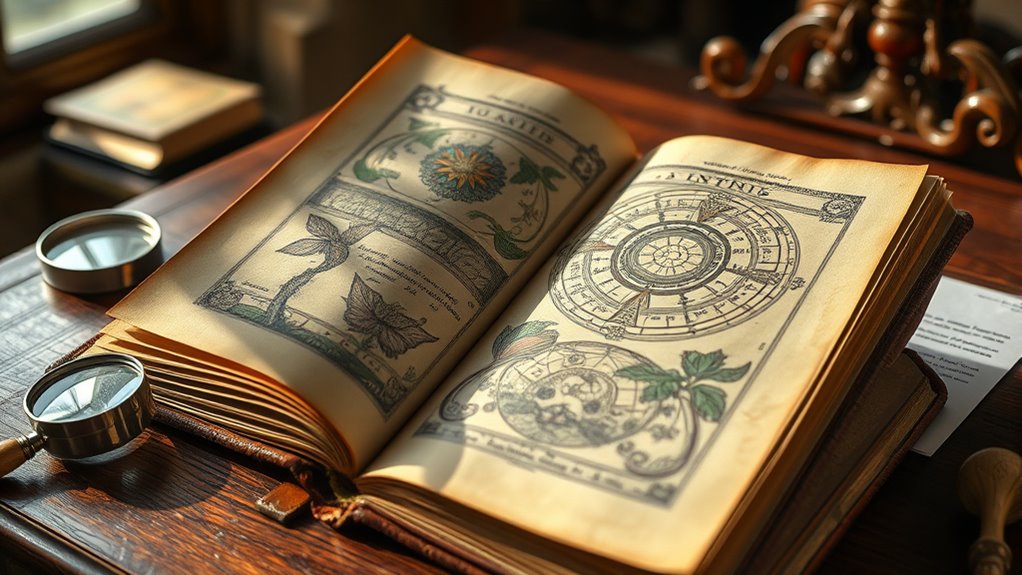
The Voynich Manuscript has long fascinated researchers and cryptographers because its mysterious symbols and illustrations resist all attempts at decipherment. This ancient book, filled with strange writing and peculiar images, embodies some of the most perplexing ciphering mysteries in history. Its indecipherability turns it into a true historical enigma, sparking endless debate about its origin, purpose, and meaning. As a reader, you’re drawn into a puzzle that seems almost deliberately designed to confound, leaving you enthusiastic to uncover its secrets but unsure where to begin. You quickly realize that the manuscript’s ciphering mysteries go beyond simple code-breaking. The symbols don’t match any known language or script, and numerous attempts at applying linguistic or cryptographic techniques have failed. This makes the manuscript a unique challenge, unlike any other deciphered text. Its complexity suggests that it might be encrypted with an unknown cipher, or perhaps written in a constructed language that has long since vanished. The illustrations, depicting strange plants, celestial diagrams, and enigmatic figures, only deepen the mystery, hinting at knowledge lost to time or deliberately hidden. The cryptographic complexity of the Voynich Manuscript highlights the limitations of our current understanding of historical ciphers and languages. In your pursuit of understanding, you encounter a range of theories. Some believe it’s a sophisticated hoax, crafted to fool scholars and collectors. Others think it could be a code based on an as-yet-undiscovered cipher system, or a form of secret communication meant for a select few. The manuscript’s age, dating back to the early 15th century, adds to its allure as a historical enigma. Its parchment, ink, and handwriting style provide clues, yet none have led to a definitive solution. Instead, each discovery raises new questions, fueling the ongoing quest to decode this ancient text. Despite centuries of research, the manuscript remains an unsolved puzzle, symbolizing the limits of our current cryptographic knowledge. You realize that its true power may lie in its mystery itself—an enduring symbol of human curiosity and the endless pursuit of knowledge. The Voynich Manuscript challenges you to think beyond conventional ciphering mysteries, pushing you to explore the boundaries of history, linguistics, and cryptography. It’s a reminder that some secrets might never be fully uncovered, but that doesn’t diminish their importance or the fascination they inspire. Instead, it invites you to accept the enigma and appreciate the enduring allure of one of history’s most enthralling mysteries.
Frequently Asked Questions
Has Anyone Ever Successfully Translated the Entire Manuscript?
No, no one has successfully translated the entire Voynich Manuscript yet. Experts have tried solving its cryptographic puzzles for decades, but the mysterious language and illustrations remain largely misunderstood. Its historical context adds to the challenge, as scholars debate its origin and purpose. Despite many claims of partial decipherments, no one has definitively cracked the code or fully translated the manuscript, leaving its secrets still hidden today.
What Are the Leading Theories About Its Original Purpose?
They say “the proof is in the pudding,” and with the Voynich Manuscript, many believe its purpose was to teach or demonstrate cryptography techniques. Some think it’s a herbal or alchemical guide from the medieval or Renaissance period, based on its historical context. Others suggest it might be a sophisticated hoax. Whatever the case, its true purpose remains a mystery, fueling endless curiosity and theories.
Could the Manuscript Be a Sophisticated Hoax?
Yes, the manuscript could be a sophisticated hoax, but forgery detection makes it difficult to confirm. Its complex illustrations and unusual language pose authenticity challenges, fueling debate about whether it’s genuinely ancient or a cleverly crafted forgery. You should consider that, despite advancements in analysis, some experts remain skeptical, and the manuscript’s true origin stays elusive. This ongoing mystery keeps the question of its authenticity unresolved.
Are There Any Similar Undeciphered Texts From That Era?
Yes, there are similar undeciphered texts from that era. You might explore medieval cryptography and ancient manuscript mysteries, as many texts from the Middle Ages remain unreadable or only partially understood. These documents often involve complex cipher systems or unique scripts, making them challenging to decode. Studying these mysteries can shed light on historical communication methods and the secrets hidden within ancient manuscripts, much like the enigmatic Voynich Manuscript.
What Materials Were Used to Create the Manuscript?
You might find it fascinating that the manuscript was created with high-quality materials like vellum made from animal skin. The illustration techniques involve detailed, colorful drawings, likely using natural pigments. The ink composition, possibly made from iron gall or carbon-based materials, reveals skilled craftsmanship. These materials suggest the manuscript was valuable and carefully crafted, hinting at its importance or secretive purpose during its time.
Conclusion
You can’t ignore that despite centuries of effort, over 90% of the Voynich Manuscript remains undeciphered. This staggering statistic shows just how mysterious and challenging it is to decipher its secrets. While many have tried, the manuscript’s true purpose and meaning still elude us. Yet, that very mystery keeps us captivated, pushing researchers to explore new theories and techniques. The Voynich continues to remind us that some puzzles are worth our persistent curiosity.