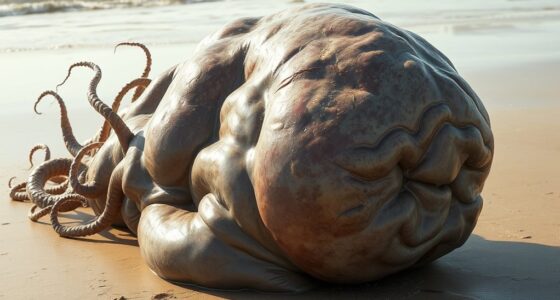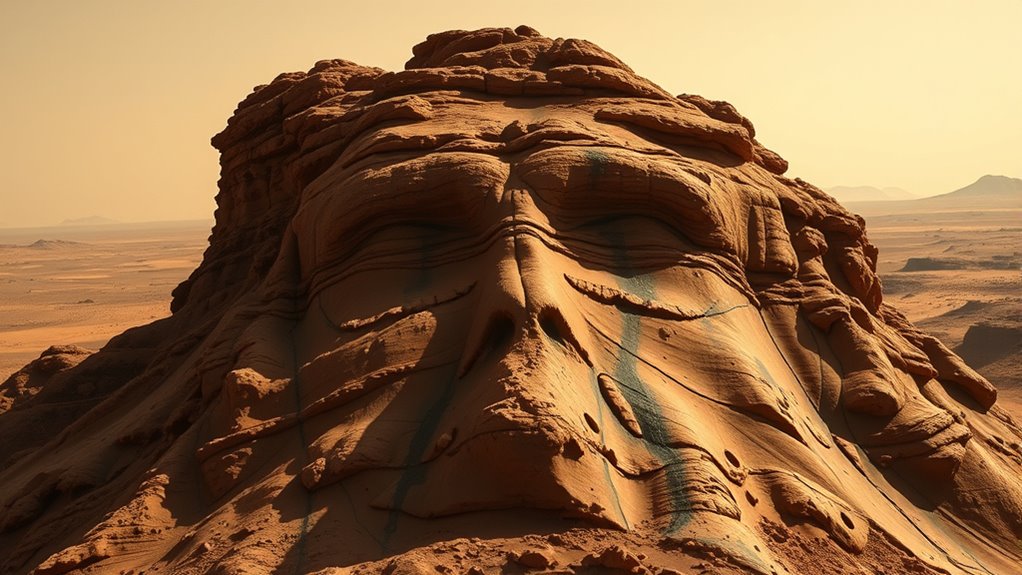

On Mars, what looks like faces or figures is often just pareidolia—your mind’s tendency to spot familiar shapes, especially faces, in natural formations. These illusions happen because of geological processes like wind erosion, volcanic activity, and sediment deposits that shape the landscape into what can appear as human-like features. Most of these formations are entirely natural, not signs of alien life. If you keep exploring, you’ll discover how science explains these intriguing planetary illusions.

Prime made for students and young adults
- Fast, free delivery for dorm and study essentials
- Prime Video and Amazon Music included
- Member-only deals
Key Takeaways
- The “Face on Mars” was initially mistaken for a humanoid face but is now understood as a natural mesa caused by shadows and lighting.
- Pareidolia causes humans to perceive familiar shapes, like faces, in natural Martian formations.
- High-resolution images and geological analysis confirm that many planetary anomalies are natural rock formations.
- Geological processes such as erosion, volcanic activity, and sediment deposition shape Mars’ landscape, creating face-like appearances.
- Recognizing pareidolia is essential to differentiate natural features from potential signs of extraterrestrial life.

Have you ever wondered if the strange formations on Mars hint at past alien life or just natural geological processes? When you look at images of the Martian surface, it’s easy to see why some people interpret certain structures as faces or figures. These formations are often called planetary anomalies because they stand out from the surrounding terrain, sparking curiosity and debate. But before jumping to conclusions, it’s essential to understand the role of mars geology in shaping these features. Mars’ landscape results from millions of years of volcanic activity, erosion, sediment deposits, and other natural processes that create a variety of unusual formations. Many of these planetary anomalies are simply the product of natural geological patterns, not signs of extraterrestrial life.
The human brain is wired to recognize familiar shapes, especially faces, even where none exist. This psychological phenomenon, known as pareidolia, explains why you might see a face in a cluster of rocks or a mountain range on Mars. When you view these formations through a camera lens, your mind tends to fill in gaps, creating images that resemble human features or other recognizable objects. This tendency fuels speculation and imaginative interpretations, but it doesn’t necessarily mean there’s anything more than natural geology behind these structures.
Take the famous “Face on Mars,” for example. Discovered in the Cydonia region by the Viking 1 orbiter in 1976, it initially appeared to resemble a humanoid face. However, subsequent high-resolution images taken by more advanced spacecraft clearly revealed it to be a natural mesa with shadows creating the illusion of facial features. This demonstrates how initial planetary anomalies can be misleading, emphasizing the importance of scientific investigation over visual impressions.
Mars geology offers a rich tapestry of formations shaped by the planet’s unique environmental history. Wind-blown dust, volcanic eruptions, water erosion, and sediment layering all contribute to creating intriguing shapes that might look like faces or figures to the human eye. But these are just natural outcomes of geological processes. Recognizing geological processes and understanding their natural formations help differentiate between pareidolia and genuine signs of past life. While it’s fun to imagine alien civilizations leaving behind structures on Mars, current evidence supports the idea that these formations are simply the result of natural planetary phenomena. Recognizing the difference between pareidolia and genuine signs of past life keeps our exploration grounded in scientific fact, even as we continue to be captivated by the planet’s mysterious landscape.
Mars geological formation posters
As an affiliate, we earn on qualifying purchases.
As an affiliate, we earn on qualifying purchases.
Frequently Asked Questions
Are There Any Scientific Explanations for the Mars Faces?
Scientists explain the Mars faces as natural geological formations shaped by erosion and sediment deposition. Image processing techniques help clarify these features, revealing their true irregular shapes. You should realize that pareidolia makes you see faces where none exist, but detailed analysis shows these formations are just weathered rocks and geological processes. So, the “face” is an optical illusion, not an artificial structure.
Have Recent Images Disproved the Face Formations?
Recent images haven’t completely disproved the face formations; instead, they highlight how mystery phenomena like optical illusions can create these intriguing shapes. You might notice that lighting, shadows, and camera angles influence what you see, reinforcing pareidolia. While higher-resolution photos show more detail, they often still resemble familiar forms, leaving the true origin of these formations a fascinating puzzle. Your perception plays a key role in interpreting these intriguing planetary features.
What Other Planets Show Similar Pareidolia Phenomena?
Just like the famous “Face on Mars,” other planets also display visual illusions caused by cognitive biases. For example, Mercury’s surface shows shapes that resemble human faces or animals, sparking speculation. These pareidolia phenomena occur because our brains seek familiar patterns even in random textures. You might see faces or figures on moons like Jupiter’s Europa or Saturn’s Titan, revealing how powerful our tendency to find familiar images in unfamiliar places can be.
How Do Human Perceptions Influence Interpretations of Planetary Images?
Your visual perception and cognitive biases heavily influence how you interpret planetary images. You tend to see familiar patterns or shapes, like faces or animals, even when none exist. These tendencies cause you to assign meaning to random surface features, leading to pareidolia. Your brain’s pattern recognition skills can be both fascinating and misleading, shaping your perception of extraterrestrial landscapes based on mental shortcuts rather than actual geological formations.
Are There Ongoing Missions Studying the Mars Faces?
Yes, ongoing robotic explorations continue to scrutinize the mysterious Mars faces. Using advanced imaging technologies, scientists analyze these enigmatic formations, seeking clues about their origins. Missions like NASA’s Mars rovers and orbiters capture detailed images, helping researchers determine whether pareidolia influences our perception or if there’s something more to these intriguing features. Your curiosity fuels further exploration, pushing the boundaries of what we comprehend about Mars’ fascinating surface formations.
Mars surface high-resolution images
As an affiliate, we earn on qualifying purchases.
As an affiliate, we earn on qualifying purchases.
Conclusion
As you explore the mysterious Mars faces, remember that appearances can be deceiving—sometimes, the mind sees what it wants to see. Like the old adage says, “Seeing is believing,” but not always the truth. These formations remind us to look deeper and question what we perceive. In the end, whether faces or illusions, the universe keeps its secrets, inviting you to stay curious and keep exploring beyond what’s immediately visible.
planetary geology educational kits
As an affiliate, we earn on qualifying purchases.
As an affiliate, we earn on qualifying purchases.
As an affiliate, we earn on qualifying purchases.
Columbus Day / Indigenous Peoples' Day Picks
long weekend sales
As an affiliate, we earn on qualifying purchases.