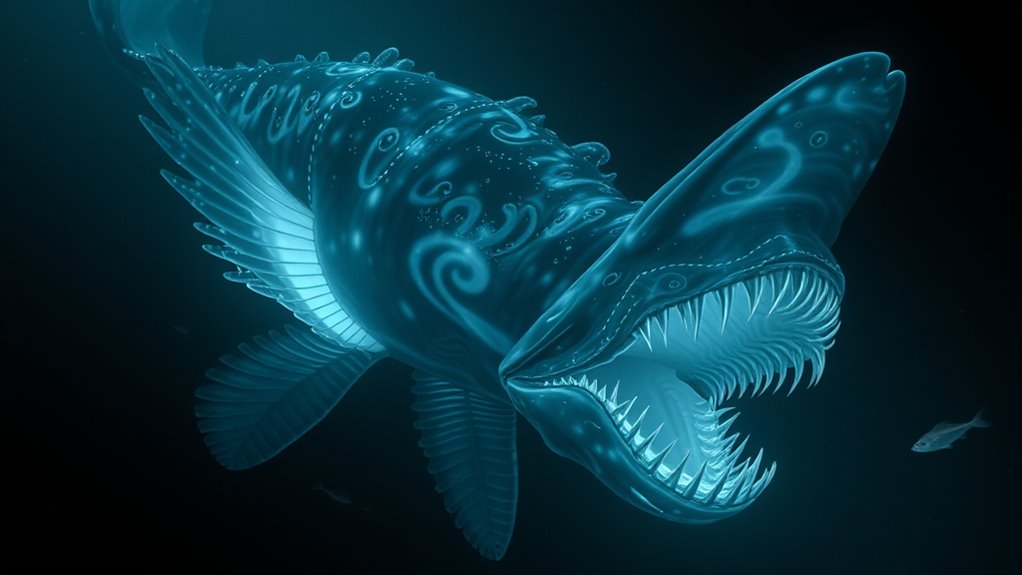

In the deep ocean, you’ll find giant, bioluminescent creatures that challenge what you think is possible in nature. These sea giants use their glowing adaptations to attract prey, communicate, or hide from predators in complete darkness. Their enormous size helps them survive extreme pressure and find scarce resources. If you keep exploring, you’ll discover even more astonishing facts about these luminous monsters and how they thrive in such an extreme environment.
Key Takeaways
- Deep-sea giants like the giant squid and colossal octopus exhibit deep sea gigantism, growing much larger than their shallow-water relatives.
- Many of these creatures utilize bioluminescence for attracting prey, communication, or evading predators in the darkness.
- Their extreme adaptations include enhanced size, bioluminescent features, and pressure resistance, enabling survival in harsh deep-sea environments.
- These mysterious monsters reveal a hidden world of luminous predators and prey, showcasing the ocean’s unexplored depths.
- Understanding these real-life sea giants helps uncover the remarkable biodiversity and evolutionary strategies of deep-sea life.

Have you ever wondered what colossal creatures might lurk beneath the ocean’s surface? The deep sea is a mysterious world filled with giants that challenge our understanding of life’s limits. Among these fascinating beings, some have developed extraordinary features such as bioluminescent adaptations, which allow them to produce their own light in the pitch-black darkness. This glowing ability is not just for show; it helps them attract prey, communicate with others, or evade predators in the deep. Imagine swimming through a black void and suddenly seeing a faint glow—those are the bioluminescent creatures, illuminating their surroundings with eerie beauty. These adaptations are essential for survival in an environment where sunlight never reaches, revealing a hidden world of luminous predators and prey. Additionally, resources and tools like local knowledge of habitats and behaviors can greatly enhance our understanding of these ocean giants. Deep sea gigantism is another remarkable trait seen in many of these ocean giants. This phenomenon causes certain species to grow much larger than their shallow-water relatives. For example, giant squid and colossal octopuses can reach impressive sizes, making them some of the most formidable predators in the deep. You might be surprised to learn that this size increase isn’t just for intimidation; it serves practical purposes. Larger bodies enable these creatures to store more energy, endure extreme pressure, and travel longer distances in search of food. In the crushing depths where food is scarce, being a giant provides a significant advantage, allowing them to dominate their environment. These adaptations and gigantism are interconnected strategies for survival in an environment that’s both alien and hostile. The pressure in the deep sea is immense, and light is nonexistent, yet these creatures have evolved ways to thrive. Their bioluminescent lights act as beacons, attracting prey or helping them find mates in the darkness. Meanwhile, their enormous sizes give them the strength and endurance needed to hunt or defend against threats. As you explore the mysteries of the deep, it’s clear that these giants aren’t just monsters; they are marvels of evolution, perfectly adapted to their extreme environment. The more you learn about them, the more you realize that the ocean’s depths are a domain of astonishing diversity, where survival hinges on extraordinary adaptations that seem almost otherworldly.
Frequently Asked Questions
Are There Undiscovered Giant Sea Creatures Still Awaiting Discovery?
Yes, there are still undiscovered giant sea creatures awaiting discovery. You might find yourself intrigued by mythical legends of enormous beings lurking in the depths. Scientists believe that unknown species of giant sea creatures could exist in the uncharted areas of the oceans, hiding in the darkness. Your curiosity drives exploration, and new discoveries are likely as technology improves, revealing these mysterious giants and expanding our understanding of marine life.
How Do Deep-Sea Monsters Survive in Extreme Pressure?
Ever wonder how deep-sea monsters survive under crushing pressures? You’d be amazed! They rely on pressure resistant physiology and bioluminescent adaptations, turning the ocean’s darkness into their playground. Their bodies are built tough, like underwater armored tanks, allowing them to withstand extreme pressure. These creatures have evolved incredible features that make them masters of their crushing, dark world, proving nature’s weirdest innovations are truly remarkable.
What Are the Latest Technological Advances in Deep-Sea Exploration?
You explore the latest advances in deep-sea exploration through innovative marine robotics and submersible technology. Cutting-edge remotely operated vehicles (ROVs) and autonomous underwater vehicles (AUVs) now dive deeper and last longer than ever before. Advances include improved pressure resistance, high-definition cameras, and advanced sensors, enabling you to study extreme environments and elusive sea giants more effectively. These breakthroughs are transforming how you uncover the ocean’s deepest secrets.
Could Any Sea Giants Pose Threats to Human Ships?
Think of sea giants like the colossal squid, which once attacked a submersible, illustrating their potential threat. While unlikely, these massive creatures could pose ship collision risks and raise maritime security concerns if they venture near vessels. Though rare, encounters could cause damage or panic. Staying vigilant with advanced sonar and monitoring helps mitigate such risks, ensuring safety in the mysterious, deep ocean environment where these giants dwell.
How Do Scientists Differentiate Between Myth and Real Sea Monsters?
You can tell myth from reality by examining the mythical origins of sea monster stories and looking for photographic evidence. Scientists analyze historical accounts and compare them with verified sightings, focusing on physical evidence like photos or videos. If there’s no concrete photographic proof, it’s likely a myth. Real sea creatures, like giant squids, are confirmed through scientific discovery and clear visual documentation, distinguishing them from legendary tales.
Conclusion
Now that you’ve uncovered the secrets of these ocean giants, you realize the sea’s mysteries are more incredible than any myth. These creatures aren’t just monsters; they’re the universe’s most awe-inspiring masterpieces, holding the power to make you feel tiny in comparison. Next time you think of the ocean, remember you’re gazing at the domain of gods and giants so colossal, they make mountains look like mere pebbles. Plunge in, and let your imagination run wild!