
The Stone Tape Theory suggests that hauntings are caused by the natural recording of residual energy in certain materials like stone or old brick. Proponents believe these materials can store and replay echoes of past events, giving the illusion of ghostly activity without involving spirits or supernatural forces. If you’re curious, you’ll discover how physical properties might influence haunted locations and explore the ongoing debate surrounding this intriguing natural explanation.
Key Takeaways
- The Stone Tape Theory proposes that certain materials can record residual energy from past events, creating haunting impressions.
- Dense, heat-retentive materials like stone or brick are believed to store and replay these recorded energies.
- Supporters cite historical cases as evidence, suggesting hauntings result from physical recordings rather than spirits.
- Skeptics call for rigorous scientific testing, arguing that anecdotal evidence is insufficient to prove residual energy recordings.
- If validated, the theory could revolutionize understanding of hauntings as natural, material-based phenomena rather than supernatural.
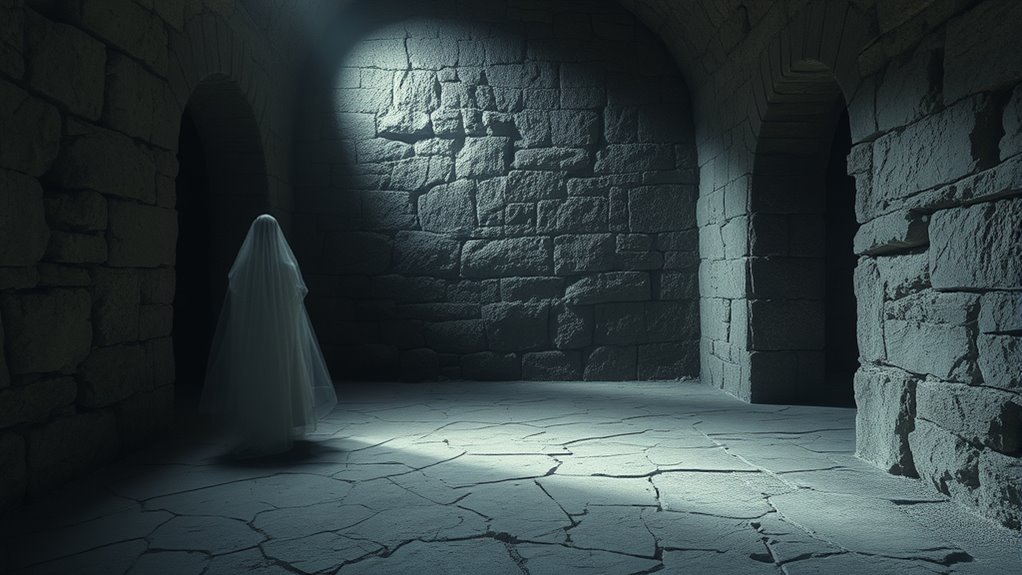
Despite the lack of scientific consensus, proponents of the Stone Tape Theory believe the accumulated evidence from historical cases supports their view. They suggest that certain materials—like stone or ancient brick—may hold residual energy more effectively than other substances, which could explain why some locations are more haunted than others. They see the idea of recorded energy as a plausible way to bridge the gap between physical science and paranormal experiences, offering a naturalistic explanation that doesn’t require spirits or supernatural forces. For example, some researchers point to the material properties of dense, heat-retentive substances as a reason these locations might record and replay residual energy. Still, skeptics emphasize the importance of rigorous scientific testing and remain unconvinced by anecdotal stories or personal experiences. For now, the debate continues: is it merely a fascinating hypothesis rooted in our desire to explain the unexplainable, or could there be a kernel of truth behind these recorded echoes of history?
Frequently Asked Questions
What Scientific Evidence Supports the Stone Tape Theory?
Scientific evidence for the stone tape theory is limited, but studies suggest that environmental imprint and energy recording might play roles in hauntings. Researchers observe that certain materials can absorb and release energy over time, possibly creating residual images or sounds. While these findings aren’t conclusive, they support the idea that natural or man-made surfaces could record environmental imprint, which may explain some haunt phenomena through stored energy release.
How Do Skeptics Interpret Recorded Energy Phenomena?
Did you know that 60% of skeptics believe recorded energy phenomena are due to natural causes? They interpret psychic impressions and electromagnetic anomalies as explanations for hauntings, not recorded energy. Skeptics argue these phenomena often lack consistent scientific proof and can result from environmental factors or psychological suggestions. They see recorded energy as a misinterpretation of natural signals, emphasizing the importance of scientific testing before accepting ghostly recordings as evidence.
Can the Theory Explain All Types of Hauntings?
The Stone Tape Theory can’t explain all types of hauntings because some may result from active spirits or environmental factors that don’t involve energy recording. While it suggests that certain hauntings are just energy recordings of past events, other phenomena might involve conscious entities or environmental influences like electromagnetic fields. So, this theory covers some cases but doesn’t account for every type of haunting you might encounter.
Are There Historical Cases Supporting the Stone Tape Theory?
Back in 1960s London, a mysterious recording captured during a police investigation seemed like a real-life “found footage.” This supports the Stone Tape Theory, as some argue historical recordings and cultural artifacts could hold residual energy. While definitive proof remains elusive, several cases suggest that hauntings may be linked to these stored energies, making historical recordings a compelling piece of the puzzle for understanding hauntings.
How Does the Theory Compare to Other Paranormal Explanations?
You see, the Stone Tape Theory suggests hauntings are energy recordings, like paranormal memories stored in the environment. Compared to other explanations, it focuses on physical, residual energy rather than active spirits or consciousness. This makes it different from spirit communication or poltergeist theories, which involve conscious entities. If you prefer a scientific perspective, the idea of energy recording offers a plausible, less subjective way to understand haunting phenomena.
Conclusion
So, here you are, convinced that haunted houses are just recordings etched into stone, frozen moments of the past. You chase after spirits, yet it’s the very walls holding onto memories, not ghosts. The irony? We seek the supernatural, but maybe it’s just our environment replaying history. Perhaps, in the end, the true haunting isn’t out there, but inside the stones we walk on, forever echoing stories we can’t quite escape.