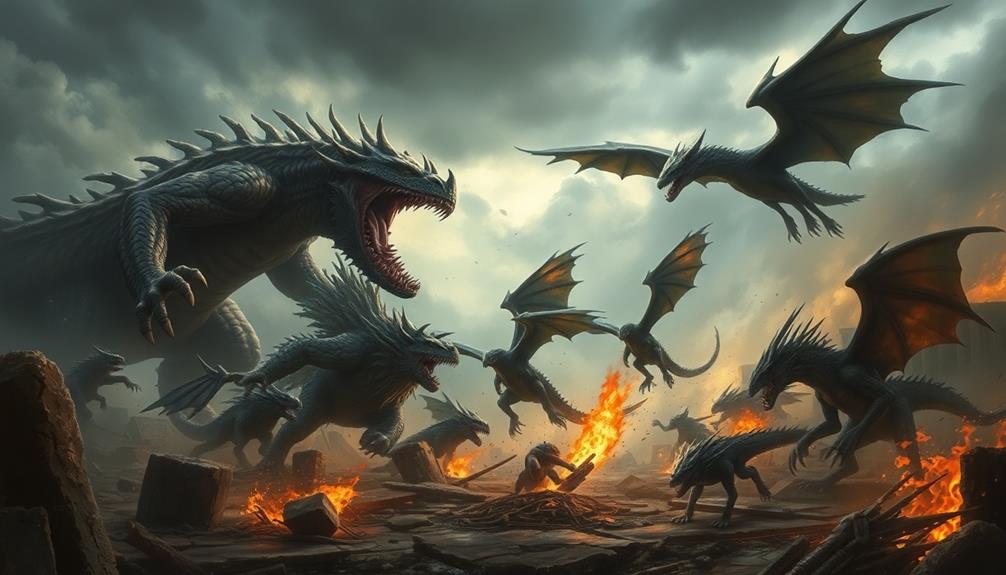
The Kraken, rooted in Scandinavian folklore, is seen as a colossal ocean creature capable of sinking ships, symbolizing nature’s uncontrollable power. Leviathan, from biblical texts, is a massive sea serpent representing divine chaos and authority. While the Kraken embodies sailors’ fears of the unknown depths, Leviathan signifies divine judgment and cosmic battles. Exploring their origins and meanings reveals how these monsters reflect humanity’s fascination and fears of the ocean’s mysteries—if you explore further, you’ll uncover even more about these legendary sea giants.

Prime made for students and young adults
- Fast, free delivery for dorm and study essentials
- Prime Video and Amazon Music included
- Member-only deals
Key Takeaways
- The Kraken originates from Scandinavian folklore as a giant octopus or squid, while Leviathan is a biblical sea serpent or dragon.
- Kraken symbolizes nature’s uncontrollable and mysterious ocean forces, whereas Leviathan represents divine power and chaos.
- The Kraken is a mythic creature used as a sailors’ cautionary tale, while Leviathan appears in religious texts as a symbol of divine authority.
- Both monsters embody human fears of the ocean’s unpredictability and danger, reflecting cultural interpretations of the sea’s mysteries.
- In modern culture, both symbolize the ocean’s power and the enduring fascination with its depths’ unknown and terrifying aspects.

Throughout history, sailors and myth enthusiasts have debated whether the fearsome Kraken or the colossal Leviathan is the true king of the deep. Both creatures have captivated imaginations, rooted in ancient tales and religious texts, and their origins reveal much about human fears and cultural symbolism. The mythical origins of these sea monsters trace back centuries—while the Kraken emerges from Scandinavian folklore, described as a giant octopus or squid capable of dragging entire ships under the waves, the Leviathan finds its roots in biblical scripture, depicted as a massive sea serpent or dragon symbolizing chaos and divine power. These origins aren’t just stories; they reflect how different cultures interpret the ocean’s mysteries and dangers.
The Kraken, with its mythical origins, is often seen as a creature born from sailors’ nightmares, embodying the unpredictable and terrifying nature of the sea. Its enormous tentacles and monstrous size symbolize nature’s uncontrollable force, and stories about the Kraken served as cautionary tales for sailors venturing into uncharted waters. Over time, the creature became a powerful cultural symbol of the ocean’s peril, representing both awe and dread. In contrast, the Leviathan’s biblical origins tie it to divine authority and chaos. Mentioned in the Book of Job and other scriptures, it’s portrayed as a creature so mighty that only God can control it. For many, the Leviathan isn’t just a beast but a symbol of divine power, chaos, and the mysteries of creation. Its biblical symbolism often evokes a sense of divine justice, a reminder of the ocean’s divine sovereignty over chaos and order.
Both monsters serve as potent cultural symbols, embodying human fears of the unknown and the ocean’s mysteries. The Kraken’s mythic origins reflect humanity’s fascination with the monstrous and the unexplored depths, fueling stories that warn sailors to respect the sea’s unpredictable nature. Meanwhile, the Leviathan’s biblical symbolism connects it to divine authority and cosmic battles, illustrating how ancient cultures viewed the sea as a realm of divine judgment and chaos. These creatures, rooted in myth and scripture, continue to symbolize the ocean’s power—both as a source of life and a realm of danger. Their stories remind us of the ocean’s dual nature: a place of wonder, mystery, and sometimes, terrifying might. Whether as mythic origins or cultural symbolism, both the Kraken and Leviathan remain enduring symbols of the unknown depths and the fears they inspire.
Kraken mythological creature figurine
As an affiliate, we earn on qualifying purchases.
As an affiliate, we earn on qualifying purchases.
Frequently Asked Questions
Are There Any Modern Sightings of These Sea Monsters?
You might be intrigued by recent cryptid sightings, but there are no confirmed modern sightings of the Kraken or Leviathan. Oceanic mysteries often fuel rumors and stories, yet credible evidence remains elusive. Some sailors and explorers report strange, massive creatures, fueling speculation about these legendary sea monsters. However, until concrete proof emerges, these legendary beings stay within the domain of myth and folklore, mesmerizing imaginations without verified sightings.
How Do Different Cultures Depict These Creatures?
You see that different cultures depict these creatures with rich mythical symbolism and varied interpretations. In Norse mythology, the Jörmungandr is a giant serpent symbolizing chaos, while Chinese legends portray sea monsters as divine beings embodying power and protection. These cultural interpretations reflect deep-rooted beliefs about nature’s mysteries, often illustrating humanity’s awe and fear of the unknown, shaping how these legendary creatures are visualized across societies.
What Scientific Explanations Exist for Sea Monster Legends?
Imagine the depths hide secrets waiting to be uncovered. Scientific explanations for sea monster legends often stem from cryptid sightings, where sailors misinterpret marine biology phenomena like giant squids or whale falls. These mysterious encounters, fueled by limited technology and folklore, create legends that persist across cultures. While no conclusive proof exists, understanding marine biology helps demystify these tales, blending science and myth into a mesmerizing oceanic mystery.
Could These Creatures Have Existed in Prehistoric Times?
You might wonder if these mythological creature origins stem from prehistoric marine life. It’s possible that ancient sailors encountered real creatures like giant squids or large whales, which inspired stories of monsters like the Kraken and Leviathan. Fossil evidence of prehistoric marine life suggests that such enormous creatures could have existed, fueling legends that persisted through generations. These legends may be exaggerated memories of actual encounters with massive, now-extinct marine animals.
How Have These Legends Influenced Maritime Folklore Worldwide?
You’re influenced by these legends because they shape maritime folklore worldwide, blending mythical origins with cultural symbolism. These stories of giant sea monsters inspire sailors and storytellers, emphasizing the power and mystery of the ocean. They serve as warnings, symbols of nature’s might, or tales of adventure, connecting cultures through shared fears and fascination. Your understanding of these myths highlights their enduring role in shaping how societies view the sea.
Leviathan biblical sea monster sculpture
As an affiliate, we earn on qualifying purchases.
As an affiliate, we earn on qualifying purchases.
Conclusion
Imagine standing on the shore, watching the waves crash wildly as if a beast from legend is stirring beneath. Just like sailors once feared the mighty Leviathan or the legendary Kraken, these monsters symbolize mankind’s awe of the unknown. Though they’re myth, their stories remind you that sometimes, what seems monstrous is simply nature’s power hiding in plain sight. In the end, these sea monsters are a reminder that some mysteries are too vast to fully tame.
Sea monster folklore collectible
As an affiliate, we earn on qualifying purchases.
As an affiliate, we earn on qualifying purchases.
As an affiliate, we earn on qualifying purchases.
Fall Picks
fall essentials
As an affiliate, we earn on qualifying purchases.