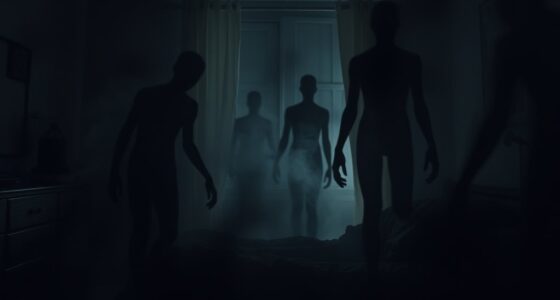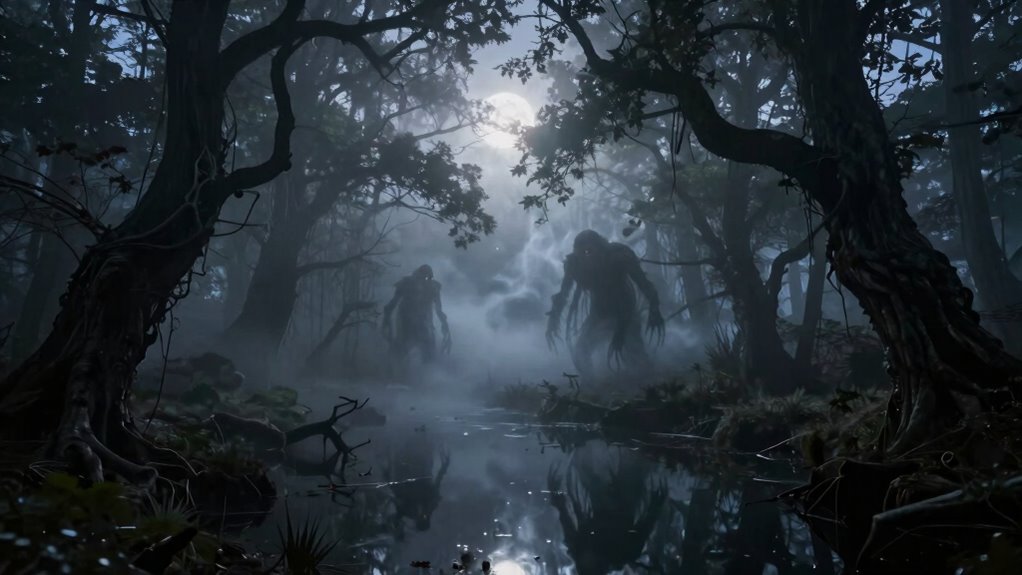

Ghost stories and monster tales often overlap because both tap into your fears of the unknown and rely on supernatural beings that blur the lines between spirits and mythical creatures. They symbolize larger societal or primal fears and reflect what’s hidden or misunderstood about reality. These stories connect cultures by embodying universal concerns around unseen forces and ambiguity. To understand how their themes intertwine across different narratives, you’ll see how these stories reveal deeper truths about human fears and beliefs.

Prime made for students and young adults
- Fast, free delivery for dorm and study essentials
- Prime Video and Amazon Music included
- Member-only deals
Key Takeaways
- Both explore fears of the unknown and unseen forces beyond human understanding.
- They symbolize societal concerns, primal energies, or unresolved issues through mythical or spectral entities.
- Cultural variations influence how spirits and monsters are portrayed, often blending their roles.
- Overlap allows stories to depict entities as both protectors and destroyers, emphasizing ambiguity.
- The fluidity between ghosts and monsters reflects universal themes of mystery, fear, and the supernatural.

Ghost and monster stories often blur the lines between supernatural hauntings and creature-based horror, creating a fascinating overlap that captivates audiences. This overlap happens because both genres tap into deep-seated fears and the unknown, making it easy to see how spectral entities and mythical creatures can intertwine. At the core, both are driven by spiritual energy—an unseen force that defies the laws of the natural world. Whether it’s a restless spirit haunting a house or a legendary beast lurking in the shadows, these stories invoke a sense of mystery rooted in forces beyond human understanding. You might find yourself wondering whether the entity is a ghost tethered to the earthly domain or a creature born from myth, each feeding off the other’s mystique.
Ghosts and monsters blur the line between hauntings and myth, both driven by mysterious spiritual forces beyond understanding.
Mythical creatures often symbolize larger fears or societal concerns, but they can also be seen as manifestations of spiritual energy. For example, dragons, phoenixes, or other legendary beings could be interpreted as embodiments of powerful spiritual forces or primal energies. When these creatures appear in stories, they often serve as guardians or destroyers, embodying the divine or the demonic. Ghost stories, on the other hand, typically revolve around spirits that have unresolved issues or are trapped between worlds. Yet, both ghosts and mythical creatures serve as symbols of what’s hidden or misunderstood about our universe. Their stories tap into collective consciousness, allowing us to explore our fears of the unknown with a sense of wonder. Additionally, the cultural significance of these stories influences how communities interpret and portray these supernatural phenomena. Recognizing the universality of supernatural themes across cultures helps us see how these stories connect on a fundamental level, transcending individual traditions.
The overlap becomes even more vivid when you consider how supernatural entities are portrayed across cultures. Many legends feature spirits that take on monstrous forms or mythical beings that act as spirits in disguise. These stories often blur the lines between ghostly hauntings and creature-based horror, emphasizing that the supernatural is not always clear-cut. Instead, it’s a fluid domain where spirits can become monsters, and monsters can be seen as spiritual protectors or punishers. This ambiguity keeps audiences engaged because it invites multiple interpretations—are we facing a vengeful ghost, or is this a creature born from myth? Or perhaps both are different faces of the same spiritual energy. Exploring how cultural variations influence these stories allows us to appreciate the rich diversity of supernatural narratives worldwide. Recognizing the interplay between myth and reality adds depth to our understanding of these intriguing stories.
As an affiliate, we earn on qualifying purchases.
Frequently Asked Questions
How Do Cultural Differences Influence Ghost and Monster Stories?
You see, cultural differences shape ghost and monster stories through cultural symbolism and mythical origins. In some cultures, spirits embody ancestral reverence, while in others, monsters symbolize societal fears or moral lessons. These stories reflect unique beliefs, values, and history, which influence how supernatural beings are depicted. As a result, you notice diverse themes and characteristics, illustrating how cultural backgrounds deeply influence the storytelling of ghosts and monsters worldwide.
Are There Psychological Reasons Why People Enjoy Ghost Stories?
Think of ghost stories as a mirror reflecting your deepest fears. You enjoy them because they offer psychological catharsis, allowing you to process fear in a safe space. By confronting chilling tales, you learn to manage anxiety and face real-life fears more confidently. The thrill of the unknown awakens your curiosity, making these stories a powerful tool for emotional release and fear processing, all while giving you an adrenaline rush.
What Role Does Fear Play in Both Ghost and Monster Narratives?
Fear plays a central role in both ghost and monster narratives by triggering your fear response, which heightens your emotional impact. These stories tap into primal instincts, making you feel vulnerable and alert. The emotional impact of fear intensifies the experience, creating suspense and adrenaline rushes. This shared focus on fear keeps you engaged, allowing you to confront your anxieties in a safe, controlled environment and fueling your fascination with these stories.
How Have Modern Media Transformed Traditional Ghost and Monster Tales?
Modern media has transformed traditional ghost and monster tales by blending haunted folklore and creature symbolism into immersive visuals and complex narratives. You now experience these stories through movies, TV shows, and games that deepen your connection to supernatural themes. This evolution allows you to explore fears and myths more vividly, making the tales more relatable and thrilling, while also expanding their cultural significance beyond classic folklore boundaries.
Can Ghost Stories and Monster Stories Serve Educational Purposes?
Yes, ghost stories and monster stories can serve educational purposes by incorporating educational symbolism and moral lessons. When you explore these tales, you learn about human fears, societal values, and ethical boundaries. They teach lessons about honesty, courage, and consequences through symbolic characters and narratives. By engaging with these stories, you gain insights into cultural beliefs and develop critical thinking skills while understanding moral lessons embedded within spooky or monstrous themes.
As an affiliate, we earn on qualifying purchases.
Conclusion
So, next time you find yourself captivated by a ghost tale or a monster story, remember they’re often two sides of the same coin. Both tap into our deepest fears and fascination with the unknown. They blur the lines between reality and imagination, proving that what we fear most is often just a shadow of our own fears. In the end, they serve as a mirror, reflecting human anxieties that are hard to ignore—sometimes, it’s all just smoke and mirrors.
As an affiliate, we earn on qualifying purchases.
As an affiliate, we earn on qualifying purchases.
Fall Picks
fall essentials
As an affiliate, we earn on qualifying purchases.