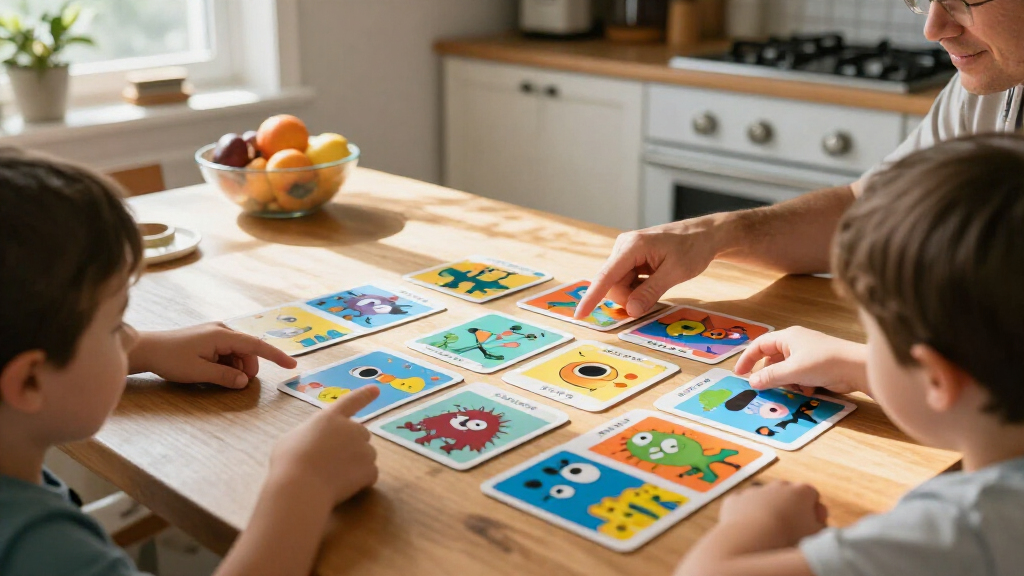

The best educational monster card games pair a clear learning goal with rules children can enjoy repeating. HABA Monster Lotto is my best overall pick for young beginners because its lotto format makes matching approachable, while Monster Nonsense stands out for targeted letter-synthesis practice and Monster Math for number-focused play. The main tradeoff is between simple visual matching, which is easy to teach, and games with a more specific academic skill, which may need closer adult guidance. Age, reading readiness, and whether a child prefers calm matching or fast play matter as much as the monster theme. Read on for how the 11 options compare and which kind of learner each suits best.

Prime made for students and young adults
- Fast, free delivery for dorm and study essentials
- Prime Video and Amazon Music included
- Member-only deals
Key Takeaways
- HABA Monster Lotto leads for younger beginners because its familiar lotto structure puts picture matching ahead of reading or complex rules.
- Monster Nonsense is the most targeted literacy choice: its focus on letter synthesis makes it more specialized than general matching games.
- Monster Math is the clearest pick for number practice, while many other entries emphasize visual attention, memory, or speed instead.
- Half Match: Monster Edition and Goliath Monster Mash suit buyers seeking matching-based play, but neither offers the same explicit academic focus as the literacy and math options.
- The lineup spans preschool-friendly matching through grade-school skill practice, so the child’s developmental stage and tolerance for competition should guide the choice more than the monster theme alone.
| HABA Monster Lotto – Children’s Card Game (Ages 3+) |  | Best for Preschool Visual Matching | Brand: HABA | Age range: 3–6 years | Components: 27 lotto cards and 27 monster cards | VIEW LATEST PRICE | See Our Full Breakdown |
| Trash Monsters Card Game |  | Best for Early Number Sequencing | Brand: Big Monster Games | Recommended age: 3 years and up | Players: Up to 4 | VIEW LATEST PRICE | See Our Full Breakdown |
| Goliath Monster Mash Matching Card Game |  | Best for Active Group Play | Players: 2–4 | Recommended age: 4 years and up | Included components: 1 monster spinner, 27 monster cards, 4 smashers, and instructions | VIEW LATEST PRICE | See Our Full Breakdown |
| Monster Jam Memory Match Game Set with Stickers and Rex-Man Door Hanger |  | Best for Monster Jam Fans | Brand: Monster Jam | Game type: Memory matching card game | Recommended age: 3 years and up | VIEW LATEST PRICE | See Our Full Breakdown |
| Monster Nonsense: A Card Game to Support Letter Synthesis for Special Education (Grades 2-4) |  | Best for Targeted Literacy Support | Brand: Persen Verlag i.d. AAP | Age range: 2nd to 4th grade | Material: Paper | VIEW LATEST PRICE | See Our Full Breakdown |
| Exploding Kittens Monster Match Kids Matching Game |  | Best for Young Beginners | Players: 2–6 | Recommended age: 4 years and up | Cards: 50 | VIEW LATEST PRICE | See Our Full Breakdown |
| Inflation Monster Educational Card Game for Kids |  | Best for Financial Literacy | Players: 2–4 | Recommended age: 8 years and up | Playing time: 15 minutes | VIEW LATEST PRICE | See Our Full Breakdown |
| Half Match: Monster Edition Memory Card Game |  | Best for Language Development | Age range: 4 years and up; listing guidance varies | Players: 2–4, or whole classroom | Material: Paper; water-resistant playing cards | VIEW LATEST PRICE | See Our Full Breakdown |
| Monster Mash Perception Card Game by FlexiQ |  | Best for Large, Lively Groups | Age range: 6 years and up | Players: 2–8 | Uni-color monster cards: 48 | VIEW LATEST PRICE | See Our Full Breakdown |
| Speedy Monsters Card Game for Kids |  | Best for Turn-Free Replay | Players: 2–6 | Recommended age: 6 years and up | Cards: 62 | VIEW LATEST PRICE | See Our Full Breakdown |
| Laurence King Monster Math: Card Games that Create Math Aces |  | Best for Math Practice | Brand: Laurence King | Age range: 5 years and up | Players: 2–4 | VIEW LATEST PRICE | See Our Full Breakdown |
| educational monster card game | Material | Players | Recommended age |
|---|---|---|---|
| HABA Monster Lotto | 100% paper | — | — |
| Trash Monsters Card Game | Paper | Up to 4 | 3 years and up |
| Goliath Monster Mash Matching | Plastic | 2–4 | 4 years and up |
| Monster Jam Memory Match Game | — | — | 3 years and up |
| Monster Nonsense: A Card Game | Paper | — | — |
| Exploding Kittens Monster Matc | Cardboard and cardstock | 2–6 | 4 years and up |
| Inflation Monster Educational | Cardstock | 2–4 | 8 years and up |
| Half Match: Monster Edition Me | Paper; water-resistant playing cards | 2–4, or whole classroom | — |
| Monster Mash Perception Card G | Cardstock | 2–8 | — |
| Speedy Monsters Card Game for | Paper | 2–6 | 6 years and up |
| Laurence King Monster Math: Ca | Cardboard | 2–4 | — |
More Details on Our Top Picks
HABA Monster Lotto – Children’s Card Game (Ages 3+)
HABA Monster Lotto is the gentlest entry here for preschoolers: children match monster cards to lotto cards, practicing visual attention and turn-taking without needing to read or count through a sequence. Its 27 lotto cards and 27 monster cards support a straightforward format that can work for family play or an individual matching activity. Compared with Trash Monsters Card Game, which asks players to arrange cards from 1 to 10, this is a better fit for children who are not ready for number sequencing. That simplicity is also the tradeoff: older children may find the matching loop less engaging, and the listing describes the cards as paper, so rough handling could shorten their life. I’d choose it for a first monster-themed card game, not for sustained challenge.
Pros:- Simple lotto-and-matching play suits young or new players
- Encourages visual perception and sustained attention
- Monster theme gives the cards an inviting child-friendly focus
- Can support family play or individual matching
Cons:- Paper components may wear with rough or frequent handling
- Simple matching mechanics may offer limited replay value as children grow
Best for: Families with children ages 3–6 who want a low-reading-pressure game for practicing visual matching and attention.
Not ideal for: Buyers seeking number sequencing, advanced reading practice, or a game with deeper variation for older children.
- Brand:HABA
- Age range:3–6 years
- Components:27 lotto cards and 27 monster cards
- Material:100% paper
- Theme:Monsters
- Dimensions:2.24 × 0.79 × 3.54 inches
- Model number:2013364001
Our verdict“Choose HABA Monster Lotto for preschoolers who need an easy first matching game rather than a more demanding number sequence like Trash Monsters.”
Trash Monsters Card Game
Trash Monsters adds a concrete counting goal to monster-themed play: players arrange cards numbered 1 through 10 while watching for Trash Pandas. That makes it a stronger pick for early number recognition than HABA Monster Lotto, whose lotto matching is aimed more at visual attention than sequencing. The rules are described as easy to learn, and the set supports up to four players, so it can suit a family game with young children. Its 68 illustrated cards provide the whole play set, with thick, durable cards noted in the product details. The limitation is scope: the sequence-building format centers on numbers, not reading or broader academic skills, and the player count stops at four. I’d pick it when counting practice matters more than a purely matching activity.
Pros:- Arranging cards from 1 to 10 gives counting and number recognition a clear purpose
- Simple rules can accommodate young players
- Thick cards are described as durable for repeated family play
- Supports up to four players
Cons:- Play is limited to four players
- Number sequencing is a narrower learning focus than literacy-oriented options such as Monster Nonsense
Best for: Families with children ready to recognize and arrange numbers who want a simple, shared card game for up to four players.
Not ideal for: Households needing a game for more than four players or buyers prioritizing reading instruction and varied learning goals.
- Brand:Big Monster Games
- Recommended age:3 years and up
- Players:Up to 4
- Included components:68 playing cards
- Material:Paper
- Game format:Arrange Monster Cards from 1 to 10 and watch for Trash Pandas
- Model year:2025
Our verdict“Choose Trash Monsters for approachable number-sequencing practice; choose Monster Nonsense instead if your main goal is literacy support.”
Goliath Monster Mash Matching Card Game
Goliath Monster Mash turns matching into a quick reaction game: a spinner sets the target, then players race to find the monster with the matching head, body, and feet. That physical race gives it a livelier group feel than HABA Monster Lotto, where players use a calmer lotto format, and it asks children to compare several visual details at once. The spinner and four smashers add tactile appeal without batteries, while the stated player range is two to four. This energy comes with tradeoffs: it requires another player, and the small pieces may be easy to lose. Its fast, competitive pace may also be less suitable for children who prefer quiet, turn-based matching. I’d choose it when movement and quick visual scanning matter more than relaxed practice.
Pros:- Matching head, body, and feet exercises visual comparison
- Spinner and smashers make play tactile and energetic
- Supports two to four players
- Does not require batteries
Cons:- Requires at least two players
- Small components may be easy to lose
- Fast competitive play may not suit children who prefer a calmer pace
Best for: Families with at least two children ages 4 and up who enjoy quick, hands-on visual matching games.
Not ideal for: Solo players, children who dislike timed competition, or families concerned about keeping track of small game pieces.
- Players:2–4
- Recommended age:4 years and up
- Included components:1 monster spinner, 27 monster cards, 4 smashers, and instructions
- Material:Plastic
- Batteries:Not required
- Dimensions:10.5 × 2.5 × 10.5 inches
- Weight:0.49 kg
Our verdict“Pick Monster Mash for active, competitive matching with a group; choose HABA Monster Lotto for calmer play or solo practice.”
Monster Jam Memory Match Game Set with Stickers and Rex-Man Door Hanger
Monster Jam Memory Match makes the most sense when a child already loves the trucks: the matching activity uses a familiar licensed theme, and the set adds stickers and a Rex-Man door hanger for play beyond the cards. Its memory-game format is easy to grasp for ages 3 and up, unlike Goliath Monster Mash, which adds a spinner, smashers, and a more active race. That makes this set a quieter option for fans who want a simple matching activity rather than a fast group contest. The learning focus is limited to memory and matching, though, and the product details do not specify how many cards are included. I’d treat the extras as a fan-oriented bonus, not evidence of broader educational content or a more varied game.
Pros:- Official Monster Jam theme can appeal to truck fans
- Memory matching offers a simple activity for young children
- Includes stickers and a Rex-Man door hanger alongside the game
- Suitable for ages 3 and up
Cons:- Product details do not state the number of cards
- The theme is specific to Monster Jam rather than monsters broadly
- The described activity focuses on matching rather than broader academic skills
Best for: Children ages 3 and up who are already interested in Monster Jam trucks and enjoy simple memory matching.
Not ideal for: Buyers who need a stated card count, a broad monster theme, or structured number and reading practice.
- Brand:Monster Jam
- Game type:Memory matching card game
- Recommended age:3 years and up
- Included items:Memory game, stickers, and Rex-Man door hanger
- Number of items:1 set
- Theme:Monster Jam trucks
- UPC:778988000915
Our verdict“Choose this set for a young Monster Jam fan who wants familiar truck-themed matching, not for a detailed learning game.”
Monster Nonsense: A Card Game to Support Letter Synthesis for Special Education (Grades 2-4)
Monster Nonsense is the most explicitly instructional option in this group: it is designed to help students with special educational needs synthesize letters into syllables and words, with nonsense-word exercises intended to support reading flow and motivation. That makes it a sharper fit for literacy practice than Trash Monsters, which focuses on arranging number cards, or HABA Monster Lotto, which emphasizes visual matching. Multiple game variants can give educators or families different ways to repeat the skill. The tradeoff is a narrower audience: the stated grade range is 2nd to 4th, and instructions are available through digital additional material rather than being fully supplied in the game as described. I’d choose it for guided reading practice, not as a general family game for preschoolers.
Pros:- Targets letter-to-syllable and word synthesis directly
- Designed with special educational needs in mind
- Multiple game variants provide different ways to practice
- Monster theme is intended to support motivation
Cons:- Instructions are available through digital additional material
- Stated grade range limits its fit for younger children or older students
- Its focused literacy exercises may feel more instructional than casual family play
Best for: Special education teachers and families supporting students in grades 2–4 who need playful practice combining letters into syllables and words.
Not ideal for: Preschool families seeking simple matching, or buyers who need a self-contained game with all instructions in the physical package.
- Brand:Persen Verlag i.d. AAP
- Age range:2nd to 4th grade
- Material:Paper
- Item weight:98 g
- Item dimensions:2.68 × 0.98 × 3.66 inches
- Theme:Monster
- Educational objectives:Letter synthesis, reading flow, and motivation
Our verdict“Choose Monster Nonsense for targeted literacy practice in grades 2–4, especially when an adult can access the digital instructions.”
Exploding Kittens Monster Match Kids Matching Game
Monster Match is the most accessible starting point in this group for preschool-age players. Rolling dice in the Monster Tower gives children a concrete cue for what to look for, then matching cards turns each round into practice with counting and pattern recognition. It supports 2–6 players, making it easier to include siblings or a small playdate than Inflation Monster, which is limited to four. Compared with Half Match: Monster Edition, this game puts more emphasis on dice-led matching than language and vocabulary. The tradeoff is a deliberately simple challenge: its age guidance starts at four, but older children looking for layered strategy may outgrow it quickly. The tower and dice also add pieces beyond the card deck to keep track of.
Pros:- Dice and card matching give young players a clear, repeatable activity.
- Practices counting and pattern recognition during play.
- Accommodates 2–6 players for family groups and playdates.
- Monster Tower adds a hands-on element beyond a standard card deck.
Cons:- Simple matching may offer too little challenge for older children.
- The tower and dice add components to store and keep together.
Best for: Families with children ages 4–6 who want a short, easy-to-explain monster game that practices counting and visual matching.
Not ideal for: Older children or adults seeking strategic depth, or families who prefer a card-only game without extra dice and a tower.
- Players:2–6
- Recommended age:4 years and up
- Cards:50
- Dice:2 Monster Dice
- Other component:1 Monster Tower
- Material:Cardboard and cardstock
- Game type:Card game
Our verdict“Choose Monster Match for young children who need an approachable first matching game with a little counting practice built in.”
Inflation Monster Educational Card Game for Kids
Inflation Monster is the clearest choice for practical learning rather than basic monster matching. Its play connects cards and dice with ideas such as inflation, saving, investing, and math, giving family game night a subject-specific focus that Speedy Monsters and Monster Match do not claim to provide. The recommended age of eight and up suits children ready for more abstract money concepts, while the roughly 15-minute playing time keeps the activity bounded. Its 2–4 player limit is tighter than Monster Mash by FlexiQ, which supports up to eight, and the finance theme may hold less appeal for children who simply want a fast visual challenge. I’d pick it for guided conversation about money, not as a broad language or early-learning game.
Pros:- Puts financial literacy concepts at the center of gameplay.
- Combines cards and dice with math and strategic play.
- A stated 15-minute playing time suits short family sessions.
- Compact dimensions make it practical to bring along.
Cons:- Supports only 2–4 players, fewer than Monster Mash by FlexiQ.
- The age guidance and financial subject matter may not suit younger children.
- Its specialized educational focus may be less appealing to families seeking simple matching.
Best for: Families with children ages 8 and up who want a short game to introduce saving, investing, inflation, and related math.
Not ideal for: Groups larger than four, younger children, or buyers seeking a quick, theme-first matching game rather than finance-focused play.
- Players:2–4
- Recommended age:8 years and up
- Playing time:15 minutes
- Included components:Cards and dice
- Educational objective:Financial and mathematical education
- Dimensions:7.25 × 5.25 inches
- Material:Cardstock
Our verdict“Choose Inflation Monster when you want a short, strategy-led way to introduce school-age children to money concepts.”
Half Match: Monster Edition Memory Card Game
Half Match: Monster Edition stands apart through its language focus: it is designed to support communication, vocabulary, and pattern recognition, with input from a speech-language pathologist. That makes it a more purposeful pick for adults who want to prompt naming and conversation than Monster Match, whose stated learning emphasis is counting and visual patterns. It is screen-free and can be played by children with adults, so a caregiver can adapt the conversation to a child’s language level. The product supports 2–4 players and can also be used with a whole classroom, while Inflation Monster offers a more defined strategic finance lesson for older kids. Age guidance in the listing varies, so I’d check suitability for a particular child rather than assume it fits toddlers. Its language-led format may also be less appealing to players who want speed or competition.
Pros:- Targets language, communication, vocabulary, and pattern recognition.
- Designed with input from a speech-language pathologist.
- Adults can play alongside children and encourage conversation.
- Water-resistant cards and a sturdy box support repeated handling and storage.
Cons:- Age guidance varies in the listing, making age suitability less clear.
- Standard player guidance is 2–4, limiting larger family groups.
- Its learning-led format may feel less lively to children who prefer reaction games.
Best for: Caregivers, educators, and families with children who benefit from adult-guided vocabulary, communication, and visual matching practice.
Not ideal for: Buyers seeking a fast competitive game, or those who need unambiguous age guidance or a large-group game for casual home play.
- Age range:4 years and up; listing guidance varies
- Players:2–4, or whole classroom
- Material:Paper; water-resistant playing cards
- Included component:Sturdy box
- Educational features:Language and communication, vocabulary, pattern recognition
- Manufacturer:Minds That Play
- Model:Half Match: Monster Edition
Our verdict“Choose Half Match for adult-child play where vocabulary and conversation matter more than speed or complex strategy.”
Monster Mash Perception Card Game by FlexiQ
Monster Mash by FlexiQ turns visual perception into a fast group challenge: players spot a correct color combination, discard a card, and mash the included monster toy. That physical response gives the game more energy than Half Match: Monster Edition’s language-oriented matching and makes it a stronger fit for a lively family gathering. Its 2–8 player range is the broadest among these five options, unlike Inflation Monster’s 2–4 limit. The game is aimed at ages six and up and promotes perception, reaction speed, and strategic thinking, though those benefits depend on players engaging with the quick pattern-spotting challenge. The tradeoff is that speed can be less comfortable for children who need more time, and the smushy toy is a separate component that may wear or be damaged.
Pros:- Supports 2–8 players, more than Inflation Monster or Half Match.
- Color-combination spotting practices visual perception and quick recognition.
- The mashable monster adds a tactile action to card play.
- Includes both uni-color and multi-color monster cards.
Cons:- Fast reactions may disadvantage players who need more time.
- The mashable toy may wear or be damaged with repeated use.
- Educational benefits depend on players engaging with the perception challenge.
Best for: Families or groups with children ages 6 and up who enjoy quick visual challenges and need a game that accommodates up to eight players.
Not ideal for: Children who prefer calm, language-led play or need extra time to identify patterns, and households that want only cards with no toy component.
- Age range:6 years and up
- Players:2–8
- Uni-color monster cards:48
- Multi-color monster cards:12
- Other included component:1 mashable monster toy
- Material:Cardstock
- Model number:MSH4065
Our verdict“Pick Monster Mash for a large group that wants energetic color-spotting play and does not mind a toy component.”
Speedy Monsters Card Game for Kids
Speedy Monsters offers two games in one compact pack, with simultaneous play and no reading or turns required. That structure gets everyone involved at once, unlike the more guided dice-and-card routine in Monster Match. It also gives families two formats to try without switching to a different deck, while Monster Mash by FlexiQ adds a tactile toy and supports a larger maximum group of eight. Speedy Monsters accommodates 2–6 and is described as encouraging memory, coordination, and concentration. The main limitation is its age guidance: although the title may suggest younger children, the manufacturer-recommended age is six and up. Its fast, simultaneous format may also be less suitable for players who prefer quieter, language-focused play like Half Match: Monster Edition.
Pros:- Includes two distinct monster card games in one pack.
- No reading is required, lowering the barrier to participation.
- Simultaneous play avoids waiting through other players’ turns.
- Compact package is easy to carry.
Cons:- Manufacturer-recommended age is six and up, despite the title’s younger-age implication.
- The fast, simultaneous format may not suit children who prefer slower play.
- The listing provides less detail about the learning mechanics than Half Match or Inflation Monster.
Best for: Families with children ages 6 and up who want a portable, no-reading card game with two simultaneous-play options.
Not ideal for: Families shopping for children under six based on the title alone, or players who prefer turn-based, language-rich activities.
- Players:2–6
- Recommended age:6 years and up
- Cards:62
- Games included:2
- Play format:Simultaneous play; no turns required
- Material:Paper
- Package dimensions:3.5 × 0.7 × 5 inches
Our verdict“Choose Speedy Monsters for portable, turn-free matching that gives children two play formats without requiring reading.”
Laurence King Monster Math: Card Games that Create Math Aces
For families who want monster-themed play to reinforce school skills, Monster Math is the most directly math-focused choice in this roundup. Its 10 games in one deck give a group several ways to practice elementary math, while the rulebook’s parental guidance can help adults support learning as play unfolds. Compared with HABA Monster Lotto, which centers on matching, this deck makes math the main activity rather than an incidental part of the theme. The tradeoff is its narrower learning scope: children who have moved beyond elementary-level math may outgrow the challenge, while younger preschoolers may find the target skills premature. It also relies on physical cards and adult guidance, not digital lessons or automated feedback. I’d choose it for repeatable math practice, not broad subject coverage.
Pros:- Ten game formats add variety without requiring multiple decks.
- Math is the central learning objective, making the educational purpose clear.
- Parental guidance in the rulebook can help adults support play and practice.
- Compact card format is easy to take along.
Cons:- The learning scope is limited to elementary-level math.
- The games require a physical deck and do not provide digital feedback.
- Play is listed for two to four players, so it may not suit larger groups without adapting the rules.
Best for: Families with children aged 5 and up who want several low-tech card games for practicing elementary math together.
Not ideal for: Buyers seeking preschool-level matching play, advanced math challenges, or app-based instruction and feedback.
- Brand:Laurence King
- Age range:5 years and up
- Players:2–4
- Included components:52 playing cards and rulebook
- Number of games:10
- Educational objective:Math
- Theme:Fantasy/Monster
- Material:Cardboard
- Dimensions:5 x 3.94 x 1.38 inches
Our verdict“Choose Monster Math if you want a portable, multi-game deck focused on elementary math practice rather than matching or broad learning themes.”
How We Picked
I ranked these games by how clearly their play supports a useful learning outcome, how readily children can understand the core activity, and how well the suggested age or grade range fits the intended skill. I gave more weight to options with an identifiable educational focus, such as letter synthesis or math practice, while also recognizing that matching and memory games can support attention and visual discrimination without teaching a formal subject.
Ranking also reflects the likely audience and the tradeoffs of each format: adult support, reading demands, pace, and whether the game’s appeal depends mostly on familiar characters or add-on items. HABA Monster Lotto ranks first for its accessible entry point; specialized learning tools rank highly for focused practice but serve narrower needs. Speed-oriented and theme-led games remain useful for particular families, though they are less universal picks for educational play.
Factors to Consider When Choosing Educational Monster Card Games
Before choosing a monster game, I’d match the activity to the skill and play setting rather than treating every matching game as the same kind of learning tool. These broader checks can help prevent a fun-looking purchase from being too simple, too demanding, or poorly suited to the way your child likes to play.
Match the Learning Goal to the Actual Game Mechanic
Start by naming the skill you want practice in: letter blending, number work, visual matching, memory, or quick recognition. A game can build useful attention and recall without teaching a school subject directly, so separate general cognitive practice from explicit academic instruction. If a child needs support with a particular literacy skill, a focused activity such as letter synthesis may be a better fit than a broad matching game. For relaxed family play, a simple visual game may be easier to bring out regularly. A common mistake is choosing a game because its packaging says educational without checking what players repeatedly do. Look for a close match between the learning target and the action required on each turn.
Choose by Readiness, Not Just Age
Age labels are useful starting points, but children of the same age can differ in reading fluency, attention span, and comfort with competition. Check whether the child must identify letters, count accurately, remember several images, or react quickly. Those demands can change how accessible a game feels even when the theme and age range seem right. A younger child may thrive with a familiar matching routine, while an older learner may find it repetitive unless the game adds a meaningful challenge. If you are unsure, favor rules that can be explained in a few steps and increase difficulty gradually. This reduces the chance that adult help becomes the main activity.
Think About Pace and Emotional Fit
Fast rounds can make recognition practice lively, but speed can also frustrate children who need time to process a visual or language prompt. Memory games offer a quieter pace, although losing track of cards may challenge players with limited working memory. Consider whether the child enjoys trying to beat others or does better with cooperative encouragement and unhurried turns. A game that is academically relevant but repeatedly ends in conflict may get little use. Ask whether quick reactions are part of the intended fun or an unnecessary barrier for your household. When children have different abilities, a slower, turn-based format can make shared play easier.
Check Adult Support and Adaptability
Some educational games work best when an adult introduces a skill, models a turn, or adjusts the challenge. Decide whether you want an activity children can manage independently or one intended for guided practice. For classroom, tutoring, or special-education use, check whether the rules allow extra response time, repeated prompts, or simpler rounds. Those adjustments can matter more than a large feature list. Do not assume a game designed around one skill will automatically suit every learner who needs that skill; interests and support needs vary. A flexible game can stay useful longer, but a specialized one may deliver clearer practice when the target is specific.
Balance Replayability Against Theme Appeal
Monster art can invite a child to play, but the game’s structure determines whether that interest lasts beyond the first few rounds. Repeated matching can be reassuring for beginners and easy to revisit, while a narrow theme may not hold every child’s attention. Extra items such as stickers or a door hanger can add excitement, but they do not necessarily add learning depth. Before paying more for themed extras, consider whether the core card activity is strong enough on its own. For regular practice, look for a mechanic that supports repeat play without requiring constant adult invention. The best choice is the one the child will willingly play again.
Plan for the Playing Group
A game that works well one-on-one may feel different with siblings or a classroom group. Check the intended number of players and whether turns keep everyone involved, especially if children have different ages or skill levels. Matching formats can be easy to explain to a group, but competition and speed may favor the quickest player. For mixed-ability play, think about whether you can adjust the pace or pair learners without undermining the goal. Also consider where the game will be used: a compact card activity may suit travel or short breaks, while guided skill practice can benefit from a quieter table. Choosing for the real group, rather than an imagined ideal session, improves the odds of regular use.
Frequently Asked Questions
Which of these games is the easiest starting point for a preschooler?
HABA Monster Lotto is my first choice for a young beginner because lotto-style matching is familiar and can put picture recognition ahead of reading. Check the child’s attention span and comfort with taking turns before choosing, since even simple rules can feel demanding to a very young player. A parent can begin with a small set of cards or demonstrate a few turns if the game allows it. If the child already enjoys quick matching, another matching title may be more engaging, but a speed-focused option can add pressure. Start with the format the child can understand independently, then add challenge later.
Which game should I choose for a specific school skill rather than general matching?
For focused literacy practice, Monster Nonsense is the standout because it is designed around letter synthesis. For number-focused play, Monster Math is the most direct match. These are more specialized choices than games built mainly around memory or visual matching, so check that the child is ready for the skill the game asks them to use. A specific learning tool may be less flexible for casual play, but it can make the purpose of a session clearer. If you want broad family entertainment with incidental skill practice, a general matching game may suit you better.
Are memory and matching games educational if they do not teach reading or math?
They can support skills such as visual discrimination, attention, and recall, even when they do not teach a formal academic topic. That is a different kind of educational value from explicit letter or number practice, so it helps to set expectations before buying. If a child needs direct help with a school skill, choose a game whose repeated actions use that skill. For a relaxed activity that builds observation and turn-taking, a matching format may be a better fit. I would not treat all educational claims as interchangeable; the mechanic should match the outcome you want.
Should I choose a fast game if my child is still learning the basics?
Only if your child enjoys quick reactions and can identify the relevant images or symbols without becoming stressed. Speed can make familiar material exciting, but it can distract from learning when a child needs more time to process each turn. A slower lotto or memory format is often a gentler first step, with faster play added once the rules and visual patterns feel familiar. You can also decide whether the game permits unhurried practice before adding competition. The best pace is the one that keeps the child engaged and able to participate successfully.
What should I prioritize for a child who needs adult-guided learning support?
Look for a clear skill target, rules that can be taught in small steps, and room to adjust pace or prompts. Monster Nonsense has a defined literacy focus, which can help an adult plan practice, while a simpler matching game may work better for warm-up play or visual engagement. Check the child’s specific reading or attention needs rather than assuming a grade label guarantees a fit. It can also help to play a short sample round together before using the game as a teaching activity. Choose a format that supports the learner without making every turn feel like a test.
Conclusion
For most families seeking a straightforward entry into educational monster card games, I recommend HABA Monster Lotto as the best overall, especially for younger children starting with picture matching. Best for beginners also goes to HABA because its familiar format is easier to introduce than speed-based play. For the most focused academic use, choose Monster Nonsense for letter synthesis or Monster Math for number practice; these are my best specific-needs picks. I’d treat simple matching options such as Goliath Monster Mash and Half Match: Monster Edition as value-minded choices when the priority is accessible repeat play, rather than specialized instruction. For a premium pick, I’d favor the option that best matches the child’s learning need and expected frequency of use, since the lineup does not establish a single universal upgrade. Match the game to the learner and the setting, and the monster theme becomes a reason to return to the skill rather than the whole point of play.