
Choosing among beginner electronics kits for kids mostly comes down to three questions: how old your child is, whether they want to build gadgets or learn to code, and how much hands-on help they will need. The Snap Circuits Jr. SC-100 earns my best overall pick because its snap-together design lets kids ages 8 and up build over 100 working circuits with no soldering, no wiring errors, and almost no adult intervention. For younger builders, the Snap Circuits Beginner SCB-20 scales the same system down for ages 5–9, while the ELEGOO UNO R3 Smart Robot Car Kit V4 is the strongest step up for kids ready to combine electronics with real programming. The main tradeoff in this category is between guided simplicity and long-term growth: snap kits teach fast but eventually get outgrown, whereas Arduino-based kits grow with your child but demand more reading, patience, and parental support. Read on for the full ranked breakdown, including budget circuit kits, single-project options, and the picks I would skip.

Prime made for students and young adults
- Fast, free delivery for dorm and study essentials
- Prime Video and Amazon Music included
- Member-only deals
Key Takeaways
- The Snap Circuits family dominated the top of this comparison because its no-tools, snap-together format makes it the only lineup that works almost independently for beginners — the SC-100 is the best overall pick and the SCB-20 is the best entry point for ages 5–9.
- A clear divide emerged between circuit-experiment kits (GadgetGlee, Sntieecr, VLGOEM, Klever Kits) that teach electrical concepts through loose wires and breadboards, and project kits (Poraxy FM Radio, National Geographic, Butterfly EduFields) that end in one finished gadget — circuit kits offer more replay value, project kits more pride of completion.
- The ELEGOO UNO R3 Smart Robot Car Kit V4 stood out as the best premium pick because it is the only option here combining a camera, app control, and genuine Arduino coding, but it requires an adult willing to debug alongside the child.
- Several budget motor kits (Sntieecr, VLGOEM) deliver real learning per dollar but use exposed wires and small fans that need supervision — a fair trade for older kids, a poor one for the under-8 crowd.
- Age labeling on these boxes is optimistic: Arduino kits marked for ages 8+ realistically suit 10+ with adult help, while the National Geographic and Klever Kits land as the best middle-ground options for 6–8 year olds who have outgrown toddler STEM toys.
| ACEBOTT QD106 Robotics Kit for Kids |  | Best for Coding Growth | Brand: ACEBOTT | Model: QD106 | Controller: ESP32 | VIEW LATEST PRICE | See Our Full Breakdown |
| GadgetGlee STEM Electric Circuit Kit for Kids |  | Best Value for First Circuit Lessons | Brand: GadgetGlee | Model: DP501 | Experiments: 8 | VIEW LATEST PRICE | See Our Full Breakdown |
| ELEGOO UNO R3 Smart Robot Car Kit V4 with Camera |  | Best Premium Robot Build | Brand: ELEGOO | Model Number: US-EL-KIT-012 | Controller Board: ELEGOO UNO R3 | VIEW LATEST PRICE | See Our Full Breakdown |
| National Geographic Circuit Maker Kit for Kids, 60+ Projects |  | Best for Younger Experimenters | Brand: Blue Marble (National Geographic) | Set Name: Circuit Maker | Model Number: NGCIRCUIT60 | VIEW LATEST PRICE | See Our Full Breakdown |
| ELEGOO UNO R3 Super Starter Kit with PDF Tutorial |  | Best for Learning Real Arduino Skills | Controller: UNO R3 | Guided Lessons: 22+ | Display: LCD1602 with pre-soldered header | VIEW LATEST PRICE | See Our Full Breakdown |
| Snap Circuits Beginner SCB-20 STEM Electronics Kit for Kids Ages 5–9 |  | Best for the Youngest Builders | Recommended age: 5–9 years | Projects: 21 guided projects | Build system: Snap-together components, no tools | VIEW LATEST PRICE | See Our Full Breakdown |
| Sntieecr STEM Electric Circuit Motor Kit |  | Best for Open-Ended Experimentation | Recommended age: 8+ years | Recommended voltage: 1.5–3 V | Components: 5 crocodile clip leads, 5 bulbs, 2 motors, 2 motor holders, 2 rocker switches, 6 propellers, 1 buzzer, 1 bulb holder, AA battery holders | VIEW LATEST PRICE | See Our Full Breakdown |
| VLGOEM 66-Piece Electronics STEM Kit for Kids |  | Best Budget Intro Kit | Brand: VLGOEM | Model number: XHJ-1 | Set size: 66 pieces | VIEW LATEST PRICE | See Our Full Breakdown |
| Snap Circuits Jr. SC-100 Electronics Kit, 100+ Projects, Ages 8+ |  | Best Overall Beginner Pick | Model: SC-100 | Projects: 100+ | Recommended age: 8 years and up | VIEW LATEST PRICE | See Our Full Breakdown |
| Snap Circuits Classic SC-300 STEM Electronics Kit, 300+ Projects, Ages 8+ |  | Best Longevity Pick | Model: SC-300 | Project count: 300+ | Included pieces: 60+ numbered, color-coded components | VIEW LATEST PRICE | See Our Full Breakdown |
| Poraxy DIY FM Radio Science Kit for Kids |  | Best Single-Project Build | Radio frequency range: 87–108 MHz | Power source: 2 AA batteries (not included) | Included: Radio kit parts, mini screwdriver, step-by-step instructions | VIEW LATEST PRICE | See Our Full Breakdown |
| Klever Kits Space Circuits Electronics Kit for Kids, 46+ Components and 50+ Projects |  | Best for Youngest Learners | Components: 46+ | Projects: 50+ | Recommended age: 5 years and up | VIEW LATEST PRICE | See Our Full Breakdown |
| Butterfly EduFields 10-in-1 STEM Electronics and Robotics Kit for Kids Ages 8–12 |  | Best Bridge to Real Robotics | Components: 100+ | Projects: 10-in-1 | Recommended age: 8–12 years | VIEW LATEST PRICE | See Our Full Breakdown |
| beginner electronics kits for kid | Recommended Age |
|---|---|
| ACEBOTT QD106 Robotics Kit for | 12 years and up |
| GadgetGlee STEM Electric Circu | 8–12 years |
| ELEGOO UNO R3 Smart Robot Car | — |
| National Geographic Circuit Ma | — |
| ELEGOO UNO R3 Super Starter Ki | — |
| Snap Circuits Beginner SCB-20 | 5–9 years |
| Sntieecr STEM Electric Circuit | 8+ years |
| VLGOEM 66-Piece Electronics ST | 6 years and up |
| Snap Circuits Jr. SC-100 Elect | 8 years and up |
| Snap Circuits Classic SC-300 S | 8+ years |
| Poraxy DIY FM Radio Science Ki | — |
| Klever Kits Space Circuits Ele | 5 years and up |
| Butterfly EduFields 10-in-1 ST | 8–12 years |
More Details on Our Top Picks
ACEBOTT QD106 Robotics Kit for Kids
Most robot car kits lock kids into a single programming environment, but the ACEBOTT QD106 stands out for its three-language path: Scratch for visual block coding, then Arduino, then Python as skills mature. That progression is what separates it from the ELEGOO Smart Robot Car, which stays firmly in Arduino territory and demands more from a beginner upfront.
The 16 story-based tutorials do real work here, turning assembly into a narrative rather than a chore list, and both app and IR remote control mean the car is drivable before a child writes a single line of code. The ESP32 controller handles phone, tablet, and computer programming alike.
The tradeoffs are real: batteries aren’t in the box, and the manufacturer’s own age guidance of 12+ conflicts with the 8–16 range in the title, so younger kids will need an adult nearby.
Pros:- Scratch-to-Python progression keeps the kit relevant for years
- Programs from computers, tablets, and smartphones without extra hardware
- 16 story-based tutorials make learning feel like play rather than coursework
- App and IR remote let kids drive the car before they learn to code it
Cons:- Batteries are not included, so it’s not playable out of the box
- Recommended age of 12+ contradicts the 8–16 label on the packaging
Best for: Kids ages 10 and up who already show interest in coding and want a kit that grows from Scratch blocks into real Python over several years
Not ideal for: Families hoping for a truly independent experience for an 8-year-old — the manufacturer’s 12+ recommendation reflects the assembly and coding complexity involved
- Brand:ACEBOTT
- Model:QD106
- Controller:ESP32
- Programming Languages:Scratch, Arduino, Python
- Control Methods:iOS/Android app, IR remote
- Tutorials:16 story-based tutorials
- Assembly:No soldering required
- Batteries:Not included
- Recommended Age:12 years and up
Our verdict“This is the pick for parents who want one robotics kit that scales with a child’s coding ability rather than being outgrown in a season.”
GadgetGlee STEM Electric Circuit Kit for Kids
Where the National Geographic Circuit Maker wins on volume of projects, the GadgetGlee kit wins on teaching the actual physics: its eight experiments deliberately cover series and parallel circuits, fruit batteries, and saltwater power generation — concepts that snap-together kits like the Snap Circuits Jr. SC-100 introduce more abstractly. Kids see cause and effect because they wire it themselves.
The included circuit book is what makes this work for a first-time learner, walking through each build rather than leaving a pile of parts and a shrug. Compared with the ELEGOO Super Starter Kit, there’s no coding required at all, which makes it accessible a full year or two earlier.
The obvious limitation is depth: eight experiments is a weekend of engagement, not months of it, and AA batteries must be sourced separately before anything lights up.
Pros:- Teaches real concepts like series vs. parallel wiring, not just assembly
- Unusual experiments like saltwater and fruit power spark genuine curiosity
- Included circuit book guides beginners step by step
- Well suited to classrooms and science fair projects
Cons:- Only eight experiments, limiting long-term replay value
- Required AA batteries are not included
Best for: Parents and teachers who want an inexpensive, low-commitment introduction to circuit fundamentals for 8–12 year olds, including science fair use
Not ideal for: Kids who already understand basic circuits or families wanting long-term replay value — eight experiments won’t sustain extended interest
- Brand:GadgetGlee
- Model:DP501
- Experiments:8
- Packs:7
- Recommended Age:8–12 years
- Included Components:Circuit kits and circuit book
- Batteries:AA required; not included
Our verdict“A modest but genuinely educational first circuit kit that teaches electricity properly without a big investment.”
ELEGOO UNO R3 Smart Robot Car Kit V4 with Camera
This is the most technically ambitious kit in the lineup. The FPV camera streaming live video over Wi-Fi, combined with line tracking and ultrasonic obstacle avoidance, gives the ELEGOO V4 capabilities the ACEBOTT QD106 doesn’t match — and unlike the ACEBOTT or the GadgetGlee kit, it includes a 2000 mAh rechargeable battery, so there’s nothing extra to buy before the first drive.
The keyed XH2.54 connectors deserve mention: they make miswiring nearly impossible, which matters for a build this complex. The illustrated tutorials are among the clearest in this category.
But complexity cuts both ways. This is an Arduino IDE kit with no block-coding option, so a 9-year-old will need an engaged adult for both assembly and programming. Build time runs long for complete beginners. Families wanting instant gratification should look at the snap-together National Geographic Circuit Maker instead.
Pros:- FPV camera with Wi-Fi streaming is a genuinely exciting payoff feature
- Rechargeable battery included — no disposable batteries to buy
- Keyed connectors prevent miswiring during a complex build
- Line tracking and obstacle avoidance teach real sensor programming
Cons:- Assembly and coding are time-consuming for first-time builders
- Manufacturer recommends ages 12+, so younger kids need adult guidance
- No block-based coding option for absolute programming beginners
Best for: Tweens and teens (or parent-child pairs) ready for a serious Arduino project with genuine robotics features like FPV video and autonomous navigation
Not ideal for: Younger kids or families wanting an independent, no-adult-required activity — assembly and Arduino programming demand patience and supervision
- Brand:ELEGOO
- Model Number:US-EL-KIT-012
- Controller Board:ELEGOO UNO R3
- Camera/Wi-Fi Module:ESP32-WROVER-based
- Sensors:Line-tracking, ultrasonic
- Battery:2000 mAh rechargeable lithium-ion
- Control:ELEGOO app, IR remote
- Compatibility:Arduino IDE
- Warranty:6 months (manufacturer)
Our verdict“The feature-richest robot kit here — worth the effort for older kids, too much project for a young child working alone.”
National Geographic Circuit Maker Kit for Kids, 60+ Projects
If the ELEGOO Super Starter Kit is a middle-school lab, the National Geographic Circuit Maker is a playground. With 60+ tool-free projects — levitating a ball, flying a copter, lighting fiber optics — it delivers the instant wow that keeps an 8-year-old engaged, something the slower, text-heavier GadgetGlee experiments can’t match. Components push together without tools, so a child can work independently from the first minute.
The illustrated manual plus QR-linked video guides handle instruction well, filling the gap for kids whose reading stamina hasn’t caught up with their curiosity.
The honest tradeoff: projects prioritize spectacle over depth. A child will learn that circuits make things happen, but not why series and parallel wiring behave differently — the GadgetGlee kit teaches that better. Think of this as motivation first, theory later.
Pros:- 60+ projects provide months of varied activities, not a single weekend build
- Tool-free connections let young kids work entirely on their own
- Spectacular results like levitation and fiber optics keep motivation high
- QR-linked video guides support kids who don’t read fluently yet
Cons:- Projects favor visual excitement over conceptual depth
- Limited path to real coding or advanced electronics skills
Best for: Kids around 8 who need fun, visible results fast and want to build independently without tools, solder, or code
Not ideal for: Older kids or analytical learners who want to understand circuit theory rather than watch flashy demonstrations
- Brand:Blue Marble (National Geographic)
- Set Name:Circuit Maker
- Model Number:NGCIRCUIT60
- Age Range:8 years and up
- Projects:60+
- Item Dimensions:11 x 3 x 12 inches
- Item Weight:2 pounds
Our verdict“The best choice for making an 8-year-old genuinely excited about electronics, even if the science stays at surface level.”
ELEGOO UNO R3 Super Starter Kit with PDF Tutorial
Every other kit here ends at circuits or a single robot; the ELEGOO Super Starter Kit is a full component library — servo, stepper and DC motors, LCD display, ultrasonic and DHT11 sensors, relay, joystick, and more — supporting 22+ guided projects through the Arduino IDE. Compared with the ELEGOO Smart Robot Car, it trades one polished end product for breadth: kids learn to wire and code many different things rather than build one vehicle.
The solderless breadboard means mistakes are reversible, and the pre-soldered LCD header removes a classic early frustration. The downloadable tutorial with example code means a motivated learner can genuinely self-teach.
There’s no toy payoff, though. No car to drive, no camera feed — this is a breadboard and a screen, best for kids drawn to tinkering itself. Polarity and power limits demand care, and younger learners will need an experienced adult on call.
Pros:- Wide component variety teaches far more than any single-project kit
- Solderless breadboard makes experimentation safe and reversible
- Downloadable tutorial with example code enables genuine self-teaching
- Pre-soldered LCD header removes a common early frustration
Cons:- Younger learners need help from an experienced adult
- Requires careful attention to polarity, breadboard layout, and power limits
- No exciting end product — appeal depends on enjoying the process itself
Best for: Curious kids around 11 and up — and parents learning alongside them — who want a genuine foundation in Arduino wiring and coding rather than a single gadget
Not ideal for: Kids who need a fun finished product as the reward — this kit’s payoff is skill, not a drivable robot
- Controller:UNO R3
- Guided Lessons:22+
- Display:LCD1602 with pre-soldered header
- Sensors:Ultrasonic, DHT11
- Motors:SG90 servo, stepper motor, DC motor
- Other Components:Breadboard power module, joystick, IR receiver and remote, relay, fan blade, LEDs, buttons, resistors, jumper wires
- Power Module Input:9V or below
- Software:Arduino IDE with example code
Our verdict“The strongest choice for building durable, transferable electronics and coding skills, provided the child is motivated by learning rather than a toy.”
Snap Circuits Beginner SCB-20 STEM Electronics Kit for Kids Ages 5–9
Most kits in this roundup start at age 8, which leaves kindergarten-aged kids watching from the sidelines. This set closes that gap with extra childproofing and larger snap-together pieces that small hands can manage without frustration. Compared with the Snap Circuits Jr. SC-100, the project count is far smaller — 21 versus 100-plus — but that brevity suits five-year-olds, who benefit from short, achievable builds rather than a dense manual. The color-changing fan project gives kids a rewarding payoff early, which keeps motivation high. The tradeoff is longevity: an eight- or nine-year-old will outgrow this set quickly, and there’s no real path to intermediate concepts here. This pick makes the most sense for families whose priority is a gentle, safe introduction rather than years of use.
Pros:- Safe, snap-together design sized for younger children
- 21 guided projects are short and achievable for early learners
- Extra childproofing features give parents peace of mind
- Rewarding lighted color-changing fan project early in the manual
Cons:- Narrow 5–9 age range means limited longevity
- Only 21 projects, so older or faster learners will exhaust it quickly
Best for: Parents of 5–7 year olds who want a genuinely safe first electronics experience without tiny parts or confusing instructions
Not ideal for: Kids 8 and up — the SC-100 or SC-300 offers far more depth and will hold their attention much longer
- Recommended age:5–9 years
- Projects:21 guided projects
- Build system:Snap-together components, no tools
- Includes:Color instruction manual, circuit components, lighted color-changing fan
- Safety features:Extra childproofing features
- Soldering required:No
Our verdict“Buy this for a five-to-seven-year-old’s first taste of circuits; skip it if your child is already reading well and ready for 100+ projects.”
Sntieecr STEM Electric Circuit Motor Kit
This kit takes a different philosophy than the Snap Circuits line: instead of snapping pre-made modules onto a grid, kids wire real components — motors, bulbs, switches, a buzzer — with crocodile clip leads. That’s messier and slower than the Snap Circuits Jr. SC-100, but it teaches how circuits actually connect, which matters for classroom science fairs and older kids who’ve outgrown guided manuals. The variety here stands out: two motors, six propellers, and a buzzer open the door to inventions the manual never imagined. The catch is safety. Running at 3 volts requires a cool-down period, and adult supervision is recommended, so this is not a hand-it-over-and-walk-away kit like the snap-based options.
Pros:- Real component wiring teaches how circuits work, not just how to follow a diagram
- Wide variety of parts including motors, propellers, buzzer, and switches
- Well suited to science fair projects and classroom demonstrations
- Encourages creative builds beyond the included instructions
Cons:- Adult supervision recommended, unlike snap-together alternatives
- Circuits can heat up or short when run at 3 V too long
- Small parts pose a choking hazard for children under 3
Best for: Teachers, homeschoolers, and parents of curious 8+ kids who want free-form circuit building rather than step-by-step project cards
Not ideal for: Independent play sessions or younger siblings — loose wiring, heating risk at 3 V, and small parts demand active adult supervision
- Recommended age:8+ years
- Recommended voltage:1.5–3 V
- Components:5 crocodile clip leads, 5 bulbs, 2 motors, 2 motor holders, 2 rocker switches, 6 propellers, 1 buzzer, 1 bulb holder, AA battery holders
- Supervision:Adult supervision recommended
- Safety note:At 3 V, limit use to 3 minutes; cool 5–10 minutes between runs
- Build system:Crocodile clip wiring, no grid
Our verdict“Choose this if your child is ready to wire genuine components with help nearby; choose a snap kit if independent play matters more.”
VLGOEM 66-Piece Electronics STEM Kit for Kids
For families who want to test whether electronics sparks interest before committing to a bigger set, this 66-piece option is a low-risk entry point. The color-coded snap-together parts work much like the Snap Circuits system, and the no-soldering, no-tools design means a six-year-old can participate with a parent’s help — a younger entry age than the SC-100’s eight-and-up rating. Compared with the Snap Circuits Classic SC-300, the component library and documentation feel thinner, and the unclear project count is a real annoyance: the packaging describes everything from dozens to over a thousand projects, so parents should expect a modest set of guided builds. Think of this as a trial kit rather than a long-term one.
Pros:- Snap-together parts require no soldering or tools
- Lower entry age of 6 makes it accessible to early elementary kids
- Includes a colorful project guide for guided first builds
- Compact 66-piece set is easy to store and travel with
Cons:- Project count is described inconsistently, from dozens to over 1,200
- Listed age ranges conflict between descriptions
- Fewer guided projects and less polish than established Snap Circuits kits
Best for: Budget-conscious parents of 6–8 year olds testing the waters before investing in a larger Snap Circuits set
Not ideal for: Buyers who want clear documentation — the inconsistent project and age listings make it hard to know exactly what you’re getting
- Brand:VLGOEM
- Model number:XHJ-1
- Set size:66 pieces
- Recommended age:6 years and up
- Build system:Snap-together color-coded components
- Tools required:None
- Soldering required:No
Our verdict“A reasonable low-commitment starter for young first-timers, but serious learners will outgrow it fast.”
Snap Circuits Jr. SC-100 Electronics Kit, 100+ Projects, Ages 8+
This is the set I’d point most families toward first. It hits the sweet spot between the Snap Circuits Beginner SCB-20‘s short shelf life and the Classic SC-300‘s higher cost: 100-plus projects is enough to keep an eight-year-old building for months, but the manual never overwhelms. The color-coded, numbered parts snap onto a plastic grid, so mistakes are easy to undo and circuits are easy to debug — a genuine troubleshooting lesson baked into the design. Because it shares the same snap platform as the larger Snap Circuits sets, parts are interchangeable, giving this kit room to grow. The main gripe: batteries aren’t clearly included, so stock up on AAs before gifting. Compared with loose-wire kits like the Sntieecr motor kit, it’s safer and fully independent, at the cost of some real-world wiring experience.
Pros:- 100+ projects provide long-lasting value for beginners
- Color-coded, numbered parts make building and debugging intuitive
- No tools or soldering needed, so kids can build independently
- Compatible with larger Snap Circuits sets for future expansion
Cons:- Batteries required and not clearly included
- Component count listed inconsistently across descriptions
- Grid-based modules hide real wiring concepts that loose-component kits teach
Best for: First-time buyers ages 8 and up who want a proven, self-directed kit with months of projects and no supervision required
Not ideal for: Kids who already understand basic circuits and want advanced builds or real wiring — the SC-300 or a component kit serves them better
- Model:SC-100
- Projects:100+
- Recommended age:8 years and up
- Components:28–32 snap-together color-coded parts
- Includes:Plastic snap grid, electronic components, illustrated project manual
- Tools required:None
- Soldering required:No
- Batteries:Required (not specified as included)
Our verdict“The safest default choice for an 8+ beginner — balanced, expandable, and genuinely educational without adult hand-holding.”
Snap Circuits Classic SC-300 STEM Electronics Kit, 300+ Projects, Ages 8+
Where the Snap Circuits Jr. SC-100 is a starting point, this set is a destination. With 300-plus projects — including builds like AM radios, alarms, and doorbells — it transforms electronics from a weekend activity into a year-long hobby. The same tool-free snap grid and color-coded numbering carry over, so kids who start here lose nothing in accessibility; they simply get a deeper library of parts and more ambitious circuits. The tradeoff against the junior kit is price and complexity: younger or less patient builders may find the bigger instruction book intimidating, and batteries are again required. Compared with a single-purpose kit like the Poraxy FM Radio set, the SC-300 delivers far more variety, though each individual project gets less narrative context.
Pros:- 300+ projects including radios, alarms, and doorbells for long-term engagement
- 60+ color-coded pieces snap together with no tools or soldering
- Same platform as smaller Snap Circuits kits, so it’s familiar and expandable
- Projects grow in complexity, matching a child’s developing skills
Cons:- Batteries required and not clearly included
- Larger instruction book can intimidate first-time or younger builders
- Higher investment than starter kits if interest is unproven
Best for: Kids 8+ who have shown sustained STEM interest and families who want one kit to last through elementary school
Not ideal for: Casual or very young builders — the scale and instruction book can overwhelm a child just testing interest in circuits
- Model:SC-300
- Project count:300+
- Included pieces:60+ numbered, color-coded components
- Recommended age:8+ years
- Tools required:No
- Soldering required:No
- Batteries:Required
- Notable builds:AM radio, alarms, doorbells
Our verdict“The right buy for a committed young builder who will actually work through 300 projects — overkill for a child with passing interest.”
Poraxy DIY FM Radio Science Kit for Kids
Most kits in this roundup spread their value across dozens of small projects, but the Poraxy FM Radio kit flips that logic: one build, one payoff. Where the Klever Kits Space Circuits kit offers 50+ quick snap-together experiments, Poraxy asks a child to assemble a working FM radio from laser-cut wooden parts — a slower, more deliberate process that ends with something genuinely functional rather than a demonstration. The retractable antenna and 87–108 MHz range mean the radio actually tunes real stations, which gives the finished project staying power beyond the build itself. The tradeoff is real, though: assembly can frustrate true first-timers, and unlike the screwless Snap Circuits Beginner SCB-20, this kit involves screws, patience, and two AA batteries you must supply yourself. The wooden pieces can be painted or decorated, adding a craft element none of the other picks offer.
Pros:- Produces a genuinely functional FM radio that tunes real stations
- Precision laser-cut wooden parts can be painted and personalized
- Includes a mini screwdriver and clear step-by-step instructions
- Retractable antenna improves real-world reception
Cons:- Requires two AA batteries that are not included
- Screw-based assembly is challenging for kids new to electronics
Best for: Kids around 8 and up who have already tried a snap-circuit kit and want a longer, more satisfying build with a keepsake result
Not ideal for: Absolute beginners or impatient younger kids — the screw-based assembly is harder than snap-together alternatives like Snap Circuits Beginner
- Radio frequency range:87–108 MHz
- Power source:2 AA batteries (not included)
- Included:Radio kit parts, mini screwdriver, step-by-step instructions
- Material:Precision laser-cut wood
- Build type:Single-project assembly
- Assembly tools:Mini screwdriver included
Our verdict“A great second kit for a child who wants one meaningful build instead of fifty throwaway experiments — just add batteries and patience.”
Klever Kits Space Circuits Electronics Kit for Kids, 46+ Components and 50+ Projects
This is the pick that answers the question most roundup entries quietly dodge: what do you buy a five-year-old? The Klever Kits Space Circuits kit is rated for ages 5 and up, while most alternatives here — including the Butterfly EduFields 10-in-1 kit — start at 8. The space theme with mission cards turns circuit-building into a guided game, which matters enormously at this age: rather than reading wiring diagrams, kids follow mission prompts on a printed assembly board. Like the Snap Circuits Beginner SCB-20, everything is solder-free and heat-free, so supervision requirements stay low. The honest limitation is depth — the 50+ projects are simple activations of lights, sounds, and movement, and an 8- or 9-year-old will outgrow the ceiling fairly quickly compared with the robotics functions in the Butterfly kit. Plastic construction also feels less durable than wood or metal alternatives.
Pros:- Rated for ages 5 and up — one of the youngest entry points in the category
- 50+ guided projects with mission cards that gamify learning
- No heat, soldering, or sharp tools required
- Printed assembly board makes circuit layout foolproof for beginners
Cons:- Simple light/sound/movement projects limit long-term engagement
- Plastic components are less durable than wood or metal alternatives
Best for: Parents of 5- to 7-year-olds who want a safe, screen-free introduction to circuits with game-style guidance
Not ideal for: Kids 8 and older, who will find the projects too simple and hit the kit’s depth ceiling quickly
- Components:46+
- Projects:50+
- Recommended age:5 years and up
- Theme:Space
- Included:Circuit accessories, game board, mission cards, kid-safe screwdriver
- Material:Plastic
- Item weight:0.97 kg
- Set size:7.48 x 10.43 x 3.54 inches
Our verdict“The right first electronics kit for early elementary kids, provided you accept they’ll graduate to something like Snap Circuits Jr. within a couple of years.”
Butterfly EduFields 10-in-1 STEM Electronics and Robotics Kit for Kids Ages 8–12
Sitting between the Klever Kits entry-level experiments and the complexity of the ELEGOO Smart Robot Car Kit, the Butterfly EduFields 10-in-1 kit occupies a useful middle ground: 100+ components, ten projects, and genuine robotics functions like line following and obstacle avoidance. That last part is what separates it from pure circuit kits — your child isn’t just lighting an LED; they’re building behavior into a machine. The illustrated manual and roughly 15-minute assembly time per model keep the barrier low for the 8–12 range, and the sheer component count means plenty of tinkering between builds. The tradeoffs: this is a tightly age-bound kit that older kids approaching their teens will outpace, and unlike the Poraxy radio or ELEGOO kits, the power requirements aren’t clearly specified, so verify battery needs before gifting. Compared with Snap Circuits Jr. SC-100, it trades project quantity for genuine mechanical and sensor-based interactivity.
Pros:- 100+ components support ten distinct builds and open-ended tinkering
- Line-following and obstacle-avoidance functions teach real robotics concepts
- Illustrated step-by-step instructions with quick ~15-minute assembly per model
- Bridges basic circuits and programmable robotics at an accessible level
Cons:- Narrow 8–12 age range limits how long the kit stays relevant
- Power requirements are not clearly specified in the product details
Best for: Kids 8–12 who have finished basic circuit kits and want their first taste of sensor-driven robotics without jumping to programmable platforms
Not ideal for: Kids outside the 8–12 window — younger ones lack the dexterity, and teens ready for coding will be better served by the ELEGOO UNO kits
- Components:100+
- Projects:10-in-1
- Recommended age:8–12 years
- Robotics features:Line following and obstacle avoidance
- Included:Wires, switches, connectors, LED lights, illustrated instruction manual
- Assembly time:About 15 minutes per model
- Soldering required:No
Our verdict“The strongest choice for a preteen ready to move beyond lights and buzzers into sensor-based robotics, as long as they’re comfortably inside the 8–12 window.”
How We Picked
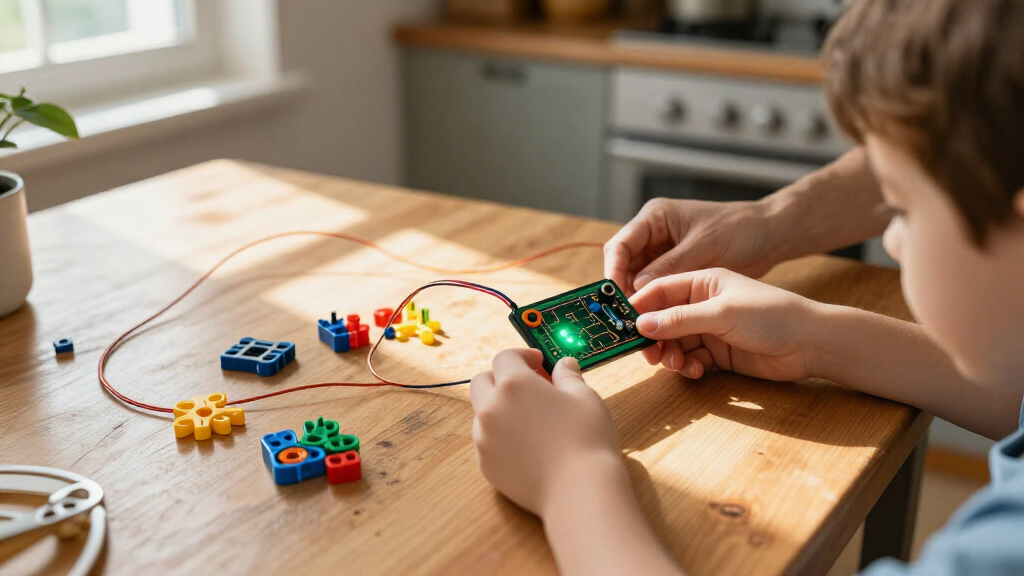
I ranked these kits against four buyer-focused criteria. Safety and age fit came first: kits with exposed wires, hot glue, or small rotating parts only scored well for older kids, while snap-together and chunky-component designs earned top marks for younger builders. Learning depth was next — I favored kits that teach why a circuit works (polarity, series versus parallel, resistance) over kits that just produce a flashy result. Independent usability measured how much a child could accomplish without an adult rescuing the project, which is where illustrated manuals and color-coded parts made a real difference. Finally, I weighed longevity: a kit with 100+ progressive projects simply delivers more months of use than a single-build kit that lands in a drawer a week later.
Those criteria explain the ordering. The Snap Circuits lineup took the top spots because it scores well on all four measures at once. Coding kits like the ELEGOO robot car and ACEBOTT QD106 ranked high on depth and longevity but lower on independence, which caps them for younger beginners. Loose-wire experiment kits fill the value tier — strong learning, lower polish. Single-project kits like the Poraxy FM Radio ranked lower overall despite being genuinely fun, because their replay value runs out fast.
Factors to Consider When Choosing Beginner Electronics Kits For Kids
Beyond the individual rankings, a few category-wide patterns decide whether a kit gets loved or abandoned. These are the factors I would weigh before clicking buy.Match the Connection Style to Your Child’s Age
The single biggest mistake parents make is buying a loose-wire kit for a six-year-old. Snap-together systems like Snap Circuits eliminate stripped wires and reversed polarity by design, which is why they dominate the under-8 segment. Breadboard and wire kits (ELEGOO, Sntieecr, GadgetGlee) teach more authentic electronics because mistakes are possible — and debugging mistakes is where real learning happens — but they demand the fine motor control and patience of a 9 or 10-year-old. If your child is on the border, buy the simpler format first; frustration at an early age kills interest in electronics faster than any boring kit ever will.
Projects vs. Parts: Count What Actually Matters
Manufacturers love big numbers — 100 projects, 66 pieces, 60 experiments — but these are not equivalent. A project count reflects guided builds in a manual, while a piece count often includes every wire, screw, and sticker. A 60-project kit with 30 components usually offers more value than a 200-piece kit with 5 builds. Look at how many of the projects are meaningfully different, too: some kits count every LED color swap as a new project. The kits that ranked highest in this guide earned it through genuinely progressive projects that build on the previous lesson.
Decide Now Whether Coding Is the Goal
This choice shapes everything downstream. Pure circuit kits teach electricity — cause, effect, and physical intuition — and require zero screen time. Arduino-based kits add programming, sensors, and robotics, but they require a computer, software installation, and an adult comfortable troubleshooting drivers and upload errors. Kids who love building but resist screens will thrive with circuits and stall with code, and the reverse is equally true. If you are unsure, start with circuits; the concepts transfer directly when they are ready to code later.
Batteries, Adapters, and Hidden Costs
Nearly every kit here runs on AA batteries, and motor-heavy projects drain them fast — budget for rechargeables or check whether the kit accepts a power adapter. Arduino kits need a laptop with a USB port, which is free if you own one and a real cost if you do not. A few budget kits also assume you own glue, tape, or scissors for assembly steps that are not listed on the box. Reading the manual’s requirements section before buying prevents the deflating moment when a project stops halfway through Christmas morning.
The Supervision Reality Check
Be honest about how much time you will spend alongside the project. Kits marketed to ages 8+ frequently assume an adult reading the manual aloud and handling fiddly steps — especially Arduino kits, where the assembly alone can take a full afternoon. Snap-together kits and well-illustrated kits like the National Geographic Circuit Maker are the realistic choices for a child who will build solo. If you want a shared weekend activity, the ELEGOO robot car and ACEBOTT kits become the better buys, because they reward collaboration rather than suffering from it.
Frequently Asked Questions
What is the best electronics kit for a 5- or 6-year-old?
For this age group, the Snap Circuits Beginner SCB-20 is the clear choice because its extra-large components and color-coded manual were designed specifically for pre-readers and early readers. Kids this age struggle with stripped wire ends, tiny screws, and breadboard grids, so most loose-wire kits will frustrate them within minutes. The Klever Kits Space Circuits set is a workable alternative if your child is already reading, thanks to its illustrated project cards. Resist the temptation to buy a bigger kit they will grow into — a kit they cannot open today teaches nothing, and the beginner sets are inexpensive enough to replace later.
Are Arduino kits like the ELEGOO starter kits really suitable for kids?
Genuinely, but with conditions the box does not always advertise. The ELEGOO UNO R3 Super Starter Kit works well for ages 10 and up who read comfortably, because its PDF tutorial walks through each project step by step. The realistic expectation is that a parent will help with software installation, wire placement, and the occasional troubleshooting session — plan on building the first few projects together. For a 10-year-old who has already shown sustained interest in circuits or coding, it is one of the best growth purchases in the category. For a child who has never wired a LED, a snap-together kit first will make the Arduino jump far smoother.
Snap Circuits SC-100 vs. SC-300: is the bigger kit worth it?
The SC-300 is worth the upgrade if electronics is likely to become a lasting interest, because it includes the components for more advanced builds like AM radios and digital logic circuits that the SC-100 cannot make. The SC-100 is the smarter first buy for a cautious parent, since it costs less and its 100 projects already cover the core concepts — series, parallel, switches, and basic sensors. There is a middle path worth knowing: Snap Circuits kits are designed to upgrade, so starting with the SC-100 and adding expansion sets later works cleanly. If your child tends to binge a toy for two weeks and move on, the SC-100’s smaller scope is actually an advantage, not a limitation.
Do these kits require soldering?
None of the thirteen kits in this roundup require soldering, which is exactly why they qualify as beginner kits. The Snap Circuits family uses press-together plastic modules, while the wire-based kits like the Sntieecr and GadgetGlee sets use pre-stripped wires and spring terminals or battery holders with screws. Soldering becomes relevant only later, if your child graduates to dedicated soldering practice kits around age 11 or 12 with direct adult supervision. For now, every option here is safe for supervised tabletop use with no hot tools involved.
Are the cheap motor-and-fan circuit kits any good for learning?
They are better than their price suggests, provided the builder is old enough. Kits like the Sntieecr motor kit and VLGOEM 66-piece set teach real lessons — circuit completion, polarity, and how motors convert electricity into motion — through hands-on trial and error rather than a polished manual. The tradeoffs are durability and finish: wire leads fray, plastic mounts crack, and the documentation is often thin, so an adult may need to fill the instructional gap. For an 8-to-12-year-old who likes tinkering and taking things apart, they are excellent value. For a child who wants polished results quickly, a Snap Circuits or National Geographic kit will land far better.
Conclusion
For most families, the Snap Circuits Jr. SC-100 is the best overall choice: it is safe, genuinely educational, and works almost entirely without adult help, which is rare in this category. If budget is the driver, the GadgetGlee circuit kit and Sntieecr motor kit deliver real electrical learning at the lowest entry cost, with the honest caveat of exposed wires and lighter documentation. The ELEGOO UNO R3 Smart Robot Car Kit V4 is the premium pick, combining electronics, robotics, and coding for around ages 10 and up — buy it as a shared project, not a solo one. For the youngest builders, the Snap Circuits Beginner SCB-20 is the right first step, while the Klever Kits Space Circuits and National Geographic Circuit Maker sets suit the 6–8 middle ground. If your child has outgrown snap circuits and wants a growth path, the ELEGOO Super Starter Kit or ACEBOTT QD106 robot bridge neatly into real programming. Whatever you choose, match the kit to the child in front of you today — the best electronics kit is the one that actually gets built.
Halloween Picks
halloween
As an affiliate, we earn on qualifying purchases.