For most new stargazers, I’d start with the Celestron StarSense Explorer DX 130AZ: its larger Newtonian optics and smartphone guidance make finding targets easier than with a basic manual scope. The Celestron StarSense Explorer LT 114AZ offers similar guided observing in a smaller package, while the Celestron Travel Scope 70 prioritizes portability over light-gathering ability. The main tradeoffs are aperture versus portability, and guided convenience versus a simpler, lower-cost manual setup. Read on for how all 15 options compare and which one best matches your first observing sessions.

Get school and study supplies delivered free — and shop member deals
- Fast, free delivery on millions of items
- Access to Prime Big Deal Days deals on October 6–7
- Prime Video, Amazon Music and more included
Key Takeaways
- The two StarSense Explorer Newtonians stand apart for target-finding help; the DX 130AZ has the larger aperture, while the LT 114AZ is the more compact guided option.
- Aperture separates the 70mm travel scopes from the 90mm refractors: the former are easier to carry, while the latter gather more light but need more room and a steadier setup.
- Several 80mm and 90mm refractors share similar beginner-friendly extras, such as phone adapters and carry bags; those accessories do not replace a stable mount or good optics.
- Longer focal lengths appear across multiple 90mm refractors, including the MEEZAA, Hawkko, Dianfan, and HUGERSTAR models, but a longer tube can be less convenient to transport and point.
- Portability is a distinct strength of the Celestron Travel Scope 70 and the 80mm backpack-style option; choose those for easy transport, not as a substitute for the larger-aperture picks.





| astronomy telescopes for beginner | Focal length | Mount | Aperture | Included accessories |
|---|---|---|---|---|
| MEEZAA Telescope for Adults & | 500mm | Altazimuth | — | Phone adapter, 45° zenith mirror, adjustable tripod, waterproof backpack |
| MEEZAA Telescope for Adults | 800mm | Altazimuth | 90mm | Tripod, phone adapter, carry bag, user manual |
| Gskyer 70mm Aperture 400mm AZ | 400mm | Altazimuth | 70mm | Phone adapter, wireless remote, carry bag |
| Celestron StarSense Explorer L | 1000mm | Altazimuth | — | — |
| Telescopes for Adults Astronom | 600mm | Altazimuth | 80mm | Phone adapter, adjustable tripod, carrying backpack |
| Hawkko 90mm Aperture 900mm Ref | 900mm | Manual altazimuth | 90mm | — |
| Celestron StarSense Explorer D | 650mm | Manual altazimuth | 130mm | — |
| Fuoibl BY-001 Refracting Teles | 300mm | Altazimuth | 70mm | Phone adapter, wireless remote, and 3X Barlow lens |
| Celestron AstroMaster 70AZ Ref | 900mm | Manual altazimuth | 70mm | — |
| Celticbird 80mm Aperture 600mm | 600mm | Altazimuth | 80mm | Backpack, phone adapter, and moon filter |
| Dianfan 90mm Aperture 800mm Te | 800mm | Altazimuth | 90mm | Stainless steel tripod, phone adapter, carry bag |
| Telescopes for Adults & Beginn | 900mm | Altazimuth | 80mm | — |
| HUGERSTAR 90mm Aperture 800mm | 800mm | Altazimuth | 90mm | 3× Barlow lens, Moon filter, phone adapter, carrying bag |
| Celestron Travel Scope 70mm Po | 400mm | Altazimuth | 70mm | Backpack, two eyepieces, star diagonal |
| Telescope for Kids | 300mm | — | 70mm | — |
More Details on Our Top Picks
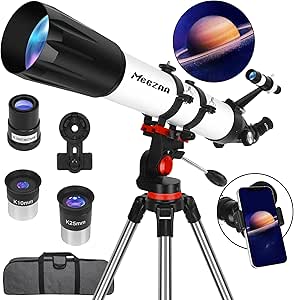
MEEZAA Telescope for Adults & Kids, 80mm Aperture, 500mm Refractor
I’d pick this MEEZAA for families who want one portable scope for both backyard astronomy and daytime nature viewing. Its 80mm aperture gathers more light than the Gskyer 70mm, while the shorter 500mm focal length favors wider views over the tighter framing of the 90mm MEEZAA 800mm model. That makes it a flexible introduction to the Moon, bright star groups, and distant scenery, rather than a choice for pushing high magnification. The phone adapter and waterproof backpack add practical value for outings, and the 45° mirror is useful for terrestrial viewing. The tradeoff is a manual altazimuth setup with a broad stated magnification range that beginners should not mistake for equally sharp performance at every setting. Young children may also need an adult to assemble and aim it.
Pros:- 80mm aperture offers more light gathering than the Gskyer 70mm beginner scope.
- 45° zenith mirror supports more comfortable daytime nature viewing.
- Includes a phone adapter, adjustable tripod, and waterproof backpack.
- Portable kit works for family outings and travel.
Cons:- Manual focusing and aiming require practice to keep targets centered and sharp.
- Shorter 500mm focal length is less suited to tight views of planets.
- Assembly may require adult help for young children.
Best for: Families seeking a shared, portable telescope for Moon viewing, casual stargazing, and daytime landscapes.
Not ideal for: Beginners focused on close planetary detail or high-power observing; its short focal length and manual controls are less suited to that use.
- Objective lens diameter:80mm
- Focal length:500mm
- Mount:Altazimuth
- Focus type:Manual
- Eyepiece description:Kellner
- Stated magnification range:20x–150x
- Optical coating:Fully multi-coated
- Included accessories:Phone adapter, 45° zenith mirror, adjustable tripod, waterproof backpack
Our verdict“Choose this MEEZAA if you want a portable family scope with useful day-and-night versatility rather than a planet-focused instrument.”
MEEZAA Telescope for Adults, 90mm Aperture, 800mm Refractor with Tripod, Phone Adapter & Carry Bag
This 90mm MEEZAA is the refractor pick for beginners who want a longer focal length and a little more light gathering than the 80mm MEEZAA 500mm. Its 800mm focal length gives a narrower view that better suits lunar and planetary observing, while the 10mm and 25mm eyepieces plus a 3x Barlow provide several starting magnifications. The fully multi-coated optics and included carry bag make it a practical step-up kit without the smartphone-guided locating system of the Celestron StarSense Explorer LT 114AZ. That distinction matters: this scope asks you to find objects manually, but avoids relying on a compatible phone app. Manual focus and the altazimuth mount still call for steady adjustments, and the listed tripod height range may not suit every observer. Its refractor design also makes it less compact than the shorter-tube options.
Pros:- 90mm aperture gathers more light than the 80mm MEEZAA 500mm refractor.
- 800mm focal length is better suited to tighter lunar and planetary views.
- Two eyepieces and a 3x Barlow provide several magnification combinations.
- Carry bag and phone adapter support transport and basic phone imaging.
Cons:- Manual target finding offers less guidance than the StarSense Explorer LT 114AZ.
- Manual focus and an altazimuth mount require careful hand adjustments.
- Tripod height adjustment may not fit every observing position.
Best for: Beginners prioritizing the Moon and bright planets who want a longer-focal-length refractor with a useful eyepiece and Barlow set.
Not ideal for: New observers who want app-guided object finding or a very compact travel scope; locating targets is manual and the 800mm tube is longer.
- Aperture:90mm
- Focal length:800mm
- Mount:Altazimuth
- Focus type:Manual
- Eyepieces:10mm and 25mm
- Barlow lens:3x
- Optical coating:Fully multi-coated
- Included accessories:Tripod, phone adapter, carry bag, user manual
Our verdict“Choose this model if lunar and planetary viewing matter more than app-guided navigation or compact packing.”
Gskyer 70mm Aperture 400mm AZ Mount Astronomical Refracting Telescope for Kids and Beginners
The Gskyer takes the simplest, lightest-duty approach in this group: a 70mm aperture and 400mm focal length in a portable beginner refractor. Compared with the 80mm MEEZAA 500mm, it gives up some light gathering and aperture, but its shorter focal length and travel-oriented kit make it an approachable choice for casual Moon viewing and wide-field exploration. The 5×24 cross-hair finder helps with manual aiming, while the smartphone adapter and wireless remote offer a low-friction way to capture basic phone images. Those additions do not make it a guided or advanced imaging setup. The adjustable aluminum tripod is convenient to carry but may be less steady when trying to focus at higher magnification. I’d treat this as an easy entry point for kids and travel, not a scope for detailed planetary study.
Pros:- Portable design and carry bag suit travel and outdoor use.
- 5×24 cross-hair finder gives beginners a straightforward aiming aid.
- Phone adapter and wireless remote support basic smartphone snapshots.
- Short 400mm focal length is suited to wider views of bright targets.
Cons:- 70mm aperture gathers less light than either MEEZAA refractor in this batch.
- Basic adjustable tripod may wobble during focusing or higher-power viewing.
- Magnification depends on the supplied eyepieces and Barlow, and the product details do not specify a fixed range.
Best for: Families and young beginners who want a compact scope for casual Moon viewing, travel, and trying phone snapshots.
Not ideal for: Observers seeking brighter views or steady high-magnification planetary detail; the smaller aperture and basic tripod limit that use.
- Aperture:70mm
- Focal length:400mm
- Mount:Altazimuth
- Finder scope:5×24 with cross-hair lines
- Tripod:Adjustable aluminum alloy
- Optical coating:Fully coated
- Included accessories:Phone adapter, wireless remote, carry bag
Our verdict“Choose the Gskyer for lightweight, casual first-time observing, but pick a larger-aperture model for brighter or more detailed views.”
Celestron StarSense Explorer LT 114AZ Newtonian Smartphone Guided Telescope
For a beginner likely to spend more time locating objects than deciding which eyepiece to use, I’d put the Celestron StarSense Explorer LT 114AZ first. Its phone-guided sky recognition helps point you toward stars, planets, and deep-sky targets, addressing a common early frustration that the manual MEEZAA refractors leave to the user. The 114mm Newtonian reflector also has a larger aperture than any other scope in this batch, giving it a stronger case for gathering light on dimmer objects. The two eyepieces and full-height tripod make it a more substantial backyard setup than the compact Gskyer. The costs of that capability are a 10.4-pound assembly, manual focusing, and dependence on a compatible smartphone and operating system. Beginners who prefer phone-free observing or a grab-and-go refractor should look elsewhere.
Pros:- StarSense smartphone guidance helps beginners locate targets more readily than manual-finding scopes.
- 114mm aperture is larger than the apertures of the four refractors in this batch.
- Newtonian reflector design offers a strong light-gathering option for deep-sky exploration.
- Full-height tripod and two included eyepieces support backyard observing.
Cons:- Requires a compatible smartphone and supported operating system for guided locating.
- At 10.4 pounds, it is less convenient to carry than the Gskyer or portable MEEZAA refractors.
- Manual focus and mount adjustments still require hands-on practice.
Best for: New backyard observers who want smartphone guidance to locate a wider range of celestial targets, including brighter deep-sky objects.
Not ideal for: Travel-focused buyers or people who do not want to depend on a compatible smartphone; this is heavier and less self-contained than the refractors.
- Objective lens diameter:114mm
- Optical design:Newtonian reflector
- Focal length:1000mm
- Mount:Altazimuth
- Focus type:Manual
- Eyepieces:10mm and 25mm
- Field of view:2.04 degrees
- Weight:10.4 pounds
- Included feature:Smartphone dock with StarSense sky recognition
Our verdict“Choose the StarSense Explorer LT 114AZ if guided target finding and a larger aperture matter more than light travel weight or phone-free use.”
Telescopes for Adults Astronomy, 80mm Aperture 600mm Refractor Telescope for Kids & Beginners, Compact and Portable Travel Telescopio with Backpack
This 80mm, 600mm refractor is a sensible middle ground for beginners who want a portable tube without giving up as much focal length as the MEEZAA 500mm. Its 80mm aperture matches that MEEZAA, while the longer 600mm focal length and included K20mm and K9mm eyepieces favor a more focused starter set for the Moon and bright planets. At a listed 840g, it is particularly easy to carry, and the backpack, finder, and phone adapter cover the basics for an outing. Compared with the 90mm MEEZAA 800mm, it is lighter and simpler but gathers less light and has less reach for tighter views. The manual altazimuth mount remains a hands-on setup, and the listed 30x–66x range is modest for users hoping to explore higher magnifications.
Pros:- 840g listed weight makes it easier to carry than the larger Celestron reflector.
- 80mm aperture provides more light gathering than the Gskyer 70mm.
- 600mm focal length offers a tighter view than the MEEZAA 500mm.
- Backpack, 5×24 finder, and phone adapter provide useful travel accessories.
Cons:- Stated 30x–66x magnification range is limited for users seeking higher-power views.
- Manual focus and altazimuth aiming need frequent hand adjustments.
- Basic construction is less suited to demanding or advanced observing.
Best for: Traveling beginners and families who want a lightweight 80mm scope for the Moon, bright planets, and daytime views.
Not ideal for: Buyers seeking stronger light gathering or higher magnification for planetary detail; the 90mm MEEZAA 800mm is better matched to those priorities.
- Aperture:80mm
- Focal length:600mm
- Magnification:30x–66x
- Eyepieces:K20mm and K9mm
- Finder scope:5×24 with crosshair
- Mount:Altazimuth
- Focus type:Manual
- Weight:840g
- Included accessories:Phone adapter, adjustable tripod, carrying backpack
Our verdict“Choose this refractor for easy transport and straightforward beginner viewing, not for maximum aperture or high-power planetary observing.”
Hawkko 90mm Aperture 900mm Refractor Telescope for Beginners and Adults with AZ Mount, Phone Adapter, and Carry Bag
The Hawkko pairs a 90mm aperture with a 900mm focal length, a combination that favors higher-magnification views of the Moon and planets over wide sweeps of the sky. Its larger aperture gives it an advantage in light gathering over the 70mm Celestron AstroMaster 70AZ, while the long tube can make celestial targets easier to examine at scale. The included 10mm and 25mm eyepieces, 3X Barlow, phone adapter, and carry bag give a beginner a broad starter kit. The tradeoff is that its advertised 36X–270X range does not guarantee useful detail at the upper end; seeing conditions and mount steadiness matter. At 5kg, it is also heavier than the AstroMaster, and the manual AZ mount needs ongoing adjustments to keep objects centered.
Pros:- 90mm aperture gathers more light than the 70mm Celestron AstroMaster 70AZ
- 900mm focal length suits higher-magnification lunar and planetary viewing
- Includes two eyepieces, a 3X Barlow, phone adapter, and carry bag
- Multi-coated optics and an AZ mount offer a straightforward manual setup
Cons:- At 5kg, it is less convenient to carry than smaller beginner refractors
- Manual aiming and tracking require frequent adjustments
- The upper advertised magnification may not deliver useful detail in typical viewing conditions
Best for: Beginners who mainly want close views of the Moon and planets and prefer a larger aperture with a bundled carry bag and phone adapter.
Not ideal for: Travelers prioritizing a lightweight setup or beginners who want smartphone-guided object locating instead of manual aiming.
- Aperture:90mm
- Focal length:900mm
- Magnification range:36X–270X
- Mount:Manual altazimuth
- Eyepieces:10mm and 25mm
- Included Barlow lens:3X
- Optical coating:Multi-coated
- Weight:5kg
Our verdict“Choose the Hawkko if lunar and planetary viewing matters more than light packing or assisted sky navigation.”
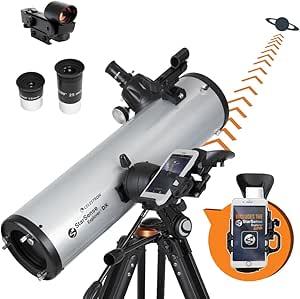
Celestron StarSense Explorer DX 130AZ Smartphone Guided Newtonian Telescope
The DX 130AZ is the clearest choice here for beginners who are more worried about finding targets than choosing eyepieces. Its StarSense smartphone guidance uses sky recognition to help direct the telescope, a meaningful change from manually aiming the Hawkko or Celestron AstroMaster 70AZ. The 130mm Newtonian aperture also collects more light than the refractors in this batch, making it better suited to bright deep-sky objects as well as the Moon and planets. Two eyepieces and a full-height tripod support a practical first setup. This assistance depends on a compatible phone, and the listed compatibility starts at Android 12 or iOS 18. At 18 pounds, it is less appealing for frequent carrying; its manual mount also means the phone helps locate objects but does not track them automatically.
Pros:- StarSense guidance helps beginners locate objects without relying on a paper chart alone
- 130mm aperture gathers more light than the refractors listed in this batch
- Two eyepieces, red-dot finder, smartphone dock, and full-height tripod are included
- Newtonian design is suited to observing both planets and brighter deep-sky objects
Cons:- Smartphone guidance requires a compatible Android or iOS device
- At 18 pounds, the complete setup is less portable than smaller refractor options
- Manual mount requires the observer to reposition the telescope as objects move
Best for: New observers with a compatible smartphone who want guided help locating celestial objects and a larger aperture for varied targets.
Not ideal for: Buyers without a compatible phone, frequent travelers seeking a lightweight telescope, or anyone expecting motorized tracking.
- Optical design:Newtonian reflector
- Aperture:130mm
- Focal length:650mm
- Mount:Manual altazimuth
- Eyepieces:10mm and 25mm
- Finderscope:StarPointer red dot
- Optical coatings:Aluminum and SiO₂
- Weight:18 pounds
- Phone compatibility:Android 12+ and iOS 18+
Our verdict“Pick the DX 130AZ if phone-guided locating and greater light gathering matter more than portability and manual simplicity.”
Fuoibl BY-001 Refracting Telescope for Kids and Adults
The Fuoibl BY-001 is aimed at families who want a low-complexity introduction, with tool-free assembly and a short 300mm tube that is easier to handle than the long Hawkko 90mm. Its 70mm aperture and fully multi-coated optics are best matched to the Moon, bright targets, and daytime scenery—not faint deep-sky observing. A phone adapter and wireless remote add a simple way to try basic phone photography, though those extras do not replace a sturdy mount or improve the telescope’s optical reach. Compared with the Celestron AstroMaster 70AZ, the Fuoibl is more oriented toward kid-friendly setup and phone accessories, while the AstroMaster has a 900mm focal length that better favors higher-power lunar and planetary viewing. The plastic construction and inverted finderscope image may frustrate users seeking a steadier, more conventional starter instrument.
Pros:- Tool-free assembly makes setup approachable for children and first-time users
- 70mm aperture and fully multi-coated optics suit bright lunar and terrestrial targets
- Phone adapter and wireless remote support basic smartphone photography
- Compact 300mm focal-length design is easier to pack than longer-tube refractors
Cons:- Short 300mm focal length offers less reach for higher-magnification lunar and planetary views than the AstroMaster 70AZ
- Plastic construction may be less stable than a sturdier tripod setup
- Inverted finderscope image can make target alignment less intuitive
Best for: Families introducing children around ages 8–12 to Moon viewing, daytime observation, and simple phone photography.
Not ideal for: Beginners seeking stronger planetary detail, a stable metal tripod, or a finderscope image that is intuitive to interpret.
- Optical design:Refractor
- Aperture:70mm
- Focal length:300mm
- Magnification range:15X–150X
- Mount:Altazimuth
- Finderscope:5×24
- Tripod height:Up to 45 inches
- Included eyepieces:6mm and 20mm
- Included accessories:Phone adapter, wireless remote, and 3X Barlow lens
Our verdict“Choose the Fuoibl for a child-friendly, easy-to-assemble first telescope, not for detailed planetary observation.”
Celestron AstroMaster 70AZ Refractor Telescope for Moon & Planet Viewing
The AstroMaster 70AZ keeps the beginner experience simple: tool-free assembly, a manual altazimuth mount, and a red-dot finder let a new observer get oriented without phone guidance or a complex setup. Its 70mm aperture is modest beside the Hawkko’s 90mm and the StarSense DX 130AZ’s 130mm, so it is better suited to the Moon, bright planets, and star clusters than dimmer deep-sky targets. The 900mm focal length gives it a more planet-focused character than the short-tube Fuoibl BY-001, though changing eyepieces is still needed to vary magnification. At 10.8 pounds, it is reasonably portable, and its terrestrial-viewing capability adds flexibility. Its manual mount does not track objects, and the smaller aperture limits detail compared with the larger telescopes in this group.
Pros:- Tool-free assembly and a red-dot finder make initial setup approachable
- 900mm focal length favors lunar and planetary viewing more than the short-tube Fuoibl BY-001
- Can be used for both night-sky and daytime terrestrial observation
- At 10.8 pounds, it is lighter than the 18-pound StarSense DX 130AZ
Cons:- 70mm aperture gathers less light than the Hawkko 90mm and StarSense DX 130AZ
- Manual altazimuth mount does not track objects as they cross the sky
- Limited light gathering restricts detail on faint deep-sky targets
Best for: First-time observers who want a conventional, quick-to-assemble refractor for the Moon, bright planets, and occasional daytime viewing.
Not ideal for: Buyers seeking smartphone-guided locating, stronger deep-sky views, or automatic tracking for extended observing.
- Optical design:Achromatic refractor
- Aperture:70mm
- Focal length:900mm
- Mount:Manual altazimuth
- Eyepieces:20mm and 10mm
- Finderscope:StarPointer red dot
- Optical coating:Fully coated
- Weight:10.8 pounds
- Warranty:2-year US warranty
Our verdict“Choose the AstroMaster 70AZ for a familiar, portable manual refractor focused on bright objects rather than guided finding or deep-sky reach.”
Celticbird 80mm Aperture 600mm AZ Mount Refractor Telescope for Adults and Kids
The Celticbird’s strongest case is convenience: its 5.8-pound weight, included backpack, and 600mm tube make it easier to take along than the 10.8-pound AstroMaster 70AZ or 18-pound StarSense DX 130AZ. Its 80mm aperture sits between those Celestron refractors and the Hawkko 90mm, offering a modest light-gathering step above a 70mm telescope without matching the Hawkko’s longer 900mm focal length for higher-power lunar and planetary viewing. The supplied 20mm and 9mm eyepieces provide 30X and 66X magnification, a practical range for bright, beginner-friendly targets. A moon filter and phone adapter add useful extras, but the stated magnification ceiling and reports of tripod wobble make it a poor fit for buyers who want detailed high-power views or a rigid platform.
Pros:- 5.8-pound weight and included backpack make it easier to transport than either Celestron model here
- 80mm aperture offers more light gathering than the 70mm AstroMaster 70AZ
- Includes 20mm and 9mm eyepieces, a moon filter, and phone adapter
- 600mm focal length provides a middle ground between compact handling and moderate viewing power
Cons:- Supplied magnifications top out at 66X, limiting higher-power viewing compared with the Hawkko 90mm
- Tripod stability may be a concern when focusing or viewing at higher magnification
- Setup instructions may leave some beginners needing extra guidance
Best for: Families and casual beginners who want a light telescope with a backpack for backyard sessions and short trips.
Not ideal for: Observers seeking high-magnification planetary detail, a particularly stable tripod, or a setup with guided object finding.
- Optical design:Refractor
- Aperture:80mm
- Focal length:600mm
- Mount:Altazimuth
- Eyepieces:20mm and 9mm
- Magnification:30X and 66X
- Finderscope:5×24
- Weight:5.8 pounds
- Included accessories:Backpack, phone adapter, and moon filter
Our verdict“Pick the Celticbird when a portable, accessory-rich kit matters more than high magnification or the steadiness of a heavier setup.”
Dianfan 90mm Aperture 800mm Telescope for Adults with Tripod & Phone Adapter
The Dianfan’s 90mm aperture gives beginners more light-gathering capacity than the 70mm Celestron Travel Scope, a useful difference when viewing the Moon and brighter planets. Its 800mm focal length and listed 32×–240× range offer room to change magnification, though the highest settings are not a guarantee of crisp views; steadiness, atmospheric conditions, and careful focusing matter. The manual altazimuth mount keeps aiming straightforward, while the phone adapter and carry bag support casual snapshots and transport. Compared with the HUGERSTAR 90mm, this Dianfan supplies a stainless steel tripod but does not list a Moon filter. Its 4.7kg weight is a real tradeoff for carrying it far, and manual focus takes patience when dialing in sharpness.
Pros:- 90mm aperture gathers more light than 70mm beginner refractors in this lineup.
- 800mm focal length and multiple eyepiece options support varied viewing magnifications.
- Includes a stainless steel tripod, phone adapter, and carry bag.
- Altazimuth mount offers simple up-down and side-to-side aiming.
Cons:- At 4.7kg, the kit may feel heavy on longer walks.
- Manual focus needs fine adjustment to bring objects into sharp view.
- The field of view narrows at higher magnifications, making targets harder to keep centered.
Best for: Beginners who want a 90mm refractor for lunar and planetary viewing, with a phone adapter and a tripod for backyard sessions.
Not ideal for: Travelers prioritizing a light kit or people seeking guided tracking; at 4.7kg it is heavier than the Celestron Travel Scope 70 and uses a manual mount.
- Aperture:90mm
- Focal length:800mm
- Mount:Altazimuth
- Focus:Manual
- Listed magnification range:32×–240×
- Field of view:1.56°
- Weight:4.7kg
- Included accessories:Stainless steel tripod, phone adapter, carry bag
Our verdict“Choose the Dianfan if you want a light-gathering 90mm beginner telescope for mostly stationary viewing and can manage its weight and manual focusing.”
Telescopes for Adults & Beginners, 80mm Aperture, 900mm Focal Length
This 80mm refractor takes a more restrained approach than the Dianfan and HUGERSTAR 90mm models: its 900mm focal length is paired with a stated 45×–90× range, a practical fit for beginners who would rather work within a narrower set of magnifications than manage a broad accessory stack. The 5×24 crosshair finderscope can help with initial aiming, while the altazimuth mount keeps movement intuitive. Its listing describes the focus as fixed, which is a major limitation beside the manual-focus Dianfan: newcomers have less control when trying to sharpen different targets. The 80mm aperture is smaller than those 90mm alternatives, so this is not the pick for maximizing light collection. I’d choose it for straightforward Moon and bright-planet sessions, not for users expecting fine focus control or motorized tracking.
Pros:- 900mm focal length and stated 45×–90× range keep the magnification choices comparatively focused.
- 5×24 crosshair finderscope supports initial target aiming.
- Fully multi-coated optics are specified.
- Altazimuth mount uses direct manual movement.
Cons:- Fixed-focus design offers less control than manual-focus options such as the Dianfan.
- 80mm aperture collects less light than the 90mm Dianfan and HUGERSTAR.
- No motorized tracking is listed, so objects must be repositioned by hand.
Best for: New observers, including families with older children, who want a modest magnification range and a crosshair finder for Moon and bright-planet viewing.
Not ideal for: Buyers who want to adjust focus across different targets or grow into more flexible observing; the fixed-focus listing and 80mm aperture are limiting beside the Dianfan and HUGERSTAR.
- Aperture:80mm
- Focal length:900mm
- Mount:Altazimuth
- Focus:Fixed focus
- Listed magnification range:45×–90×
- Finderscope:5×24 with crosshair
- Coating:Fully multi-coated
- Field of view:1.35°
Our verdict“Pick this model for basic, manually aimed lunar and planetary sessions if its fixed-focus design suits your expectations.”
HUGERSTAR 90mm Aperture 800mm Refractor Telescope for Adults with Tripod, Moon Filter, Phone Adapter & Carrying Bag
The HUGERSTAR shares the Dianfan’s 90mm aperture and 800mm focal length, so the choice between them is less about basic optical scale and more about included tools. This kit adds a Moon filter, 5×24 finderscope, 10mm and 25mm eyepieces, and 3× Barlow lens, giving a beginner several ways to set up a session without sourcing those accessories separately. Its adjustable tripod height also helps accommodate different observers. The tradeoff is a crowded stated range of 32×–240×: the maximum is not a promise of useful detail, and manual focus still requires careful adjustment. Compared with the Dianfan, it lists more astronomy-oriented accessories but no stainless steel tripod material. The product description also flags durability as a concern, so I’d favor it for accessory variety over rugged, frequent transport.
Pros:- 90mm aperture matches the Dianfan and exceeds the 70mm Celestron Travel Scope in light-gathering area.
- Includes a Moon filter, two eyepieces, and a 3× Barlow lens.
- 5×24 finderscope and phone adapter add practical aiming and image-capture options.
- Adjustable tripod height ranges from 28.7 to 46.4 inches.
Cons:- Manual focusing calls for careful adjustment to achieve a sharp image.
- The upper end of the listed magnification range may not provide usable detail in typical conditions.
- Build durability may be a concern for frequent transport and outdoor handling.
Best for: First-time observers who want a Moon filter, multiple eyepieces, a Barlow lens, and a phone adapter in one beginner-oriented kit.
Not ideal for: People who need especially durable gear for frequent outdoor trips or want a telescope with guided tracking; this is a manual setup and build durability is a stated concern.
- Aperture:90mm
- Focal length:800mm
- Mount:Altazimuth
- Focus:Manual
- Listed magnification range:32×–240×
- Eyepieces:10mm and 25mm
- Finderscope:5×24
- Included accessories:3× Barlow lens, Moon filter, phone adapter, carrying bag
- Tripod height range:28.7–46.4 inches
Our verdict“Choose the HUGERSTAR over the more basic Dianfan if a Moon filter and broader accessory bundle matter more than a stated stainless steel tripod.”
Celestron Travel Scope 70mm Portable Refractor Telescope with Backpack
The Celestron Travel Scope 70 earns its place through portability and simple setup, not maximum lunar detail. At 4.2 pounds with a backpack, it is far easier to take on a walk than the 4.7kg Dianfan, while its 400mm focal length and 70mm aperture make it a compact choice for wide, bright targets and daytime landscapes. A reflex finderscope keeps aiming straightforward, and the altazimuth mount avoids a complicated learning curve. The compromise is clear beside the 90mm Dianfan and HUGERSTAR: the smaller aperture gathers less light, so fine planetary detail is more limited. Manual focusing and a basic manual mount also mean no automatic tracking. I’d pick it for family outings and mixed day-night use, rather than as the strongest option for dedicated astronomy sessions.
Pros:- At 4.2 pounds, it is substantially lighter than the 4.7kg Dianfan.
- Backpack supports storage and transport for family outings.
- Reflex finderscope and altazimuth mount keep basic aiming approachable.
- Fully coated optics and two eyepieces are included.
Cons:- 70mm aperture limits light gathering and fine planetary detail compared with 90mm options.
- Manual focus and mount require the observer to make adjustments by hand.
- 400mm focal length is less suited to higher-magnification lunar and planetary viewing than the longer Dianfan.
Best for: Families and beginners who want a light telescope with a backpack for outdoor trips, landscape viewing, and occasional looks at the Moon.
Not ideal for: Observers focused on extracting more lunar or planetary detail; the 70mm aperture is smaller than the Dianfan and HUGERSTAR’s 90mm optics.
- Aperture:70mm
- Focal length:400mm
- Mount:Altazimuth
- Focus:Manual
- Finderscope:Reflex
- Field of view:1.43°
- Weight:4.2 pounds
- Included accessories:Backpack, two eyepieces, star diagonal
- Warranty:2 years
Our verdict“Choose the Travel Scope 70 if easy carrying and daytime versatility matter more to you than the extra light gathering of a 90mm telescope.”
Telescope for Kids, 70MM Aperture Refractor Telescope with 15X-150X Zoom and Phone Adapter
This 70mm refractor is aimed at a different beginner than the Celestron Travel Scope 70: its appeal is tool-free setup and kid-friendly extras, including a phone adapter and gift box, rather than the Celestron’s named backpack and 400mm focal length. The listed 15×–150× magnification range, 20mm and 6mm eyepieces, and 3× Barlow offer several combinations for exploring the Moon and nearby daytime subjects. Its 300mm focal length makes the kit compact, but the smaller aperture and beginner-level design set a ceiling on detail compared with the 90mm Dianfan or HUGERSTAR. A stable tripod matters, especially when increasing magnification, and the finder’s inverted image may confuse children who expect an upright view. I’d treat the phone adapter as a casual sharing tool, not a substitute for a dedicated imaging setup.
Pros:- Tool-free setup makes it accessible for first-time family use.
- Includes 20mm and 6mm eyepieces plus a 3× Barlow lens.
- Phone adapter supports casual image sharing.
- Compact 300mm focal length and gift box suit a beginner-oriented kit.
Cons:- 70mm aperture collects less light than the Dianfan and HUGERSTAR 90mm models.
- High magnification depends on a stable tripod and suitable viewing conditions.
- The finder shows an inverted image, which can confuse young users.
Best for: Children and caregivers looking for a tool-free starter telescope for the Moon, casual nature viewing, and simple phone snapshots.
Not ideal for: Beginners seeking stronger planetary detail or a telescope to grow into for advanced observing; its 70mm aperture and 300mm focal length are more limited than the 90mm refractors.
- Aperture:70mm
- Focal length:300mm
- Listed magnification range:15×–150×
- Eyepieces:20mm and 6mm
- Barlow lens:3×
- Finderscope:5×24
- Phone adapter:Included
- Objective lens diameter:7cm
Our verdict“Choose this telescope as a simple first kit for a child if easy setup and a phone adapter matter more than advanced observing capability.”
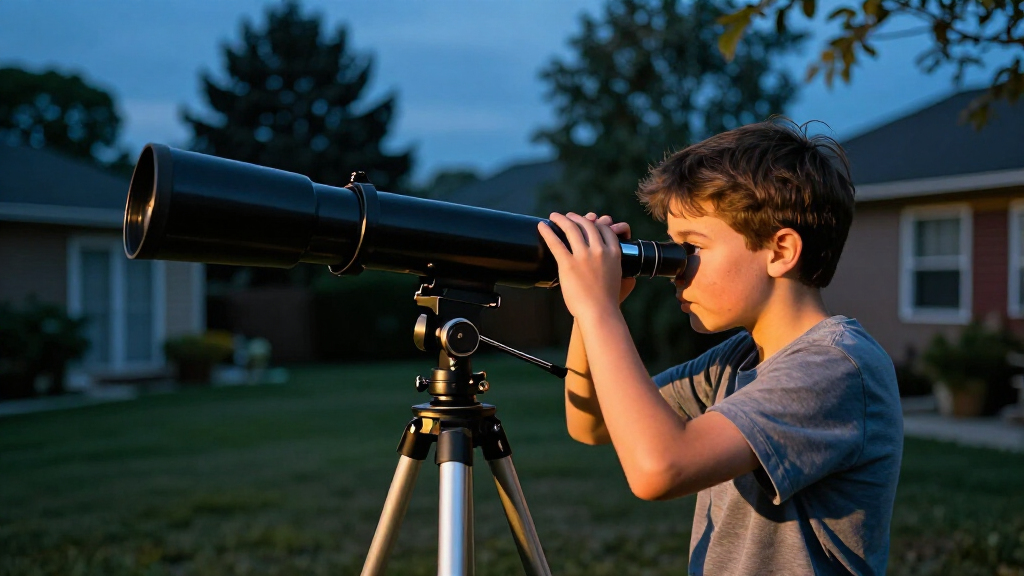
How We Picked
I ranked these astronomy telescopes for beginners by how well their stated designs match the first challenges new observers face: locating objects, getting a stable view, transporting the setup, and learning what each telescope can realistically show. Aperture and optical design informed the performance comparison, while focal length, mount type, included accessories, and portability helped reveal who each model suits. I treated phone guidance as a practical advantage for learning the sky, not a guarantee of better optical views.
The ranking gives more weight to useful capability and beginner usability than to accessory counts or headline magnification claims. The StarSense Explorer DX 130AZ leads for its larger listed aperture and smartphone-assisted target finding; the LT 114AZ follows with the same guided approach in a smaller format. Refractors with 80mm or 90mm apertures offer straightforward alternatives, while 70mm models rank higher for buyers who put portability or a simple first setup ahead of gathering more light. Where the supplied product names do not specify enough detail to judge stability or optical quality, I avoid treating those claims as proven advantages.
| astronomy telescopes for beginner | Mount |
|---|---|
| MEEZAA Telescope for Adults & | Altazimuth |
| MEEZAA Telescope for Adults | Altazimuth |
| Gskyer 70mm Aperture 400mm AZ | Altazimuth |
| Celestron StarSense Explorer L | Altazimuth |
| Telescopes for Adults Astronom | Altazimuth |
| Hawkko 90mm Aperture 900mm Ref | Manual altazimuth |
| Celestron StarSense Explorer D | Manual altazimuth |
| Fuoibl BY-001 Refracting Teles | Altazimuth |
| Celestron AstroMaster 70AZ Ref | Manual altazimuth |
| Celticbird 80mm Aperture 600mm | Altazimuth |
| Dianfan 90mm Aperture 800mm Te | Altazimuth |
| Telescopes for Adults & Beginn | Altazimuth |
| HUGERSTAR 90mm Aperture 800mm | Altazimuth |
| Celestron Travel Scope 70mm Po | Altazimuth |
| Telescope for Kids | — |
Factors to Consider When Choosing Astronomy Telescopes For Beginners
Choosing a first telescope is less about chasing maximum magnification and more about matching the instrument to the way you’ll observe. I’d make the decision by weighing the observing site, how often the scope will be carried, and how much help you want finding objects.
Choose Aperture for the Views You Want
Aperture is the telescope’s light-gathering opening, so it has a more direct effect on faint-object potential than a large magnification number on a box. In this lineup, the 90mm and 114mm options collect more light than the 70mm models, though a larger aperture cannot remove light pollution or poor seeing. For bright targets such as the Moon and planets, a smaller scope can still provide satisfying views. A common mistake is to buy the largest telescope without checking whether it will be used often. If carrying or storing a bigger instrument becomes a chore, a smaller scope that gets outside regularly may be the better choice.
Think About Mount Stability Before Magnification
A steady mount makes focusing and tracking easier, especially when the target is magnified and appears to drift across the view. Beginners often blame blurry views on the optics when a lightweight tripod is shaking from touch or wind. High magnification also narrows the view, making objects harder to locate and follow; advertised maximum magnification is not a promise of sharp, useful images. Check whether the tripod can be set at a comfortable height and whether the mount moves smoothly. I’d favor reliable, controlled movement over a bigger magnification claim.
Decide How Much Help You Want Finding Objects
Smartphone-guided models can reduce the learning curve by helping point toward celestial targets, which can be especially useful under light-polluted skies. They still depend on a compatible phone, power, alignment, and clear instructions, so the app is not a replacement for understanding the sky. A manual mount avoids app setup and can teach basic star-hopping, but locating dim objects may take more patience. Before choosing guided features, consider whether you want a phone involved during observing and whether you’re comfortable setting up the software. Guidance is most valuable when it makes you more likely to keep observing, rather than when it adds another setup task.
Match Telescope Type to Your Routine
Refractors are generally straightforward to set up and are common among the 70mm to 90mm beginner options here. Newtonian reflectors, such as the StarSense Explorer models, offer larger apertures in their listed designs but have a different tube layout and may need occasional optical alignment. That maintenance is not automatically difficult, but it is part of ownership that a buyer should be ready to learn. Think about where the telescope will live and whether you prefer a sealed refractor-style tube or can accommodate a bulkier reflector. A scope that suits your storage and care habits is more likely to become a regular part of your routine.
Treat Accessories as Convenience, Not Performance
Phone adapters, backpacks, and carry bags can make a setup easier to use, but they do not improve the telescope’s core optics. A phone adapter may help with casual imaging, yet taking clear astronomical photos often requires more stable tracking and technique than a beginner kit provides. A bag is useful if it fits the assembled or disassembled scope and its accessories without forcing awkward packing. Moon filters can reduce perceived brightness, but they are not a substitute for safe solar-viewing equipment. Compare what is included with what you’ll actually use, then give greater weight to the telescope and mount themselves.
Choose for Your Observing Site and Transport Needs
Portability can decide whether a telescope gets used, especially if you need to carry it upstairs, travel by car, or walk to a darker viewing spot. The 70mm travel models and backpack-equipped refractors are built around easier transport, while the longer 90mm tubes call for more space. At home, a heavier or longer setup may be manageable if it can stay assembled and reach a clear view of the sky. Before buying, measure your storage space and consider the distance from the door to your observing spot. Buyers who travel often should accept some aperture tradeoff rather than end up with a telescope that rarely leaves storage.
Frequently Asked Questions
Is a 70mm telescope enough for a first astronomy telescope?
A 70mm telescope can be a sensible first scope if you mainly want the Moon, bright planets, and a portable setup. In this roundup, the Celestron Travel Scope 70 and Gskyer 70mm prioritize a manageable size over the larger apertures found in the 90mm refractors and 130mm reflector. Smaller aperture limits how much light the telescope gathers, so faint deep-sky objects are less suitable targets. A 70mm model can still teach focusing, locating objects, and basic sky orientation. Choose one when convenience matters more to you than seeing the faintest possible targets.
Should I choose a smartphone-guided telescope or a manual one?
Choose smartphone guidance if finding targets is your biggest hurdle and you are comfortable using an app during a session. The StarSense Explorer LT 114AZ and DX 130AZ are the lineup’s clearest options for guided locating. A manual telescope avoids phone setup and can help you learn star-hopping, but early sessions may involve more searching. Guidance cannot compensate for cloudy skies, poor alignment, or a shaky mount. If you want both the app and a larger aperture, the DX 130AZ has the stronger listed aperture; if a smaller setup matters more, the LT 114AZ is the alternative.
Does a 90mm refractor make a better first telescope than a 70mm travel scope?
A 90mm refractor favors light gathering, while a 70mm travel scope favors easy transport. The MEEZAA 90mm, Hawkko 90mm, Dianfan 90mm, and HUGERSTAR 90mm list longer tubes and larger apertures than the 70mm travel options. That extra size can be less convenient to store or carry, particularly if you observe away from home. Neither size automatically makes a better first purchase; the right choice depends on what you will carry and where you’ll observe. Pick the 90mm class for more aperture when you can manage the larger setup, or the 70mm class for frequent travel and simpler handling.
Are the phone adapters in these telescope kits good for photographing planets?
A phone adapter can help you attach a smartphone to the eyepiece, but it does not make a telescope a dedicated astrophotography system. Bright targets such as the Moon are usually more approachable for casual phone captures than faint objects. Planet photography can be difficult because the target is small, the view moves, and phone alignment takes patience. A stable mount and careful focus matter more than having an adapter in the box. Treat the adapter as a way to experiment, not as the main reason to pick a telescope.
Which beginner telescope makes sense if I want to travel to dark skies?
Portability should lead your decision if you plan to travel often, so compare the Celestron Travel Scope 70 with the 80mm backpack-style refractor. Both put easier transport ahead of the larger aperture of the 90mm models or the 130mm StarSense reflector. Check the complete packed size and weight, since a carry bag does not always mean the kit is comfortable to move over long distances. Also think about whether the tripod fits your car and whether you can set it up on uneven ground. If you can handle a bulkier instrument, the DX 130AZ trades some convenience for a larger listed aperture and guided target finding.
Conclusion
Best overall: I’d pick the Celestron StarSense Explorer DX 130AZ for beginners who want smartphone-assisted target finding paired with the largest listed aperture in this group. Best for beginners who want guided setup in a smaller format: the StarSense Explorer LT 114AZ keeps that locating help with a more compact reflector. Best value: the Gskyer 70mm is the straightforward fit for someone who wants a simple, smaller first telescope, while accepting its limited aperture. Best premium: the DX 130AZ is the strongest capability-led choice here, though buyers should be comfortable with a larger reflector. Best for specific needs: choose the Celestron Travel Scope 70 for portability, or a 90mm refractor such as the HUGERSTAR or MEEZAA 90mm when you want more aperture in a refractor-style setup. My shortlist comes down to one question: do you value easier target finding, greater portability, or a larger aperture most?
Fall Picks
fall essentials
As an affiliate, we earn on qualifying purchases.