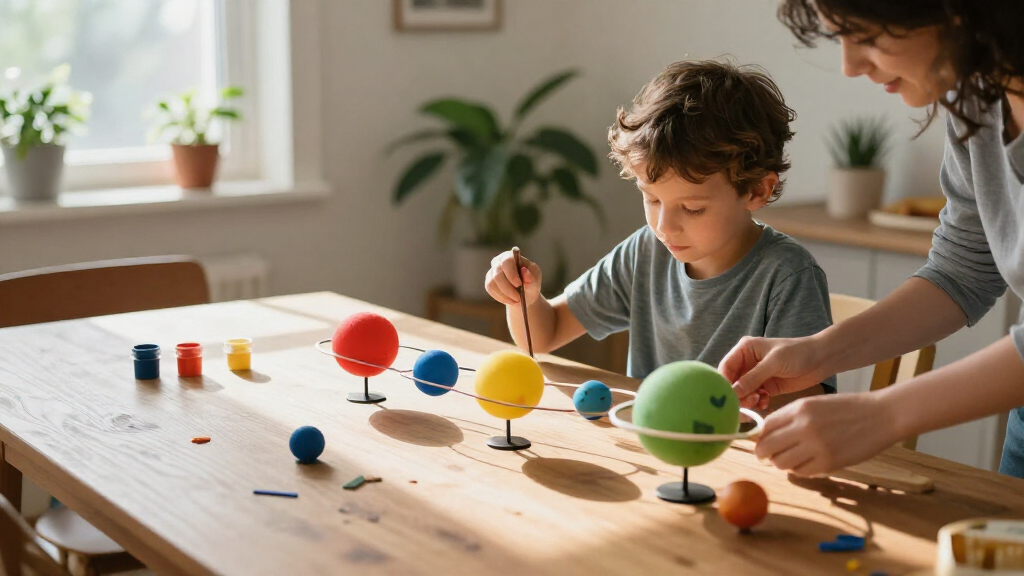
For most families, I’d make the Smartivity DIY Solar System Kit the best overall pick because its gear-driven planets add motion to a hands-on build. The Science Can Talking Planets and Projector kit stands out for children who learn through sound and projected visuals, while the National Geographic Glow-in-the-Dark kit suits kids who want a display they can enjoy after assembly. The main tradeoff is between interactive features and a simpler craft project: projectors and moving parts add activity, while foam-ball kits leave more room for painting and customization. Age guidance, adult help, and the space needed to display a finished model also vary. Read on for the full breakdown and help match a kit to your child’s interests.

Prime made for students and young adults
- Fast, free delivery for dorm and study essentials
- Prime Video and Amazon Music included
- Member-only deals
Key Takeaways
- Motion adds a different kind of learning: Smartivity’s gear-driven design distinguishes it from the many paint-and-assemble foam-ball kits, though moving mechanisms may call for more careful assembly.
- Projector kits suit guided discovery: Science Can and Playz add projected visuals, while the Science Can talking options also bring spoken planet information; these extras matter most when kids will use them beyond the initial build.
- Foam-ball kits put creativity first: The 35-piece, 63-piece, 64-piece, and UNGLINGA sets focus on painting and arranging, with piece counts and included accessories affecting how much room there is for customization.
- Display format changes the finished project: Pllieay’s display-box versions are designed around a contained presentation, unlike open models that may need a shelf or a separate display solution.
- Choose by the child’s role in the project: A younger child who wants immediate interaction may prefer talking or glow features, while a patient maker may get more from a kit that asks them to paint, assemble, and personalize planets.
| Pllieay Solar System Model Kit for Kids |  | Best for Wall Displays | Brand: Pllieay | Model: CR-001FO | Age range: 8–17 years | VIEW LATEST PRICE | See Our Full Breakdown |
| Science Can Solar System Model Kit with Talking Planets and Projector |  | Best for Younger Kids | Brand: Science Can | Model number: 1204732021es0001 | Planets: 8 | VIEW LATEST PRICE | See Our Full Breakdown |
| Pllieay 3D Solar System Model Kit with Display Box |  | Best for Guided 3D Crafting | Brand: Pllieay | Model number: SC-008KI | Recommended age: Over 8 years | VIEW LATEST PRICE | See Our Full Breakdown |
| Smartivity DIY Solar System Kit, Gear-Driven Planet Model for Kids Ages 8–14 |  | Best for Moving Orbits | Brand: Smartivity | Model number: SMRT1313 | Manufacturer part number: SMRT1303 | VIEW LATEST PRICE | See Our Full Breakdown |
| Pllieay 3D Solar System Model Project Kit with Display Box |  | Best for School Projects | Brand: Pllieay | Model number: T-044F | Recommended age: Over 8 years; product information also states 3 years and up | VIEW LATEST PRICE | See Our Full Breakdown |
| 4M Solar System Planetarium STEM Kit |  | Best Glow-in-the-Dark Mobile | Brand: 4M | Model: 3427 | Recommended age: 8 years and up | VIEW LATEST PRICE | See Our Full Breakdown |
| Solar System Model Craft Kit with Foam Balls, Paints, and Accessories |  | Best for Planet-Size Crafting | Brand: Ourtroness | Materials: Polystyrene, bamboo, paper, plastic, and synthetic nylon | Foam balls: 12 pieces listed, in 10 sizes from 1.4 to 4.4 inches | VIEW LATEST PRICE | See Our Full Breakdown |
| 35-Piece Solar System Model Kit with Foam Balls, Paints, Felt Display, and Astronaut Ornaments |  | Best for a Hangable Space Display | Brand: PPXMEEUDC | Piece count: 35 | Recommended age: 8–10 years | VIEW LATEST PRICE | See Our Full Breakdown |
| Pllieay Solar System Foam Ball Model Kit, 63 Pieces |  | Best for a Larger DIY Build | Brand: Pllieay | Set size: 63 pieces | Age range: 8–17 years | VIEW LATEST PRICE | See Our Full Breakdown |
| Science Can Interactive Talking Solar System Model for Kids |  | Best Interactive Learning Model | Brand: Science Can | Age range: 36 months–14 years | Recommended age: 6–12 years | VIEW LATEST PRICE | See Our Full Breakdown |
| National Geographic Glow-in-the-Dark Solar System Model Kit for Kids |  | Best for a Polished Glow-in-the-Dark Display | Brand: Blue Marble | Recommended age: 8 years and up | Planets: 8 | VIEW LATEST PRICE | See Our Full Breakdown |
| 64-Piece Solar System Model Kit for Kids |  | Best Value for a Group Craft | Brand: wookidel | Model: WK0017 | Pieces: 64 | VIEW LATEST PRICE | See Our Full Breakdown |
| Playz Solar System Model Kit with Planetarium Projector |  | Best for Motion and Projection | Brand: Playz | Recommended age: 8–12 years | Number of parts: 75+ | VIEW LATEST PRICE | See Our Full Breakdown |
| Solar System Project Kit for Kids |  | Best Wall-Mounted Solar System Craft | Brand: wookidel | Model number: WK0033 | Recommended age: 6 years and up | VIEW LATEST PRICE | See Our Full Breakdown |
| UNGLINGA DIY Solar System Model Foam Ball Kit for Kids |  | Best for a Glow-and-Play Craft | Brand: UNGLINGA | Model number: SOLARLQY02 | Age range: 3 years and up | VIEW LATEST PRICE | See Our Full Breakdown |
| kids solar system model kit | Brand | Recommended age | Included components |
|---|---|---|---|
| Pllieay Solar System Model Kit | Pllieay | — | — |
| Science Can Solar System Model | Science Can | 36 months–12 years | Manual, 8 planet axes, planet stickers, projector, and 3 slides |
| Pllieay 3D Solar System Model | Pllieay | Over 8 years | — |
| Smartivity DIY Solar System Ki | Smartivity | — | Box |
| Pllieay 3D Solar System Model | Pllieay | Over 8 years; product information also states 3 years and up | — |
| 4M Solar System Planetarium ST | 4M | 8 years and up | Planets, stencils, glow paint pen, rods, string, wall chart, quiz questions, and instructions |
| Solar System Model Craft Kit w | Ourtroness | — | — |
| 35-Piece Solar System Model Ki | PPXMEEUDC | 8–10 years | Felt background plate, 14 foam balls, 4 foam stars, 2 brushes, 12 color pigments, palette, adhesive dot, label sticker, 4 self-adhesive hooks, instruction manual, and 3 astronaut ornaments |
| Pllieay Solar System Foam Ball | Pllieay | — | 12 color pigments, 1 palette, 2 brushes, 12 bamboo sticks, 10 toothpick flags, and 1 planetary distribution map |
| Science Can Interactive Talkin | Science Can | 6–12 years | — |
| National Geographic Glow-in-th | Blue Marble | 8 years and up | Planets and Sun model, brush, palette, decals, facts poster, and instructions |
| 64-Piece Solar System Model Ki | wookidel | 6–12 years | Foam discs and balls, Sun, foam stars, bamboo sticks, toothpick flags, 12 acrylic paints, 2 brushes, palette, and instruction guide |
| Playz Solar System Model Kit w | Playz | 8–12 years | — |
| Solar System Project Kit for K | wookidel | 6 years and up | Felt board, Sun, 12 foam hemispheres, 4 foam stars, adhesive hooks, hook-side tape, adhesive dots, label stickers, silicone paste, palettes, brushes, and booklet |
| UNGLINGA DIY Solar System Mode | UNGLINGA | — | 12-color acrylic paint, glitter powder, wooden sticks, foam base, glow-in-the-dark stickers, planet fact guide, and paper cup game |
More Details on Our Top Picks
Pllieay Solar System Model Kit for Kids
The Pllieay Solar System Model Kit for Kids suits children who want a paint-and-build project that can stay on display after the activity is over. Its felt backdrop and adhesive hooks turn the finished planets into a wall piece, unlike the Pllieay 3D Solar System Model Kit with Display Box, which presents the model in a tabletop case. Instructions help children identify planet names and orbital positions, so the craft has a clear learning purpose as well as a decorative one. Painting and assembly give kids room to personalize the result, but they also mean this is not a ready-to-use model. The listed kit includes paint, brushes, and a palette; however, the description does not clarify whether any additional supplies are needed. I’d choose it for a guided home or classroom project, not for a quick, low-mess activity.
Pros:- Instructions connect planet names with their orbital positions
- Felt backdrop and hooks allow wall display without using a shelf
- Includes foam pieces, paints, brushes, and a palette for a hands-on project
- Painting and assembly support creative choices and fine motor practice
Cons:- Painting and assembly require time and adult support for some children
- The description does not say whether extra supplies are needed
- A flat wall display offers less of a three-dimensional presentation than a display box
Best for: Families or teachers seeking a guided painting project that can be hung on a child’s wall afterward
Not ideal for: Caregivers who want a ready-made model or a low-mess activity, since planets need to be painted and assembled
- Brand:Pllieay
- Model:CR-001FO
- Age range:8–17 years
- Number of items:63
- Materials:Foam and felt
- Kit includes:Felt background plate, 9 foam hemispheres, 4 foam stars, hooks, adhesive dots, label sticker, paints, brushes, palette, and instruction manual
- Dimensions:12.99 x 8.46 x 3.34 inches
- Weight:0.4 kg
- Educational objective:STEM
Our verdict“Choose this kit for a child who wants to paint a solar system project and hang the finished display on a wall.”
Science Can Solar System Model Kit with Talking Planets and Projector
For younger children, the Science Can Solar System Model Kit with Talking Planets and Projector trades a paint-heavy craft for more immediate interaction. Its eight planets, bilingual facts, and space-image projector give caregivers several ways to introduce the subject, while the Pllieay Solar System Model Kit for Kids puts more emphasis on painting and making a wall display. The three discs contain 24 images, and the projector can also function as a night light or flashlight, extending its use beyond a single learning session. English and Spanish facts may be especially useful in bilingual households. This is a better fit for ages 3 and up than the construction-focused Smartivity DIY Solar System Kit, which is aimed at older builders. The tradeoff is that it does not offer the same substantial build project, and its three AA batteries are not included.
Pros:- Offers planet facts in both English and Spanish
- Projects 24 space images from three included discs
- Can also serve as a night light or flashlight
- Designed for a broad age range starting at 36 months
Cons:- Requires three AA batteries that are not included
- Provides less hands-on construction than the foam-and-paint kits
- Projector use adds an electronic component rather than focusing solely on a physical model
Best for: Families with preschool or elementary-age children who want planet facts and projected space images in English and Spanish
Not ideal for: Older kids seeking a detailed construction project or families who prefer not to supply separate batteries
- Brand:Science Can
- Model number:1204732021es0001
- Planets:8
- Projector slides:3 discs with 24 images
- Languages:English and Spanish
- Power:3 AA batteries, not included
- Recommended age:36 months–12 years
- Included components:Manual, 8 planet axes, planet stickers, projector, and 3 slides
- Educational objectives:Hand-eye coordination, imagination development, and STEM
Our verdict“Pick this for younger children who are more likely to engage with projected images and bilingual facts than with a painting project.”
Pllieay 3D Solar System Model Kit with Display Box
The Pllieay 3D Solar System Model Kit with Display Box is the more structured pick for children who want to paint individual planets and then keep the result together in a starry display box. Its illustrated guide and included paints, brushes, stickers, and palette give the project a clearer path than the Smartivity DIY Solar System Kit, which centers on building a gear-driven mechanism rather than decorating foam planets. Compared with the Pllieay Solar System Model Kit for Kids, this one favors a contained three-dimensional display over a felt-backed wall hanging. The listing includes 17 foam balls, allowing the activity to focus on shaping and decorating a fuller set of pieces. That process takes time and may need adult help; children looking for movement or a quick assembly should choose another style. The product data also lists no manufacturer warranty.
Pros:- Illustrated guide supports a more structured build-and-paint activity
- Includes paints, brushes, palette, and stickers
- Starry display box keeps the completed project together for presentation
- 17 foam balls provide multiple pieces to paint and arrange
Cons:- Painting and assembly take more time than using an interactive ready-to-play model
- Does not offer the gear-driven motion of the Smartivity kit
- Manufacturer warranty is not provided in the product information
Best for: Children over 8 who enjoy painting several foam pieces and want an illustrated guide plus a contained display
Not ideal for: Kids who want a moving model, a fast activity, or a kit with a stated manufacturer warranty
- Brand:Pllieay
- Model number:SC-008KI
- Recommended age:Over 8 years
- Educational objective:STEM
- Material:Foam
- Included items:17 foam balls, 12 paints, brushes, palette, dot stickers, label stickers, illustrated guide, and display box
- Dimensions:11.81 x 7.87 x 2.56 inches
- Weight:0.33 kg
- Unit count:92
Our verdict“Choose this for an older child who wants a guided painting project with a box to display the finished model.”
Smartivity DIY Solar System Kit, Gear-Driven Planet Model for Kids Ages 8–14
The Smartivity DIY Solar System Kit stands apart from the foam-and-paint options because its central appeal is a gear-driven rotating model. That makes it the strongest choice here for children curious about how planets move, rather than primarily about painting a decorative display. Compared with the Pllieay 3D Solar System Model Kit with Display Box, it offers a mechanism to build instead of a collection of foam planets to color and arrange. The MDF construction and age range of 8 and up suit an older child ready for a more engineering-oriented activity. Assembly is part of the learning, but it also means this is not an instant-play model. The provided product data lists only a box as an included component and does not detail individual parts or a guide, so buyers may want to verify package contents before choosing it over the more fully itemized craft kits.
Pros:- Gear-driven motion gives the model a focus on planetary movement
- Build activity combines construction with basic astronomy
- MDF material offers a different building experience from foam craft kits
- Designed for children ages 8 and up
Cons:- Requires assembly before the model can be used
- Product data lists only a box as an included component, leaving package details unclear
- Does not include the listed painting and display supplies found in the Pllieay display-box kit
Best for: Ages 8–14 who are more interested in constructing a moving orbit model than painting planets
Not ideal for: Younger children or families who want clearly itemized paint-and-display supplies and a simple ready-to-use model
- Brand:Smartivity
- Model number:SMRT1313
- Manufacturer part number:SMRT1303
- Age range:8 years and up
- Educational objective:STEM
- Material:MDF
- Included components:Box
- Dimensions:12.91 x 11.61 x 1.97 inches
- Weight:650 g
Our verdict“Choose Smartivity when a child wants to build a rotating mechanism; choose a Pllieay foam kit for painting and decorative display.”
Pllieay 3D Solar System Model Project Kit with Display Box
The Pllieay 3D Solar System Model Project Kit with Display Box is geared toward a school assignment or parent-child craft where both the build and the final presentation matter. It includes paint, string, bamboo sticks, and plastic screws alongside foam pieces, giving children several ways to assemble and suspend the planets inside its starry box. Compared with the Pllieay 3D Solar System Model Kit with Display Box, this version lists 13 foam balls and a broader set of hanging and assembly materials, while the other kit specifies 17 foam balls and an illustrated guide. That difference may matter more than the shared display-box idea: choose this one for the listed project supplies, and the other for its more clearly described guide. The age information conflicts, with over 8 years listed alongside a manufacturer recommendation of 3 and up, so I would confirm suitability rather than rely on the lower figure.
Pros:- Includes string, bamboo sticks, and plastic screws for assembling and suspending pieces
- Starry display box can present the finished project as room decor
- Paint, brushes, and palette support a complete craft activity
- Product description links the project with learning about the eight planets
Cons:- Requires painting and assembly
- Age guidance conflicts between over 8 years and a manufacturer recommendation of 3 years and up
- Lists fewer foam balls than the Pllieay SC-008KI display-box kit
Best for: Families or teachers planning a supervised school project that needs painting supplies and hanging materials for a display
Not ideal for: Buyers who need a clear age recommendation or children who want a ready-made model without painting and assembly
- Brand:Pllieay
- Model number:T-044F
- Recommended age:Over 8 years; product information also states 3 years and up
- Material:Foam
- Theme:Space
- Includes:Display box, 13 foam balls, 4 foam stars, paint, brushes, palette, stickers, string, plastic screws, bamboo sticks, and instruction manual
- Dimensions:13.12 x 6.69 x 4.72 inches
Our verdict“Choose this for a supervised school or home project that benefits from included hanging supplies, but confirm the age guidance first.”
4M Solar System Planetarium STEM Kit
I’d choose the 4M Solar System Planetarium STEM Kit for a child who wants a finished project to hang up, not just a set of painted planets on a tabletop. Its rods and string form a 16.5-inch mobile, while the glow paint adds a visual payoff after the room lights go out. A wall chart and quiz questions give the craft an astronomy-learning component that the more open-ended Ourtroness Solar System Model Craft Kit doesn’t list. The tradeoff is that this kit channels the project into one format: a hanging mobile, rather than a customizable foam-ball display. Children also need to assemble and paint it, and Pluto is not included. I’d rank it ahead of basic craft kits for its built-in learning materials and glow effect, but not for buyers seeking a quick, ready-to-display model.
Pros:- Glow paint gives the completed mobile a visible after-dark feature.
- Wall chart and quiz questions add learning materials beyond the craft itself.
- Rods and string create a hanging display rather than requiring shelf space.
- No batteries are required.
Cons:- Assembly and painting take time and adult help may be needed depending on the child.
- Pluto is not included.
- The mobile format offers less freedom to arrange the planets than loose foam-ball kits.
Best for: Families with children eight and older who want a glow-in-the-dark hanging project with astronomy facts and quiz prompts.
Not ideal for: Buyers who want a ready-made model, a tabletop display, or a kit that includes Pluto.
- Brand:4M
- Model:3427
- Recommended age:8 years and up
- Educational focus:STEM, astronomy, and earth science
- Included components:Planets, stencils, glow paint pen, rods, string, wall chart, quiz questions, and instructions
- Mobile dimensions:16.5 x 16.5 inches
- Planets:8; Pluto is not included
- Batteries required:No
- Manufacturer warranty:1-year replacement
Our verdict“Choose this for an older child who will enjoy painting and hanging a glowing solar system mobile with learning prompts.”
Solar System Model Craft Kit with Foam Balls, Paints, and Accessories
The Ourtroness Solar System Model Craft Kit suits a child who wants to paint and position planets rather than follow a fixed display design. Its foam balls come in 10 listed sizes, giving families a way to talk about relative planet size as they build. Paint, brushes, bamboo sticks, rings, and flags support a hands-on project; compared with the 4M Solar System Planetarium STEM Kit, this one favors a customizable model over a glow-in-the-dark hanging mobile with a chart and quiz. That flexibility comes with less structured astronomy guidance in the supplied details, and the small, sharp parts rule it out for children under four. There is also an inconsistency between the stated 12 foam balls and the description of 10 sizes, so I wouldn’t choose it when exact piece quantities matter.
Pros:- Ten listed foam-ball sizes support discussion of relative planet sizes.
- Paint, brushes, sticks, rings, and flags provide materials for a hands-on build.
- The open craft format leaves room for children to decorate and arrange their model.
- Multiple paint colors let children create a varied finish.
Cons:- Small sharp parts make it unsuitable for children under four.
- The listed foam-ball quantities and kit counts are inconsistent.
- No fact chart or quiz questions are specified, so the learning is less structured than with the 4M kit.
Best for: Families with school-age children who want to paint a customizable model and discuss how planet sizes compare.
Not ideal for: Households with children under four, or buyers who want clear, consistent piece counts and a guided astronomy lesson.
- Brand:Ourtroness
- Materials:Polystyrene, bamboo, paper, plastic, and synthetic nylon
- Foam balls:12 pieces listed, in 10 sizes from 1.4 to 4.4 inches
- Foam rings:2 pieces; 4-inch outer diameter
- Bamboo sticks:15 pieces; 7.8 inches long
- Toothpick flags:15 pieces
- Paint:12 colors; 5 ml each
- Brushes:2 pieces; 6.5 inches long
- Age warning:Not suitable for children under 4
Our verdict“Pick this for a supervised, creative planet-size project, but skip it if age safety or exact component counts are a concern.”
35-Piece Solar System Model Kit with Foam Balls, Paints, Felt Display, and Astronaut Ornaments
The PPXMEEUDC 35-Piece Solar System Model Kit is the display-focused choice in this group: its felt background, self-adhesive hooks, and astronaut ornaments give the project a space-scene feel beyond painted planets. That makes it distinct from the Pllieay 63-Piece Solar System Foam Ball Model Kit, which lists more components for assembling a planet model but no comparable hanging display pieces. The PPXMEEUDC set includes paints and brushes, so the child still has to do the creative work before it can go on a wall. The stated age range is eight to ten, and the finished dimensions are not provided; buyers can’t tell how much wall space to reserve. I’d favor it for a school project or bedroom display, but not for anyone prioritizing a clearly specified model size or a detailed astronomy guide.
Pros:- Felt background and adhesive hooks support a wall-mounted finished display.
- Three astronaut ornaments add a space-scene element beyond the planet model.
- Includes foam balls, paint, brushes, palette, and adhesive supplies for crafting.
- Suitable for a school project or a creative activity at home.
Cons:- Painting and assembly require time and hands-on effort.
- Finished model dimensions are not specified.
- The product information emphasizes exploratory skills but does not list a fact guide or quiz.
Best for: Families with children ages eight to ten who want a paint-and-build project that can become a wall display.
Not ideal for: Buyers who need the finished dimensions in advance or want a kit centered on detailed astronomy facts and quizzes.
- Brand:PPXMEEUDC
- Piece count:35
- Recommended age:8–10 years
- Minimum age:96 months
- Educational objective:Exploratory skills
- Included components:Felt background plate, 14 foam balls, 4 foam stars, 2 brushes, 12 color pigments, palette, adhesive dot, label sticker, 4 self-adhesive hooks, instruction manual, and 3 astronaut ornaments
- Number of packs:1
Our verdict“Choose this for an eight-to-ten-year-old who wants to paint a solar system scene and hang the result, rather than build from a detailed science guide.”
Pllieay Solar System Foam Ball Model Kit, 63 Pieces
With 26 assorted foam pieces and a 63-piece set, the Pllieay Solar System Foam Ball Model Kit gives children more raw material for painting and arranging than the 35-piece PPXMEEUDC Solar System Model Kit. Its planetary distribution map can help turn the craft into a basic positioning exercise, while the flags and bamboo sticks support labeling or displaying the planets. This is a better fit for children who enjoy making the model themselves than for anyone wanting a polished, ready-to-use planetarium: all the foam pieces still need assembly and painting. Compared with the 4M Solar System Planetarium STEM Kit, it offers a loose-build format rather than a hanging glow mobile, and the supplied details don’t list a quiz or fact-filled wall chart. The eight-and-up age guidance also makes it a project for older children, not preschoolers.
Pros:- Twenty-six assorted foam pieces offer plenty of material for a hands-on model.
- Planetary distribution map supports basic learning about planet placement.
- Paint, brushes, bamboo sticks, and flags provide a broad set of craft supplies.
- The 63-piece set offers more components than the 35-piece PPXMEEUDC kit.
Cons:- Foam pieces require painting and assembly before the model is complete.
- Recommended for ages eight and up, so it is not aimed at younger children.
- No projector, glow effect, or supplied quiz questions are listed.
Best for: Children ages eight and up who want a substantial painting-and-assembly project with materials for labeling and arranging planets.
Not ideal for: Families seeking a quick, ready-made display, a glow-in-the-dark feature, or a project for young children.
- Brand:Pllieay
- Set size:63 pieces
- Age range:8–17 years
- Foam balls:26 assorted polystyrene pieces
- Included components:12 color pigments, 1 palette, 2 brushes, 12 bamboo sticks, 10 toothpick flags, and 1 planetary distribution map
- Material:Polystyrene foam, bamboo, and acrylic pigments
- Model number:P-003B
Our verdict“Choose this for an older child who wants a well-supplied, build-it-yourself planet model and is happy to handle the painting.”
Science Can Interactive Talking Solar System Model for Kids
The Science Can Interactive Talking Solar System Model is the clear choice for children who learn better through prompts and demonstrations than through painting. It supplies 48 facts and 53 quiz questions, plus a projector with 24 color images; unlike the DIY Pllieay Solar System Foam Ball Model Kit, it needs no assembly and can start teaching as soon as batteries are installed. English and French options add flexibility for bilingual homes or classrooms. The tradeoff is that it is a plastic electronic model rather than a craft project, so it offers less opportunity to paint, build, and personalize the planets. It also needs three AA batteries that are not included. I’d rank it highest for guided interactive learning, but lower for buyers who want a hands-on construction activity or a battery-free kit like the 4M mobile.
Pros:- Forty-eight facts and 53 quiz questions provide substantial interactive learning content.
- Projects 24 full-color images using three projector disks.
- English and French options support bilingual learning.
- No assembly is required, unlike the foam-ball craft kits.
Cons:- Requires three AA batteries, which are not included.
- Plastic electronic format offers less craft and personalization than the Pllieay foam-ball kit.
- The supplied information does not specify a glow-in-the-dark feature.
Best for: Families and educators seeking a no-assembly model with quizzes, projected images, and English-French language options.
Not ideal for: Children who mainly want to paint and build their own model, or buyers who prefer a battery-free activity.
- Brand:Science Can
- Age range:36 months–14 years
- Recommended age:6–12 years
- Planets:8
- Learning content:48 facts and 53 quiz questions
- Languages:English and French
- Projector:3 disks; 24 full-color images
- Batteries:3 AA batteries, not included
- Assembly:No assembly required
Our verdict“Choose this for children who want guided facts, quizzes, and projected space images rather than a paint-and-build project.”
National Geographic Glow-in-the-Dark Solar System Model Kit for Kids
I’d choose this kit for a child who wants a solar system model that can move from craft project to bedroom display. It includes the Sun and all eight planets, paint supplies, decals, and a facts poster, while movable arms let kids adjust how the planets sit around the center. Glow-in-the-dark accents add a decorative payoff that the 64-Piece Solar System Model Kit for Kids, with its foam construction and classroom-craft emphasis, does not specifically offer. The tradeoff is that this is a paint-and-assembly activity, not a ready-to-use model, and its recommended age starts at eight. Its compact listed dimensions make it easier to display than the Playz Solar System Model Kit with Planetarium Projector, which assembles to 26 x 18 x 11 inches, but it lacks that kit’s motorized orbit and projector.
Pros:- Includes the Sun and all eight planets along with paints, brush, palette, and decals.
- Movable arms allow children to adjust the planet display.
- Glow-in-the-dark accent paint adds a display feature beyond the build activity.
- Facts poster and instructions pair the craft with introductory astronomy information.
Cons:- Assembly and painting take time and may call for adult help.
- Recommended for ages eight and up, so it is less suited to younger children.
- Does not include a motorized orbit or planet projector.
Best for: Families seeking a paintable, adjustable model that can double as glow-accented room decor for a child aged eight or older.
Not ideal for: Buyers who want a motorized demonstration, a projector, or a model that can be used straight out of the box without painting and assembly.
- Brand:Blue Marble
- Recommended age:8 years and up
- Planets:8
- Material:Plastic
- Included paint:6 paint colors and glow-in-the-dark accent paint
- Included components:Planets and Sun model, brush, palette, decals, facts poster, and instructions
- Dimensions:7.09 x 2.36 x 12.01 inches
- Weight:0.3 kg
Our verdict“Choose this for an older child who wants a hands-on painting project and an adjustable, glow-accented display rather than moving or projected planets.”
64-Piece Solar System Model Kit for Kids
For a home or classroom craft where several steps matter as much as the finished model, I’d put this foam kit ahead of more display-focused options. Its 64-piece assortment includes foam discs and balls, bamboo sticks, flags, 12 acrylic paints, and two brushes, giving children plenty to build and decorate. Compared with the National Geographic Glow-in-the-Dark Solar System Model Kit for Kids, it offers a broader paint palette and a stated age range of 6–12, but it does not list movable arms or glow effects. The product description supports a hands-on introduction to the planets and fine motor practice, though it gives less detail about a finished model’s display setup. Assembly and painting are part of the task, and the age guidance differs across product details, so I’d check the packaging before buying for a specific child.
Pros:- Includes foam parts, bamboo sticks, flags, paints, brushes, and a palette for a substantial craft activity.
- Twelve acrylic paint colors give children room to personalize the planets.
- Instruction guide supports introductory astronomy learning alongside the build.
- Listed for home or classroom projects.
Cons:- Foam pieces need assembly and painting before the model is complete.
- Age guidance is inconsistent across the product details.
- The supplied information does not describe a motor, movable orbit, or finished display dimensions.
Best for: Parents and teachers looking for a multi-material solar system craft for children in the listed 6–12 age range, especially for a supervised group activity.
Not ideal for: Buyers who want a clearly specified movable display, glow-in-the-dark decor, or unambiguous age guidance before purchase.
- Brand:wookidel
- Model:WK0017
- Pieces:64
- Recommended age:6–12 years
- Material:Foam
- Included components:Foam discs and balls, Sun, foam stars, bamboo sticks, toothpick flags, 12 acrylic paints, 2 brushes, palette, and instruction guide
- Dimensions:10.24 x 8.66 x 3.62 inches
- Educational objective:Hand-eye coordination
Our verdict“Pick this for a guided group craft with plenty of painting supplies, but choose another kit if a defined display mechanism or clear age specification matters more.”
Playz Solar System Model Kit with Planetarium Projector
This is the strongest choice in this group for children who want more than a static craft: the four-speed orbit motor gives the assembled model motion, and a portable sun projector displays all eight planets on a surface. With 75+ parts, paint supplies, and a color manual, it offers a more involved build than the National Geographic Glow-in-the-Dark Solar System Model Kit for Kids. That extra activity comes with a larger footprint: the assembled model measures 26 x 18 x 11 inches, compared with National Geographic’s more compact listed dimensions. The projector and motor also add setup needs, including four AA batteries that are not included. I’d favor Playz for a science project or a child keen on moving models; families after simple hanging or room decor may find the Solar System Project Kit for Kids easier to fit into a wall display.
Pros:- Four-speed orbit motor adds motion to the assembled model.
- Portable projector displays the eight planets on a surface.
- Includes 75+ parts, paint supplies, and a color instruction manual.
- Can support a science fair or school project.
Cons:- Requires four AA batteries, which are not included.
- The assembled dimensions require more display space than compact craft kits.
- Assembly and painting may need adult assistance for younger children.
Best for: Families with children aged 8–12 who want an interactive build for demonstrating planetary motion or supporting a school science project.
Not ideal for: Buyers with limited display space, children who need a simple craft, or families who do not want to supply batteries or help with assembly.
- Brand:Playz
- Recommended age:8–12 years
- Number of parts:75+
- Planets:8
- Orbit motor:4-speed
- Assembled size:26 x 18 x 11 inches
- Batteries:4 AA batteries required; not included
- Weight:1.38 kg
Our verdict“Choose Playz when moving planets and projection justify a larger, battery-powered build with more setup than a static craft kit.”
Solar System Project Kit for Kids
I’d select this kit when the goal is a solar system project children can arrange on a board and keep on display. The felt backing and adhesive attachments make it distinct from the freestanding Playz Solar System Model Kit with Planetarium Projector: this one is designed to hang, not to demonstrate planetary motion with a motor. Children paint the foam pieces, add labels, and can move planets around the board, creating a useful way to talk about arrangement and paths. Its 12 colors of silicone paste and included booklet support a full craft session, while the movable pieces offer more interaction than a fixed foam-ball model. The tradeoff is hands-on assembly, with small foam and adhesive parts that call for supervision. Buyers seeking a conventional three-dimensional orbiting model should look instead at Playz or the National Geographic kit.
Pros:- Felt board and attachment supplies create a project that can be hung as room decor.
- Planets can be moved on the board to explore their arrangement and paths.
- Includes foam pieces, labels, 12 colors of silicone paste, palettes, brushes, and instructions.
- Activities support hand-eye coordination, spatial awareness, imagination, and logical thinking.
Cons:- Requires painting and assembly before the display is ready.
- Small foam and adhesive pieces may need adult supervision.
- Wall-board format does not offer the freestanding motorized movement of the Playz kit.
Best for: Families or teachers who want a paintable, movable wall display for children aged six and up, with an activity that can be completed under adult supervision.
Not ideal for: Children who want a freestanding three-dimensional model or motorized planetary movement, and households that cannot supervise small adhesive and foam pieces.
- Brand:wookidel
- Model number:WK0033
- Recommended age:6 years and up
- Included components:Felt board, Sun, 12 foam hemispheres, 4 foam stars, adhesive hooks, hook-side tape, adhesive dots, label stickers, silicone paste, palettes, brushes, and booklet
- Silicone paste colors:12
- Subject:Solar System
- Educational objectives:Hand-eye coordination, imagination, logical thinking, and spatial awareness
Our verdict“Choose this for a movable, paint-your-own wall display, not for a three-dimensional or motorized planet model.”
UNGLINGA DIY Solar System Model Foam Ball Kit for Kids
UNGLINGA is a craft-led pick for families who want painting, decorating, and a little follow-up play in one box. Its listed supplies include foam balls, acrylic paints, glitter, wooden sticks, a foam base, glow-in-the-dark stickers, plus a planet fact guide and memory game. That gives it a different emphasis from the Solar System Project Kit for Kids, which centers on a movable felt-board display, and from Playz, which supplies motorized orbits and projection. The glow feature and game can extend interest beyond painting, but the product details have a significant inconsistency: they list nine foam balls while also referring to the Sun plus 11 planets. I would verify the actual model contents before choosing it for a lesson that needs a specific planet count. The listed age range starts at three, but small craft components still call for adult supervision.
Pros:- Includes foam balls, paints, glitter, wooden sticks, and a base for building and decorating.
- Glow-in-the-dark stickers add a night-time display element.
- Planet fact guide and memory game provide activities beyond construction.
- Listed for school projects, science fairs, and creative play.
Cons:- Product details conflict: they list nine foam balls but also refer to the Sun plus 11 planets.
- The foam model needs assembly and painting.
- Does not offer the motorized orbit or projector found in the Playz kit.
Best for: Families seeking a decorative foam-ball craft with glow accents, painting supplies, and simple planet-themed activities, provided they confirm the included model contents.
Not ideal for: Teachers or parents who need a reliably specified Sun-and-planets count, or buyers looking for motorized motion or a projector.
- Brand:UNGLINGA
- Model number:SOLARLQY02
- Age range:3 years and up
- Included foam balls:9 listed
- Included components:12-color acrylic paint, glitter powder, wooden sticks, foam base, glow-in-the-dark stickers, planet fact guide, and paper cup game
- Material type:Plastic
- Dimensions:6.1 x 6.1 x 3.94 inches
- Listed glow duration:Up to 8 hours
Our verdict“Choose UNGLINGA for a glow-accented craft with extra play materials only if you first confirm the model’s planet and foam-ball contents.”
How We Picked
I compared these kids’ solar system model kits by the experience they offer, not by piece count alone. The main criteria were how much children can do themselves, how clearly the kit supports learning about planets, whether it adds motion, sound, projection, or glow effects, and how practical the finished model is to display. I also considered the likely need for adult help, the role of craft materials, and whether added features give a child reasons to return to the kit after assembly.
The ranking favors kits with a clear purpose and a useful balance of hands-on building, learning, and continued play. That puts the gear-driven Smartivity kit first as a distinctive all-around activity, with talking and projector kits high for guided interaction and glow or display-box options serving more specific needs. Foam-ball sets remain worthwhile for open-ended crafting, but their relative value depends on included materials and how much decoration or display work the family wants to supply. Product names and listed features guide this comparison; the ranking is not a claim of hands-on testing.
Factors to Consider When Choosing Kids Solar System Model Kits
Before choosing, I’d decide what you want the child to do with the finished model. The same solar system theme can mean a science lesson, a painting project, a moving mechanism, or a bedroom display. These factors help separate kits that look similar in a listing but create very different activities.
Choose the activity before the feature list
Think about whether your child enjoys building, painting, listening, or watching a demonstration. A foam-ball kit can suit a child who likes making choices about color and layout, while a talking or projector model offers more guided interaction. A gear-driven kit asks the builder to connect the planets to a mechanism, which can be rewarding for children drawn to how things work. Avoid choosing a kit just because it has the most add-ons; extra features may go unused if they do not match the child’s interests. For a shared project, pick a format that gives both adult and child clear tasks rather than one that leaves the adult doing most of the assembly.
Match the build to age, patience, and adult help
Age labels are a starting point, but dexterity and patience matter just as much. Painting several spheres, handling small accessories, or assembling a gear mechanism can demand different skills even when kits target similar ages. If the child is young or new to craft projects, check whether the build can be broken into short stages and whether an adult will need to guide delicate steps. A more involved kit can be a good choice for a family activity, but it may frustrate a child expected to complete it alone. Plan for supervision when the set contains small pieces or materials that need careful handling.
Treat projector and talking features as a separate use case
Projectors and spoken planet facts can make a model useful after assembly, but they change the kind of activity the kit provides. Ask whether the child enjoys learning from audio or projected images, and whether the household has a suitable place to use the projector. These features are not a substitute for building; a child seeking a long craft session may prefer paint and assembly instead. Check the product’s listed power or operating requirements before buying, since interactive components may need more setup than a basic model. If the child is likely to revisit the kit, a feature they can operate independently may matter more than a longer list of included parts.
Plan for where the finished solar system will live
A model that looks manageable during assembly can take more room once its planets are spaced around a display. Display-box formats may help keep the project together, while open arrangements often need a shelf, tabletop, or hanging space. Before buying, measure the intended spot and think about whether the model should be portable or remain in one place. A child who wants to show the project at school may value a contained display more than a larger, less portable arrangement. Do not assume that a kit’s display accessories solve storage; check what the finished layout actually requires.
Compare materials and included supplies, not just piece counts
A high piece count can reflect many small accessories rather than a more complete or educational build. For craft-focused kits, check whether paint, brushes, display materials, and decorating accessories are included, and whether the child will need household supplies to finish the work. More colors and decorations offer freedom but can add setup and cleanup. A simpler kit may work better for a short activity or a first project, even if it leaves less room for customization. Think about whether you want a ready-to-start package or are happy to provide extra materials yourself.
Decide what kind of learning matters most
Solar system kits can introduce planet names and appearance, but not every model is designed to teach scale, orbital motion, or the distances between planets. Moving parts may help explain motion, while a projector or talking feature can add planet information; a painting kit may better support observation and creative discussion. None of these formats automatically makes the model to scale, so avoid using planet size or spacing as precise scientific reference unless the product says so. If accuracy is a priority, check the included instructions or learning materials before purchase. For a broad family activity, focus on whether the kit gives you useful prompts to discuss the planets together.
Frequently Asked Questions
Which type of solar system kit is best if my child wants to build without much adult help?
Start with the listed age guidance and the kind of assembly involved, not the product’s total piece count. A straightforward craft set may be easier to approach in stages, while a gear-driven model or an interactive kit can require more attention to assembly and setup. Check whether the instructions describe painting, cutting, or connecting small components. If your child is new to model-making, plan to help with the first steps even when the kit is intended for children. The right choice is the one your child can meaningfully participate in, rather than a set they can only watch an adult finish.
Should I choose a projector kit or a paint-and-assemble kit?
Choose a projector kit if your child is likely to enjoy watching planet visuals or listening to information after building. Choose a paint-and-assemble kit if the main goal is a hands-on craft with room for personal choices. Projected content adds another way to engage, but it may involve setup and a suitable space; painting brings more creative control and usually more cleanup. Some children enjoy both, but the product format determines which activity gets the most attention. Consider how your child already likes to learn before paying for features they may not use.
Are foam-ball solar system kits useful for learning, or are they mainly crafts?
They can support learning when an adult or child uses the build to talk through planet names, appearance, and order. Their strongest built-in value is usually the process of painting and arranging the planets, rather than a mechanical explanation of orbits. Do not assume that the size of each foam sphere or the final spacing represents actual scale. If you want to teach motion or hear planet facts, a gear-driven, talking, or projector model may fit better. A foam-ball kit makes the most sense when creative making is part of the learning goal.
Will the finished model fit on a desk or bedroom shelf?
That depends on the display format and how far apart the planets need to sit. A display-box design may keep pieces in a more contained arrangement, while open models can spread beyond the footprint of the materials during assembly. Check the product’s dimensions and display instructions rather than judging by the package alone. If space is limited, measure the shelf first and consider whether a compact, contained presentation matters more than a wide layout. Also think about whether the child will want to move the model, since delicate arrangements can be less practical to transport.
What should I check before buying a kit with paint, lights, sound, or projection?
Read the included-material list and operating details closely. Craft kits may need extra supplies or a protected work surface, while interactive models can have power, setup, or space requirements. For sound or projected content, consider whether your child will use those features independently and whether they suit the home environment. Check for age guidance and any small-part or supervision notes as well. A kit with fewer extras can be the better fit if it lets the child start quickly and focus on the activity they enjoy.
Conclusion
For a single pick that blends building with a clear interactive feature, I’d choose the Smartivity DIY Solar System Kit as best overall. For value-focused craft time, compare the foam-ball options by their included paints, brushes, and display materials rather than piece count alone. The Science Can talking and projector kits are my premium-style choices for children who will use audio or projection beyond the build, while a simpler craft-focused set is a stronger beginner choice when the child wants to paint and assemble at their own pace. For a display-first project, look at the Pllieay display-box models; for a glow effect, consider the National Geographic kit. Choose based on the activity your child will return to, the help they’ll need, and the space available for the finished solar system.