

A good science reference book turns a confusing homework question into a two-minute lookup, and the right choice depends heavily on grade level and how the book will be used. My top pick is Knowledge Encyclopedia Science! 2nd Edition, which combines DK’s visual spreads with explanations that work for a curious fourth grader and still hold up for a high schooler. Students in grades six through eight get the most from Everything You Need to Ace Science in One Big Fat Notebook, while the Oxford Dictionary of Science serves high school and college readers who need precise definitions fast. The core tradeoff in this category is breadth versus focus: encyclopedias and dictionaries cover every branch of science, but laminated QuickStudy guides put one subject’s key facts on a few pages for a fraction of the price. Keep reading for the full ranking and the student each book fits best.

Prime made for students and young adults
- Fast, free delivery for dorm and study essentials
- Prime Video and Amazon Music included
- Member-only deals
Key Takeaways
- Format is the real dividing line in this roundup: full-size encyclopedias and the Oxford dictionary cover every branch of science, while the three QuickStudy laminated guides each isolate a single subject for fast exam review.
- Middle schoolers are spoiled for choice, everyone else is not: five of the eight picks target grades six through eight, leaving Everything You Need to Know About Science Homework as the lone elementary-level option and the Oxford dictionary as the only one built for high school and college.
- Knowledge Encyclopedia Science! 2nd Edition took the top spot because its visual explanations serve the widest age range — a single purchase that stays useful for years instead of one semester.
- Price gaps are dramatic: a QuickStudy guide costs about as much as a paperback, while the DK encyclopedia runs several times higher, though it can replace buying separate books for biology, chemistry, physics, and earth science.
- Everything You Need to Ace Science in One Big Fat Notebook is the only pick that mirrors a real school curriculum unit by unit, which makes it the strongest homework companion even though it functions more as a study guide than a pure reference.



| science reference books for student | Format | Publisher | ISBN-10 | Series |
|---|---|---|---|---|
| Knowledge Encyclopedia Science | Hardcover encyclopedia | DK Children | 0593964330 | — |
| Earth Science: A QuickStudy La | Laminated reference guide | QuickStudy Reference Guides (BarCharts) | 1423239806 | — |
| Everything You Need to Know Ab | Paperback desk reference | Scholastic Reference | 0439625440 | Everything You Need to Know homework series |
| Science Fundamentals 3 | Laminated reference and study guide | QuickStudy Reference Guides (BarCharts) | 1423249399 | Science Fundamentals (Book 3) |
| A Dictionary of Science | Paperback dictionary | Oxford University Press | 0198738374 | Oxford Quick Reference |
| Science Fundamentals 4 | Laminated reference guide (tri-fold) | BarCharts, Inc. (QuickStudy) | 1423249402 | Science Fundamentals |
| Science Fundamentals 1 | Laminated reference guide (tri-fold) | BarCharts, Inc. (QuickStudy) | 1423249372 | Science Fundamentals |
| Everything You Need to Ace Sci | Paperback | Workman Publishing | — | Big Fat Notebooks |
More Details on Our Top Picks
Knowledge Encyclopedia Science! 2nd Edition
For a single reference that can carry a student from elementary curiosity into middle school coursework, the Knowledge Encyclopedia Science! 2nd Edition is the strongest all-rounder in this lineup. DK’s signature CGI cutaways and photo-real illustrations turn abstract ideas — cell structures, circuit diagrams, tectonic movement — into something a reader can actually see, which plain-text references like A Dictionary of Science simply don’t attempt. Compared with the QuickStudy guides, it trades portability for depth: this is a desk book, not a backpack one, and its broad sweep means individual topics get a spread or two rather than a full chapter. I’d pick it over Everything You Need to Know About Science Homework for visual learners, though students who mainly need homework coaching will find that title more targeted.
Pros:- CGI cutaways and illustrated spreads make abstract concepts visible
- Covers physics, chemistry, biology, space, and earth science in one volume
- Second edition refreshes facts and imagery
- Engages a wide age range, from about 9 through early teens
Cons:- Bulky hardcover that lives on a desk, not in a backpack
- Broad scope means shallow treatment of any single topic
Best for: Upper-elementary and middle school students (roughly ages 9–14) who need one visual, cover-the-bases science reference at home
Not ideal for: Students needing exam-level terminology or step-by-step homework help — the Oxford dictionary and the Scholastic homework guide serve those needs better
- Format:Hardcover encyclopedia
- Edition:2nd edition
- Publisher:DK Children
- Pages:208
- Coverage:Physics, chemistry, biology, space, and earth science
- Visuals:CGI cutaways and illustrated spreads
- Reading level:Ages 9–12 (grades 4–7)
- ISBN-10:0593964330
Our verdict“The one science reference to buy first if a household needs a single book that engages ages 9 through early teens.”
Earth Science: A QuickStudy Laminated Reference Guide
At roughly the price of a notebook, the Earth Science QuickStudy guide earns its spot as the budget pick of this roundup. Its six laminated pages compress rocks, plate tectonics, weather systems, and the water cycle into charts and labeled diagrams a student can scan in minutes — a very different job from the Knowledge Encyclopedia Science!, which rewards slow reading where this rewards fast recall. The lamination isn’t a gimmick: it survives a school year shoved in a binder, and the three-hole punch means it actually lives there. The tradeoff is depth. Where the Oxford dictionary defines thousands of terms, this covers one subject at survey level, so anyone past introductory earth science will outgrow it quickly.
Pros:- Laminated panels survive a full school year of binder duty
- Charts and labeled diagrams built for fast pre-quiz recall
- Cheapest full reference in the roundup
- Three-hole punched and light enough to carry daily
Cons:- Survey-level depth only — advanced earth science topics are absent
- No narrative explanation for a student meeting a concept for the first time
Best for: Middle and early high school students who want a cheap, durable earth science refresher they can keep clipped in a binder
Not ideal for: Anyone studying past the introductory level — six pages of charts can’t carry an honors, AP, or college earth science course
- Format:Laminated reference guide
- Pages:6 laminated panels
- Size:8.5 x 11 in, three-hole punched
- Publisher:QuickStudy Reference Guides (BarCharts)
- Subject:Earth science
- Audience:Middle school through early high school
- Use case:Binder-ready quick review
- ISBN-10:1423239806
Our verdict“Buy it as a binder companion for earth science units; skip it as a primary learning text.”
Everything You Need to Know About Science Homework: A Desk Reference for Students and Parents
Everything You Need to Know About Science Homework fills a gap the other picks don’t address: it’s written for students and parents together, explaining topics the way a patient tutor would rather than the way a textbook does. Its desk-reference structure — key terms, explanations, and study tips arranged by school subject — makes it the book I’d reach for when a fourth grader’s assignment stumps the whole kitchen table. Against the Knowledge Encyclopedia Science!, it offers less visual spectacle and fewer illustrations, but more plain-language explanation per page. And unlike the QuickStudy sheets, which assume a student already knows what to look up, this one teaches the looking-up itself. The plain, text-heavy pages and older presentation are the real costs.
Pros:- Explains topics in language a non-specialist parent can follow
- Organized by school subject, so lookups match actual homework assignments
- Spans life, earth, and physical science for grades 4–6
Cons:- Dated, text-heavy design with little visual appeal
- Runs shallow once a student moves past middle school material
Best for: Parents of grades 4–6 students who get drafted into homework duty, and kids who need concepts re-explained in plain language
Not ideal for: Visual learners and older teens — the text-heavy, dated layout won’t hold their attention or match their coursework
- Format:Paperback desk reference
- Publisher:Scholastic Reference
- Series:Everything You Need to Know homework series
- Audience:Students grades 4–6 and their parents
- Coverage:Life, earth, and physical science homework topics
- Approach:Key terms, explanations, and study tips
- ISBN-10:0439625440
Our verdict“The right pick for families who tackle science homework together, as long as plain pages won’t put the student off.”
Science Fundamentals 3 – Physical Science: for Middle School – A QuickStudy Laminated Reference & Study Guide
Among the middle school entries here, Science Fundamentals 3 – Physical Science is the most tightly scoped, and that focus is its strength. It distills force, motion, energy, and matter into formula boxes, diagrams, and vocabulary that line up with what grades 6–8 actually test, so revision before a quiz takes minutes instead of an evening. Its sibling guides cover life science and Earth and space the same way, and families wanting the full middle school spread in one volume should look at Everything You Need to Ace Science in One Big Fat Notebook instead, which adds worked examples and practice questions this sheet skips. Like the Earth Science QuickStudy, it sacrifices explanation for speed — students who haven’t grasped a concept yet need a teacher or a fuller book first.
Pros:- Tightly aligned to grades 6–8 physical science curriculum
- Formula boxes and diagrams compress a unit into minutes of review
- Laminated and three-hole punched for daily binder use
Cons:- No worked examples or practice questions
- Covers physical science only — full middle school coverage requires buying its sibling guides
Best for: Grades 6–8 students reviewing physical science units before quizzes, especially those with a binder-based study routine
Not ideal for: Students encountering force, motion, or energy for the first time — it summarizes rather than teaches
- Format:Laminated reference and study guide
- Pages:6 laminated panels
- Series:Science Fundamentals (Book 3)
- Subject:Physical science — force, motion, energy, matter
- Grade level:Middle school (grades 6–8)
- Publisher:QuickStudy Reference Guides (BarCharts)
- Size:8.5 x 11 in, three-hole punched
- ISBN-10:1423249399
Our verdict“A fast, cheap revision sheet for middle school physical science — a supplement, never a substitute for a real textbook.”
A Dictionary of Science (Oxford Quick Reference)
A Dictionary of Science from Oxford Quick Reference plays a different game from everything else on this list: over 9,500 entries across physics, chemistry, biology, astronomy, and earth science, written with the precision a high school or early university student needs once picture-book explanations stop being enough. Where the Knowledge Encyclopedia Science! shows a concept, this defines it in a sentence or two — exact, cross-referenced, and free of padding. I’d recommend it ahead of Everything You Need to Know About Science Homework for older students writing lab reports or tackling exam terminology, since the definitions hold up to teacher scrutiny. The tradeoffs are clear: no illustrations, no examples, and a density that will overwhelm anyone below about grade 9. It’s a reference to grow into, not start with.
Pros:- Over 9,500 entries spanning every major science discipline
- Definitions precise enough for lab reports and exam answers
- One portable paperback replaces several subject glossaries
Cons:- Definitions only — no illustrations, examples, or context
- Density and vocabulary overwhelm students below high school
Best for: High school and early university students writing lab reports, revising exam terminology, or crossing into unfamiliar disciplines
Not ideal for: Readers below about grade 9 and anyone who learns through diagrams — there are none here
- Format:Paperback dictionary
- Edition:7th edition
- Publisher:Oxford University Press
- Series:Oxford Quick Reference
- Entries:9,500+ across science disciplines
- Coverage:Physics, chemistry, biology, astronomy, earth science
- Audience:High school, university, and educators
- ISBN-10:0198738374
Our verdict“The reference a serious high school or university student will keep using long after the illustrated books are outgrown.”
Science Fundamentals 4 – Earth & Space: for Middle School – A QuickStudy Laminated Reference & Study Guide
Six laminated pages sound like a limitation until the night before an earth science test, when they’re exactly what a student needs. Science Fundamentals 4 – Earth & Space distills rocks, weather, oceans, and astronomy into labeled diagrams and tight summaries that a middle schooler can scan in minutes, and the wipe-clean finish survives backpack abuse that would shred a paperback. Three-hole punching means it lives in the binder a student already carries, so it’s there even when the quiz isn’t announced.
I’d treat it as a companion, not a replacement, for Everything You Need to Ace Science in One Big Fat Notebook: the notebook teaches, this refreshes. Students meeting these topics for the first time will hit its limits fast, and families wanting one purchase for every subject will get more from Everything You Need to Know About Science Homework.
Pros:- Scans in minutes, ideal for pre-test review
- Laminated pages shrug off spills and backpack wear
- Three-hole punched to live in a standard binder
- Cheap enough to pair with a main textbook
Cons:- Summaries only — it can’t teach the material from scratch
- Covers a single subject, so families may need multiple guides
- No practice questions for self-testing
Best for: Middle schoolers reviewing for earth and space science tests who already have a textbook or class notes to learn from
Not ideal for: Students encountering earth science for the first time — six pages of summaries can’t stand in for real explanations
- Format:Laminated reference guide (tri-fold)
- Page count:6 pages
- Publisher:BarCharts, Inc. (QuickStudy)
- Series:Science Fundamentals
- Subject:Earth & space science
- Grade level:Middle school
- ISBN-10:1423249402
- ISBN-13:9781423249405
Our verdict“Buy it as the binder-ready refresher for earth and space science tests, not as the book that teaches the subject.”
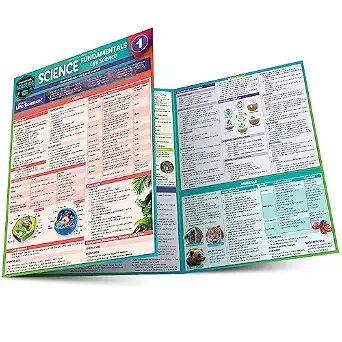
Science Fundamentals 1 – Life Science – Cells, Plants & Animals: for Middle School – a QuickStudy Laminated Reference & Study Guide
Cells, plants, and animals are usually a student’s first real encounter with science vocabulary, and Science Fundamentals 1 – Life Science is built for that moment. The six-page tri-fold puts cell diagrams, plant structures, and animal classifications in one spread, so a sixth grader can self-quiz without flipping through chapters. Next to its sibling Science Fundamentals 4 – Earth & Space, the material here is gentler and more diagram-led, which suits kids still learning how to study rather than what to study.
My hesitation is the ceiling: a student who masters life science by spring will outgrow it quickly, and it shares the series’ weak spots — no practice questions, no online extras. Readers who want pictures plus narrative explanation will connect more with Knowledge Encyclopedia Science!; I’d buy this as the cheap, durable prompt card alongside something meatier.
Pros:- Diagram-heavy layout suits first-time science learners
- Durable laminated tri-fold holds up to daily use
- Fits in a standard three-ring binder
- Focused scope keeps revision unintimidating
Cons:- Basic content only — quickly outgrown by strong students
- No multimedia or online resources
- No practice questions for self-assessment
Best for: Sixth graders meeting biology vocabulary — cells, plants, and animals — for the first time
Not ideal for: Confident science students past the basics, and anyone who needs practice questions to study effectively
- Format:Laminated reference guide (tri-fold)
- Page count:6 pages
- Publisher:BarCharts, Inc. (QuickStudy)
- Series:Science Fundamentals
- Subject:Life science — cells, plants & animals
- Grade level:Middle school
- ISBN-10:1423249372
- ISBN-13:9781423249375
Our verdict“A low-cost first study aid for a student just starting life science, best paired with a fuller guide.”
Everything You Need to Ace Science in One Big Fat Notebook: The Complete Middle School Study Guide
If I could hand a middle schooler only one book from this lineup, it would be this one. Everything You Need to Ace Science in One Big Fat Notebook covers life, earth, and physical science in a single 528-page paperback, so a student studying cells in September and plate tectonics in April never needs a second reference. Where the Science Fundamentals 4 – Earth & Space guide squeezes a subject onto six laminated pages, this one explains ideas step by step and then backs them with practice questions — which is where real retention happens.
The tradeoff is speed and size. It weighs more than a pound and won’t help much the night before a quiz, when the laminated guides scan far faster. It’s also strictly a middle school book, so high schoolers should look at A Dictionary of Science instead.
Pros:- Covers life, earth, and physical science in one volume
- Practice questions and quizzes support self-testing
- Doodle-style visuals make dense ideas approachable
- Better value than buying separate guides for each subject
Cons:- Too heavy and slow for night-before review
- Middle school only — students outgrow it after grade 8
- Paperback pages wear faster than laminated guides
Best for: Middle schoolers in grades 6-8 who want one book for the whole year, plus parents helping with homework
Not ideal for: Last-minute crammers — 528 pages don’t scan fast — and high schoolers who need more advanced material
- Format:Paperback
- Page count:528 pages
- Publisher:Workman Publishing
- Publication date:August 9, 2016
- Series:Big Fat Notebooks
- Subject coverage:Life, earth & physical science
- Grade level:6-8 (middle school)
- Age range:11-14 years
- ISBN-13:9780761160953
Our verdict“The single best buy for a middle school student who wants one science book that teaches rather than just summarizes.”

How We Picked
I judged every book on five criteria that matter at the desk rather than on the shelf: accuracy and currency of the science, how quickly a student can find an answer, reading level relative to the intended grade, durability for daily use, and price relative to how long the book stays useful. A laminated card that survives three years of backpack abuse delivers value differently than a hardcover that never leaves a desk, so I weighed cost per year of use instead of sticker price alone. Books that explain concepts visually scored higher for younger readers, while dense text and precise terminology counted as strengths for advanced students rather than flaws.
The ranking logic follows the title’s promise. Because this roundup serves students across all grade levels, books covering the full science curriculum rank ahead of single-subject guides, and books that stay useful for more years rank ahead of one-semester helpers. The laminated QuickStudy guides earn their spots as targeted, low-cost specialists: each covers one slice of science, but within that slice nothing here is faster for pre-test review. The Oxford dictionary and the elementary-level homework reference land where they do because their audiences are narrower — excellent for the right reader, mismatched for everyone else.
| science reference books for student | Publisher | Subject | Series |
|---|---|---|---|
| Knowledge Encyclopedia Science | DK Children | — | — |
| Earth Science: A QuickStudy La | QuickStudy Reference Guides (BarCharts) | Earth science | — |
| Everything You Need to Know Ab | Scholastic Reference | — | Everything You Need to Know homework series |
| Science Fundamentals 3 | QuickStudy Reference Guides (BarCharts) | Physical science — force, motion, energy, matter | Science Fundamentals (Book 3) |
| A Dictionary of Science | Oxford University Press | — | Oxford Quick Reference |
| Science Fundamentals 4 | BarCharts, Inc. (QuickStudy) | Earth & space science | Science Fundamentals |
| Science Fundamentals 1 | BarCharts, Inc. (QuickStudy) | Life science — cells, plants & animals | Science Fundamentals |
| Everything You Need to Ace Sci | Workman Publishing | — | Big Fat Notebooks |
Factors to Consider When Choosing Science Reference Books For Students
Every book in this roundup answers science questions, but they do it in different formats, at different reading levels, and at very different prices. Most regret in this category comes from buying the right book for the wrong student. These are the factors I would weigh before choosing.
Match the Reading Level to the Student, Not the Subject
The most common mistake in this category is shopping by topic when reading level decides whether a book gets opened. A middle schooler handed a college-level dictionary will stop using it within a week, and a high schooler handed an illustrated beginner’s guide will feel talked down to. Look for cues before buying: sentence length, glossary size, and illustration density tell you more than any age range printed on the cover. Middle-school titles dominate this roundup because grades six through eight are when science homework first demands real reference support, so students outside that band need to choose more carefully. Buying slightly above a student’s current level extends a book’s useful life, since curiosity pulls readers upward into harder material. Buying far above it does the opposite — the book becomes furniture. When in doubt, flip to a random page and ask the student to read a paragraph aloud; stumbling over every third sentence means the level is wrong.
Know Whether You Need a Reference Book or a Study Guide
These two formats do different jobs, and mixing them up leads to disappointed buyers. A reference book — an encyclopedia or dictionary — is built for lookup: a student has a question, finds the entry, and goes back to work. A study guide is built for sequence: it walks through a curriculum in order so a student can learn or relearn a unit before a test. Laminated reference cards sit in a third niche, acting as memory triggers for exam week rather than teaching tools. The failure mode is expecting one format to do another’s job: a laminated card cannot explain photosynthesis to someone who never understood it, and an encyclopedia will not drill vocabulary the night before a quiz. If the student’s complaint sounds like ‘I don’t get this chapter,’ start with a study guide; if it sounds like ‘what does this word mean,’ start with a reference. Many households end up with one of each, and that pairing often costs less than a single tutoring session.
Breadth Versus Depth: One Big Book or Several Small Ones
A single wide-ranging reference covers biology, chemistry, physics, and earth science between two covers, while subject-specific books go deeper on one field. Breadth wins for general homework support, multi-child households, and long shelf life, because the book answers questions across every school year. Depth wins when a student has one weak subject or one high-stakes exam, since a focused book spends all its pages on the material causing trouble. Price complicates the choice less than you’d expect: three laminated subject guides cost roughly the same as one mid-priced hardcover, so the decision is really about usage pattern, not budget. Curriculum alignment is the hidden variable — a book mapped to the order in which schools actually teach units pays off week after week, while an unaligned book gets opened only when a student thinks to reach for it. For most elementary and middle school students, breadth is the safer default. Subject-specific purchases make the most sense once a student hits high school lab sciences with discrete course names.
Format and Durability Decide Whether the Book Gets Used
A reference book that stays on a shelf helps no one, so match the physical format to where studying actually happens. Laminated cards lay flat beside a worksheet, shrug off spills, and slide into a binder, which makes them ideal for the kitchen table during homework — but they are poor candidates for reading in bed or on the bus. Hardcover encyclopedias are desk-bound by weight, yet their build lets them survive a decade of use and multiple siblings. Paperback study guides invite highlighting and margin notes, and that wear is a feature rather than a flaw, since annotation is how many students actually learn. Weight deserves a check if the book will travel in a backpack daily; anything over a couple of pounds tends to get left at home, which defeats the purpose. Think about the student’s real routine — after-school table, library, commute — and pick the format that fits it. The best-made book in the wrong format loses to a modest book that is always within reach.
When Paying More Actually Saves Money
Cheap and expensive books in this category fail in opposite ways. A low-cost laminated guide is tied to one subject at one level, so it gets replaced as the student advances — buying three of them across three school years is normal, not a rip-off. A higher-priced encyclopedia that spans grades four through twelve amortizes its cost across many years, often ending up cheaper per year than the budget options. Advanced references like a university-level dictionary hold their value longest of all, since a motivated student can carry one from high school through a college science requirement. The rule I would follow: spend more on books the student will grow into, and spend as little as possible on books tied to a single course or semester. Edition year is the last check — core science changes slowly, but newer editions fix errors and refresh fast-moving areas like space exploration and genetics, so prefer the latest printing when prices are close.
Frequently Asked Questions
What is the difference between a science encyclopedia, a science dictionary, and a science study guide?
An encyclopedia explains topics in short articles, usually with heavy illustration, and is designed for browsing and building understanding — a student reads the volcanoes entry and comes away knowing how eruptions work. A dictionary strips that down to alphabetical definitions of terms, which makes it the fastest lookup tool but the weakest teacher; it tells you what a word means, not why it matters. A study guide works sequentially through a curriculum, summarizing each unit the way a good teacher’s notes would, and is built for learning material before a test rather than answering one-off questions. The formats complement each other: the encyclopedia feeds curiosity, the dictionary kills vocabulary confusion, and the study guide handles exam prep. If you can only buy one, choose based on the student’s most frequent need — puzzled browsing, term lookup, or test readiness. Most buyer regret in this category comes from picking a dictionary when the student actually needed explanations.
Are laminated reference guides enough to study for a science test on their own?
No, and treating them that way is their only real failure mode. Laminated guides compress a semester’s vocabulary, formulas, and labeled diagrams onto a few panels, which makes them outstanding for the final one or two weeks of review but thin as a first exposure to the material. They assume the student has already met the concepts in class and just needs them organized and refreshed. A student who never understood the unit will find the card too compressed to learn from, while a prepared student will find it the fastest review tool available at any price. The smart use is as a companion to a textbook or study guide: learn from the full source, then use the card to drill and to spot gaps. At their typical price, buying one per subject per year is an easy yes — just do not ask it to do a teacher’s job.
Which science reference book should I buy for a middle school student?
Middle school is the best-served band in this roundup, so the choice comes down to how the student studies. Everything You Need to Ace Science in One Big Fat Notebook is the natural anchor because it follows the actual middle school curriculum in order, reads like a classmate’s notes, and covers the units a student will meet in grades six through eight. Pairing it with the QuickStudy Science Fundamentals guide that matches the current unit — life science, physical science, or earth and space — adds a fast review sheet for test weeks. If the student is a visual learner who resists text-heavy pages, Knowledge Encyclopedia Science! 2nd Edition is the better motivator, since its spreads pull reluctant readers into topics they would skip in a plainer book. The one option I would skip for this age group is the Oxford dictionary, whose definitions are pitched well above middle school reading level. Start with the notebook, then add the laminated guide for whichever subject is causing the most homework friction.
How long will a science reference book stay accurate and useful?
Longer than most buyers expect. The material these books teach — cell structure, the periodic table, Newton’s laws, rock cycles — changes very little over a decade, so a well-made reference stays accurate for five to ten years of regular use. The parts that date fastest are topical examples: recent space missions, newly named species, and current genetics news, which is why a newer edition is worth a small premium when prices are close. Format affects longevity too. Laminated guides stick to settled fundamentals and rarely go stale, while study guides tied to curriculum standards can drift as standards shift between adoption cycles. Encyclopedias age the most gracefully of all, because their job is explaining enduring concepts rather than tracking a syllabus. The practical takeaway: do not replace a reference book because it is a few years old; replace it when the student has outgrown its reading level.
Should I buy one general science reference or separate books for biology, chemistry, and physics?
For any student below high school, one general reference is the right call. Elementary and middle school science courses blend all the branches into a single class, so a book that does the same matches how homework actually arrives — and it costs less than three subject books while taking up one spot on the shelf. Separate subject books start paying off in high school, where courses split into discrete classes with their own textbooks, labs, and exams, and where depth in one field matters more than breadth across all of them. A practical middle path is a general reference for the shelf plus one inexpensive laminated guide for the current course, replaced each year as the subject changes. The mistake to avoid is buying a stack of subject-specific books for a student who has not reached those courses yet; unused depth is wasted money. Buy for the class the student is in now, with one eye on the class coming next fall.
Conclusion
After weighing all eight books against each other, my recommendations sort cleanly by buyer type. Best overall: Knowledge Encyclopedia Science! 2nd Edition is the one purchase that covers every branch of science and stays useful from upper elementary through high school, which no single-subject guide here can match. Best value: the Earth Science QuickStudy laminated guide delivers organized, exam-ready facts for the price of a paperback, and its Science Fundamentals siblings for life science and physical science share that strength for their own subjects. Best for beginners: Everything You Need to Know About Science Homework speaks to younger students and the parents helping them, a combination nothing else in this lineup attempts. Best for middle school: Everything You Need to Ace Science in One Big Fat Notebook mirrors the actual curriculum better than any other pick, making it the strongest daily homework companion for grades six through eight.
Best for advanced students: A Dictionary of Science from Oxford is the only choice that keeps pace through high school and into college-level coursework. If the decision still feels open, default to the DK encyclopedia for households with multiple children and to the Big Fat Notebook for a single middle schooler — those two picks cover the most buyers with the least chance of a mismatch.
Halloween Picks
halloween
As an affiliate, we earn on qualifying purchases.