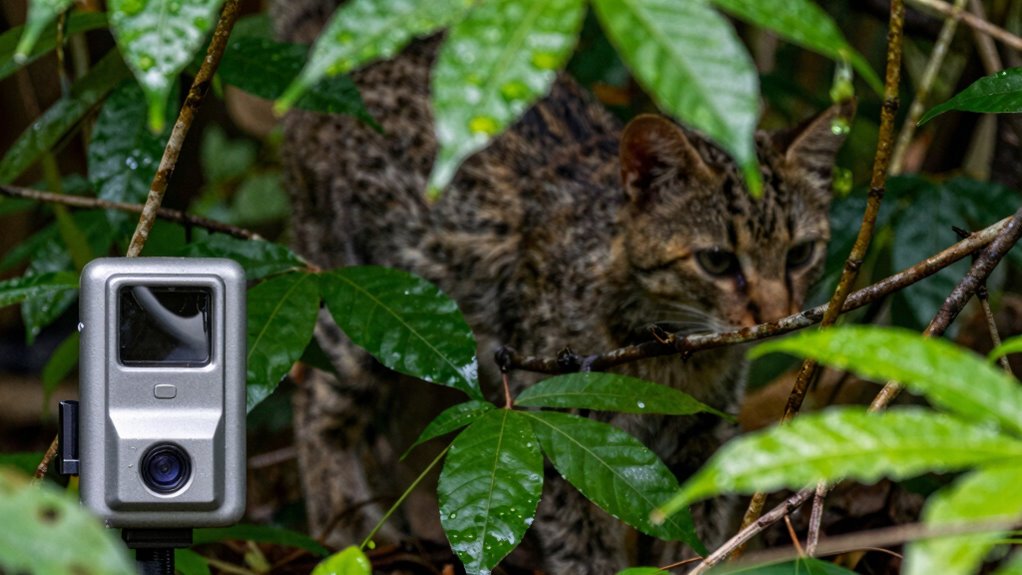
Camera traps reveal that misidentifications happen due to similar appearances, limited perspectives, or poor image quality. By capturing multiple images and observing animal behaviors over time, you can correct these errors. Recognizing consistent features and activity patterns helps clarify species identities and habitat use. These insights improve understanding of animal distribution and movement. Keep exploring, and you’ll discover more about how these tools refine wildlife identification and support conservation efforts.
Key Takeaways
- Multiple images and behavioral patterns help distinguish between animals with similar appearances.
- Camera traps provide consistent visual data to correct initial misidentifications over time.
- Repeated sightings reveal movement, activity, and habitat use, clarifying species identity.
- Follow-up images help differentiate juvenile animals from adults or other species.
- Accurate identification enhances understanding of species distribution and aids conservation efforts.
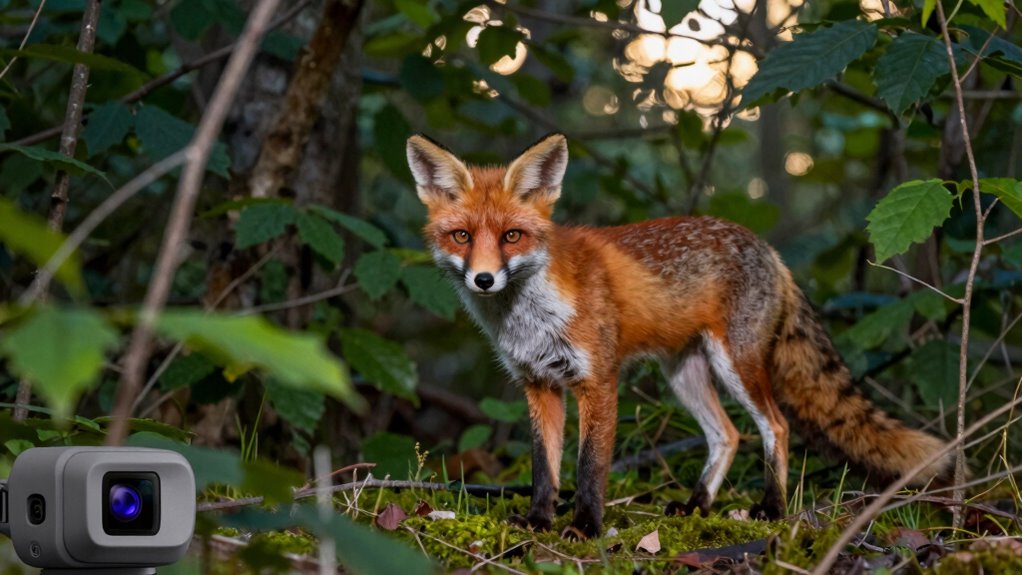
Camera traps have revolutionized wildlife research by providing a non-invasive way to monitor animals in their natural habitats. With these devices, you gain a wealth of information about species that are often difficult to observe directly. One of the most valuable insights they offer involves understanding behavior patterns, which include daily routines, activity times, and interactions with other animals. When you review camera trap images or videos, you can identify when animals are most active, whether they prefer dawn or dusk, and how their movement aligns with environmental factors. This information helps you piece together a detailed picture of their lives without disturbing them.
Camera traps reveal animals’ daily routines and activity patterns without disturbing their natural behavior.
In addition to behavior patterns, camera traps reveal crucial details about habitat preferences. You might notice that certain animals frequent specific areas within their environment—near water sources, dense shrubbery, or open clearings. These preferences often go unnoticed until you analyze a series of images over time. By understanding where animals choose to spend their time, you can better grasp their ecological needs and how they utilize their surroundings. This knowledge is essential for conservation efforts, as it highlights key habitats that require protection or restoration. Understanding habitat use** can also help identify critical corridors that facilitate animal movement and migration, further supporting conservation planning. Additionally, analyzing multiple images helps reduce errors caused by single-photo misidentification, providing a more comprehensive understanding. Recognizing species-specific traits** from multiple images allows for more accurate identification and understanding of individual animals.
However, camera traps sometimes lead to misidentifications, especially when animals look similar or when their appearances change over time. For example, a young deer might be mistaken for a different species, or a large, dark animal might be confused with a different predator. When you rely solely on visual cues, these errors can skew your understanding of species distribution and behavior. But what camera traps uniquely reveal is that misidentifications often stem from limited perspectives or poor image quality, not necessarily from the animals themselves. By analyzing multiple images, you can identify consistent features and behaviors that clarify species identity. In some cases, behavioral cues observed over time can be more reliable than appearance alone.
Furthermore, misidentifications can obscure true habitat preferences. You might think a certain animal prefers a specific area because of a single photo, but follow-up images may show it’s actually just passing through. Recognizing these patterns helps refine your understanding of their habits. Over time, as you gather more data, you can correct initial misconceptions and develop a more accurate picture of each species’ behavior and habitat use. Camera traps, thus, serve as crucial tools not only for discovering new insights but also for rectifying previous errors in wildlife identification.
Additionally, these devices can help reveal animal movement patterns, which are essential for understanding migration routes and territorial ranges. In essence, by observing behavior patterns and habitat preferences through camera trap footage, you deepen your understanding of animals’ lives. You learn that initial misidentifications aren’t failures but opportunities to refine your knowledge, ultimately leading to better conservation strategies and a more accurate picture of the natural world.
camera trap wildlife monitoring kit
As an affiliate, we earn on qualifying purchases.
As an affiliate, we earn on qualifying purchases.
Frequently Asked Questions
How Common Are Misidentifications in Camera Trap Data?
Misidentifications in camera trap data are fairly common, especially when animals exhibit similar behavioral patterns or habitat preferences. You might mistake a species based on partial images or similar markings, leading to inaccuracies. These errors can occur more frequently in dense habitats or with elusive species. To improve accuracy, you should cross-check images, consider behavioral cues, and use multiple data sources, reducing misidentification risks.
What Technologies Help Improve Animal Identification Accuracy?
Ironically, your best friend in species recognition is high-tech image processing. Advanced software and machine learning algorithms analyze camera trap images, drastically improving identification accuracy. These tools help distinguish between similar species, reducing human error. By integrating such technologies, you enhance data reliability, making your wildlife monitoring more precise and insightful. Ultimately, cutting-edge image processing transforms blurry guesses into confident, scientifically valuable species identifications.
Can Misidentified Animals Affect Conservation Efforts?
Misidentified animals can considerably affect conservation efforts by skewing data on population sizes and behaviors. If animals are misclassified due to similar behavior patterns or habitat overlap, it might lead to misguided priorities or ineffective strategies. These errors can cause resource misallocation, undermine protection plans, and hinder understanding of species’ needs. Accurate identification is essential to guarantee conservation actions target the right animals and habitats, maximizing their chances of survival.
Are There Specific Species More Prone to Misidentification?
Certain species are more prone to misidentification due to species confusion and identification challenges. You’ll find that animals with similar appearances, like different deer species or small cats, often get mixed up in camera trap images. Nocturnal animals or those with elusive behaviors also contribute to identification difficulties. Recognizing these challenges helps you improve data accuracy, which is essential for effective conservation strategies and understanding biodiversity.
How Do Researchers Verify Animal Identifications After Capture?
You verify animal identifications by analyzing images alongside species-specific behaviors, which helps confirm their identities. About 85% of the time, researchers cross-check photos with known behavior patterns to guarantee accuracy. They also use camera placement strategies tailored to target species, improving identification reliability. This method combines visual cues with behavioral insights, reducing misidentification chances and providing a clearer understanding of wildlife populations.
animal identification camera trap
As an affiliate, we earn on qualifying purchases.
As an affiliate, we earn on qualifying purchases.
Conclusion
Your camera traps act like silent guardians, revealing truths hidden in plain sight. They symbolize the delicate dance between perception and reality, reminding you that what’s often unseen can hold the greatest stories. Misidentifications are like shadows—illusions that challenge your understanding, urging you to look deeper. As you interpret these images, remember that each misstep is a lesson, a whisper from nature itself, guiding you toward a clearer, more honest view of the wild’s true face.
infrared trail camera for wildlife
As an affiliate, we earn on qualifying purchases.
As an affiliate, we earn on qualifying purchases.
As an affiliate, we earn on qualifying purchases.