
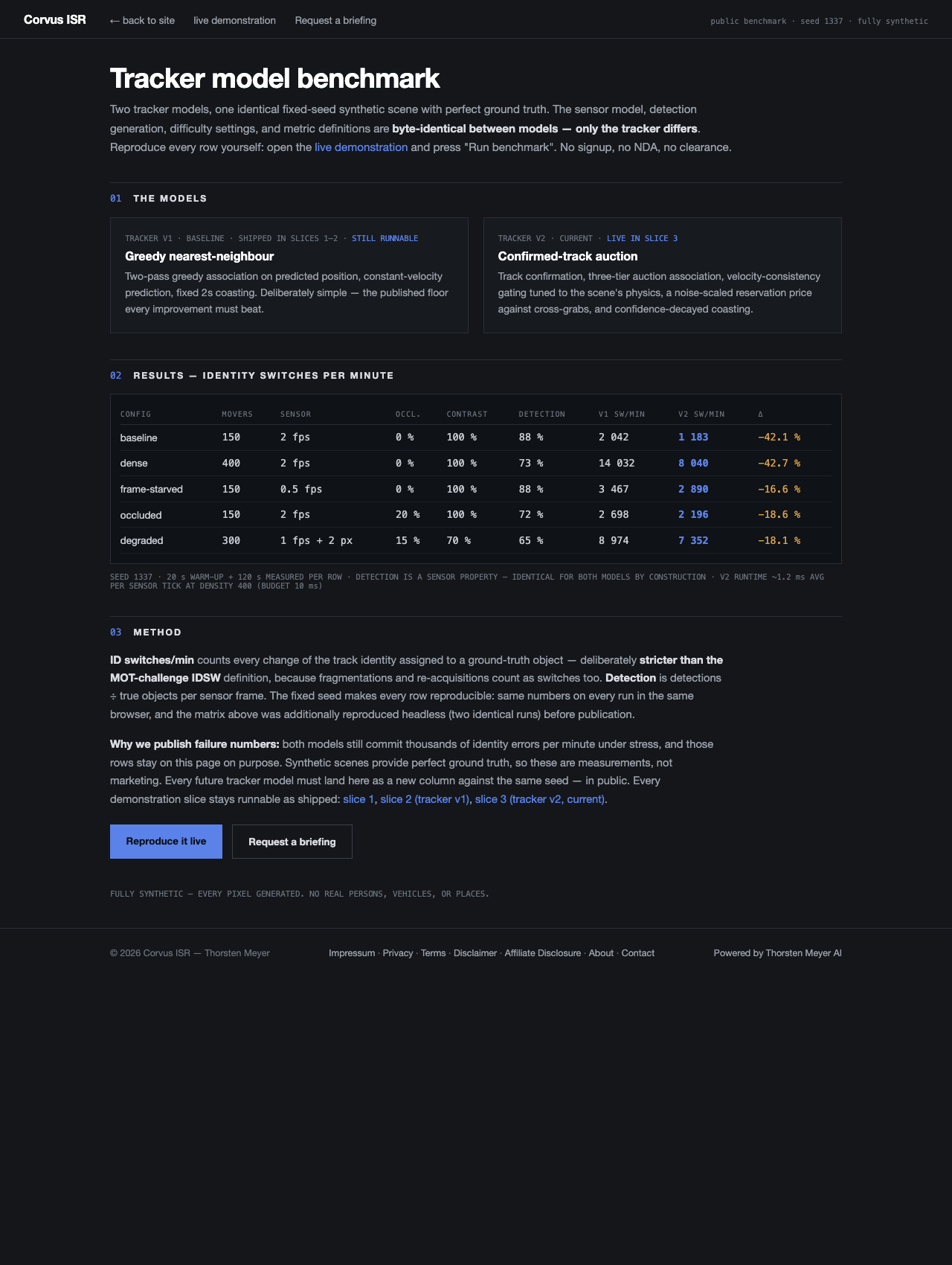
Corvus ISR, a leader in wide-area motion imagery (WAMI) exploitation, has published a comprehensive public tracker benchmark comparing two of its tracker models on a synthetic scene with perfect ground truth. This benchmark uses a fixed seed (seed 1337) and a carefully controlled environment: 20 seconds of warm-up followed by 120 seconds of measured data per row, with sensor models, detection generation, and metric definitions all byte-identical. The only variable is the tracker model itself, enabling a clean comparison of performance.

Prime made for students and young adults
- Fast, free delivery for dorm and study essentials
- Prime Video and Amazon Music included
- Member-only deals
The first model, v1, employs a greedy nearest-neighbour approach with a two-pass association, constant velocity prediction, and a fixed 2-second coasting period. It’s deliberately simple and serves as the published baseline, still functional in the archived demo slices 1-2. The second model, v2, introduces a confirmed-track auction methodology, utilized in demo slice 3, featuring three-tier auction association, velocity-consistency gating, noise-scaled reservation prices, and confidence-decayed coasting — all designed to improve robustness under stress.
Results show significant improvements with v2 over v1 in terms of ID switches per minute. For instance, under a baseline scenario with 150 movers at 2fps, ID switches decreased from 2,042 to 1,183, a 42.1% reduction. In a denser scene with 400 movers, switches dropped from 14,032 to 8,040, a 42.7% improvement. Additional stress factors such as frame starvation at 0.5fps, 20% occlusion, and degraded conditions (1 fps with jitter and reduced contrast) all resulted in roughly 18% reductions in ID errors, demonstrating the robustness of v2’s advanced association strategies.
It’s important to note that detection rate is purely a sensor property, maintained identically for both models by design. The benchmark’s strict ID switch metric counts every change in track identity, including fragmentations and re-acquisitions, making it a more honest measure of tracker performance than some industry standards. The goal of publishing these failure numbers is to foster a transparent understanding of tracker limitations, especially since synthetic scenes provide perfect ground truth. This allows for precise measurement of errors, unlike real-world data which often involves uncertainties.
Corvus ISR emphasizes that every future tracker should be evaluated against the same fixed seed, ensuring fair comparison. As they state, “Vendors who show only successes ask for faith; a published failure matrix asks for measurement.” The results are not marketing hype but genuine performance data, openly accessible on their site. Since the scenes are fully synthetic, no real persons, vehicles, or locations are involved—every pixel is generated to ensure controlled testing conditions.
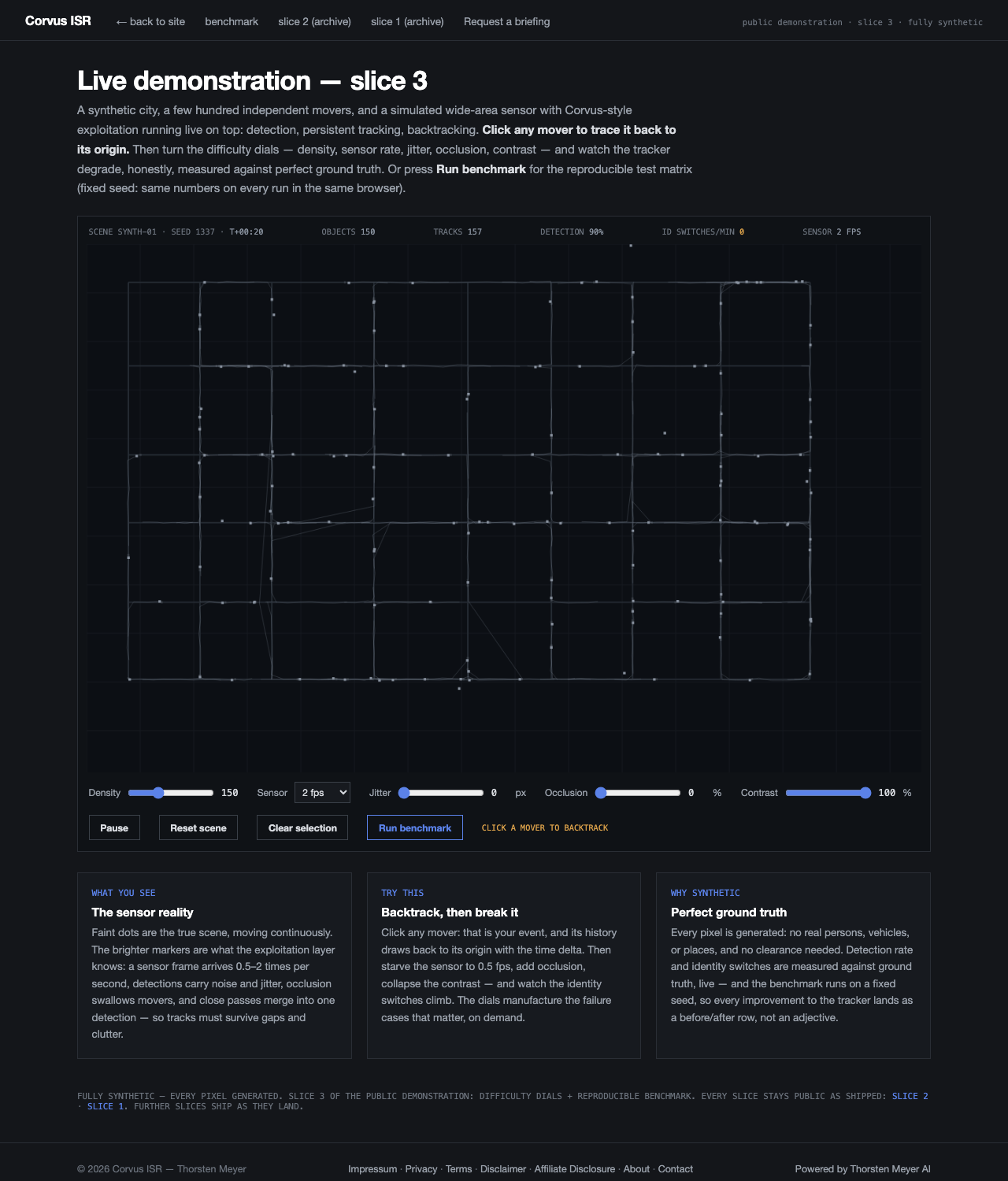
From an engineering perspective, the v2 tracker operates at an average of approximately 1.2 milliseconds per sensor tick at a scene density of 400, with worst-case runtimes around 5 milliseconds—well within real-time constraints for web applications. To encourage further experimentation, Corvus ISR provides a live demo where anyone can reproduce every benchmark row. Simply click “Run benchmark,” with no signup or NDA required — enabling scientists and developers to verify these results firsthand.
This fully synthetic approach demonstrates the importance of transparent benchmarking and methodological rigor in advancing WAMI tracking technology. If you’re interested in seeing how your own algorithms compare or just exploring the benchmarks, you can run the benchmark yourself and see the detailed error metrics firsthand.
wide-area motion imagery (WAMI) tracking system
As an affiliate, we earn on qualifying purchases.
As an affiliate, we earn on qualifying purchases.
synthetic scene tracking benchmark software
As an affiliate, we earn on qualifying purchases.
As an affiliate, we earn on qualifying purchases.
real-time object tracker for surveillance
As an affiliate, we earn on qualifying purchases.
As an affiliate, we earn on qualifying purchases.
advanced multi-object tracking device
As an affiliate, we earn on qualifying purchases.
As an affiliate, we earn on qualifying purchases.
Fall Picks
fall essentials
As an affiliate, we earn on qualifying purchases.