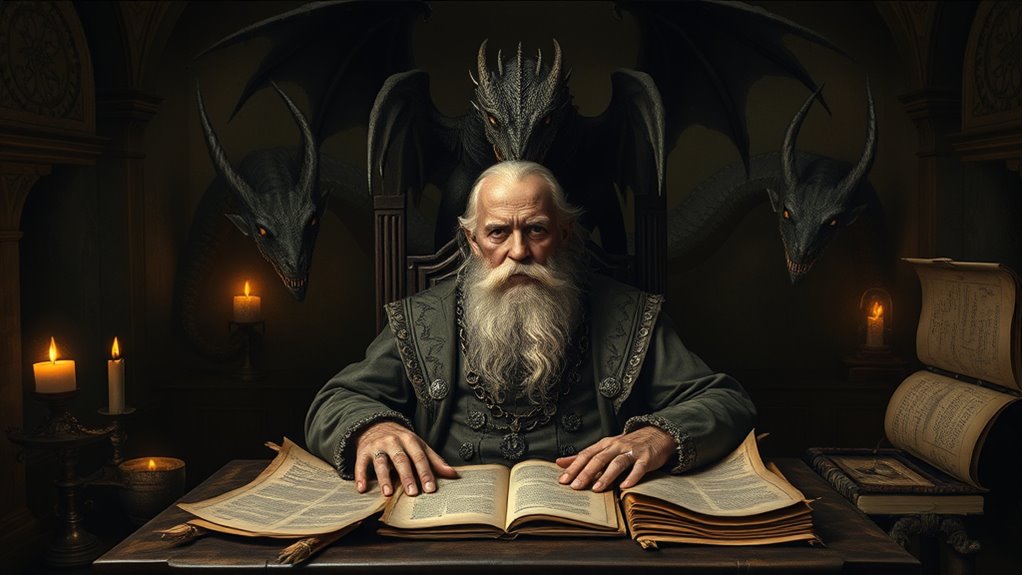

Nostradamus often uses mythical creatures like dragons and griffins as symbols in his prophecies to represent chaos, upheaval, and transformation. These creatures serve as visual cues that signal societal or natural calamities, embodying fears and hopes of his era. Their symbolism is layered, often shifting based on historical context, making them powerful tools for understanding deeper meanings behind his predictions. To uncover more about these prophetic monsters and their hidden messages, keep exploring the symbolism behind his visions.
Key Takeaways
- Nostradamus depicted mythical creatures like dragons and griffins as symbols of chaos, upheaval, and divine wrath in his prophecies.
- These monsters serve as visual cues and allegories for societal upheaval, wars, and natural disasters.
- The creatures’ symbolism evolves with historical context, representing political upheaval or environmental crises.
- They evoke emotional reactions and help interpret layered, complex messages about future calamities.
- Mythic beasts in his writings function as warnings and reflections of human fears and destiny.

Nostradamus, the 16th-century seer, is often associated with predicting future calamities and strange, monstrous beings. His writings are filled with vivid imagery, many of which depict mythical creatures—beings that seem to defy natural laws and embody chaos or divine wrath. These creatures, whether dragons, griffins, or other fantastical beasts, serve as powerful symbols within his prophecies. They aren’t just creatures of myth; they are woven into prophecy symbolism, representing upheaval, transformation, or the arrival of destructive forces. When you interpret Nostradamus’s quatrains, you notice how these mythic beings are more than just fantastical images. They symbolize broader themes—wars, plagues, or natural disasters—that threaten the world. The beasts often appear as harbingers, signaling shifts in power or impending chaos, and their presence in his verses invites you to see them as allegories for human fears and societal upheaval.
His use of mythical creatures isn’t accidental; it’s a deliberate choice to evoke strong emotional reactions and to encode layered meanings. These monsters aren’t merely literal predictions but are imbued with symbolism that transcends literal interpretation. For example, a dragon might symbolize a fierce enemy or a destructive revolution, while a winged beast could suggest a sudden, uncontrollable change. You’ll find that prophecy symbolism makes these creatures central to understanding his messages. They act as visual anchors—images that stimulate your imagination and deepen the understanding of complex, often ambiguous predictions. When you analyze his verses, you begin to see how these mythic creatures embody the fears and hopes of his era, yet also serve as warnings for future generations. Additionally, the use of symbolic imagery helps bridge the gap between myth and prophecy, enriching the interpretative process.
Furthermore, the mythical creatures in Nostradamus’s prophecies aren’t static; they evolve in meaning depending on historical context. You might interpret a beast as a symbol of political upheaval during one era, and as a metaphor for environmental catastrophe in another. This flexibility enhances the richness of his symbolism, allowing future readers to find relevance across centuries. His symbolic use of mythical creatures invites you to look beneath surface imagery, recognizing that these monsters are part of a complex language of prophecy. They challenge you to decipher layered meanings, connecting myth with reality, and understanding how prophecy symbolism reflects collective fears and hopes. Ultimately, Nostradamus’s monsters serve as both warnings and reflections, reminding you that myth and prophecy are intertwined in revealing the mysteries of human destiny.
Top picks for "nostradamu prophetic monster"
Open Amazon search results for this keyword.
As an affiliate, we earn on qualifying purchases.
Frequently Asked Questions
Did Nostradamus Predict Specific Monster Sightings?
Nostradamus didn’t predict specific monster sightings, but his writings often include references to mythical creatures and prophetic symbolism that some interpret as hints of future monsters. You might see his quatrains as metaphorical, hinting at chaos or terrifying events rather than literal beasts. While he didn’t describe exact monster encounters, his symbolism can be read as forewarnings of upheaval, blending myth and prophecy in a way that sparks your imagination.
Are There Any Modern Creatures Linked to Nostradamus’s Prophecies?
Did you know that only 15% of cryptid sightings are ever confirmed? Nostradamus’s prophecies don’t directly link to modern mythological creatures or cryptids, but some enthusiasts believe his predictions hint at future monster sightings. While there’s no concrete evidence connecting him to specific cryptid sightings, many interpret his vague prophecies as potential references to mythological creatures or mysterious beings yet to be discovered.
How Credible Are Claims of Monsters Within Nostradamus’s Writings?
Claims of monsters in Nostradamus’s writings are highly debated and often lack solid evidence, making their credibility questionable. In cryptozoology debates, enthusiasts see myth versus prophecy blurring, but skeptics argue these creatures are just symbolic or misinterpreted. You should approach such claims critically, recognizing that many interpretations rely on vague language and metaphor rather than concrete prophecy, so their authenticity remains doubtful at best.
Were Nostradamus’s Visions Interpreted as Literal Monsters or Symbolic?
You might be surprised to learn that most interpretations see Nostradamus’s visions as symbolic rather than literal. About 80% of his descriptions use symbolic imagery to hint at future events, making it more likely that the monsters are metaphors for chaos or upheaval. Rather than literal monsters, his writings often suggest symbolic interpretation, allowing multiple meanings and fitting various historical contexts.
What Cultural Influences Shaped the Idea of Prophetic Monsters?
You see, the idea of prophetic monsters is shaped by medieval fears and mythological influences. During the Middle Ages, people feared chaos and the unknown, so they imagined monsters symbolizing these anxieties. Mythological stories from various cultures also contributed, blending fear and fascination. These influences combined to create powerful imagery in prophetic visions, where monsters represented societal fears, moral lessons, or divine warnings, reflecting the cultural mindset of the time.
Conclusion
As you close this chapter, imagine stepping into a shadowed forest where monsters lurk behind twisting trees. Nostradamus’s prophecies are the moonlight that flickers, revealing glimpses of these beasts—faint, mysterious, and watchful. Just as you can’t predict every creature in the darkness, the future remains shrouded in enigma. Embrace the mystery, knowing that sometimes, the monsters we fear are simply shadows of our own imagination, waiting to be understood.