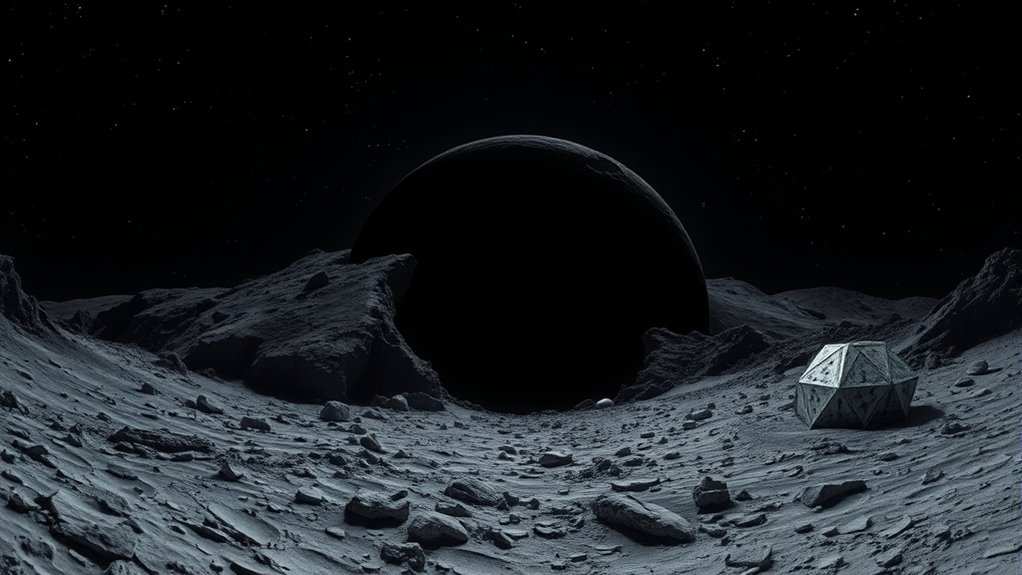

The idea that the Moon is hollow and used as an alien base is a popular myth but has no scientific support. Seismic data from Apollo missions proves the Moon has a solid, layered interior, ruling out the possibility of giant cavities or hollowness. While these theories attract curiosity, they’re firmly debunked by scientific evidence. If you want to understand why scientists dismiss these claims and what the real Moon’s interior looks like, explore further.

Prime made for students and young adults
- Fast, free delivery for dorm and study essentials
- Prime Video and Amazon Music included
- Member-only deals
Key Takeaways
- The hollow Moon theory suggests it might be an artificial structure or alien base, but lacks scientific evidence.
- Seismic data from Apollo missions shows the Moon has a solid, layered interior, contradicting hollow or cavity-based theories.
- No seismic or geological signs support the existence of large cavities or hollows within the lunar interior.
- Mainstream science confirms the Moon formed naturally from debris after a giant impact, not as an artificial construct.
- The hypothesis of a hollow Moon is considered a fringe theory, unsupported by credible scientific research.
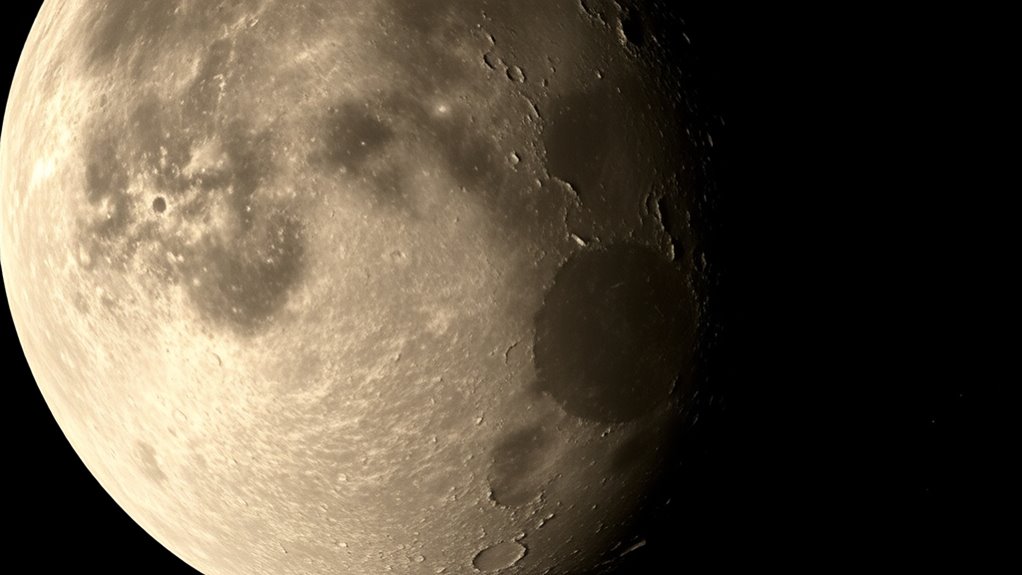
Have you ever wondered if the Moon is truly solid? The idea of a hollow Moon challenges everything we think we understand about its moon formation. Traditionally, scientists believe that the Moon formed about 4.5 billion years ago, most likely from debris resulting from a giant impact between Earth and a Mars-sized body. This collision ejected material into orbit, which eventually coalesced into the Moon we observe today. But some fringe theories propose that the Moon might not be a solid sphere at all. Instead, they suggest it could be hollow, perhaps serving as an alien base or some sort of artificial construct. To evaluate such claims, we need to look at what seismic evidence tells us about the Moon’s interior.
During the Apollo missions, astronauts placed seismic instruments on the lunar surface, allowing scientists to analyze moonquakes and other seismic activity. These instruments transmitted data back to Earth, providing a window into the Moon’s internal structure. The seismic evidence gathered from these experiments indicates that the Moon has a differentiated interior, with a crust, mantle, and core, similar to Earth but on a smaller scale. The seismic waves traveled through the Moon’s interior at speeds consistent with solid rock, which strongly suggests the Moon isn’t hollow. If it were, seismic waves would behave differently, showing signs of empty space or a significant cavity. The absence of such anomalies in the seismic data is a vital point against the hollow Moon hypothesis.
Seismic data confirms the Moon’s layered, solid interior, refuting the hollow Moon theory.
Furthermore, the way seismic waves reflect and refract within the lunar interior helps scientists model its structure accurately. These models reveal a layered composition, with no indication of a large, hollow cavity. The seismic evidence is consistent across multiple lunar missions and experiments, reinforcing the idea that the Moon’s interior is indeed solid and layered. Additionally, modern seismic analysis techniques continue to support these findings, confirming the Moon’s solid interior. The seismic evidence is consistent across multiple lunar missions and experiments, reinforcing the idea that the Moon’s interior is indeed solid and layered. The seismic evidence is consistent across multiple lunar missions and experiments, reinforcing the idea that the Moon’s interior is indeed solid and layered. While some conspiracy theories argue that seismic data could be manipulated or misinterpreted to hide a hollow core, the scientific consensus remains firm: the evidence points toward a solid Moon, formed through natural processes.
In the end, the notion of a hollow Moon is more fiction than fact. The seismic evidence collected from lunar missions provides substantial proof that the Moon’s interior is not empty but composed of solid materials. The moon formation process and the data we have amassed over decades support the idea of a natural, solid satellite orbiting Earth. So, if you’re curious about whether aliens built a secret base inside the Moon or if it’s just a myth, the seismic evidence makes it clear: the Moon is solid, not hollow, and its formation was a natural event, not an artificial construct.
seismic instruments for lunar research
As an affiliate, we earn on qualifying purchases.
As an affiliate, we earn on qualifying purchases.
Frequently Asked Questions
What Evidence Supports or Refutes the Hollow Moon Theory?
You see moon anomalies like unusual internal structures and satellite imaging suggesting hollowness, which some interpret as supporting the hollow moon theory. However, scientific evidence refutes this idea, showing the moon’s density and seismic data confirm it’s solid, not hollow. Experts explain that natural geological processes account for observed irregularities, making the theory unlikely. So, while anomalies pique curiosity, current evidence doesn’t support a hollow moon.
Have Any Space Agencies Officially Investigated the Moon’s Internal Structure?
You might imagine space agencies as detectives probing a cosmic mystery, yet no official investigations have confirmed a hollow moon. During moon landings, astronauts collected lunar geology samples, revealing a solid, differentiated interior. These findings, alongside seismic data from lunar missions like Apollo, suggest the moon isn’t hollow. While intriguing theories persist, current scientific evidence points to a traditional, rocky interior rather than an alien base or hollow core.
Could Ancient Myths Hint at an Artificial Moon or Alien Presence?
Ancient myths often describe mythical structures or beings that some interpret as hints of an artificial moon or alien presence. You might notice stories of celestial objects with mysterious origins or features that resemble constructed or hollow shapes. While these myths are symbolic, they fuel speculation that ancient civilizations could have encountered or even built structures related to the moon, suggesting a possible connection between myth and the idea of an artificial or alien-influenced celestial body.
How Do Scientists Explain Anomalies in Moon Density and Composition?
Scientists explain anomalies in moon density and composition through moonquake mysteries and gravitational anomalies. Moonquakes reveal the moon’s interior dynamics, hinting at complex layered structures. Gravitational anomalies suggest uneven mass distribution, possibly from dense core regions or hidden structures. These findings help scientists understand the moon’s formation and evolution, rather than supporting theories of hollow or artificial origins. Instead, they point to natural geological processes shaping our lunar neighbor.
Are There Credible Eyewitness Accounts of Alien Activity on the Moon?
You might think the truth is buried deep, but credible eyewitness accounts of alien activity on the moon are scarce. Historical sightings often involve misidentifications or hoaxes, and many believe government cover-ups have hidden evidence. While some claim to have seen strange lights or structures, no definitive proof exists. Keep an open mind, but also consider that most reports lack the solid evidence needed to confirm extraterrestrial presence.
As an affiliate, we earn on qualifying purchases.
Conclusion
As you weigh the mysterious claims against scientific facts, the hollow moon theory feels like a tantalizing myth rather than a proven truth. While some see an alien base hiding beneath its surface, others recognize it as a compelling story fueled by curiosity and imagination. In the end, the moon’s silent presence reminds you that sometimes, the greatest mysteries spark the wildest theories—yet remain just that, theories, forever dancing on the edge of reality and fiction.
As an affiliate, we earn on qualifying purchases.
As an affiliate, we earn on qualifying purchases.
Halloween Picks
halloween
As an affiliate, we earn on qualifying purchases.