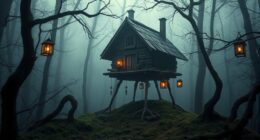
The Green Children of Woolpit are a mysterious medieval legend from England. Their story features two children with green skin who appeared unexpectedly and claimed to come from an underground land of twilight. Their strange origins and appearance have sparked myths and folklore for centuries, symbolizing otherworldly mystery and cultural fears. If you keep exploring, you’ll discover more about how their tale reflects societal values and enduring myths that continue to fascinate today.
Key Takeaways
- The Green Children of Woolpit are a medieval English legend involving two children with green skin appearing in Woolpit.
- Their origins are mysterious, with tales suggesting they came from an underground or twilight land.
- The children spoke an unknown language and refused to eat normal food, fueling folklore intrigue.
- Their story symbolizes themes of otherworldliness, innocence, and societal fears of the unfamiliar.
- The legend reflects medieval cultural values and has persisted as a myth symbolizing the mysterious and supernatural.

The Green Children of Woolpit are among England’s most intriguing medieval mysteries. Their story has captivated people for centuries, blending elements of myth and reality into a compelling tale. When you hear about these children, you’re drawn into a world where the boundary between legend and history blurs. Their origins are shrouded in myth, and many believe their story holds deeper folklore significance, symbolizing themes of otherworldliness and the unknown. Some suggest that their green hue and strange background point to supernatural or mystical origins, while others see it as a reflection of medieval fears and beliefs. Regardless of the explanations, their story remains a fascinating example of how folklore weaves itself into history, giving life to legends that continue to enchant.
You might wonder how such a story could be rooted in myth. The children’s green skin, their unfamiliar language, and their mysterious disappearance contribute to the aura of myth surrounding their origins. Some tales claim they came from a land of perpetual twilight or a hidden underground world, emphasizing their mythical origins. Others interpret their story as a moral lesson or a reflection of cultural anxieties about the unfamiliar. Their folklore significance lies in their ability to symbolize the mysterious and the otherworldly, serving as a bridge between the known and the unknown. Their story also demonstrates the importance of cultural interpretation in shaping legends and how societal fears can influence myth creation. Over time, stories about them have been embellished, transforming their tale into a myth that explores themes of alienation, innocence, and the supernatural.
As you explore their legend, you realize that the story’s folklore significance goes beyond mere curiosity. It reflects the medieval mindset, where unexplained phenomena often took on mystical dimensions. The children’s story became a vessel for cultural values, fears, and hopes. Their mythical origins, whether literal or symbolic, serve to remind us of how societies interpret the unfamiliar—sometimes with skepticism, sometimes with reverence. Their tale persisted because it resonates with universal themes of otherness and mystery, making it a lasting part of England’s rich folklore tapestry. In the end, the Green Children of Woolpit exemplify how legends can endure, shaped by the collective imagination, and how myths continue to inform our understanding of history’s most curious episodes.
Frequently Asked Questions
Are There Any Modern Sightings Related to the Green Children?
Yes, there are no modern sightings of the green children, but some folklore influences keep the legend alive. You might hear stories inspired by medieval legends, reflecting ongoing fascination with the mystery. While no recent reports confirm green-skinned children, the folklore continues to inspire writers and researchers, blending historical intrigue with modern curiosity. These tales often serve as a reminder of how legends evolve and persist through generations.
What Are the Latest Theories Explaining Their Origin?
The latest theories about the green children’s origin lean towards scientific explanations, suggesting they might have had a rare condition like chlorosis, which causes greenish skin due to iron deficiency. Some propose mythical origins, believing the children could be supernatural or alien beings from folklore. While these theories offer different perspectives, scientific explanations are currently the most plausible, as they align with known medical conditions and historical context.
Have Any Similar Cases Been Documented Elsewhere?
Imagine wandering through foggy forests where legendary sightings blur the line between myth and reality. Similar cases to the Green Children have been documented in medieval folklore, such as mysterious children with unusual skin colors or strange origins. These stories, often shrouded in secrecy, suggest that legendary sightings of otherworldly children appear across cultures and eras, hinting at shared fears, beliefs, and folklore about supernatural beings or unexplained phenomena.
Could Their Story Have Been a Medieval Hoax?
You might think their story was a medieval deception, but some believe the tale has folklore origins rather than being a hoax. While medieval deception was common, there’s little concrete evidence to prove the children’s story was fabricated. Instead, the story could reflect cultural beliefs or symbolic folklore, making it more likely a genuine, though mysterious, account that evolved over time rather than a simple medieval hoax.
What Impact Did the Children’s Story Have on Local Culture?
You can’t ignore how the Green Children’s story transformed local folklore into a legend so powerful it’s still told today. Their tale sparked medieval legends that echoed through generations, fueling imaginations and shaping cultural identity. The story’s bizarre nature made it a cornerstone of Woolpit’s history, turning ordinary villagers into legendary figures and inspiring countless stories, myths, and beliefs that continue to influence local culture long after the medieval era.
Conclusion
As you ponder the green children of Woolpit, remember they’re like a faint star in a night sky full of mystery. Their story weaves through time, whispering secrets from a world unseen. Whether they’re lost souls or otherworldly visitors, their tale invites you to believe in the extraordinary hidden within the ordinary. Like a shadow in the fog, the truth remains elusive, leaving you captivated by the magic of history’s unanswered questions.